
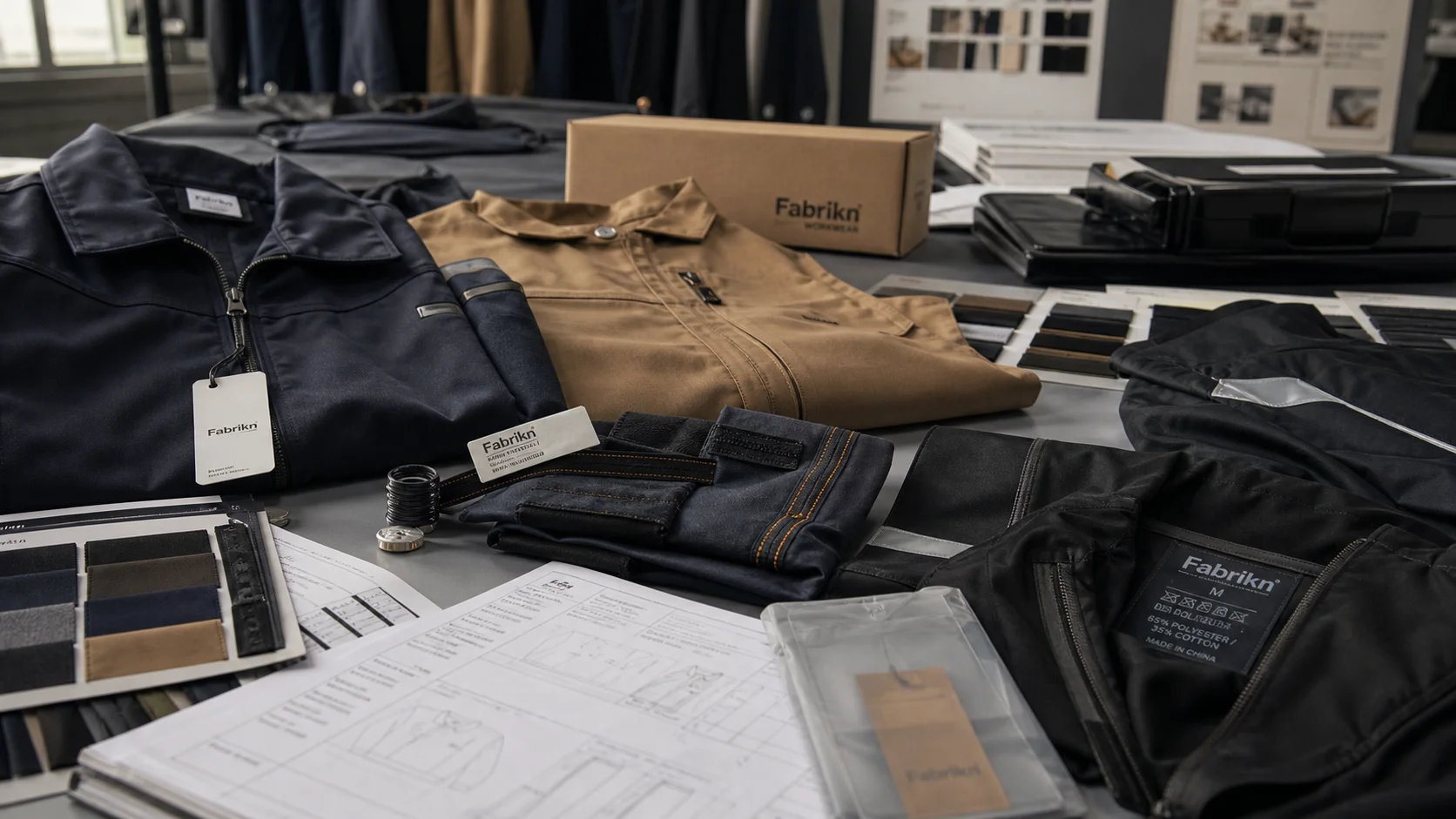
A Clothing Manufacturer for Small Business compared by sample evidence, fabric or trim specs, MOQ, AQL terms, cost lines, delivery timing, and rework...
Fast answer: A Clothing Manufacturer for Small Business: Sample Evidence, MOQ, Capacity, and Rework Terms should be judged by production evidence, not by a generic sourcing promise. The buyer needs sample proof, cost breakdowns, QC checkpoints, and delivery buffers in writing.
Ask for recent sample photos, measurement tolerances, fabric or print test assumptions, decoration test notes, packing examples, and a named inspection checkpoint. These details show whether the team can repeat an approved sample at bulk volume.
Separate garment cost, decoration, labels, packaging, sampling, testing, freight, and rush charges. Clear cost lines make it easier to reduce colorways, adjust size depth, or reserve more time for sampling.
The graveyard of first collections is full of beautiful sketches and broken budgets. Nearly 60% of early apparel founders I’ve interviewed underestimated sampling, freight, and defect costs by at least 30%, and that mistake can sink a launch before one carton leaves the factory. A clothing manufacturer for small business has to fit the bank account before it fits the mood board, because pretty product means nothing if the deposit empties the account before bulk gets approved.
I’ve watched founders budget $8.00 per tee, then run into the real number: $11.40 after a $2.50 sample, $0.35 labeling, $1.10 freight from port to warehouse, and a 6% defect allowance. That is not a cosmetic gap. It is survival math. It decides whether you can reorder in 4 weeks or wait 4 months.
The lowest quote usually hides the most expensive process. One factory in Turkey quoted me $4.20 for a 240 GSM jersey tee, then dragged the approval cycle through 5 rounds; every revision added $180 in sampling and 10 to 14 lost days. Portugal came back at $5.10 and shipped first samples in 8 days, bulk in 3 weeks. Higher unit cost, lower launch risk.
Price-only buying also ignores how a factory handles small lots. A plant built for 50,000 pieces may treat a 300-piece order like spare change. The line gets interrupted, smaller markers sit behind larger programs, and your shipment drifts behind a client paying for 8,000 pieces. In premium and independent factories, managers sometimes reserve a dedicated sample sewer for 1 to 2 days a week. Fast fashion sites almost never do that for tiny accounts.
When I visited factories in Vietnam, India, and Italy, the pattern was blunt. Fast fashion production moved at scale, but small orders soaked up time in administrative friction more than in sewing. Premium ateliers sewed more slowly, yet their sample rooms were cleaner, their QA notes tighter, and their replies faster by 1 to 2 days. Independent operators were the most flexible, though they needed clearer tech packs and stricter payment discipline.
The thing nobody tells you: a factory with a higher minimum order quantity can still be cheaper for a tiny brand if it has stronger pattern support, fewer corrections, and a 7-day sampling turnaround instead of 21. A good launch partner protects the order, not just the invoice.
Manufacturing language gets fuzzy fast, so here it is plain. Cut-and-sew means the manufacturer cuts fabric, sews the garment, and usually handles finishing. CMT, or cut, make, trim, means you supply fabric and trims; the factory only assembles. Private label usually means the supplier offers an existing base style with your label and color changes. Full package means they may source fabric, make patterns, grade sizes, sample, sew, pack, and sometimes arrange export paperwork.
If your category is complex, such as children’s sleepwear or a technical shell, the factory may also manage testing and compliance checklists. I’ve seen cut and sew manufacturing cover fabric selection, marker efficiency, final pressing, carton labeling, and polybag specs in one contract. That matters because every task removed from the brand shortens the internal checklist by 3 to 5 steps.
Under CMT, you keep more control and more risk. You buy the fabric, you approve the trims, and you usually absorb the consequence if rolls arrive late or shade lots vary. Under full package, the factory controls more of the production chain, which can reduce coordination errors, but the price usually includes sourcing margins and a higher service fee. Private label is the fastest path, often 2 to 4 weeks faster than full development, but it gives you less originality.
I’ve worked with founders who chose private label for a first drop because they needed to test sell-through before investing in pattern development. Others needed a fully custom fit, and only a true cut-and-sew factory could get the shoulder slope, rib recovery, and 320 GSM French terry handfeel right.
For a first collection, the model should match cash, not ego. If you are testing demand with 200 to 500 pieces, private label or light cut-and-sew can preserve capital. If your product depends on fit, grading, or a custom wash, full package may be smarter because one partner controls more of the process. A brand doing babywear, for instance, often needs a factory that understands safety labeling and softer trims, which is why custom baby clothing manufacturing can be a better fit than a generic apparel line.
My rule is simple. Keep sourcing in-house only if you have the people to manage it, the spreadsheet to track it, and the cash to survive a 20% delay. Otherwise, push more responsibility to the factory and pay for that speed in one clean line item.
Regional comparison is where founders make expensive assumptions. A $3.80 unit in one country can land at $6.90 after freight, duties, testing, and 3 weeks of delay, while a $5.40 domestic unit may arrive cheaper overall because the order skips air freight and customs surprises. For small brands, the real number is landed cost per sellable piece, not the factory quote alone.
According to trade.gov guidance on apparel sourcing and market access, supply chains remain highly concentrated across a few manufacturing hubs, which is why communication speed and logistics discipline matter as much as labor cost. I’ve visited factories where a 2-day timezone gap added 1 extra week to sample approval, and others where same-day video feedback cut development time by 40%.
Domestic production usually offers MOQs from 50 to 300 pieces for simple tees, 100 to 500 for knits, and 200 to 600 for denim depending on the wash. Lead times can be 2 to 6 weeks for simple products and 6 to 10 weeks for more complex garments. Overseas factories often want 300 to 1,000 pieces and 30 to 90 days, though bulk volume can push the per-piece price down by 15% to 35%.
Nearshore manufacturing sits in the middle. In Mexico or Central America, I’ve seen knitwear move in 18 to 30 days with freight costs 25% lower than Asia and fewer customs delays than trans-Pacific shipping. For brands selling seasonal goods, that time difference can protect margins better than a lower sewing rate ever will.
Lower labor rates do not erase defects, slow replies, or rework. In one factory visit, a very cheap quote from a large South Asian mill looked attractive at $2.95 per basic tee. But the factory required a 1,500-piece minimum, 45 days for sample approval, and air freight to meet the launch window, which added $1.80 per piece in logistics alone. A European factory at $4.90, with a 250-piece MOQ, transparent production planning, and 10-day samples, finished cheaper in total.
There is also the hidden cost of compliance. If your market needs OEKO-TEX certification or restricted substance testing, the paperwork can take 7 to 14 days and cost $120 to $350 per style, depending on the lab and fiber mix. Data from OEKO-TEX shows how much buyer scrutiny now sits around fabric safety, especially for children’s and skin-contact products. The smartest founders compare total landed cost, not factory geography.
The best factory for a test launch is rarely the best factory for reorder volume. Early stage needs responsiveness, low MOQs, and patience for messy development. Scale needs repeatable quality, stable pricing, and capacity for 2,000 to 10,000 units without constant supervision. I’ve seen brands outgrow a beloved small workshop because the workshop could not handle a second colorway, a 4-size grade, and a December deadline at the same time.
Manufacturers also read you. They see whether your tech pack is complete, whether your payment terms are honored, and whether you can answer a fit question in 24 hours or 10 days. Those signals affect where your order sits in the queue.
A startup brand might need 150 tees, 120 sweatshirts, and a 60-piece sample run for a photoshoot. A scaling brand may need 500 tees monthly, 800 leggings per season, and a supplier that can reserve yarn or fabric in advance. A repeat-order brand needs consistency more than experimentation, which means shade control, stitch density, and size tolerance become non-negotiable.
For tees, MOQ ranges of 100 to 300 pieces are common in smaller facilities. For denim, 300 to 1,000 pieces is more typical because wash runs and hardware setup eat time. Outerwear can push to 500 to 2,000 pieces once zippers, quilting, and seam sealing enter the picture.
There are three levers worth discussing: fabric commitment, payment timing, and style simplification. If a factory wants 500 pieces but you only need 250, ask whether they can split the lot by color, reduce trim complexity, or use stock fabric. I’ve gotten smaller orders accepted when brands agreed to 60% deposit, faster artwork approval, and a narrower color palette of 2 shades instead of 5.
Keep the negotiation respectful. Offer certainty where you can. If the factory believes order 1 can become order 3, it is more likely to protect your first production slot. One smart brand I advised secured a lower MOQ by promising a second PO within 90 days if sell-through hit 70% in the first month. Better trade than squeezing the factory on pennies and losing priority.
The first sample is usually a conversation, not a verdict. In my experience, 2 to 4 rounds is normal for a custom garment, and 5 rounds is not rare if fit, wash, and branding all need adjustment. One brand sent me a hoodie sample that looked perfect until we measured it: the body was off by 1.8 cm at the chest, the sleeve shrank 4% after wash, and the hood lining twisted after steam pressing.
Sampling should test the things shoppers can feel. That means color fastness, shrinkage, stitch density, seam strength, print placement, and packaging. A basic knit shirt might tolerate a 1 cm measurement variation, while tailored trousers may need tighter control. For sustainable programs, I ask for traceability on recycled yarns, proof of fiber claims, and documented dyehouse standards from verified suppliers such as Textile Exchange.
Ask for a fit sample, a color sample, and a pre-production sample if the garment is complicated. That sequence catches most of the expensive errors before bulk cutting. I also want a measurement sheet with 6 to 12 key points, plus wash test results after 3 cycles if the garment will be laundered often.
Packaging deserves the same scrutiny. Check polybag thickness, barcode placement, carton count, and label spelling. A mislabeled carton can delay receiving by 2 to 7 days and trigger chargebacks from retailers that do not care how pretty the garment looks.
Markets differ. The U.S. requires accurate fiber content and care labeling, while the EU is more demanding on language, product traceability, and chemical compliance. If you make claims like “recycled polyester” or “organic cotton,” request supplier declarations and third-party documents before production. A factory can say almost anything on a sales call; paperwork is what counts.
Ask for restricted substance testing when the fabric or finish is new. It can cost $80 to $250 per test set, but that is far cheaper than a rejected shipment. Compliance is boring until it protects a margin.
Two manufacturers can quote $6.75 per sweatshirt and still produce wildly different outcomes. One may include pattern making, packing, and standard cartons. The other may leave out sampling, omit freight, and bill trims separately. I always price the full order, because the factory quote is only the opening line.
A realistic cost stack for a 300-piece sweatshirt might look like this: pattern making at $120, 2 rounds of sampling at $180 to $260 total, fabric at $2.80 to $4.50 per yard, rib and drawcord trims at $0.55 to $1.20, labor at $2.10 to $3.60, labels and packaging at $0.35 to $0.90, freight at $0.70 to $2.20 per piece, and duties at 5% to 18% depending on market and fiber content.
Fabric choice has the biggest impact. A 160 GSM cotton jersey costs much less than a 320 GSM French terry, and enzyme wash costs less than stone wash because stones add abrasion, time, and waste handling. Complex details also add up fast: double topstitching, custom zippers, embroidered logos, and size labels in multiple languages all push labor and admin higher.
Volume changes the math. At 150 pieces, a hoodie may cost $18 to $24 landed. At 500 pieces, the same style can fall to $12 to $17 landed because setup costs spread across more units. That is why a slightly larger run often beats a tiny one on margin, even if the absolute order value feels scary.
Development costs do not vanish after approval. Last year I worked with a brand that paid $7.10 per unit in production, then spent another $1.90 per unit on air freight after missing a retail deadline by 9 days. Their margin disappeared in transit, not on the sewing line.
For brands needing white-label speed, private label clothing services can reduce development cost, but the tradeoff is less control over fit and fabric. I always ask founders to compare two full scenarios: one with a 250-piece order and slower freight, one with 500 pieces and ocean shipping. The cheaper quote is often not the cheaper order.
Start with a brief, not a price request. A clothing manufacturer for small business can only quote accurately if you give them style sketches, measurements, fabric targets, target retail price, and projected quantities. I have seen brands send a mood board and wonder why the quote varies by 40%. A factory is not a mind reader.
Your document set should include a tech pack, size chart, reference sample photos, trim specifications, labeling instructions, and order forecast. If you can add target MOQ, required certifications, and preferred ship date, you will look prepared even if your order is small.
Use a simple sequence: shortlist 3 to 5 factories, request itemized quotes, compare sample timelines, approve one development route, then place a production order only after the pre-production sample is signed off. If the factory offers to get a free quote, use that first contact to gauge response speed, clarity, and whether they actually read your materials.
I would compare factories on five points: MOQ, sample speed, quoted lead time, payment terms, and communication quality. Score each from 1 to 5. The best factory is not always the cheapest. It is the one that cuts surprises by the biggest margin.
Ask who owns the pattern, how many sample rounds are included, what happens if fabric arrives late, whether defects are repaired at factory cost, and how they handle color tolerance between lots. Also ask for a production calendar with dates in writing, not vague promises. That calendar should show sampling, fabric booking, bulk cutting, sewing, packing, and dispatch, ideally with 7-day checkpoints.
If you only remember one thing, remember this: hire the partner who can explain a delay before it happens. That habit saves cash, protects launch timing, and keeps your first collection from turning into expensive inventory.
For a basic tee, I usually see factory prices from $3.00 to $7.00 per piece depending on fabric weight, order size, and region. Sampling adds $50 to $300 per style, and freight can add another $0.70 to $2.50 per unit on small runs.
Many small-batch factories accept 50 to 300 pieces for simple knits, 300 to 1,000 for denim, and 500 or more for outerwear. The exact MOQ depends on fabric sourcing, color changes, and how much setup the factory must absorb.
Simple products can take 2 to 6 weeks domestically and 4 to 10 weeks overseas. Custom styles with sampling, grading, and fabric development often take 6 to 16 weeks from first brief to bulk shipment.
Send a tech pack, size chart, reference images, fabric target, trim details, estimated quantities, and target delivery date. If you have a target retail price, include it, because it helps the factory understand your cost ceiling.
Yes. Private label is often the fastest way to test demand because it can cut development time by 2 to 4 weeks and lower sampling costs. It works best when fit precision is less critical than speed and market testing.