
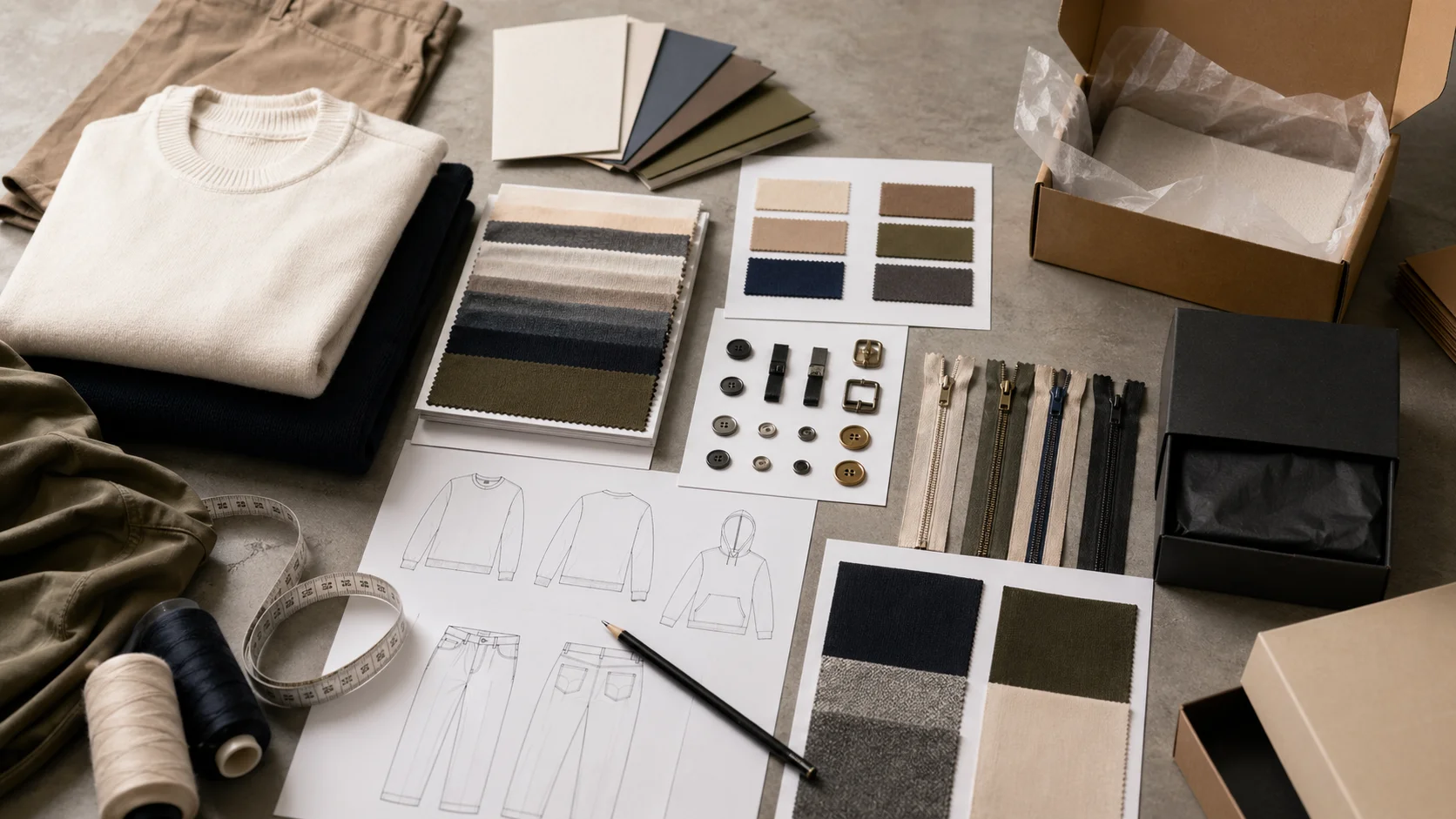
Clothing Packaging Inserts with checks for samples, fit, MOQ, QC evidence, pricing terms, and delivery risk.
Fast answer: Clothing Packaging Inserts: Message, Size, Paper, and Unboxing should be judged by production evidence, not by a generic sourcing promise. The buyer needs sample proof, cost breakdowns, QC checkpoints, and delivery buffers in writing.
Ask for recent sample photos, measurement tolerances, fabric or print test assumptions, decoration test notes, packing examples, and a named inspection checkpoint. These details show whether the team can repeat an approved sample at bulk volume.
Separate garment cost, decoration, labels, packaging, sampling, testing, freight, and rush charges. When every cost line is visible, it becomes easier to reduce colorways, adjust size depth, or reserve more time for sampling.
The first thing a customer notices inside the mailer can make the garment feel expensive or careless before it is even touched. I’ve watched a 180 GSM tissue insert make a $120 blouse look cared for, then watched a bent, cheap sheet turn a $28 tee into a return risk. That is the first lesson in how to choose clothing packaging inserts: the insert is not filler. It is part of the product experience.
On factory floors in Vietnam, Portugal, and Turkey, I saw the same pattern repeated across 200-plus visits. Premium brands spent $0.18-$0.45 per set on heavier boards, custom folds, and clean print because they wanted the garment to arrive flat, protected, and photo-ready. Mass-market labels often used $0.04-$0.10 tissue or thin chipboard, prioritizing speed and low unit cost. DTC brands sat in the middle, usually around $0.09-$0.22, because they needed presentation without bloating freight weight. Different price points, different jobs.
What buyers notice first is not the spec sheet. It is the first visual cue inside the mailer: whether the shirt collar is crisp, whether the sleeve line holds, whether the insert supports a neat fold or creates a limp, wrinkled pile. I’ve seen brands reduce return requests by 6-12% simply by upgrading insert rigidity and improving the fold system, especially on rayon, modal, and lightweight cotton knits that crease at the slightest pressure.
The surprise is that the cheapest insert can cost more. I saw one factory in Bangladesh save $0.03 a piece by switching to a thinner board, then lose far more when cartons collapsed in transit and 4.8% of units needed rework or replacement. The labor, repacking, and freight swallowed the savings. Cheap is expensive when it causes damage.
There is also brand recall. A neatly structured insert tells customers the brand is disciplined before they read a label or scan a QR code. That matters across channels, from private label orders to premium wholesale drops. If your operation includes clothing packaging solutions, the insert is one of the few low-cost surfaces where presentation, protection, and repeatability overlap. I treat it as an operations decision first and a branding decision second, because the packaging has to survive the truck before it earns the unboxing photo.
The material choice starts with the garment, not the mood board. Folded knits, structured shirts, denim, and luxury silks need different support, different stiffness, and different print behavior. In practice, I sort insert materials into four buckets: paperboard, tissue, molded pulp, and plastic alternatives. Each solves a different problem, and each creates a different cost trail.
Paperboard is the workhorse. At 250-400 GSM, it holds a clean fold for shirts and woven tops, and at 500-700 GSM it can support heavier denim or jacket presentation without sagging. Tissue, usually 17-30 GSM, works for anti-scuff protection and a softer unboxing feel, especially for knitwear and premium basics. Molded pulp, often 1.0-2.0 mm thick, is stronger than many buyers expect, and it can reduce crush damage on shoulders and cuffs. Plastic alternatives offer moisture resistance, but they are harder to defend in sustainability reviews and often carry higher scrutiny from retail partners.
Finish matters as much as thickness. A matte uncoated board with low ink coverage usually prints cleaner and recycles more easily than a laminated sheet with foil, soft-touch coating, and heavy solid blacks. For brands learning how to choose clothing packaging inserts, the finish should support the garment, not distract from it. For a French terry 320 GSM hoodie, I prefer a firmer insert with a smooth edge; for a silk blouse, I want softness and no scuffing.
The counterintuitive finding from my visits is that heavier stock can lower damage claims while raising freight costs by 8-14% on long-haul export programs. That trade-off is real. On a 50,000-piece order shipping from Asia to North America, an extra 20 grams per unit can become a meaningful container penalty. For domestic programs under 1,000 km, the heavier board often wins because the savings in reduced damage and fewer returns outweigh the transport bill.
Match material to price point and distance. A $12 tee shipped locally does not need the same board as a $220 blazer moving through three distribution centers. If your range includes infant or toddler garments, I would also align inserts with the standards used in custom baby clothing manufacturing, where softness, safety, and low ink migration are non-negotiable. Sustainable choices are not about using the lightest material possible. They are about using the right one.
Packaging inserts speak before labels do. A rigid board with sharp folds and restrained typography reads differently from a soft tissue wrap with a blind deboss and almost no color. I’ve seen the same hoodie feel “premium” at $85 and “generic” at $85, depending entirely on structure and finish. Buyers assume quality from the first tactile cue, and they do it in under 3 seconds.
High-street brands in Spain and the UK often use clean white or kraft inserts, 1-2 colors, and a simple fold pattern because they need speed and consistency. Premium brands in Italy and South Korea tend to use heavier board, 2-4 spot colors, embossed logos, and tighter geometric folds. Luxury labels, especially in France and Japan, may use 400-600 GSM stock, soft-touch coatings, and minimal ink so the garment, not the insert, feels like the hero. The signal is clear: restraint costs less than clutter, and it often looks richer.
Typography carries more weight than people think. A narrow sans serif in 8-10 pt can look precise, while oversized script type can cheapen a package if the garment is not priced accordingly. Color does the same job. Black on natural board says disciplined and contemporary. Warm neutrals on uncoated stock read quieter and more sustainable. Too much foil, embossing, and lamination can make an insert feel performative, especially when the garment itself is a basic tee or jersey pant.
Here’s what most people miss: a simpler insert can outperform a decorated one if the fold holds the garment flatter and the box closes with less compression. I have watched brands spend $0.12 extra on embellishment, then lose perceived value because the shirt arrived wrinkled. A good insert should support the cut, not compete with it. That matters even more for brands using private label clothing services, where the packaging often carries the first brand-owned impression the customer sees.
For customer experience, I look for two things: a clean opening moment and zero frustration. If the insert tears the fabric, sheds lint, or forces a buyer to wrestle a folded garment out of the carton, the brand loses trust. Simple can be sharper than ornate. A 1-color print on 350 GSM recycled board often feels more intentional than a 4-color laminated sheet with no structural purpose.
Budgeting packaging inserts without freight, storage, and setup fees is how brands overspend by 12-25%. I have seen sourcing teams fixate on the unit price, then miss the real cost sitting in cartons, pallet space, and reprint risk. If you are figuring out how to choose clothing packaging inserts on a budget, the financial lens has to include order size and production method.
At small volumes, digital print usually wins. Expect roughly $0.10-$0.35 per insert at 500-2,000 pieces, depending on board weight and finish. Offset print becomes cheaper at scale, often $0.03-$0.12 per unit at 10,000-50,000 pieces, but setup charges can run $150-$600 before the first sheet is printed. Custom die-cut inserts add tooling, sometimes $80-$300 for simple shapes and more for complex folds or locking tabs.
MOQ changes the whole equation. A supplier offering MOQ 300 may charge more per piece than a factory asking for 3,000 because the setup and labor are spread over fewer units. That creates stock risk, though. If a style runs only one season, holding 12 months of insert inventory can eat margin fast. I usually advise brands to align insert MOQ with garment sell-through, not with a supplier’s ideal batch size.
Lead times are equally uneven. Digital print and stock-size inserts can move in 3-7 business days after artwork approval. Offset print typically needs 10-18 days, while custom die-cut work can stretch to 15-25 days if proofing, cutting, and sample corrections are involved. Add 5-12 days for ocean freight if you are sourcing abroad, and a simple insert becomes a month-long planning item.
A useful decision table concept: standard insert, semi-custom insert, or fully custom insert. Standard works for fast restocks and low risk, semi-custom fits brands that need a logo and color control, and fully custom suits seasonal launches, luxury capsules, or complex garment shapes. For cut-heavy product lines, I compare insert planning the same way I compare cut and sew manufacturing decisions: design only what the operation can repeat at margin.
Freight and storage deserve a line item of their own. Heavier inserts can add 4-9% to carton weight, and oversized flat sheets eat warehouse space fast. I have seen a brand save $900 on unit cost and spend $2,300 extra on storage because the inserts arrived too large for the inbound cartons. The price on the invoice is not the full price.
Sustainability claims fail when paper, ink, and adhesives are treated as afterthoughts. Buyers should ask for FSC certification, recycled content proof, chain-of-custody documents, and compostability testing where claims are made. If a supplier cannot show the paperwork within 24-48 hours, I treat the claim as marketing, not evidence. According to Textile Exchange, traceability has become a core expectation in responsible sourcing, and packaging is now under the same scrutiny as fabric.
Factory conditions matter more than logos. I have seen “100% recycled” inserts made from recovered fiber but printed with heavy coverage, plastic lamination, and weak adhesive lines that made the final product nearly impossible to recycle. A sheet can be technically recyclable and practically unrecyclable if it contains too many mixed materials. In some markets, a compostable claim is meaningless without local infrastructure to process it.
Regional recycling reality is messy. A kraft insert that is accepted in Germany may be rejected in parts of the United States because of municipal sorting rules. A molded pulp tray may be welcomed by one retailer and refused by another if it is too bulky for their pack-out line. That is why I ask where the goods will be sold, not just where they are made.
Inks and coatings are the hidden problem. Heavy coverage, UV varnish, foil blocking, and soft-touch laminates reduce recyclability and complicate recovery. A small tweak can help: reducing insert size by 8-15% or removing one fold panel can cut material use without changing presentation. I have seen brands drop board weight from 400 GSM to 320 GSM, keep the same outer impression, and reduce paper use by roughly 18% on a 20,000-piece run.
Environmental claims should be tested against the garment category too. A basic tee does not need luxury-grade coated board, and a knitted baby bodysuit should prioritize safe, low-odor, low-ink packaging. Sustainability is not a decal. It is a series of design choices that should survive factory reality, not just a pitch deck.
For brands selling into regulated markets, I also check guidance from the U.S. Department of Commerce trade resources and third-party certification standards before finalizing claims. That helps avoid language that sounds green but fails in market review.
The best insert brief is technical, not poetic. Request dimensions in millimeters, GSM or thickness, fold-line placement, print method, color targets, moisture resistance, carton fit, and approved artwork files before production starts. If the garment ships folded to 280 x 220 mm, the insert should be specified to that exact packed format, with a tolerance of ±2 mm for key folds and cuts.
Sampling should always include warping, scuffing, and color drift checks. I have seen blue logos swing by 3-5 Delta E points between proof and mass production because the supplier changed ink batches. That is enough to make a navy print look washed out. Moisture resistance matters too, especially for sea freight or humid warehouses. A board that bends after 72 hours at high humidity is a problem, not a packaging choice.
Common factory errors are painfully ordinary. Misaligned fold lines cause a shirt to sit crooked in the carton. Weak glue spots open during transport. Print registration drifts by 1-2 mm and suddenly the logo looks amateur. I once saw a supplier ship 40,000 inserts with a slightly off die-cut, and the carton team spent 14 extra hours correcting each batch by hand. Labor turned a low-cost item into a staffing headache.
When I visit factories, the failures that trigger the biggest downstream costs are not dramatic. They are small. A crushed corner. A wrong fold direction. A board that curls after printing because the moisture balance was never checked. These issues show up later as rework, slower packing, or a customer receiving a garment that looks less premium than it should.
Use a sign-off checklist across vendors:
Procurement teams that work from this checklist catch problems earlier and spend less later. That is the boring truth. Boring is profitable. When choosing a manufacturer, factory, or supplier, ask for production references, QC photos, and documented quality controls before you approve bulk or wholesale orders, especially if the inserts are made in China or shipped from China.
Start with the garment, the route, and the margin. A 320 GSM French terry sweatshirt going by air to London needs a different insert than a rayon camisole shipping by sea to Texas. Shortlist 2-3 material options based on whether the product wrinkles easily, whether the carton travels far, and whether the brand promise is premium, minimal, or value-led.
Then build a supplier brief that includes quantity, target cost, artwork count, recycled content requirement, packaging size, and timeline. I would also ask for sample lead time in 5-10 days, mass production in 15-25 days, and reprint terms if color shifts beyond the approved proof. That level of detail cuts back-and-forth and prevents vague quotes that hide cost.
Test before committing. Order 2 or 3 sample versions, pack real garments into them, and ship those samples through the same route your full order will take. Check for scuffing after 48 hours, crushing after 72 hours, and carton fit at the warehouse dock. If the insert works for a 12-piece sample pack, it is far more likely to hold up at scale.
My editorial view is simple: choose inserts that protect the garment, protect the margin, and protect trust. Decoration comes after that. Brands that obsess over the prettiest insert but ignore damage rates are paying for packaging twice. Brands that choose carefully keep returns lower, packing faster, and customer confidence higher.
If you are refining your sourcing process this week, send suppliers three questions today: What is the exact GSM or thickness? What is the MOQ at 1,000, 5,000, and 10,000 units? Which documents prove the sustainability claim? That is how serious buying starts. For brands sourcing custom packaging in bulk, clear specs also make it easier to compare custom and wholesale options across factories and suppliers without losing consistency.
For basic tees, 250-350 GSM paperboard usually works best because it holds shape without adding much cost. If the tee is lightweight and ships long distance, add tissue at 17-24 GSM to reduce scuffing and wrinkling.
At small runs, expect about $0.10-$0.35 per insert for digital print. At larger volumes, offset-printed inserts can fall to $0.03-$0.12 each, but setup fees of $150-$600 and freight can change the total.
Stock-size digital inserts can be ready in 3-7 business days after approval. Offset print usually takes 10-18 days, while custom die-cut inserts often need 15-25 days, plus shipping time of 5-12 days if imported.
Ask for FSC, recycled content proof, and chain-of-custody documentation. If compostability is claimed, request testing details and check whether your sales markets can actually process that material through local recycling or composting systems.
You can, but it is usually a compromise. Shirts often work with 250-300 GSM board, denim may need 500 GSM or thicker support, and knitwear often benefits from softer tissue or a lighter board to avoid creasing.