
Packaging for Private Label Clothing compared by sample evidence, fabric or trim specs, MOQ, AQL terms, cost lines, delivery timing, and rework responsibility.
Fast answer: Packaging for Private Label Clothing: Material, Print, MOQ, and QC Terms should be judged by production evidence, not by a generic sourcing promise. The buyer needs sample proof, cost breakdowns, QC checkpoints, and delivery buffers in writing.
Ask for recent sample photos, measurement tolerances, fabric or print test assumptions, decoration test notes, packing examples, and a named inspection checkpoint. These details show whether the team can repeat an approved sample at bulk volume.
Separate garment cost, decoration, labels, packaging, sampling, testing, freight, and rush charges. Clear cost lines make it easier to reduce colorways, adjust size depth, or reserve more time for sampling.
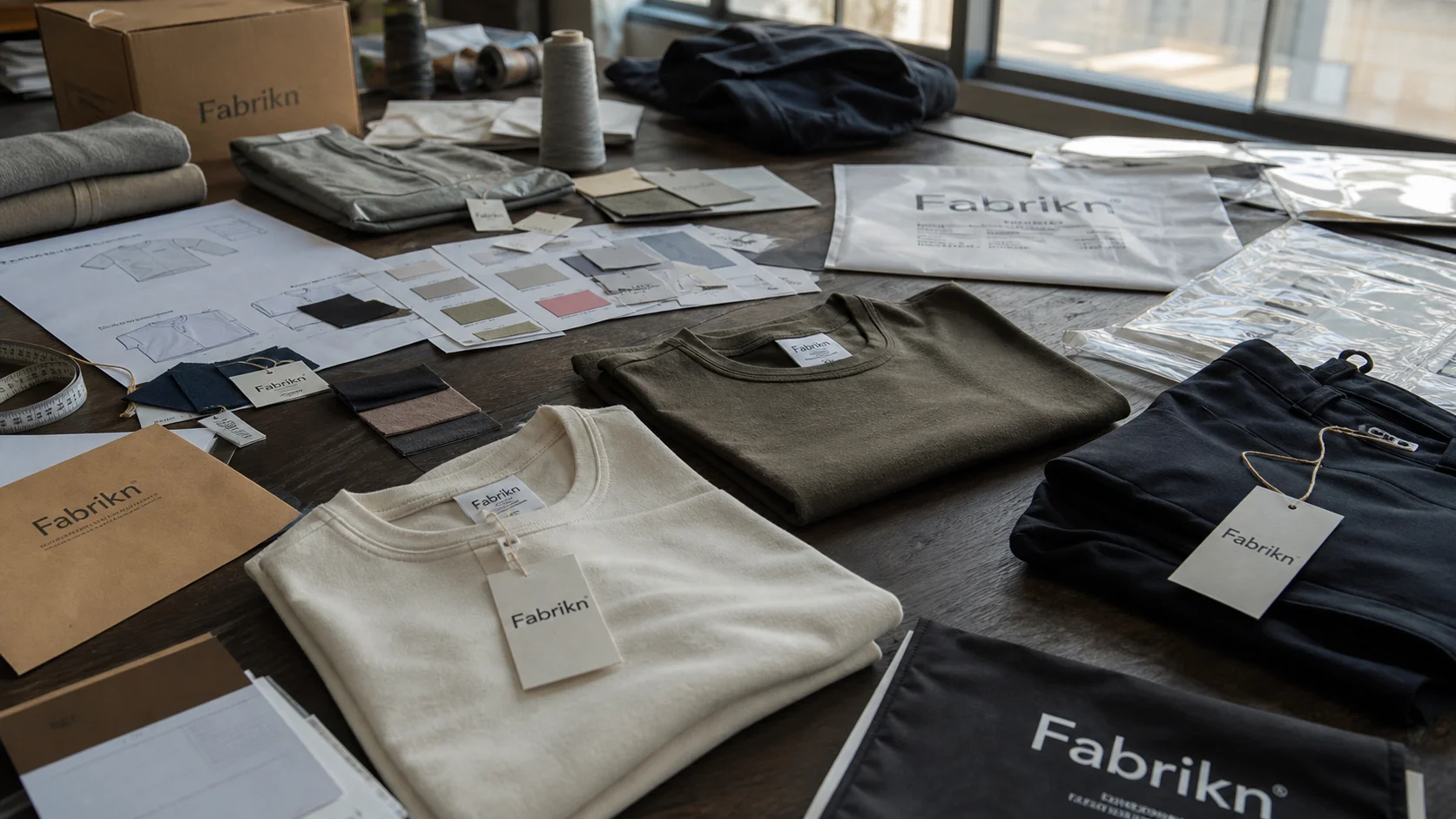
A package can sell the promise before the garment has a chance to speak. And if you're trying to figure out how to choose packaging for private label clothing, start with the box, bag, or mailer because that's usually the first thing the customer experiences. I watched it on a factory floor in southern China, just outside Guangzhou: same cotton jersey shirt, two pack-outs. One lane used a thin mailer. The other used a rigid box with tissue printed on a Heidelberg Speedmaster 102, UV coating, and a GOTS-certified ribbon. Identical garment inside — 180 GSM OEKO-TEX Standard 100 combed cotton, taped neck, clean neck label, 3-day sewing lead time. Buyers called the boxed version “premium” and “giftable” before they touched the collar.
Seven seconds. That’s the window. Speed, texture, hierarchy — all of it gets read at once. Logo placement. Opening method. Dented corners. Deliberate, or thrown together? In DTC, packaging also shapes unboxing content and review behavior. And clean presentation can cut visible damage complaints by 10-15 percent in my experience. Sloppy poly mailers do the opposite. They make a good garment feel cheap, and they can turn a decent delivery into a return reason.
But regional norms still pull hard. In Asia, shipping-first packaging dominates: thin poly bags, compact folding, carton optimization, especially on 200-500 piece runs from a manufacturer or factory in China, Bangladesh, or Vietnam. A lot of those runs pass through Dhaka for final QC on garment hang tags, then on to Ho Chi Minh City for warehousing and last-mile kitting. Europe leans toward paper wraps and minimal print, partly because boutique labels there tend to value restraint and recyclability. North America sits in the middle, though e-commerce brands often spend more on branded mailers and inserts because acquisition costs can run $25-$60 per order. The package has to work harder.
It feels like a tug-of-war: premium feel versus shipping efficiency versus sustainability credibility. A box can add $0.90 to $2.50 per unit before freight. A mailer may cost $0.08 to $0.35 and still drag down perceived value on a $60 sweatshirt. On a denim line in Vietnam, the packaging manager put it plainly: “The cheapest package is not always the cheapest outcome.” He wasn’t guessing, because that rigid folding box, produced on a Bobst die-cutter with lamination and foil, cost $2.50-4.00 per unit at 500 MOQ including printed inserts, certified under WRAP, BSCI, and GRS standards.
Different products need different protection. Miss that, and money leaks fast. Soft goods like tees and leggings compress neatly. And intimates need discretion and hygienic sealing. Denim arrives heavy, crease-prone, abrasive, so the corners and carton spacing have to be stronger. Outerwear is bulky and usually sold at a higher ticket, which buys room for a better opening experience. Accessories? Easy to underpackage, easy to lose in transit, and they disappear visually if the branding isn’t sharp.
Low-price labels selling tees at $18-$28 rarely need a rigid box. A printed poly mailer, folded tissue printed on a Roland VersaUV, size sticker, one insert — that’s enough to support the margin without strangling it. Mid-price brands at $35-$75 can justify a branded mailer or a folding carton for hero SKUs, especially if the product gets photographed as a gift. Premium outerwear at $120-$300 can absorb a structured box, satin hanger loop, custom tissue, because the package becomes part of the product story. If packaging eats more than 3-5 percent of retail on a value item, you’re probably overbuilding.
Here is the matrix I use when advising brands on private label clothing packaging strategy:
Get the mismatch wrong and you pay twice. Cheap packaging can make a high-margin item feel unworthy. And I saw a $180 wool overshirt leave in a crinkled gray mailer, and the reviews did the rest. Overbuilt packaging can wreck the economics of a value item. A $22 top cannot carry a $1.40 box, $0.18 tissue, and $0.12 sticker without pressure somewhere else. Product type and price point should drive the package, not taste alone. If the item sits inside a wider assortment, align the pack-out with the category ladder and keep the system consistent. Brands built on private label clothing need that discipline early, before scale turns every wasted penny into a daily problem. Knowing how to choose packaging for private label clothing means knowing where not to spend.
Material choice affects more than appearance. Moisture resistance. Scuffing. Print quality. Stackability. How a parcel survives a 3,000-kilometer ride through humid warehouses and rough conveyor belts. Paper bags, poly mailers, recycled plastics, rigid boxes, tissue, stickers, garment inserts — each behaves differently. A paper mailer may photograph beautifully and still collapse in rain. Plastic protects better, but glossy and unbranded can undercut premium positioning. Rigid boxes have the strongest shelf presence and the highest freight penalty. Tissue and stickers are small, yet they set tone immediately when the choices are right.
According to OEKO-TEX Standard 100 and GOTS certifications, chemical and material standards matter in the textile supply chain because packaging often sits in direct contact with garments. That means off-gassing, odor, stain risk. On factory visits, I’ve seen recycled-content mailers fail on seal consistency, especially when adhesive lines were laid down too thin on colder days. I’ve also seen compostable bags fall apart in humid shipping lanes from South Asia to the Gulf, where softening and curling started after 48-72 hours in transit. The marketing copy said “eco.” The cartons told a different story.
The thing nobody tells you: recycled and compostable packaging only helps if the supply chain can keep it intact. A beautiful sustainability claim means nothing when the seal fails on the second transit scan.
Print fidelity matters too. Paper gives sharper color and better matte finishes. Poly and recycled plastic support bold graphics, but very dark inks can smear if the surface isn’t treated correctly. Mixed formats often win: a recycled poly mailer for shipping, paper tissue inside, and a paper insert with care instructions and a quick note. Keeps the tone consistent without overcomplicating the stack.
A strong brief makes the supplier's job narrower and the quote more reliable. For choose packaging for private label clothing, include the target customer, sales channel, expected order quantity, size range, decoration needs, packaging requirements, and delivery market. Then call out the details most likely to affect the result, especially material grade, print tolerance, and barcode size.
The brief should also explain what cannot change. Some brands care most about hand feel, some about price, some about launch timing, and some about retail compliance. When those priorities are not written down, suppliers tend to optimize for whatever is easiest to quote. Clear priorities help the factory make better tradeoffs before the first sample is cut or printed.
Ask the supplier to respond with assumptions, not just a price. A useful reply states MOQ, sample route, production capacity, inspection plan, packing method, and freight handoff. If the answer is vague, the project may still work, but it needs a tighter pre-production stage before money and calendar pressure build up.
The best time to catch problems is before the pre-production sample is approved. Check measurements, color, placement, material behavior, shrinkage, construction, labels, and packaging in the same review instead of approving each item in isolation. Many bulk issues are not caused by one dramatic mistake; they come from several small unchecked assumptions.
For choose packaging for private label clothing, pay special attention to folding method, pack-out sequence, and retail compliance. These details often look minor in an email but become expensive once cutting, printing, sewing, packing, or shipping begins. A simple checklist with owner, due date, and approval status keeps the brand team and factory aligned.
Bulk production should not start until the supplier can explain how the approved sample becomes a repeatable production standard. That means reference sample storage, line instructions, inline checks, final inspection, and defect handling. A factory that can describe this process clearly is usually safer than one that only promises speed.
Price differences are useful only when the quotes cover the same work. Compare sample cost, material source, trims, decoration, packaging, testing, inspection, and freight assumptions. A low unit price can become expensive if it excludes items the brand needs before launch.
Timeline promises deserve the same scrutiny. Ask what happens if the first sample needs revision, whether materials are in stock, when the production slot is reserved, and how export packing is handled. The most reliable supplier is often the one that gives a realistic calendar instead of the fastest optimistic answer.
Before making the final decision, write down the specification, approval owner, delivery expectation, and the one or two risks that would cause the most trouble if missed. For choose packaging for private label clothing, this usually means checking material grade, print tolerance, barcode size, and the support process after the order is placed.
This last review does not need to be complicated. It simply makes the decision easier to repeat, easier to explain, and easier to verify when the finished product or jewelry arrives.
One useful way to pressure-test the decision is to ask what would happen if the order had to be repeated in six months. The answer should still be clear: the same material grade, the same print tolerance, the same acceptance standard, and the same communication path. If a second order would depend on memory or guesswork, the first order is not documented well enough yet.
Another useful check is to separate preference from requirement. Preference is the look, wording, or finish the brand likes. Requirement is the measurement, tolerance, certificate, material, or delivery condition that cannot fail. Good buying decisions keep both visible, so the final choice is not pushed around by the last email, the cheapest quote, or the prettiest sample photo.
Finally, ask who owns each approval. A project with one accountable owner for sample review, one owner for final content or artwork, and one owner for delivery sign-off usually moves faster than a project where every decision is shared loosely across a team. Clear ownership reduces delays and makes the finished result easier to judge.