
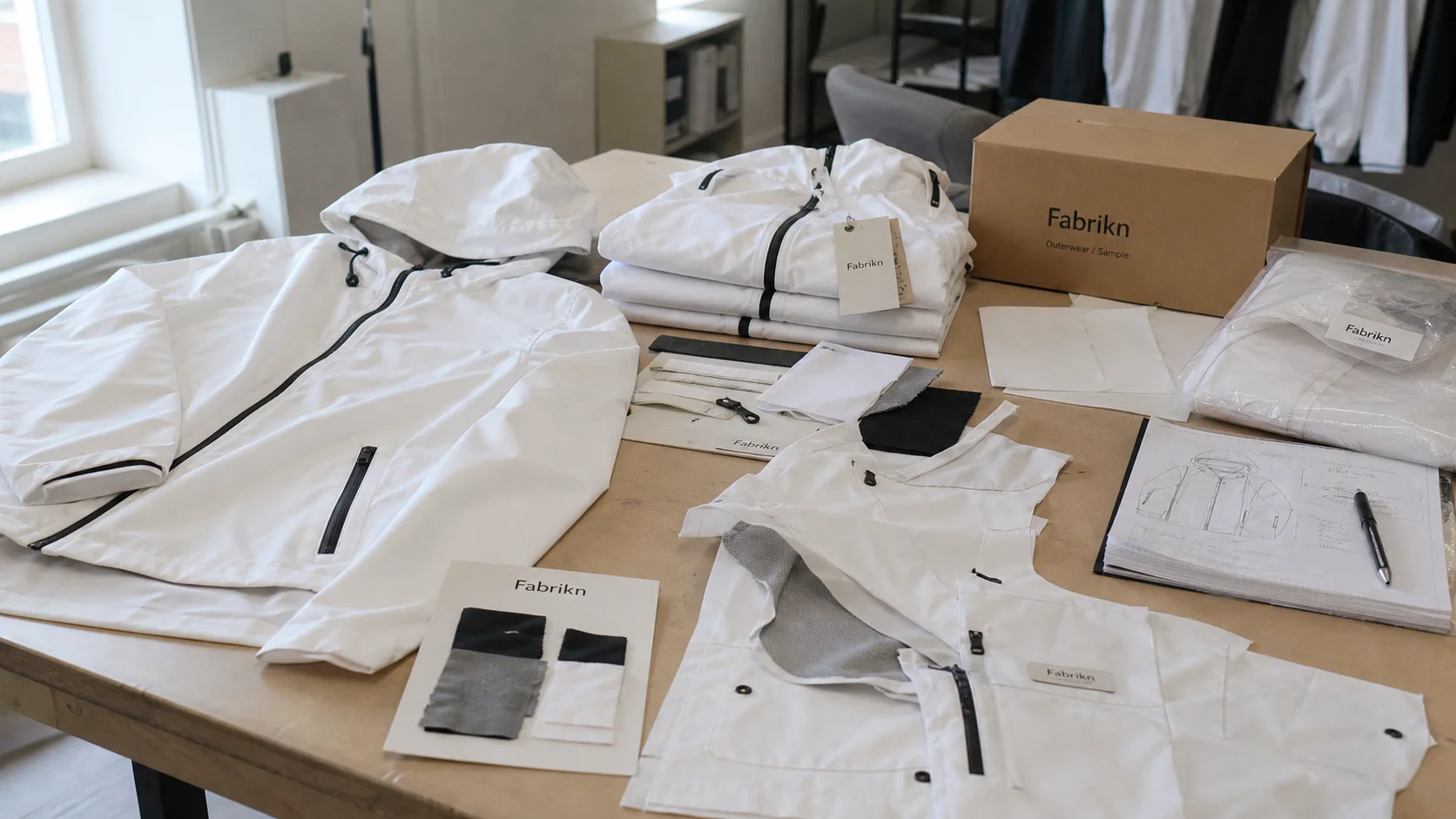
Garment Packaging Inserts Decision compared by sample evidence, fabric or trim specs, MOQ, AQL terms, cost lines, delivery timing, and rework responsibility.
Fast answer: Garment Packaging Inserts Decision: Material, Print, MOQ, and QC Terms should be judged by production evidence, not by a generic sourcing promise. The buyer needs sample proof, cost breakdowns, QC checkpoints, and delivery buffers in writing.
Ask for recent sample photos, measurement tolerances, fabric or print test assumptions, decoration test notes, packing examples, and a named inspection checkpoint. These details show whether the team can repeat an approved sample at bulk volume.
Separate garment cost, decoration, labels, packaging, sampling, testing, freight, and rush charges. Clear cost lines make it easier to reduce colorways, adjust size depth, or reserve more time for sampling.
I once watched a $42 tee arrive looking like a $12 clearance mistake: collapsed collar, twisted sleeves, flimsy insert, instant buyer’s remorse. That is the retail reality behind how to choose packaging inserts for clothing orders. The insert is part of the product experience, not filler. In factory after factory, from Portugal to Guangzhou’s Baiyun district and Dhaka’s knitwear corridors, the same lesson kept showing up: the garment does not need a luxury box to feel considered. It needs control.
In the first 10 seconds, shoppers notice shape retention, creasing, and whether the item feels protected. Factory owners kept bringing up the same complaints—crushed collars, folded denim that leaves a hard ridge, knitwear that shifts inside a carton and arrives with snagged trims. I was standing next to a Heidelberg Speedmaster with a duplex feeder where a Bobst 1020 die cutter had just finished punching 1.2 mm paperboard collar stays and the line operator switched to a Duplo-type MBO folder for the belly band. They also adjusted the water-based EVA adhesive temperature to 45°C so the insert stayed tack-free at 700 ppm without a second touch. Without that control, the same problems persist. Expensive problems, too. They create returns, customer service tickets, and re-folding labor. A pack line that saves 4 seconds per unit can lose that gain the moment a brand starts handling damaged stock.
I’ve seen damage rates sit at 0.8% with well-specified inserts and climb to 4.5% with vague, over-soft packaging for structured shirts. On 10,000 units, that means 80 damaged pieces versus 450. If each return or remake costs $8 to $18, the “cheap” insert turns reckless fast. In Dhaka, a GOTS-certified water-based adhesive used to secure molded pulp supports cut edge tearing and helped maintain that lower damage rate while keeping the insert flexible enough to slip inside pleated cartons. Weight matters as well. A 12-gram paperboard insert behaves very differently from a 38-gram molded pulp support, and that extra mass multiplies across 25,000 units.
Premium presentation does not require expensive materials. It requires the right balance of stiffness, fold memory, and handling speed. A shirt packed with a 1.2 mm paperboard collar stay and a simple belly band can beat a glossy custom sleeve that adds two extra packing motions. I saw packers in Mexico and a Ho Chi Minh City fulfillment center choose the simpler option because their lines move at 600 to 900 pieces per shift, and every extra motion becomes a bottleneck.
So the first decision is operational, not visual. Strong inserts protect trims, keep garments flat, and reduce friction in transit without turning packing into a craft project. A brand that sells at $18 and a brand that sells at $180 still need the same basic truth: the customer should open the parcel and see intention, not chaos.
The garment should dictate the insert, not the other way around. T-shirts, denim, knitwear, and structured apparel fail in different ways, so the brief has to reflect that. A slub jersey tee in 180 GSM cotton can tolerate a soft tissue wrap. A French terry 320 GSM hoodie needs enough support to stop shoulder distortion. A silk blouse needs anti-slip control. A blazer needs crease management and edge protection. That sounds obvious until you walk into a factory packing 2,000 mixed SKUs a day and see the same insert used for everything.
For single-item DTC orders, presentation matters because the customer experiences the garment alone. For multi-item wholesale cartons, separation and compression control matter more. A carton holding 24 folded units needs dividers or interleaving sheets that stop dye transfer and keep corners from digging into softer fabrics. In one Turkish plant I visited, a shirt program using 140 GSM tissue between folds cut crease complaints from 3.2% to 1.1% over six weeks. The tissue cost less than $0.03 per unit. Almost embarrassing, when one reassortment costs far more.
Denim deserves its own callout. Heavy jeans can survive rough transport, but folded edges still leave pressure marks if the insert is too narrow or too glossy. Structured apparel, especially tailored jackets and woven shirts, needs edge support at the collar, placket, and cuffs. Knitwear is different again. It shifts. It stretches. It collapses in transit. A low-friction paperboard cradle often outperforms a heavier insert because it holds the fold without grabbing the yarn.
Order profile changes the brief fast. A one-piece mailer for a $28 top needs visual order, clean fold retention, and a reveal that feels deliberate. A 48-piece wholesale carton needs separation, compression control, and a material that does not shed lint or transfer color under heat. Brands that also manage newborn or kids’ lines often ask about custom baby clothing manufacturing, where softer trims and smaller garments make stain transfer and shape retention even more sensitive. In that category, I’ve seen a 15-gram insert beat a 30-gram one because it was easier to pack consistently.
What most people miss: the most expensive insert often underperforms if it slows the line or adds friction during packing. I watched one premium magnetic insert cut a team’s output from 520 units per shift to 410 because packers had to reposition every garment twice. That 21% labor hit wiped out the visual gain. If the insert causes stress on the line, the customer pays for it later in defects and delays.
Six material families keep showing up in real sourcing work: paperboard, tissue, recycled paper, molded pulp, corrugated dividers, and poly alternatives. Each does a different job. Paperboard is best for shape retention and branding. Tissue is light, cheap, and useful for crease reduction. Recycled paper can add cushioning and a softer feel. Molded pulp offers structure and decent compression resistance. Corrugated dividers work for bulk separation. Poly alternatives still exist for moisture control or surface slip, though they bring harder sustainability questions.
Premium brands often land on a 300 to 450 GSM paperboard sleeve with 85% recycled fiber. Mid-market brands usually do well with 120 to 180 GSM tissue, 1.0 to 1.5 mm paperboard, or molded pulp trays at 18 to 35 grams each. Value brands usually need the simplest route: recyclable kraft sheets, low-ink print, and format consistency. The right choice is rarely the thickest one. It is the one that protects the garment at the lowest total mass per shipment.
Sustainability tradeoffs get messy fast. A recycled-content claim means little if the insert is laminated, UV-coated, or held together with mixed adhesives that can block fiber recovery. A 25-gram insert made from 100% virgin paper can be less circular than a 32-gram insert with 80% post-consumer content, depending on local recycling rules. According to Textile Exchange, material sourcing decisions matter because recycled content only solves part of the footprint. The rest sits in transport, conversion, and end-of-life behavior.
Print finish changes perception and recyclability. A matte aqueous coating signals restraint and usually recycles more cleanly than plastic lamination. A high-gloss finish can feel premium, but it often adds a mixed-material layer that recycling facilities may reject. I’ve seen brands spend $0.12 extra per insert on foil stamping when a plain debossed mark would have looked sharper and packed cleaner. For brands building private label clothing services, that detail matters because the insert is part of the brand story, not separate from it.
Sourcing reality shifts by region. In Asia, molded pulp and plain paperboard are widely available, with lead times of 2 to 4 weeks and MOQs from 2,000 to 10,000 units. In Europe, smaller custom runs are easier, but a printed insert can still take 3 to 5 weeks depending on finishing. North America often offers faster stock formats, yet custom tooling can push lead times to 4 to 8 weeks. I saw a U.S. buyer accept a slightly higher unit price just to avoid a 14-day airfreight scramble. Sensible call.
If you need packaging that behaves around sewing lines as carefully as it does in transit, think like a custom cut-and-sew manufacturing partner: match the insert spec to the way their Juki AMS-221UNS feeders, lockstitch lines, and Kongsberg cutting tables move, and include the collar stay in the bundling station so the same Bobst 1020 die cutter can notch it without extra tooling. That coordination saves the sewing line roughly 14 seconds per unit, and packers in Ho Chi Minh City reported fewer jams when the insert followed the same path as the garment.
Cost and performance are siblings: the insert that ticks the CSR boxes, fits the line, and survives transit is rarely the cheapest per sheet but also never the most decorated. Use your data—return rate, packer throughput, and fold count—to assign a per-unit value. If a tested insert saves 0.4% in returns, and the insert costs $0.08 more than the current insert while the garment is $48, that incremental spend is economic. A brand we audited in Istanbul concluded that a $0.10 increase per insert was more than offset by the drop in defect rate, so the decision went through.
Concrete numbers help. For a 500-unit MOQ run in Guangzhou or Ho Chi Minh City that uses 1.2 mm recycled paperboard or molded pulp, rates typically sit at $2.50-4.00 per unit, inclusive of die cutting, creasing, and a single-sided aqueous coating done on a Heidelberg CD 102. Those quotes assume a 1 mm perimeter crease and the use of WRAP-certified, water-based adhesives with no lamination. If you need embossing or foil, the cost jumps another $0.35 to $0.55, but an OEKO-TEX Standard 100 or OEKO-TEX STeP certified print partner can usually keep the run within a manageable budget.
Plan lead times accordingly. Custom tooling, like a Kongsberg cutting table pattern or a Bobst 1020 die, typically takes 18-22 business days from Guangzhou or Dhaka to deliver tight tolerances, including a prototype sample for approval. That time includes board sourcing, a two-stage press test, and a finishing pass on a Heidelberg folder gluer or automated trimming table. If you compress the timeline to 10 days, expect rush fees or upfront air freight, and you will probably run into BSCI or WRAP audit scheduling conflicts.
Another lever is how inserts are handled onsite: adhesives matter because they control whether the glue smears across the garment. Teams using heat-activated, GRS-certified kraft strips on 1.5 mm supports cut pack time by 6 seconds versus those relying on solvent-based glues. That small win can save $1,200 per day on a 900-piece line and keeps teams within the same cost envelope as running a cheaper, bold-printed sleeve that slows them down.
When you evaluate packaging inserts, sustainability checks should include chain of custody for both fibers and adhesives so the insert mirrors the care you take with body fabrics. Nothing undermines a conscious collection more than an insert shipped from Guangzhou with a PET lamination when the garments tout GOTS certification.
Use the certifications as conversation starters: GOTS or OEKO-TEX Standard 100 for the cloth components, WRAP for the factory practices, BSCI for social compliance, and GRS for the recycled content claims on inserts. For example, a Dhaka supplier with a WRAP certificate, a BSCI audit score above 90%, and GRS-marked recycled pulp can guarantee that a mold-pressed support with 60% post-consumer content stays green from intake to final pack. OEKO-TEX Standard 100 ensures the inks and adhesives—ideally water-based, low-VOC formulas—do not introduce unwanted chemicals when the insert touches a child's collar.
Run verification tests annually: ask for the latest certificate copies, review the factory's GOTS or OEKO-TEX Standard 100 list, confirm the adhesives have the same certification scope, and even include lab testing for any adhesives or coatings applied in Guangzhou or Ho Chi Minh City. That due diligence keeps you ahead of regulators and retains the trust of sustainability-focused retailers.
The insert spec is not final until it survives a sample run on your chosen supplier’s line. Send a "functional prototype" with the same paper stock, adhesives, and finish you plan to mass-produce, then run it through the packers’ process. That means placing the insert into a controlled mock order, letting your U.S. or European team fold and band a shirt, then running that assembly past the seamstress or pressing station. It is much easier to spot a snag when you can feel the adhesive edge, the fold memory, and how it feeds through a Kongsberg cutting table.
On the machine side, insist the supplier can match your specification using a Bobst 1020 die cutter, Heidelberg SX 102 folding line, or an automated Kongsberg scorer for the heavier supports. If the insert uses molded pulp, check the precision of pressure-cure forms and the ability to run BRP-80 pumps that can handle the thicker slurry. For 1.0 mm to 1.5 mm inserts, the packaging team should also show how they handle adhesives: water-based EVA, acrylic hot melt, or pressure-sensitive adhesives require different applicators, and the wrong setting can cause the insert to curl or bleed onto garments. Ask to see a video of the applicator head relative to the conveyor speed to confirm they can hold 600 to 900 units per shift without deformation.
That testing is particularly important when you source from multiple hubs. A supplier in Istanbul might match your spec quickly because they already produce trims for Turkish apparel brands, but a Dhaka facility may need to adjust humidity controls before using the same adhesive. Ho Chi Minh City and Guangzhou plants often share tooling, yet their conversion steps—die cutting, scoring, folding—can differ, so sample runs expose those differences before the first carton ships.
Document each run with line speed, per-unit adhesive weight, and crease stiffness so you can benchmark against future orders. An insert that requires a packer to pause for more than 1.2 seconds to align the adhesive edge is already slower than your standard. Once you standardize those numbers, you can negotiate with suppliers using your own data instead of vague claims.
Start with a table that lists the garment type, SKU, and the intended packing operation. Include the grammage, finish, and brand story, and make sure your spec calls out the exact machine sequence: e.g., "Die cut on Bobst 1020, crease on Heidelberg, fold on MBO," plus the adhesives (water-based EVA, 5 g/m² pattern). Also note if the insert needs to be wrapped in tissue before shipping or paired with a belly band.
Include sustainability credentials in the brief. Spell out that you require GRS-certified board with at least 85% recycled fiber, OEKO-TEX Standard 100 certified inks, and adhesives that meet WRAP and BSCI expectations. If a supplier in Guangzhou or Ho Chi Minh City cannot provide those, put it in writing so they can either upgrade or redirect you to a certified partner.
Finally, note the delivery expectation—sample due in 10 business days, final tooling in 18-22 business days, and full order to arrive within 4 weeks from the pilot approval. Share a photo of the finished pack, a video of the insert being applied, and the CAD file for your own archives. Clear direction prevents missteps and keeps your unboxing experience consistent.