
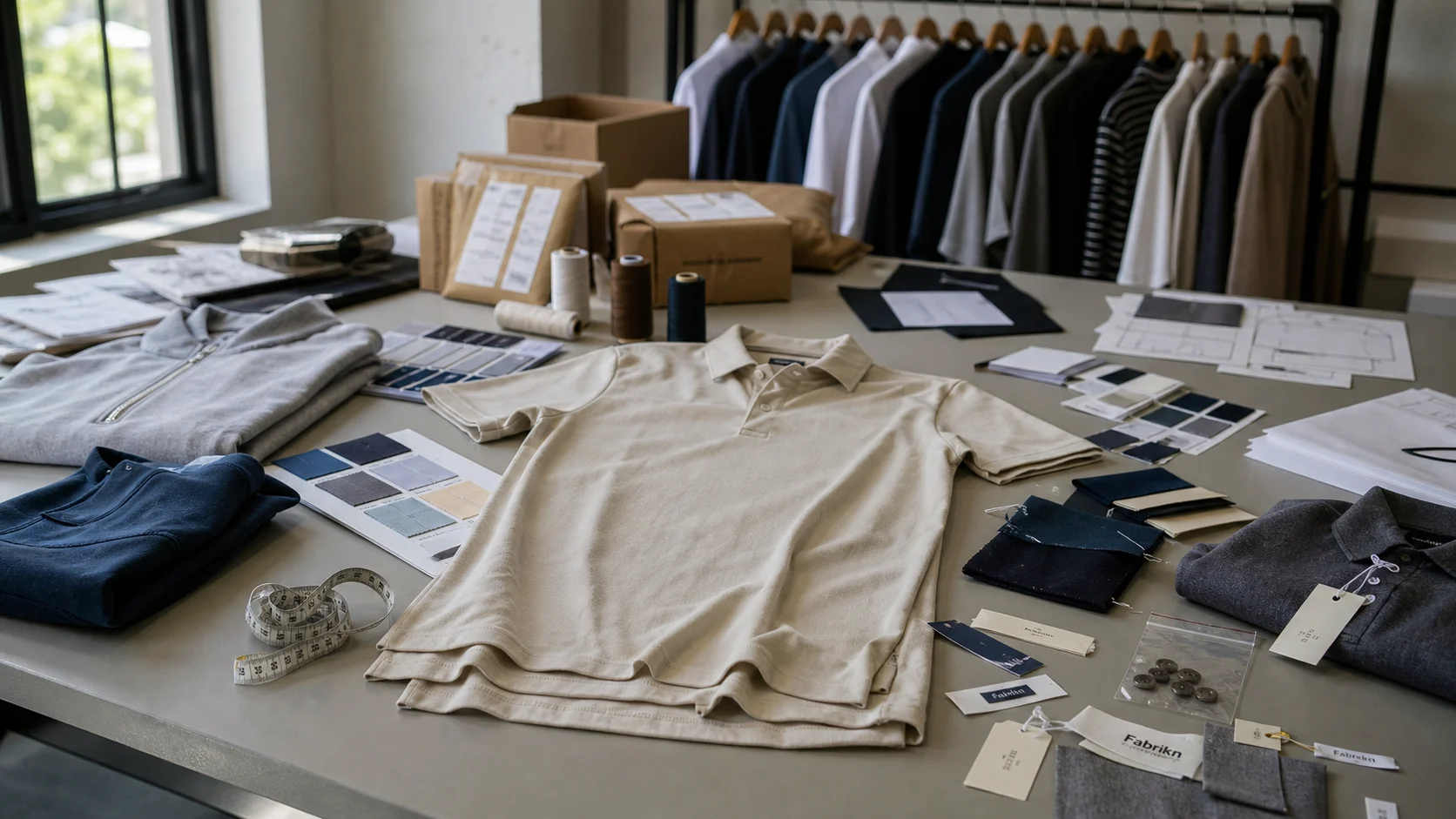
Negotiate MOQ with A Clothing Manufacturer compared by sample evidence, fabric or trim specs, MOQ, AQL terms, cost lines, delivery timing, and rework...
Fast answer: Negotiate MOQ with A Clothing Manufacturer: Sample Evidence, MOQ, Capacity, and Rework Terms should be judged by production evidence, not by a generic sourcing promise. The buyer needs sample proof, cost breakdowns, QC checkpoints, and delivery buffers in writing.
Ask for recent sample photos, measurement tolerances, fabric or print test assumptions, decoration test notes, packing examples, and a named inspection checkpoint. These details show whether the team can repeat an approved sample at bulk volume.
Separate garment cost, decoration, labels, packaging, sampling, testing, freight, and rush charges. Clear cost lines make it easier to reduce colorways, adjust size depth, or reserve more time for sampling.
Minimum Order Quantity, or MOQ, is one of the most common hurdles brands face when sourcing apparel from a clothing manufacturer. Whether you are launching a new fashion label, testing a product idea, or scaling a growing brand, MOQ can have a major impact on cash flow, inventory risk, and production planning. The good news is that MOQ is often negotiable if you approach the conversation strategically.
In this guide, we will explain how to negotiate MOQ with a clothing manufacturer, what motivates factories to set minimums, and which tactics can help you secure a lower threshold without damaging the relationship. If you are a startup brand, a small business, or an established company launching a new line, these business tips will help you make smarter sourcing decisions and improve your chances of getting a workable order quantity.
For brands exploring production support, you can learn more about our capabilities on the services page, or get in touch through our contact page.
MOQ is the smallest quantity a manufacturer is willing to produce for a specific garment, color, fabric, or style. In clothing manufacturing, MOQ can apply to several elements of production, including:
For example, a manufacturer may require 300 pieces per style, 100 pieces per color, or 500 units per fabric order. These requirements vary widely depending on the factory size, machinery, labor costs, material sourcing, and the complexity of your product.
Understanding MOQ is important because it affects your budget, inventory strategy, and product assortment. If you negotiate well, you may be able to reduce the upfront financial burden and test the market more efficiently. If not, you may end up overcommitting to stock you cannot sell quickly enough.
Before negotiating, it helps to understand why manufacturers insist on minimums. MOQ is not usually arbitrary. It exists to make production economically viable for the factory.
Every production order involves setup costs, such as pattern making, cutting, machine setup, printing screens, embroidery digitizing, and quality checks. If the order is too small, those fixed costs take up too much of the total price.
Suppliers often sell materials in bulk. A factory may need to buy fabric, labels, zippers, buttons, or packaging in minimum quantities. To avoid leftover materials and wasted costs, they set a production MOQ that matches supplier requirements.
Factories are more efficient when they can produce larger runs. Workers, machines, and production lines are easier to schedule when orders are consistent and substantial. Small orders can interrupt workflow and increase per-unit costs.
Manufacturers need enough volume to maintain profitability. A low-volume order may not provide sufficient margin to justify the time, management, and operational overhead involved.
A factory also takes on risk when it allocates materials, labor, and production time to a new client. MOQ helps reduce the risk of underutilized resources and unprofitable production runs.
Not every situation calls for a negotiation, but there are many cases where it makes sense to ask. You should consider negotiating MOQ if:
It is especially smart to negotiate MOQ when you are trying to validate a product-market fit. A lower minimum lets you gather real sales data before making larger commitments.
Successful negotiation starts long before you ask for a lower minimum. If you want a manufacturer to take your request seriously, you need to show that you are organized, realistic, and ready to place an order.
Before contacting a factory, calculate how many units you can realistically sell, store, and fund. If the manufacturer asks what quantity you need, you should have a confident answer. Even if your ideal MOQ is low, you should understand your actual budget ceiling.
The more precise your tech pack, design details, fabric choice, and size range, the easier it is for a manufacturer to estimate costs. Ambiguity makes factories cautious, and cautious factories are less flexible on MOQ. Clear specifications build trust and reduce friction.
Know the average cost of similar garments in your category. This will help you estimate the production economics and understand where the manufacturer has room to negotiate. If you know the market, you can ask smarter questions and avoid unrealistic demands.
Some factories specialize in large-scale production, while others are better suited to small-batch or custom orders. If a factory is geared toward mass production, pushing for a very low MOQ may not be practical. Select the right manufacturing partner from the start. You can read more about our company and approach on our about us page.
Negotiating MOQ with a clothing manufacturer is not about demanding a lower number. It is about creating a business case that makes the order worthwhile for both sides. Below are the most effective strategies.
Approach the manufacturer professionally. Be clear that you understand MOQ exists for a reason, and then explain your situation. Respectful communication sets the tone for collaboration rather than confrontation.
Rather than saying, “Your MOQ is too high; can you lower it?” try asking, “Is there flexibility on MOQ for a first order?” or “What options do you offer for a startup brand?” This invites the factory to propose solutions instead of feeling pressured.
Manufacturers are often more open to a lower MOQ if you frame it as a test run. A trial order reduces their perceived risk because it may lead to a larger repeat order if the product performs well.
Complex garments are more expensive to produce. You can improve your negotiating position by simplifying the design, reducing the number of components, or choosing standard construction methods. A simpler style may allow the factory to accept a smaller order.
If the factory’s MOQ is high because of color or fabric minimums, reduce your assortment. Instead of producing three colorways, launch with one. Instead of multiple fabric blends, focus on one core material. Fewer variations often lead to a more manageable MOQ.
Some factories are willing to lower MOQ per style if the total order value is higher. If you are producing several related pieces, ask whether combining styles, sizes, or colors can help meet the factory’s production threshold.
Manufacturers value repeat business. If you communicate that this order is the first of many, they may be more willing to accommodate a lower MOQ now in exchange for a longer-term relationship.
One of the most common trade-offs is paying more per unit in exchange for a smaller order. This is often a fair compromise because the factory still covers its setup and overhead costs. If your priority is testing the market, a slightly higher unit cost may be worth the flexibility.
If the manufacturer cannot lower MOQ, ask whether they can offer more favorable payment terms. For example, a lower deposit or staged payments can reduce your cash flow pressure even if the order size stays the same.
Factories sometimes have more flexibility during slow periods. If your timing is flexible, ask whether they can accommodate a smaller order during an off-peak production window.
MOQ negotiation works best when both sides benefit. If you want the manufacturer to make an exception, you should be ready to offer something valuable in return.
Think of the negotiation as a value exchange. The more certainty and convenience you can provide, the more likely a manufacturer will consider lowering MOQ.
Even strong brands can hurt their chances by approaching the negotiation the wrong way. Avoid these common mistakes:
If you have not finalized your design, sizing, and materials, the manufacturer may view your inquiry as unserious. Be prepared before you request a lower MOQ.
Cheapest is not always best. A lower MOQ with poor quality or unreliable delivery will cost more in the long run. Always consider the full value of the partnership.
Factories are more likely to help brands they trust. Share enough about your business model, sales channels, and growth plans to show credibility.
If a factory has a standard MOQ of 500 pieces, asking for 50 without offering anything in return is unlikely to succeed. Be realistic and patient.
A low MOQ may be possible for a simple T-shirt but not for a fully customized jacket. Match your expectations to the product category.
Sometimes a manufacturer cannot lower its MOQ, and that is okay. Instead of forcing the issue, consider alternative strategies.
Some manufacturers are designed for low-volume production. These partners may be a better fit for startups and niche brands than large-scale factories.
Instead of producing inventory upfront, collect customer orders first and then manufacture based on demand. This approach can reduce financial risk and help you justify a larger production run.
Focus on one hero product rather than multiple styles. This allows you to concentrate your budget and meet MOQ more easily.
Custom materials often increase minimums. If you are flexible on fabric or trims, the manufacturer may be able to produce smaller quantities.
A sourcing partner can help you identify the right factory, negotiate terms, and reduce production risk. This can save time and improve your chances of finding a workable MOQ.
If you are not sure what to say, here is a simple and professional script you can adapt:
“Thank you for sharing your MOQ and pricing. We understand that minimums are necessary for efficient production. We are currently launching a new collection and would like to start with a smaller trial order to test the market. Would there be any flexibility on the MOQ for this first run if we simplify the design and commit to a larger repeat order based on performance?”
This kind of message shows respect, business awareness, and willingness to collaborate. It also gives the manufacturer a clear reason to consider your request.
At Fabrikn, we understand that MOQ can be a major challenge for brands at different stages of growth. That is why we work closely with clients to assess production needs, explore practical options, and support smart sourcing decisions. Whether you need help with product development, sampling, or scaling production, it helps to work with a manufacturer that understands both quality and business flexibility.
If you are planning a new launch or want to discuss your production requirements, you can explore our services or reach out directly through our contact us page. If you would like to learn more about who we are and how we work, visit our about us page.
Negotiating MOQ with a clothing manufacturer is a skill that can save you money, reduce inventory risk, and help you grow with confidence. The key is to approach the conversation with preparation, professionalism, and a clear understanding of what the factory needs in return. Instead of asking for a lower MOQ without context, build a case based on simplicity, long-term potential, flexibility, and mutual benefit.
When you know how to negotiate MOQ with a clothing manufacturer, you gain more control over your sourcing strategy and open the door to smarter product launches. Whether you are producing a small test run or planning a long-term manufacturing partnership, the right approach can lead to better terms and a stronger supplier relationship.
Get a free quote from Fabrikn — your trusted B2B clothing manufacturer with 10+ years of experience. MOQ as low as 200 pieces.
Get a Free Quote →MOQ stands for Minimum Order Quantity. It is the smallest number of units a clothing manufacturer will produce for a specific style, fabric, color, or order.
Not always. Some factories are more flexible than others. Manufacturers that specialize in large-scale production may have less room to negotiate, while small-batch or custom factories may be more open to lower quantities.
A reasonable MOQ depends on the product type, complexity, and budget. For startups, lower MOQs are often better because they reduce inventory risk, but the final number will depend on the factory’s capabilities and your negotiation position.
That depends on your business goals. If you want to test demand and protect cash flow, paying more per unit for a lower MOQ may be worth it. If you are confident in sales volume, a larger order may offer better margins.
You can improve your chances by simplifying your design, reducing color variations, offering a repeat-order potential, paying faster, and communicating professionally and clearly.
If MOQ cannot be reduced, consider alternatives such as finding a small-batch manufacturer, using a pre-order model, limiting your SKU count, or using stock fabrics and standard trims.