
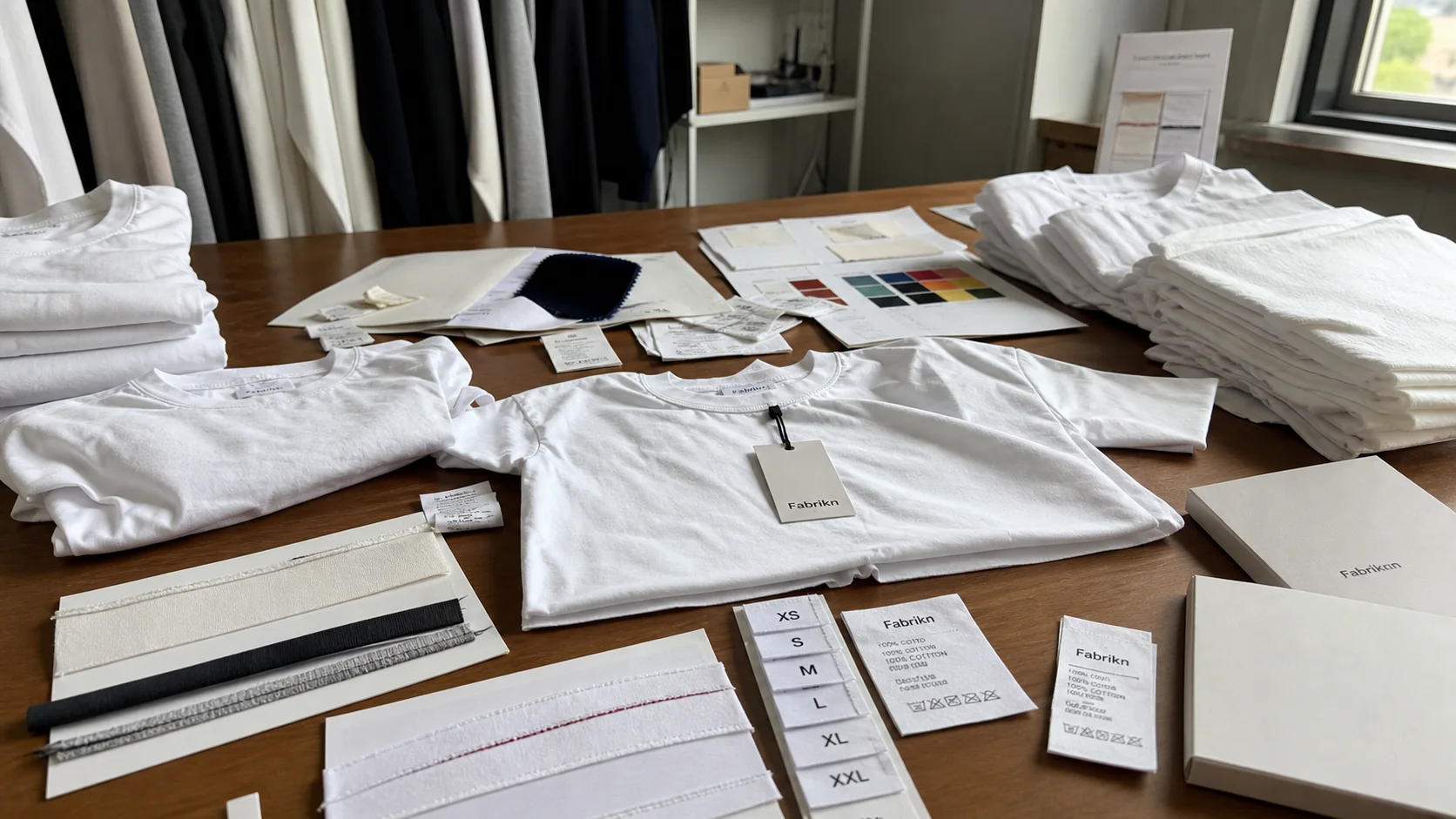
Price Clothing for Direct-to-consumer Brands compared by sample evidence, fabric or trim specs, MOQ, AQL terms, cost lines, delivery timing, and rework...
Fast answer: Price Clothing for Direct-to-consumer Brands: Tech Pack, Sample Gate, MOQ, and QC Terms should be judged by production evidence, not by a generic sourcing promise. The buyer needs sample proof, cost breakdowns, QC checkpoints, and delivery buffers in writing.
Ask for recent sample photos, measurement tolerances, fabric or print test assumptions, decoration test notes, packing examples, and a named inspection checkpoint. These details show whether the team can repeat an approved sample at bulk volume.
Separate garment cost, decoration, labels, packaging, sampling, testing, freight, and rush charges. Clear cost lines make it easier to reduce colorways, adjust size depth, or reserve more time for sampling.
Pricing clothing for a direct-to-consumer brand is one of the most important decisions you will make. The price you set affects your gross margin, paid advertising performance, customer perception, and long-term ability to scale. In DTC fashion, pricing is not just about covering costs. It is about building a business model that can support acquisition costs, returns, discounts, shipping, inventory risk, and growth.
Many new brands underprice their products because they focus only on production cost and a simple markup. That approach can be dangerous. Clothing businesses often face high overhead from sample development, freight, warehousing, content creation, exchanges, and marketing. If your price is too low, you may sell units and still lose money.
A strong pricing strategy helps you create sustainable profit while keeping your brand competitive. It also gives you room to run promotions without destroying your margins. For DTC apparel brands, pricing should be based on the full economics of the business, not just the factory cost.
To price clothing correctly, you need to understand every cost involved in bringing a product to market. This is often more complex than people expect. A garment may have a low manufacturing cost, but the true cost of selling it can be much higher.
These include pattern making, sampling, grading, tech packs, fabric sourcing, fit sessions, and revisions. If you are launching a new line, development costs can be significant, especially for custom styles.
This is the factory price per unit for cutting, sewing, finishing, and packing. It can vary widely depending on fabric quality, construction complexity, trims, print or embroidery, order quantity, and country of production.
Shipping products from the factory to your warehouse adds to your landed cost. Depending on your supply chain, you may also need to include customs duties, brokerage fees, and inland transportation.
Storage, pick-and-pack fees, packaging materials, and last-mile shipping all affect your profitability. DTC brands frequently underestimate fulfillment costs, especially when offering free shipping.
In apparel, returns are a reality. Sizing issues, fit preferences, and customer behavior can reduce your net revenue. Your pricing should account for a return rate that matches your category and sales channel.
Paid social, search ads, influencer campaigns, affiliate commissions, email tools, and creative production can take a large share of revenue. If you are selling direct to consumer, customer acquisition cost must be built into pricing from the beginning.
Software, salaries, design, photography, accounting, and office costs all need to be supported by product margin. Even if these costs are not tied to a single item, they still impact the price you need to charge.
Cost of goods sold, or COGS, is the total cost to produce and deliver one sellable unit to your warehouse. For DTC clothing, COGS should include more than just factory pricing.
A simplified formula is:
For example, if a hoodie costs $12 to manufacture, $1.25 for packaging, $1.80 for freight, and $0.95 for duties, your landed cost is $16.00 per unit. That does not yet include marketing, payroll, or returns. It only tells you what it costs to get the product ready for sale.
Many brands use landed cost as the starting point for pricing, but the final retail price should be based on margin targets and business goals. A product with a $16 landed cost may need to retail for $48, $58, or even more depending on brand positioning and acquisition costs.
There is no single correct way to price clothing for direct-to-consumer brands. However, there are several common models that help structure your thinking.
This method adds a markup to your cost. For example, if your landed cost is $20 and you want a 3x markup, your retail price would be $60. Cost-plus pricing is simple, but it can be misleading if it ignores market demand and customer expectations.
Keystone pricing is a classic retail method where the product is priced at roughly double the wholesale cost. In DTC, the idea is similar, but brands often need a higher multiple because they are both the retailer and the brand owner. Direct sales usually require stronger margins than wholesale.
This strategy sets prices based on perceived value rather than only cost. If your brand offers premium fabric, exceptional fit, sustainability, or strong design identity, customers may be willing to pay more. Value-based pricing is especially relevant for lifestyle and fashion brands with a clear point of view.
With this model, you compare your product to similar items in the market. This is useful when entering a competitive category. You still need to know your costs, but market benchmarking helps you avoid pricing yourself far outside customer expectations.
Some DTC brands use tiers to serve different customer segments. For example, basics may be priced more accessibly, while premium capsules or limited drops command higher margins. This can help you broaden your assortment without weakening the brand.
Price is a signal. Customers do not only see the number on the product page; they interpret what that number says about quality, exclusivity, and brand identity. This is why positioning matters so much in DTC clothing.
If your brand is positioned as premium, your prices should support that story. Premium pricing can reinforce better materials, more thoughtful construction, and a more elevated customer experience. On the other hand, if you want to be known for affordable everyday essentials, your pricing needs to align with that promise while still preserving margin.
When defining price, ask yourself:
The more consistent your pricing is with your brand positioning, the easier it becomes to convert customers and maintain trust. If you want to refine your product strategy early, it helps to work closely with manufacturing and development partners. You can learn more about our capabilities at Fabrikn Services.
Gross margin is the difference between your selling price and your product cost, expressed as a percentage of revenue. In DTC clothing, gross margin is a critical metric because it determines how much money you have left to fund operations and marketing.
The formula is:
For example, if you sell a T-shirt for $40 and its landed cost is $12, your gross margin is 70%. That may sound healthy, but you still need to pay for ads, fulfillment, and overhead. If your blended customer acquisition cost is high, a 70% gross margin may not be enough.
Many DTC apparel brands aim for gross margins between 65% and 75%, though this varies by category, channel mix, and order volume. Accessories, premium basics, and direct-only products can sometimes support higher margins. Highly competitive categories may require more careful pricing and operational efficiency.
It is also useful to think in contribution margin, not just gross margin. Contribution margin shows what remains after variable costs like shipping subsidies, payment processing, and returns. This gives a more realistic view of whether your pricing is truly sustainable.
Here is a practical framework for pricing clothing for a direct-to-consumer brand.
Start with the full landed cost of each product. Do not rely on factory cost alone. Include packaging, freight, import fees, and any costs required to make the item sale-ready.
Set a gross margin target based on your business model. If you plan to spend heavily on paid acquisition, you will likely need stronger margins than a brand with organic traffic and a loyal customer base.
Review competitor pricing in your category. Look at premium, mid-market, and value brands. Pay attention to product details, materials, and customer reviews, not just the listed price.
Test how your audience responds to price in focus groups, pre-launch campaigns, waitlists, or limited drops. You want a price that reflects your value while still feeling credible to your target buyer.
Most DTC brands will eventually run promotions, bundles, or seasonal sales. Set prices with enough margin to absorb a controlled discount without turning every promotion into a loss.
Model different scenarios. What happens if CAC rises by 20%? What if return rates increase? What if you need to offer free shipping? A good price should still work under less-than-ideal conditions.
Your pricing should work across the whole collection. Hero products may carry lower margins to attract customers, while add-on products, accessories, or premium items can improve overall profitability.
Even experienced founders make pricing mistakes when launching clothing brands. Avoid these common issues:
A common trap is assuming that a product is “cheap to make” so it should be “cheap to sell.” In reality, the brand may need a much higher price to remain viable. This is especially true for small-batch apparel companies, where lower order quantities increase per-unit cost.
Pricing should not be static forever. DTC brands need to review pricing as costs change and the brand matures. Fabric prices, freight rates, ad costs, and customer preferences all shift over time.
Useful ways to test pricing include:
You can also use pricing ladders to guide customer choice. For example, offer a core tee, a premium heavyweight tee, and a limited-edition version at different price points. This allows you to capture different willingness-to-pay levels without confusing the market.
If you are early in development, getting the right product and cost structure from the start is essential. For help with production planning, pattern development, and scalable manufacturing, visit About Fabrikn or reach out through Contact Fabrikn.
Your manufacturer plays a major role in pricing success. The right production partner can help you optimize fabric selection, construction methods, and minimum order quantities so your product can hit the margin you need.
When discussing pricing with a manufacturer, be clear about your target retail price and target landed cost. A good manufacturing partner can often suggest alternatives that reduce cost without hurting quality, such as adjusting fabric weight, simplifying trims, improving lay efficiency, or consolidating colorways.
Ask your production partner for cost breakdowns whenever possible. This helps you identify where value is being created and where costs can be reduced. It also makes future pricing decisions easier when you launch new styles.
For DTC brands, pricing and manufacturing should be developed together, not separately. If you price first and ask the factory to “make it work,” you may end up with weak margins or poor product quality. If you develop with profitability in mind from day one, you can build a much stronger business.
Learning how to price clothing for direct-to-consumer success is about more than arithmetic. It requires a clear understanding of costs, market positioning, customer behavior, and long-term brand strategy. The best pricing decisions protect your margins, support growth, and reinforce what makes your brand special.
When you take the time to calculate landed costs accurately, define healthy margins, and test your pricing against real customer demand, you create a foundation for a more durable apparel business. Whether you are launching a new basics line or a premium fashion brand, pricing should be treated as a strategic lever, not an afterthought.
Get a free quote from Fabrikn — your trusted B2B clothing manufacturer with 10+ years of experience. MOQ as low as 200 pieces.
Get a Free Quote →The best strategy usually combines landed cost analysis, margin targets, market benchmarking, and value-based pricing. Most successful brands do not rely on cost-plus alone.
Many DTC apparel brands aim for gross margins in the 65% to 75% range, but the right target depends on your category, customer acquisition costs, return rate, and overhead.
Competitor pricing is a useful reference, but it should not be the only factor. Your own costs, positioning, and target customer should guide the final price.
Returns reduce net revenue and can increase fulfillment and restocking costs. You should factor expected return rates into your pricing model to protect profitability.
Yes, but only if you build enough margin into your original pricing and use discounts strategically. Frequent or deep discounting can weaken brand perception and train customers to wait for sales.
Fabrikn helps brands develop products with cost, quality, and scalability in mind. By working with a manufacturing partner early, you can build better unit economics and more sustainable pricing from the start. Learn more at /services/ or get in touch via /contact-us/.