
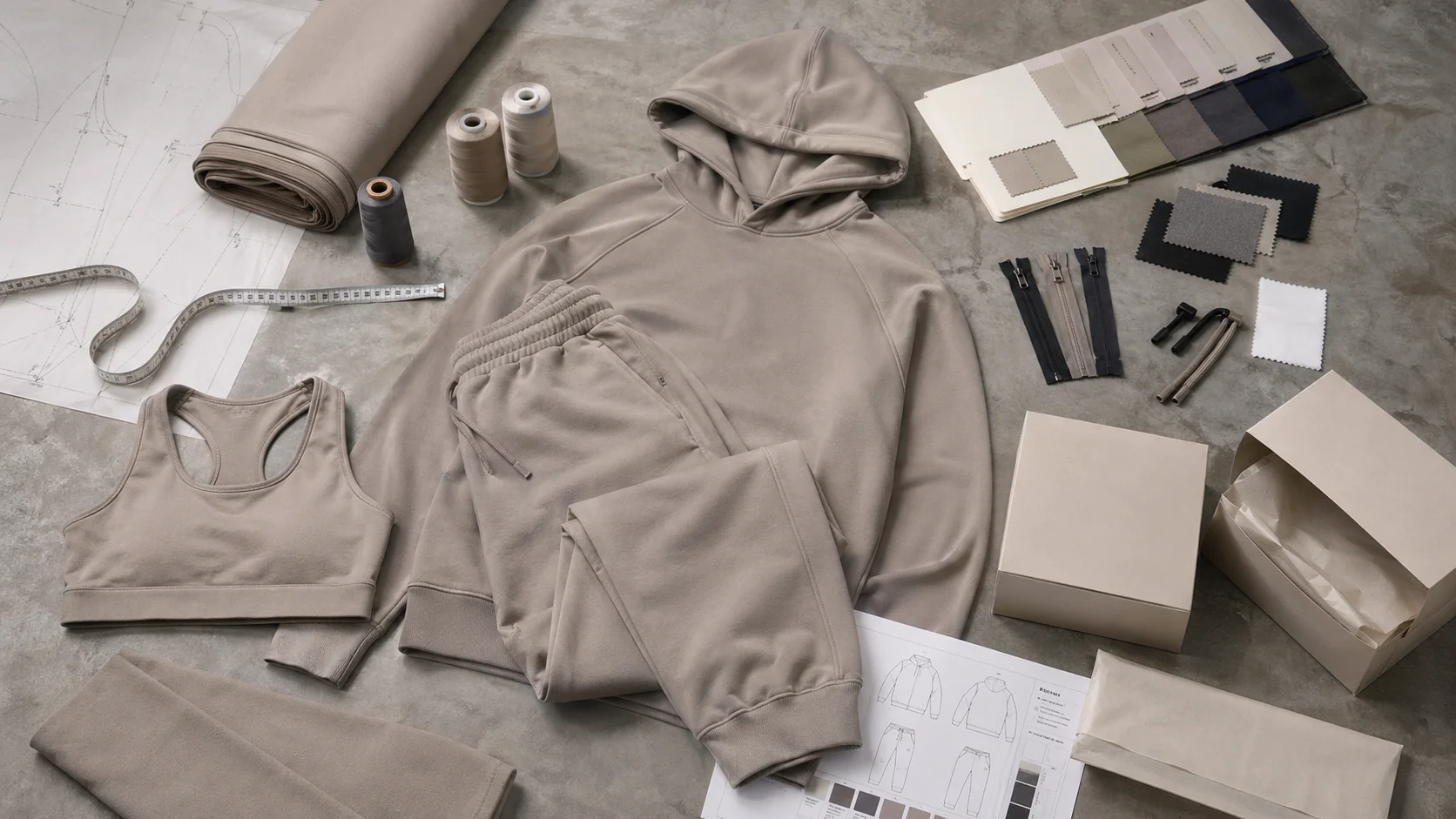
Print Logo on Mailer Bags compared by sample evidence, fabric or trim specs, MOQ, AQL terms, cost lines, delivery timing, and rework responsibility.
Fast answer: Print Logo on Mailer Bags: Material, Print, MOQ, and QC Terms should be judged by production evidence, not by a generic sourcing promise. The buyer needs sample proof, cost breakdowns, QC checkpoints, and delivery buffers in writing.
Ask for recent sample photos, measurement tolerances, fabric or print test assumptions, decoration test notes, packing examples, and a named inspection checkpoint. These details show whether the team can repeat an approved sample at bulk volume.
Separate garment cost, decoration, labels, packaging, sampling, testing, freight, and rush charges. Clear cost lines make it easier to reduce colorways, adjust size depth, or reserve more time for sampling.
Before a parcel is opened, it's already talking about your brand. Planning to print logo on mailer bags? Start there: the bag is not a shipping afterthought. It's the first retail surface your customer sees, sometimes the only one couriers, neighbors, front-desk staff, or building security ever glimpse before the box is opened. A first impression, pure and simple.
Mailer bags travel farther than cartons. And boxes get stacked, crushed, hidden under tape labels; a mailer stays visible in hand, on bikes, in delivery vans, and in apartment lobbies. That makes print quality matter at every handoff. I watched brands pay $0.12 more per unit for printed bags, then lose the effect because the logo sat 18 mm off-center or faded against a light gray film. Cheap looked careless. Expensive looked worse when the ink smeared.
Plain poly mailers can cost $0.08-$0.18 each at scale, while printed versions often land at $0.14-$0.35 depending on size, thickness, and colors. DTC brands usually want clean, high-contrast logos with one strong message. Luxury labels lean toward a restrained mark, often black on matte white or metallic on deep navy. Discount retailers push volume and accept simpler artwork because moving 50,000 units at 2-3 week lead times matters more than a perfect finish. The print strategy should match the price point, not the mood board.
What I have seen on factory floors is revealing. Off-center prints are usually not a machine failure; they're a measurement failure. But low contrast happens when buyers approve artwork on a screen but ignore the 65%-75% opacity that film and pigment will actually hold. Weak adhesion shows up after bags are folded 2 or 3 times, especially on recycled film with a rougher surface. A logo that looks fine on one sample can fail across 10,000 bags if the buyer never specified where the top seal, gusset, and barcode zone should sit.
When a brand is moving beyond packaging and into apparel, the same discipline applies. And I've seen teams that already understand sublimation printing services on garments still under-specify mailers, even though the same logic governs ink control, color match, and substrate behavior. Packaging is less forgiving because customers touch it first and discard it faster.
On the ground, the difference between a good and a great bag is clear. And a Guangzhou operation using a Windmöller & Hölscher flexo press and Mitsubishi UV dryer can run 120 gsm kraft mailers printed in five colors for $2.50-4.00 per unit at 500 MOQ, with delivery in 18-22 business days once artwork is approved. The same line can switch to 30 micron LDPE film that has passed GRS tests for recycled content, while a nearby atelier handles white cotton drawstring mailers approved under GOTS and OEKO-TEX Standard 100 for premium accessories. In Dhaka and Ho Chi Minh City, plants certified to WRAP and BSCI focus on heat sealing, corona treatment, and inline barcoding, while Istanbul workshops service European fast fashion clients who need wagons of 100% compostable PLA mailers with metallic inks.
You can go in four directions to print mailer orders: flexographic printing, gravure, screen printing, or digital methods. Each behaves differently on PE, LDPE, compostable films, and paper mailers. The right choice depends on order size, color count, artwork tweaks, and whether your buyer tolerates a 5% color variance or wants tighter targets. When comparing factories, figure out which method they run in-house and which steps get outsourced.
Flexographic printing is the workhorse for 10,000 units and up. It uses plates, runs quickly, and usually supports 1-4 colors with good consistency. Setup fees often sit in the $150-$500 range, while plates cost $30-$90 per color. Gravure gives excellent detail and denser ink laydown, but cylinder costs can push setup beyond $800-$2,000, so it only makes sense for very large runs, often 100,000 pieces or more. Screen printing handles bold graphics and small jobs, sometimes as low as MOQ 500, though it slows production and struggles with fine text under 4 pt.
Digital printing is where buyers tend to get surprised. But per unit, it can cost 20%-50% more than flexo on a 20,000-piece order, yet it may be cheaper for 1,000-3,000 bags if you change artwork often or test seasonal drops every 4-6 weeks. A digital run with three artwork revisions can still beat flexo once you count plate charges, wasted proofs, and re-run delays. I have seen startups save $400-$700 by switching to digital for a short launch, then move to flexo once demand stabilized.
Startups often do best with digital or single-color screen printing, especially if the first order is 500-2,000 pieces and the logo is simple. And mid-market brands do well with flexo because the price drops sharply at 5,000-20,000 units, and the print quality is strong enough for retail fulfillment. Large retailers should look at gravure or high-output flexo when they need 50,000-plus bags, tight repeatability, and a 2-3 week replenishment cycle. When your product line includes apparel, the same supplier logic often extends to private label clothing services, where artwork control and MOQ planning work the same way.
Paper mailers and compostable blends deserve a close look. And ask the supplier whether they use water-based ink, UV, or low-migration systems. Get the print limit in mm, not just a color count. A four-color logo on film is not the same as a four-color logo on kraft paper. On paper, 2-3 spot colors can hold cleanly; on thin compostable film, the same artwork may dull or crack if the substrate is below 70 microns. For compliance-sensitive programs, you can also review guidance from OEKO-TEX and Trade.gov before finalizing materials and claims.
Specific machinery matters too. HP Indigo 25K digital presses maintain Pantone matches across short runs, while Bobst Masta and Comexi flexo lines thrive on corrugates and thicker films. And if your supplier runs a 40-inch Omet XJet for multi-pass printing, you can expect a standard deviation of 3-4 Delta E on CMYK blends, compared to 8-10 on older wide-format inkjets. Combining that with corona and plasma treatment raises ink adhesion on low surface energy poly, and you are far more likely to pass a QC check coming from a WRAP- or BSCI-certified plant.
Most artwork failures come from bad files, not bad factories. That's the part buyers resist, because fixing a logo in Illustrator feels less glamorous than debating bag thickness. Yet when you're serious about how to print logo on mailer bags without distortion, the file package matters more than the first quote. I have watched perfectly capable factories reject jobs because the buyer sent a PNG at 72 dpi, then blamed the press when the edges looked fuzzy.
Send vector files whenever possible: AI, EPS, or PDF with outlines. For raster art, 300 dpi at final size is the minimum, and 600 dpi is safer for small text. Keep line thickness above 0.25 pt for flexo and above 0.5 pt if the substrate is flexible film. On a bag that bends, a 1 mm line can visually break when folded at the seam. Safe zones should stay at least 8-10 mm from the seal and 5 mm from edges, because heat sealing, trimming, and gusset expansion can eat into the print area.
Color matching is where brands get emotional and factories get technical. Pantone spot colors give better control than CMYK on dark bags, especially when you need a clean white underbase or metallic accent. CMYK can work on pale films and paper mailers, but gradients usually soften, and 10%-15% tonal shifts are normal on flexible substrates. White ink is essential on black, navy, or kraft-black hybrid bags, yet it can add $0.02-$0.06 per bag depending on coverage. Metallic inks look rich, but they can raise costs and require slower curing, so plan for the drying time.
A strong brief makes the supplier's job narrower and the quote more reliable. For print logo on mailer bags, include the target customer, sales channel, expected order quantity, size range, decoration needs, packaging requirements, and delivery market. Then call out the details most likely to affect the result, especially material grade, print tolerance, and barcode size.
The brief should also explain what cannot change. Some brands care most about hand feel, some about price, some about launch timing, and some about retail compliance. When those priorities are not written down, suppliers tend to optimize for whatever is easiest to quote. Clear priorities help the factory make better tradeoffs before the first sample is cut or printed.
Ask the supplier to respond with assumptions, not just a price. A useful reply states MOQ, sample route, production capacity, inspection plan, packing method, and freight handoff. If the answer is vague, the project may still work, but it needs a tighter pre-production stage before money and calendar pressure build up.
The best time to catch problems is before the pre-production sample is approved. Check measurements, color, placement, material behavior, shrinkage, construction, labels, and packaging in the same review instead of approving each item in isolation. Many bulk issues are not caused by one dramatic mistake; they come from several small unchecked assumptions.
For print logo on mailer bags, pay special attention to folding method, pack-out sequence, and retail compliance. These details often look minor in an email but become expensive once cutting, printing, sewing, packing, or shipping begins. A simple checklist with owner, due date, and approval status keeps the brand team and factory aligned.
Bulk production should not start until the supplier can explain how the approved sample becomes a repeatable production standard. That means reference sample storage, line instructions, inline checks, final inspection, and defect handling. A factory that can describe this process clearly is usually safer than one that only promises speed.
Price differences are useful only when the quotes cover the same work. Compare sample cost, material source, trims, decoration, packaging, testing, inspection, and freight assumptions. A low unit price can become expensive if it excludes items the brand needs before launch.
Timeline promises deserve the same scrutiny. Ask what happens if the first sample needs revision, whether materials are in stock, when the production slot is reserved, and how export packing is handled. The most reliable supplier is often the one that gives a realistic calendar instead of the fastest optimistic answer.
Before making the final decision, write down the specification, approval owner, delivery expectation, and the one or two risks that would cause the most trouble if missed. For print logo on mailer bags, this usually means checking material grade, print tolerance, barcode size, and the support process after the order is placed.
This last review does not need to be complicated. It simply makes the decision easier to repeat, easier to explain, and easier to verify when the finished product or jewelry arrives.
One useful way to pressure-test the decision is to ask what would happen if the order had to be repeated in six months. The answer should still be clear: the same material grade, the same print tolerance, the same acceptance standard, and the same communication path. If a second order would depend on memory or guesswork, the first order is not documented well enough yet.
Another useful check is to separate preference from requirement. Preference is the look, wording, or finish the brand likes. Requirement is the measurement, tolerance, certificate, material, or delivery condition that cannot fail. Good buying decisions keep both visible, so the final choice is not pushed around by the last email, the cheapest quote, or the prettiest sample photo.
Finally, ask who owns each approval. A project with one accountable owner for sample review, one owner for final content or artwork, and one owner for delivery sign-off usually moves faster than a project where every decision is shared loosely across a team. Clear ownership reduces delays and makes the finished result easier to judge.