
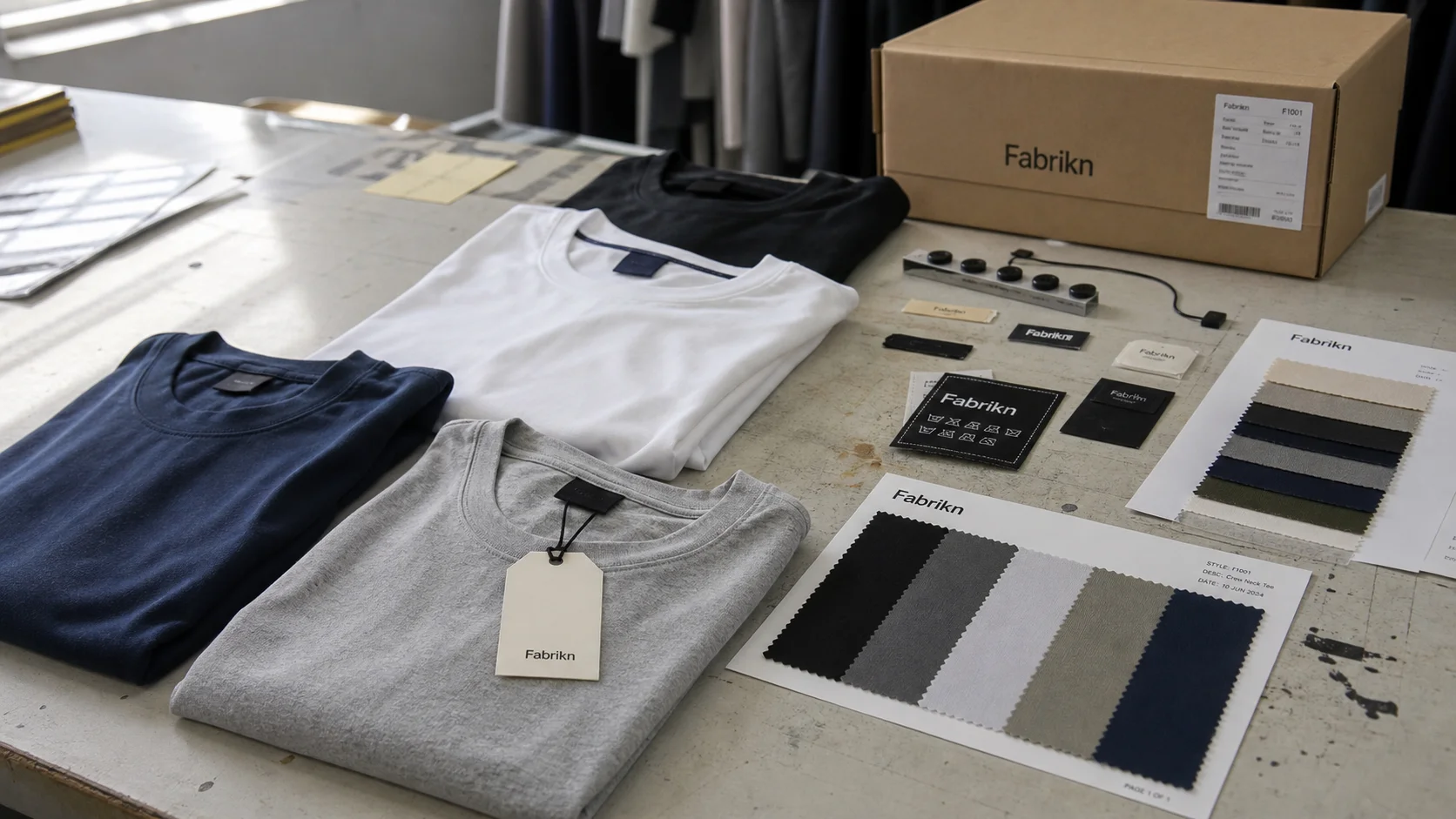
Lookbook Insert Buyer Checklist with checks for samples, fit, MOQ, QC evidence, pricing terms, and delivery risk.
Fast answer: Lookbook Insert Buyer Checklist: Page Count, Paper, Print, and Retail Impact should be judged by production evidence, not by a generic sourcing promise. The buyer needs sample proof, cost breakdowns, QC checkpoints, and delivery buffers in writing.
Ask for recent sample photos, measurement tolerances, fabric or print test assumptions, decoration test notes, packing examples, and a named inspection checkpoint. These details show whether the team can repeat an approved sample at bulk volume.
Separate garment cost, decoration, labels, packaging, sampling, testing, freight, and rush charges. When every cost line is visible, it becomes easier to reduce colorways, adjust size depth, or reserve more time for sampling.
A folded insert can do what a better product photo sometimes cannot: make a $40 tee feel like a considered purchase. When brands plan lookbook inserts for clothing packaging wholesale, they are shaping the first impression before the customer even touches the garment. I have watched that happen in packing rooms from Ho Chi Minh City to Leicester. Sounds simple until the numbers show up: a 2-page fold printed on 128 gsm uncoated stock can lift perceived value far more than another 15 grams of cotton. In the first five seconds after unboxing, shoppers read paper before they read stitching.
In Guangzhou’s Baiyun district, I once reviewed a 4-page lookbook project that quoted $2.50-4.00 per unit at 500 MOQ, coated on GOTS-certified 150 gsm organic cotton fiber stock and finished on a Heidelberg Speedmaster CX 102. The supplier guaranteed color stability within Delta E 2.0 thanks to inline spectrophotometers and a Komori Lithrone G40 for the text passes. That insert traveled to multi-brand boutiques in Istanbul, where a WRAP-certified logistics partner unpacked cartons and saw buyers pause on the soft-touch cover before anything else.
lookbook inserts for clothing packaging wholesale are not decorative filler. They are a packaging asset with a job: shape the first impression, explain the product, and nudge repeat purchase behavior. In DTC, the insert often carries brand story, styling ideas, and a QR code to the next collection. In wholesale, it may sit inside polybags or cartons as a sales tool for boutiques, department stores, and franchise buyers who need to reorder fast.
I have seen the same garment sold at $18, $40, and $120 with three very different insert strategies. The $18 tee usually gets a single fold card, 300 gsm, with care instructions and a promo code. The $40 tier often uses a 4-page mini lookbook, 150 to 170 gsm, with three outfit pairings and a subtle sustainability claim. At $120, brands move to stitched booklets, 8 to 12 pages, a soft-touch cover, and editorial photography that makes the garment feel scarce. Same shirt. Different frame. Different margin.
Some low-cost mills print inserts better than higher-end garment factories because they run dedicated paper lines with tighter registration control. A manufacturer making 20,000 inserts a day can hold color within Delta E 2.0, while a polished apparel factory may struggle with paper dust, inconsistent drying, and slower finishing. That does not make the paper vendor better in general. It means specialization matters.
The best wholesale buyers treat inserts as part of the sell-through strategy. They use them to increase giftability, reduce return anxiety with clear care notes, and support repeat purchase rates through cross-sell content. A plain tee in a plain bag is a commodity. A plain tee with a sharp insert feels considered. That difference can move a wholesale account from one seasonal order to three, especially when buyers compare similar brands at the same price point.
For brands building out clothing packaging solutions, the insert is one of the cheapest places to add discipline. It does not change the seam. It changes the story. In retail, story often wins the shelf edge before fabric handfeel ever gets a chance.
Most buyers think of a lookbook as a glossy mini magazine, but wholesale versions are usually leaner. Common formats: folded card, stitched booklet, tear-out sheet, flat insert. Each serves a different use case. A folded card works well for one to three key messages, fits inside a polybag, and keeps freight low. A stitched booklet is stronger for seasonal storytelling and can hold 8 to 16 pages without feeling bloated. Tear-out sheets are useful when you want one page for styling and one page for compliance or care. Flat inserts are the cheapest to pack by the thousand and the easiest to count at pick-and-pack.
Page count matters because it changes cost, weight, and reader behavior. A 2-page fold can be printed on 250 gsm stock and still fold cleanly. A 12-page booklet usually needs 128 to 157 gsm text paper plus a 250 to 300 gsm cover if you want it to survive shipment. Trim sizes often sit at A6, A5, or custom 5 x 7 inches. Bigger is not automatically better. A bulky insert tends to get tossed unless it has a job beyond looking premium.
Content is where brands decide whether the insert sells or just informs. I have seen inserts with styling grids, care instructions, SKU data, traceability notes, and retail-ready UPC placement. I have also seen pure brand story pieces that read like magazine editorials, which work better for direct-to-consumer orders than for wholesale cartons going to 80 stores. If you sell into multi-brand boutiques, a balanced insert can also explain how to group items by collection and increase average basket size by 12% to 18%.
Short-run lookbook inserts for clothing packaging wholesale are often digitally printed in batches of 500 to 2,000 units on machines like the Xerox Iridesse or Konica Minolta AccurioPress C14000, then updated every six to eight weeks. Warehouse-friendly flat inserts are built for longer runs, usually 5,000 to 50,000 units, with simpler artwork and cleaner stacking. That choice matters for brands selling both online and through stores. The online box can carry more editorial content, while the warehouse insert needs to be efficient enough to survive carton packing, pallet wrap, and handling by people who never asked to become brand ambassadors.
For baby and children’s labels, inserts get used more cautiously, especially where care directions, fiber content, and safety warnings must be clear. Brands working through custom baby clothing manufacturing often print larger type, simpler icons, and fewer glossy claims because parents want facts first, sentiment second.
Paper stock is where wholesale pricing starts to drift. Coated paper gives sharper photography and richer black, which suits fashion images and clean layouts. Uncoated stock feels more tactile and reads as honest, especially for sustainability messaging. Recycled stock, usually 30% to 100% post-consumer content, can fit when the brand wants an environmental signal without paying for specialty effects. FSC paper helps with chain-of-custody messaging, though the certification only matters if the claim is documented correctly and printed accurately. According to OEKO-TEX, certification language needs to match the actual material and product scope, or it becomes a liability instead of a selling point. Buyers we work with in Dhaka extend that further by demanding GOTS and OEKO-TEX Standard 100 confirmations for every fiber blend, and the printers in Ho Chi Minh City often supplement that with GRS-certified recycled cotton pulp sourced from the Mekong Delta.
Finishing changes both the feel and the bill. Foil stamping, embossing, soft-touch lamination, and spot UV all add tactile drama, but they also complicate recyclability and raise setup costs. A foil logo on a 4-page insert might add $0.08 to $0.18 per unit at 1,000 pieces, then drop to pennies at 50,000. Soft-touch lamination can improve the handfeel, but it can also make folding more prone to cracking unless the score line is precise. Spot UV works beautifully on dark covers, though it can create alignment headaches on press if the dieline is loose by even 1.5 mm. Cold foil stamping machines like the MGI Meteor and automated MBO K800 folders keep finishing consistent, but they need daily maintenance to stay within WRAP and BSCI audit standards.
Here is a practical cost picture from recent quotes I reviewed. At 1,000 units, a basic 4-page insert on 157 gsm stock might land at $0.42 to $0.85 each, depending on region and shipping. At 10,000 units, the same piece can fall to $0.14 to $0.28. At 50,000 units, unit price may compress to $0.06 to $0.14, but only if the artwork is stable and the finishing is simple. The cheaper the run, the more setup dominates. The larger the run, the more print efficiency and carton packing decide the final cost.
Digital print wins when speed matters and quantity is modest. I usually see the best value at 300 to 3,000 pieces, especially if the brand needs versioning by region or collection. Offset wins on unit economics once you pass 5,000 to 8,000 pieces, because plate costs are spread across the run. That said, offset is unforgiving if your artwork is late or your color proof changes after plates are made. One missed correction can eat the savings quickly.
The cheapest quote can become the most expensive after rework, especially when a WRAP or BSCI audit flag means a second run.
Regional nuance matters. Guangzhou remains the go-to for offset runs printed on Heidelberg Speedmaster CX 102 presses, where operators dial in Pantone matches with inline spectrophotometers and a 96-page maximum binding run is manageable. The local suppliers there often hold both OEKO-TEX Standard 100 and WRAP certifications, and they will quote 18-22 business days for a complete 5,000-piece run, including die-cutting on a Polar 115 or Polar 155 automatic cutter.
Dhaka factories, by contrast, specialize in high-touch finishing for textiles—think 170 gsm GOTS-certified organic cotton stock and hand-applied pH-neutral wheat starch adhesives for binding the booklet spine. They lean on Komori Lithrone G40s and Ryobi sheet-fed machines to keep registration tight on thin linen stocks. Many of the mills maintain BSCI and WRAP certifications and integrate QR codes linking to GRS traceability registers.
Ho Chi Minh City blends speed with flexibility. If a brand needs 500 units of a special collection insert on 120 gsm recycled cotton paper with soft-touch lamination, the MBO K800 folding line and Heidelberg Polar cutters can polish the job in two weeks, shipping through the Saigon port. The local factories typically manage GRS certifications and have the dexterity to run both digital and offset on the same floor, giving buyers the ability to pair seasonally updated inserts with longer-run stock pieces.
Istanbul finishes inserts for the European market, adding gold foil and embossing on 250 gsm cover stock with KBA Rapida presses and foil stamping stations. Because Istanbul suppliers are already plugging into EU packaging requirements, the additional paperwork for reuse claims and the GRS lead sheets is easier. You just need to confirm the supplier holds current WRAP, BSCI, or OEKO-TEX Standard 100 certificates before you lock in an order, especially if your wholesale stores talk about circularity.
Poor dielines can derail even the most polished insert. Always ask for the 1:1 master file with bleed, safety, and fold lines clearly marked, and confirm the supplier uses a Kongsberg digital cutter or a Zund sheet cutter that maintains +/- 0.3 mm accuracy. A misaligned spot varnish or emboss can tear along a seam weight if the score line is too light, so insist on fold tests and digital proofs from both the pre-press house and the finishing team.
Material compliance is another trap. If you claim GOTS-certified organic cotton stock or GRS-certified recycled fiber, the factory must send you the certificate, batch lot number, and a chain-of-custody form. Buyers often forget to ask for WRAP or BSCI audit dates during negotiation, and then the marketing department can’t legally promote the certification. Track traceability numbers in your artwork files so you can reproduce the claim on future orders.
And do not overlook regulatory print content. Some APAC markets require fiber content, country of origin, or care icons displayed in a minimum 6-point font. Others demand a chemical handling statement if you are using solvent-based inks. Prevention is easier than correction, so build a compliance checklist into your artwork review process.
A 500-unit MOQ for a 4-page insert printed digitally in Dhaka costs roughly $2.50-4.00 per unit, depending on paper (150 gsm recycled cotton vs. 170 gsm GRS-certified stock) and finishing (spot UV or soft-touch). For a 2,000-unit offset order produced in Guangzhou on a Heidelberg Speedmaster, expect $0.65 to $1.20 per unit, assuming the artwork is locked and no cold foil is involved.
Timing follows a predictable cadence: artwork approval (2–3 business days), printing and finishing (12–15 business days), and packing plus inspection (3–4 business days), which adds up to 18–22 business days when shipping from the factory gate to the carrier in Shanghai, Saigon, or Istanbul. If you need customization like cold foil stamping on a seasonal release, add an extra 5 business days for die making and machine setup.
Factor freight too. A 5,000-piece carton of inserts finished in Ho Chi Minh City often moves via DHL or ocean freight, adding 4–6 business days to North America and 7–10 business days to Europe. Ask suppliers to provide a landed cost with Incoterms—DDP from Istanbul to Paris might be cheaper than ex-works from Guangzhou once you include duties.
Always build a buffer of one extra production week for QC and certification checks. If a batch fails, most print shops begin a re-run immediately, but you can still lose 5–7 business days if the stock needs to be re-ordered or the dieline updated.
Start with a proof-of-concept sample run. Order 100–200 pieces from the same supplier you plan to scale with, so you can verify color, coating, and folding before committing to 5,000 units. Use that sample to test inserts in your packing station—do they fit inside polybags, do they staple cleanly into cartons, do they survive a heat-sealed polybag line? That one test can save thousands.
Negotiate a pilot price and lock in a price-break table. Once you hit 10,000 units, the unit price should fall by 35% to 45%, assuming you keep the same stock and finishing. Ask suppliers in Guangzhou and Istanbul to confirm the price per tier, e.g. $0.40 at 5,000, $0.28 at 10,000, $0.18 at 25,000, so you can plan seasonality without renegotiating each time.
Keep your artwork flexible. Layer your digital files so you can switch between languages, colorways, or retailer logos without rebuilding the entire layout. It is cheaper to change a single layer and update a PDF proof than to reset plates or make new dies. Make sure your supplier has a shared color reference guide—ideally built from a Pantone Calibration Card—and that they record the Spectro L*a*b* values for future runs.
Finally, plan for compliance documentation. Request copies of GOTS, OEKO-TEX Standard 100, WRAP, BSCI, and GRS certificates with each new order. Attach them to your purchase order so the supplier knows they will be audited, and keep digital versions in a folder for retail partners who may request proof.