
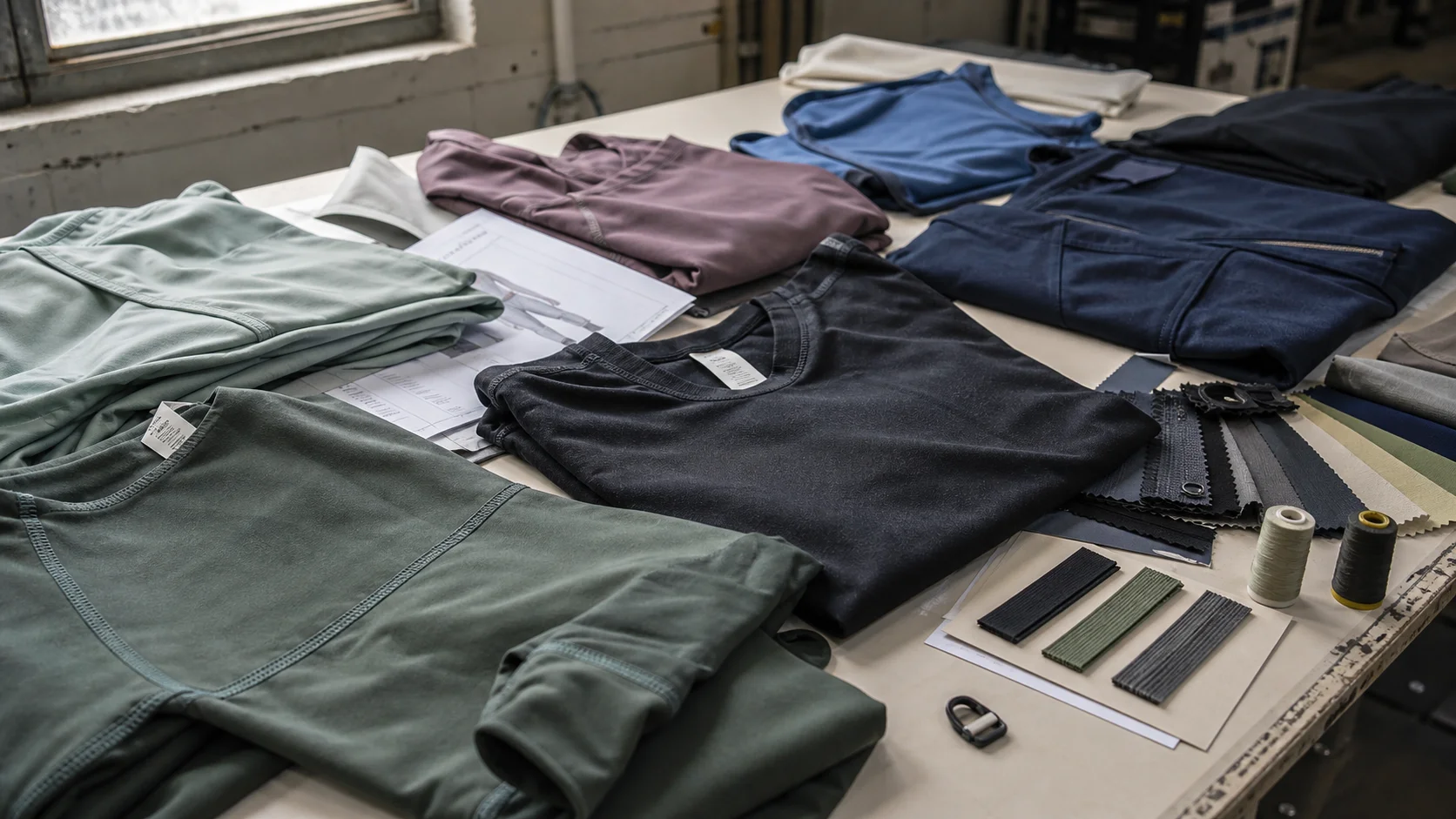
A cost-focused outline for startup brands planning OEM cut and sew activewear sets, covering fabric, trims, pattern work, sampling, MOQ, labor, packaging, and landed cost decisions.
OEM Activewear Sets Cost Planning for Startups - Fabrikn production reference
OEM activewear sets can look straightforward on paper: a sports bra, a pair of leggings, a fabric choice, a logo, and a target price. In production, the picture is more layered. For startup brands, the real challenge is not simply finding a supplier to make the product. It is understanding how cut and sew construction, MOQ, fabric selection, trim count, sampling revisions, and delivery timing shape the final cost.
That is why cost planning matters early. A startup that budgets only for an estimated unit price often runs into avoidable pressure later. Sample fees, pattern adjustments, fabric testing, carton requirements, labeling, and rework risk can move the landed cost well beyond the original target.
In the activewear category, this pressure is stronger because fit, stretch recovery, opacity, and seam performance all matter at the same time. A set that looks good on a tech pack can still fail in production if the fabric weight is too light, the elastane content is unstable, or the sewing line cannot maintain flatlock consistency across sizes.
This guide breaks down OEM activewear sets cut and sew cost for startup brands in practical terms. It covers what usually drives price, where MOQ affects negotiation, what sample stages need approval, and which sourcing shortcuts often create bigger costs later. Brands comparing suppliers can also review service details on /services/, company background on /about-us/, and direct inquiry options at /contact-us/.
Startup brands usually work with narrower capital, smaller order quantities, and less tolerance for inventory mistakes. That changes the sourcing logic. A large brand may accept a higher development bill because it can spread that cost across thousands of units. A startup often cannot.
At the same time, trying to reduce every up-front expense can backfire. Cutting corners on fabric validation or sample approvals may save a few hundred dollars and then create a full production problem. In activewear, one fabric issue can affect every size and every color in the order.
Cost planning should answer a few direct questions before sourcing moves too far:
Brands that do this work early usually negotiate from a clearer position. Brands that skip it often compare supplier quotes that are not built on the same assumptions. One quote may include custom dyeing, branded packaging, and size-set samples. Another may cover only basic sewing and plain polybag packing. The price gap then looks misleading.
Cut and sew activewear pricing is built from several layers, not one single rate. Fabric is usually the biggest cost driver, but not always the only one that matters. Construction complexity can push labor higher than expected, especially when the set includes shaped waistbands, removable bra pads, mesh panels, bonded seams, or multiple needle operations.
Most startup activewear sets use nylon-spandex or polyester-spandex blends. Common ranges include 75% nylon / 25% spandex, 78% polyester / 22% spandex, or similar performance knits. Fabric weights often sit between 220 and 320 GSM depending on compression, hand feel, and opacity target.
Lighter fabrics may reduce material cost, but they can also raise risk. Squat-proof performance, recovery, and coverage are harder to hold when the fabric is too light for a legging. A low quoted fabric price can become expensive if the final garment fails wear testing or customer expectations.
A basic legging with side seams and a simple high waistband is cheaper to cut and sew than a contour-seamed version with gusset shaping, hidden pocket construction, contrast panels, and coverstitch detailing. The same applies to bras. A simple racerback bra with elastic finishing is easier to manufacture than a style with molded cups, adjustable straps, hook closures, and layered power mesh.
Every added panel increases marker planning, cutting time, and sewing operations. Startups often underestimate how quickly those changes add cost.
Activewear trims can include elastic, drawcords, silicone logos, heat-transfer labels, woven size labels, cup inserts, strap adjusters, hooks, zipper units, and branded packaging. Each trim looks minor in isolation. Together, they can shift the unit cost materially.
Imported or custom-developed trims also add timing risk. If one trim is late, the sewing line can stall even when the fabric is ready.
Solid black is usually easier to plan than multiple seasonal tones, custom Pantone shades, or contrast set programs. Custom color matching may require lab dips and approval rounds. Small runs with many colors usually cost more because dye lots are less efficient and fabric utilization becomes less favorable.
Quantity remains one of the biggest cost levers. A supplier producing 100 to 200 sets per color has less room to absorb setup time, pattern grading, fabric sourcing inefficiency, and line changeover. At 500 to 1,000 sets per color, the costing base often improves. The exact change depends on style simplicity and fabric source.
For startup budgeting, it helps to separate unit cost into visible buckets. That makes supplier comparisons more useful.
Cost Component Typical Role in Total Cost Key Variables Fabric Usually the largest share Composition, GSM, knit structure, dyeing method, yield Cut and sew labor High impact for complex styles Panel count, seam type, machine operations, skill level Trims Moderate but often underestimated Elastic, cups, zippers, adjusters, logos, labels Sampling and development Front-loaded startup cost Pattern work, revisions, fit rounds, proto count Packaging Small per unit, meaningful in total Folding method, barcode stickers, cartons, inserts Inspection and quality control Protective cost, often worth including AQL level, measurement checks, inline and final reviewAs a broad market guide, startup OEM activewear sets can land in a wide FOB range depending on complexity. A basic bra-and-legging set using standard performance knit and straightforward construction may fall around the lower-middle range of the category. A more premium set with heavier compression fabric, removable cups, shaped seams, custom dyed colors, and branded trim can rise quickly.
Quoting by piece instead of by set often gives clearer visibility. The bra and the legging do not carry the same labor or material cost. Brands should ask for the breakdown.
MOQ is where many startup negotiations either become practical or fall apart. In OEM activewear, typical MOQs can range from about 100 to 300 pieces per style per color for simpler programs, while more specialized factories or custom fabric programs may ask for 300 to 600 pieces per color, sometimes more. Fabric mills can have their own minimums, which may sit above garment factory MOQs.
This matters because the garment supplier may be willing to sew a small run, but the fabric source may not support the same flexibility without surcharge. Small custom-dyed orders often carry a premium or require combining colors with stock fabric options.
There is no universal best MOQ. The right level depends on cash flow, forecast confidence, and the product’s role in the line. Core black leggings may justify deeper volume. Seasonal fashion shades usually should not, unless preorders or wholesale demand are already validated.
For startups, a slightly higher unit cost on a controlled first run is often a better decision than chasing the lowest factory quote tied to inventory levels that are hard to move.
Sample development is where startup cost planning often becomes unrealistic. Brands sometimes expect one sample to solve fit, fabric, color, and construction at once. In most OEM activewear programs, approval takes stages.
Each stage may involve separate fees, especially for startups ordering below a supplier’s preferred scale. Sample charges are not just revenue items for the supplier. They cover pattern making, cutting inefficiency, machine setup, fabric consumption, and technician time for a low-volume process.
A practical startup budget should allow for at least two to three rounds if the product is genuinely custom. Trying to compress everything into one round usually creates production risk later.
Those issues are not minor. They affect returns, reviews, and brand credibility. Spending carefully on sample approval is usually cheaper than dealing with bulk defects.
Lead time is often treated as a scheduling issue, but it also affects price. Standard development and production timing gives suppliers room to source material efficiently and plan line capacity. Rush timelines reduce that flexibility.
Typical lead times for OEM activewear sets may look like this:
These are only working ranges. Actual timing depends on order queue, holiday periods, raw material availability, testing needs, and whether the style uses stock fabric or a custom-developed base.
Startups should be cautious with launch calendars built on optimistic assumptions. If the brand needs custom colors, branded trims, and several fit revisions, the timeline should expand accordingly. Last-minute air shipment to protect a launch date can wipe out the margin that was negotiated on the FOB price.
Costing varies too widely for one exact number to be reliable, but scenario planning helps. The ranges below are directional and should be treated as budgeting references rather than universal market quotes.
Scenario Order Profile Cost Pressure Buying Judgment Entry basic set Simple bra and legging, stock fabric, limited colors, low trim count, MOQ around 100 to 200 sets per color Higher per-unit cost due to low volume, lower development complexity Useful for testing demand, but margin can be tight if retail pricing is too low Balanced startup set Moderate compression fabric, improved fit detailing, limited custom branding, MOQ around 200 to 300 sets per color More stable costing and better material options Often the most practical starting point for brands aiming at repeatability Premium custom set Custom color, heavy performance knit, removable cups, advanced seam work, branded trim, MOQ 300 plus High development and material burden Best reserved for brands with stronger pricing power or validated demandOne important point for startups: the cheapest set to produce is not always the cheapest product to operate. If the fit is weak, the fabric pills early, or the opacity is inconsistent, returns and discounting quickly erase the initial savings.
Cost control in activewear is mostly about disciplined simplification. The strongest gains usually come from reducing unnecessary variation, not from pushing a supplier for unrealistic prices.
There is a tradeoff in every one of these decisions. Reducing variation helps cost and speed, but it may also reduce perceived differentiation. For most startups, that is still the right trade in the first run. Product-market fit matters more than launching an overbuilt assortment.
A sensible first collection usually proves fit, fabric acceptance, and reorder logic. Brand storytelling can grow later once the supply base is stable.
Activewear carries several quality risks that should be addressed before bulk production. These are not theoretical. They are among the most common sources of claim disputes and rework.
Inspection should cover both workmanship and performance-related checkpoints. A final AQL inspection alone is useful, but it may be too late if a recurring seam issue started early in sewing. Inline inspection and measurement review are safer when the order carries tighter fit expectations.
For startups, a modest quality-control spend is usually justified. The cost of receiving unusable inventory is far worse than the cost of catching problems before shipment.
Supplier communication should get specific quickly. Generic answers create expensive misunderstandings later.
Clear answers to those questions usually reveal whether the supplier is quoting carefully or loosely. A low quote with vague scope is rarely a bargain.
OEM activewear sets cost planning for startups is less about finding a magic unit price and more about building a realistic sourcing model. Fabric choice, cut and sew complexity, MOQ, sampling rounds, trim development, and lead-time discipline all shape the final outcome.
For most startup brands, the better buying strategy is straightforward: simplify the first range, protect fit and fabric quality, budget properly for development, and avoid volume commitments that depend on perfect sell-through. That approach may not produce the lowest apparent unit cost, but it usually leads to a healthier launch and a more repeatable reorder path.
Brands that want to compare sourcing options or discuss OEM program structure can review services, learn more about the company, or send project details through the contact page.
Get a free quote from Fabrikn — your trusted B2B clothing manufacturer with 10+ years of experience. MOQ as low as 200 pieces.
Get a Free Quote →Typical MOQs often start around 100 to 300 pieces per style per color for simpler programs. Custom fabric, dyed-to-order colors, or more specialized construction can push the requirement to 300 to 600 pieces or higher. Fabric mill minimums may be the real limiting factor.
There is no single standard price because cost depends on fabric composition, GSM, construction complexity, trim package, and quantity. A basic set using stock fabric and limited branding costs less than a premium set with compression fabric, removable pads, custom colors, and advanced seam work. Startups should budget by scenario instead of relying on one market average.
Activewear samples often require technical pattern work, performance fabric handling, fit adjustments, and multiple approval rounds. The process is labor-intensive at low volume. Costs also increase when the style includes custom trims, cups, or color approvals.
Two to three rounds are common for a genuinely custom activewear set. More may be needed if fit is complex or if the brand is still refining measurements, support level, or fabric choice. Planning for only one round is usually too optimistic.
Composition, GSM, stretch and recovery, opacity under extension, colorfastness, pilling resistance, and hand feel are all important. For leggings especially, lightweight fabric that looks attractive in swatches may still underperform in wear.
Not necessarily. Lower MOQ can reduce inventory exposure, but it often raises unit cost and limits customization. It may also require using stock materials instead of custom-developed components. The best MOQ is the one that fits both demand risk and margin structure.
One common mistake is focusing only on the quoted unit price while underbudgeting sampling, quality control, packaging, and freight timing risk. Another is adding too many colors and design details to the first run before fit and demand are proven.