
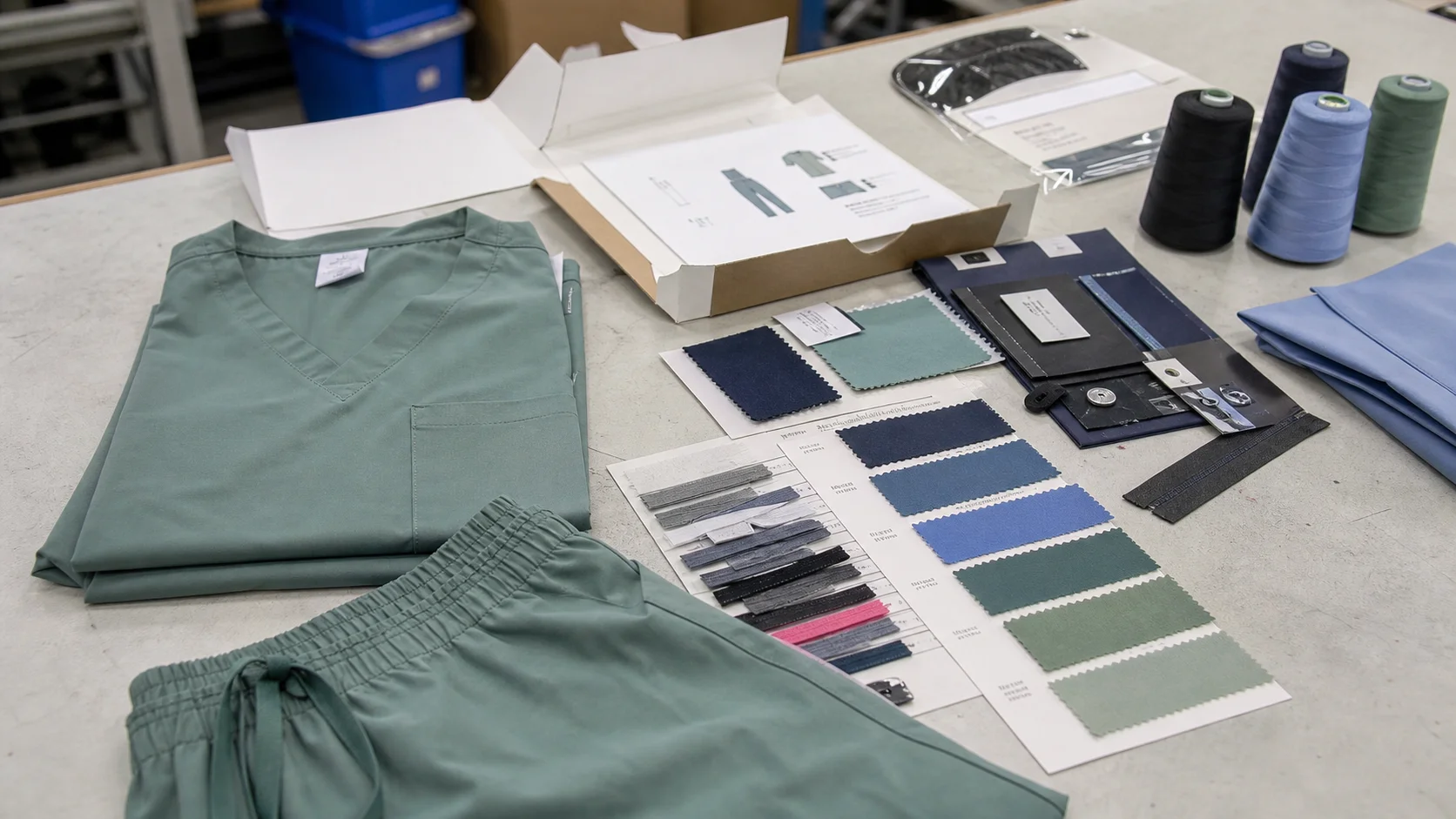
A focused outline for startup medicalwear brands evaluating OEM cut and sew scrubs, covering product development, fit, fabrication, labeling, and production details specific to scrub manufacturing.
OEM Cut and Sew Scrubs for Startup Brands - Fabrikn production reference
OEM cut and sew scrubs give startup medicalwear brands a way to build a product that looks and performs like a real brand collection, not a generic wholesale blank with a logo added at the end. For founders entering the healthcare apparel market, that distinction matters. Nurses, dental teams, aesthetic clinics, veterinary staff, and private practices all buy with practical expectations: comfort over long shifts, reliable sizing, functional pockets, easy care, and a professional appearance after repeated laundering.
That is why many emerging brands move quickly from stock programs to custom development. OEM manufacturing allows a startup to define fit, fabric composition, stitching details, trim selection, labeling, and decoration methods from the start. It also creates more complexity. Sampling costs rise, approval cycles lengthen, and mistakes in fabric or measurement specs can become expensive once bulk production begins.
For buyers sourcing oem scrubs cut and sew for startup medicalwear brands, the best results usually come from disciplined product development rather than aggressive cost cutting. A low opening price can look attractive, but if the supplier cannot control shrinkage, colorfastness, seam strength, or size consistency, the reorder problem arrives before the brand gains traction.
This guide breaks down how startup brands should approach OEM scrub development, what technical details deserve attention, and where decoration and printing fit into the process. If you are comparing factory capabilities, product development support, or private label programs, review service scope early and verify how the supplier handles patterning, sourcing, samples, and production management. A useful starting point is the manufacturer’s services page, followed by direct discussions through contact channels once your target product brief is ready.
Startup brands usually choose OEM scrub manufacturing for one of three reasons. First, they want product differentiation. Second, they need better control over quality and fit. Third, they want a foundation for scaling beyond a single logoed set.
Medicalwear may look simple from the outside, but customers notice small functional differences very quickly. A scrub top that pulls across the shoulders, a jogger cuff that twists after wash, or a pocket opening that gapes during wear can damage a new brand faster than a delayed shipment. OEM cut and sew gives more control over those details than buying pre-made stock garments.
Common advantages include:
The tradeoff is straightforward: more customization means more development work. A startup that wants five colors, four silhouettes, inclusive sizing, and multiple logo placements in its first order will usually face higher MOQs and a slower launch. A tighter, smarter opening range often performs better.
In practical sourcing terms, OEM cut and sew means the garments are produced from raw fabric and components to the buyer’s agreed specification. The supplier does not simply decorate an existing blank. The product is patterned, cut, sewn, finished, labeled, and packed as a custom item.
For scrubs, that process often includes:
Some suppliers also support decoration under the same production flow. That matters because logo placement, embroidery backing, print curing temperature, and panel distortion all affect final quality. Scrubs made in stretch woven or knit performance fabrics need decoration methods that do not damage elasticity or create uncomfortable stiffness.
A startup brand should always ask where responsibility sits for each stage. One manufacturer may manage fabric, cut and sew, and decoration in-house or through controlled partners. Another may outsource several stages. Neither model is automatically wrong, but fragmented production increases the risk of color mismatch, trim delays, and inconsistent quality accountability.
A first collection should be commercial before it tries to be expansive. Many startup founders overbuild their line because they are thinking like a brand presentation team rather than a purchasing manager. Scrubs are a repeat-purchase category. A tight, wearable opening assortment beats a broad range that is difficult to restock.
A sensible starting structure often includes:
This kind of range is easier to sample, easier to fit, and easier to reorder. It also helps the factory allocate production quantities efficiently. If the first order spreads too thinly across many colors and sizes, each SKU can fall below practical cut and sew efficiency.
Startups should prepare a development brief that covers:
A manufacturer can guide details more effectively when the commercial target is clear. If your brand needs a premium drapey scrub set for medspa staff, the fabric and finishing direction will differ from a value-focused hospital basics line. Clear briefs reduce sampling rounds, which saves both time and money.
Fabric choice drives most of the wearing experience in scrubs. It also drives a large share of cost, performance risk, and decoration compatibility. Startup buyers should not select material based only on touch in a showroom swatch. The real question is how the fabric behaves after washing, stretching, pressing, and logo application.
Common scrub fabric constructions include:
Typical specification points worth confirming include fabric weight, composition tolerance, stretch percentage, recovery, pilling resistance, opacity, shrinkage limits, and colorfastness to washing and rubbing. For many scrub programs, buyers review weights around 150 to 220 GSM depending on construction and market position. Lighter fabrics can feel cooler but may become too transparent in light colors. Heavier fabrics can improve opacity and structure but may feel warm in long shifts.
Trim selection deserves the same discipline. Waist elastics, drawcords, zipper tape, bartack thread, labels, and snap finishes are easy to overlook. They are also frequent failure points. Cheap elastic loses recovery. Weak bartacks break at pocket stress points. Rough label edges irritate the wearer. Decorative trims that look good in presentation photos can interfere with industrial wash durability or everyday comfort.
Founders should ask for trim specifications in writing, not just photos. If the product includes an elastic waistband, request width, composition, stretch behavior, and attachment method. If the scrub top includes side vents, confirm reinforcement details. If joggers include cuff rib, check colorfastness and recovery after wash.
Background information about the supplier’s approach and production process can often be found on an about us page, but technical confirmation should still happen in the quote and sample approval stage.
Because this topic sits in Decoration & Printing, it is worth being direct: decoration should support the medicalwear product, not dominate it. Scrubs are function-first garments. Branding must survive frequent laundering, maintain wearer comfort, and suit the fabric construction.
The most common decoration options for OEM scrubs include:
Embroidery is often the safest choice for professional medical branding, especially for left chest logos. It delivers a familiar uniform look and generally holds up well. The tradeoff is that dense embroidery can pucker lightweight fabric or feel stiff against the body unless backing and placement are well controlled. Stretch fabrics need extra attention because logo stitching can restrict fabric movement.
Screen printing works best when the design is simple and the end use is less formal, such as event scrubs, promotional sets, or support apparel associated with a healthcare brand. Large prints on workwear scrubs are less common because repeated washing can affect hand feel and appearance, and many buyers prefer a cleaner uniform aesthetic.
Heat transfer branding has become more relevant for modern athleisure-inspired scrubs. It can create a sleek logo with low bulk, but transfer quality varies widely. Poor-grade transfers may crack, peel, or discolor during laundering if the pressing conditions or substrate compatibility are wrong. Startup brands should test wash durability before approving bulk.
Decoration planning should cover:
If the design includes chest pockets, princess seams, or stretch side panels, decoration placement may need adjustment. A logo that looks centered on paper can sit awkwardly on a worn garment. This is why decorated fit samples are useful before bulk approval.
Sampling is where startup brands either gain control or lose it. A factory can produce a neat first prototype and still fail in bulk if the approval chain is vague. For OEM cut and sew scrubs, startups should expect at least three major checkpoints.
This sample tests construction, interpretation of the design, and basic material direction. The fabric may be substitute quality if final sourcing is not complete. At this stage, the goal is to identify obvious problems in shape, pocket placement, stitching methods, and general styling.
This is the stage where measurements matter. A startup should review shoulder width, bust or chest ease, hip ease, rise, thigh room, sleeve opening, cuff behavior, inseam, and top length. Scrubs need mobility. A garment that measures correctly on paper can still fail in movement if the balance is wrong.
The PPS should reflect bulk fabric, bulk trims, approved branding, labels, and intended finishing. This is the sample closest to production reality. If the PPS differs materially from what will be made in bulk, approval is not meaningful.
Useful sample approval practices include:
Many production delays come from weak approvals rather than factory sewing speed. When comments are scattered across email threads or sent verbally, errors multiply. A clean approval trail is one of the cheapest ways to protect a startup order.
MOQ is one of the first questions startup founders ask, and it should be. Yet MOQ only becomes meaningful when tied to style count, color count, size breakdown, fabric type, and decoration method.
For OEM cut and sew scrubs, typical MOQ ranges often fall into these broad patterns:
Program Type Typical MOQ Range Notes Basic custom style using stock fabric 100-300 pieces per style/color More feasible for startups if trims remain simple Custom dyed fabric program 300-800 pieces per color Dye lots and fabric mill minimums often drive the threshold Multi-style premium launch with several trims 500+ total pieces, sometimes higher per style Depends heavily on sourcing complexityThese are not fixed industry rules. They are practical sourcing ranges that shift with the supplier’s setup and the product brief. A startup can often reduce MOQ pressure by using stock fabric colors, limiting trim variation, and launching fewer silhouettes.
Lead time also varies by development maturity. A rough but realistic breakdown may look like this:
Lead time stretches when fabric must be custom developed, logos need strike-offs, trims are imported, or approvals are delayed. Startups should be cautious with launch calendars that assume best-case timing. The practical approach is to build margin into the schedule rather than treating every estimate as a guarantee.
Cost tradeoffs are equally important. Some decisions reduce unit price while raising quality risk. Others increase product value more than they increase cost. For example, simplifying a pocket construction may be sensible. Downgrading fabric opacity in white or light colors usually is not. Saving a few cents on elastic or logo application can create returns that cost far more later.
Scrubs live through repeated use and repeated washing. That makes quality control less about showroom appearance and more about consistency under wear. Startup buyers should pay close attention to the failure points that commonly affect medicalwear.
High-risk areas include:
Inspection should not wait until final random checks. The best control points start earlier:
If the startup lacks internal quality staff, it should still ask the supplier how inspection is handled and what reports are available. A buyer does not need to overcomplicate a first order, but it does need to know whether the factory checks seam strength, measurement tolerance, labeling accuracy, and decoration placement consistently.
Practical purchasing judgment: if a supplier is eager to discuss price but vague about shrinkage, fabric testing, or sample revision records, that is usually a warning sign. Scrubs are a repeat business category. Reliability matters more than the lowest opening quote.
The right supplier for a startup is not always the largest or the cheapest. It is the one that can support the brand’s actual stage of development. A startup needs a manufacturing partner that understands smaller-volume customization without treating the project like an afterthought.
Key evaluation points include:
A serious supplier should be able to explain what is realistic for your quantity level. If your order volume is too low for custom dyeing, a good manufacturer will say so and suggest stock color options. If your tech pack leaves out important construction details, the supplier should identify the gaps before production starts. That kind of communication saves money even when it slows the front end slightly.
Buyers should also test responsiveness early. The sampling stage often predicts the production stage. If comments are missed, measurements are not tracked, or decoration placements keep changing without written confirmation, the risk in bulk rises.
For most startup medicalwear labels, the smartest launch path is disciplined rather than dramatic. Begin with a focused SKU count, use a commercially safe fabric, and build a fit block that can be repeated. Once customer feedback confirms sizing and comfort, the brand can add seasonal colors, specialty fits, or higher-end details.
A practical first-launch roadmap often looks like this:
This approach protects cash flow and reduces operational stress. It also gives the startup clearer sales data. Once reorders begin, the buyer can introduce additional fits, maternity options, petite lengths, or coordinated jackets based on evidence rather than guesswork.
In the end, oem scrubs cut and sew for startup medicalwear brands is not just about making a garment. It is about building a product system that can be repeated with consistent quality. Startups that treat sampling, fabric approval, decoration testing, and MOQ planning seriously are much better positioned to create a credible medicalwear brand in a crowded market.
If you are evaluating next steps, begin by aligning your design brief, target price, and quantity expectations with a manufacturer that can explain the tradeoffs clearly. That is usually the fastest way to move from concept to a sellable scrub collection without avoidable development mistakes.
Get a free quote from Fabrikn — your trusted B2B clothing manufacturer with 10+ years of experience. MOQ as low as 200 pieces.
Get a Free Quote →It means the scrubs are produced as a custom garment from fabric and trims to your specification, rather than taking a ready-made blank and only adding a logo. This usually includes pattern development, material sourcing, sewing, labeling, and finishing.
Many startup programs begin around 100 to 300 pieces per style and color when using simpler constructions and stock fabric options. Custom dyed fabrics, multiple trims, or more complex styles often raise the MOQ. Exact thresholds depend on the supplier and product brief.
Sampling and revisions commonly take several weeks, and bulk production can take another four to ten weeks or more depending on fabric sourcing, trim readiness, and approval speed. Startups should allow extra margin for fit corrections and decoration testing.
Embroidery is often the most common choice for professional branding because it looks clean and durable. Heat transfer can work well for modern stretch scrubs if wash performance is tested carefully. Large graphic printing is less common for core uniform programs.
There is no single best blend for every brand. Polyester-rich blends often help with durability and easy care, while rayon and spandex can improve softness, drape, and stretch. The right choice depends on target price, desired hand feel, opacity, and laundering performance.
At minimum, approve the measurement spec, fabric, trims, color, decoration placement, labels, packaging method, and a pre-production sample that reflects bulk intent. Skipping these approvals increases the risk of preventable mistakes in production.
Common causes include unclear tech packs, too many launch SKUs, weak fit review, untested decoration methods, inconsistent fabric quality, and poor communication during revisions. Most early problems are preventable with tighter development controls.