
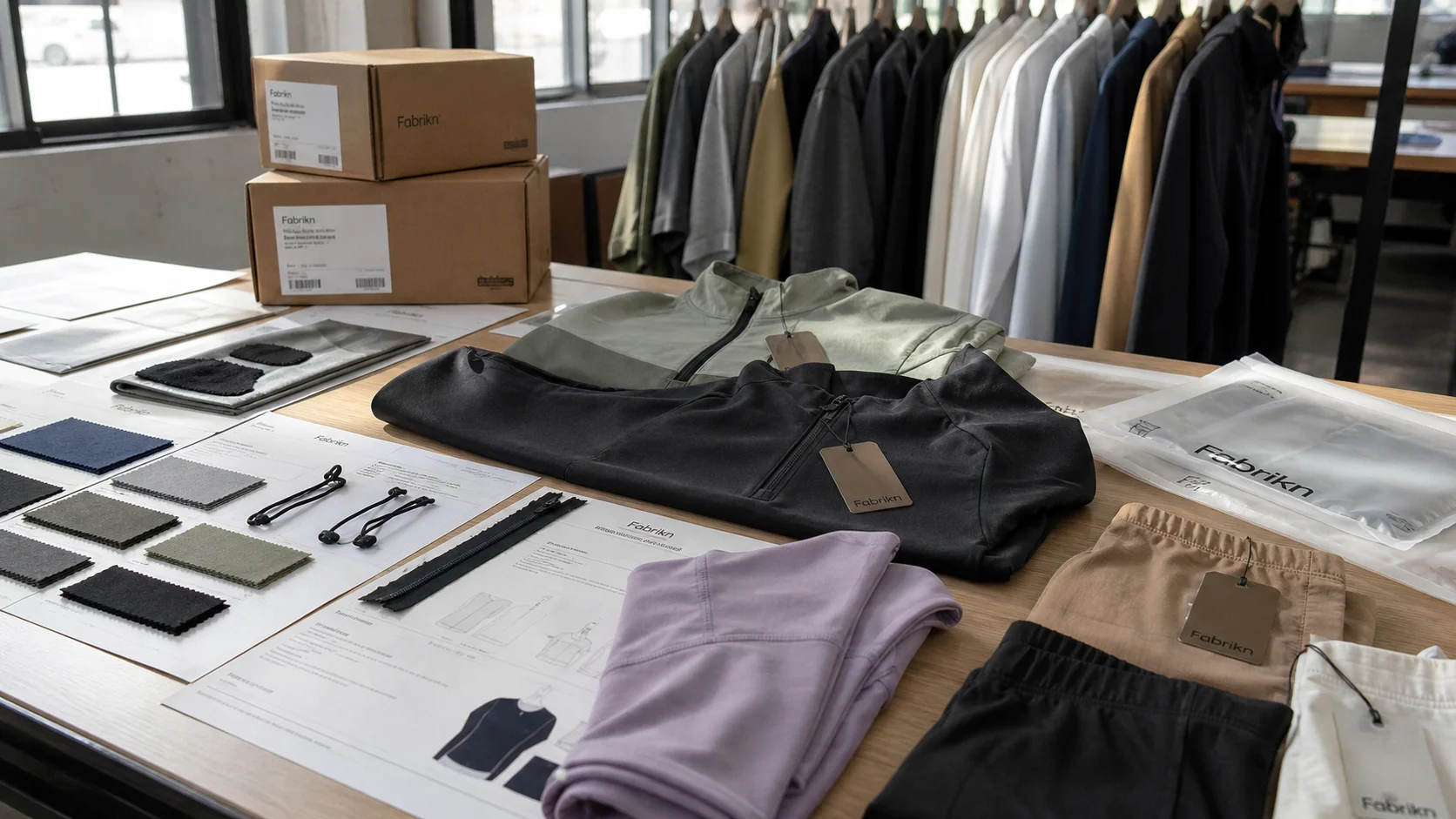
A focused outline for academy sportswear distributors evaluating custom tracksuits with fabric testing, covering material specs, lab checks, decoration compatibility, fit consistency, and bulk-order decision points.
Buy Custom Tracksuits With Fabric Testing - Fabrikn production reference
For academy sportswear distributors, custom tracksuits are not a basic commodity purchase. They sit in a category where fit consistency, fabric durability, wash performance, and branding precision all affect reorder potential. A tracksuit that looks sharp in the first shipment but pills quickly, loses color, or fails seam performance after repeated training use creates avoidable claims and weakens distributor margins.
That is why fabric testing should be treated as part of the buying process, not an optional add-on. When distributors buy custom tracksuits with fabric testing, they reduce risk before bulk production starts. This matters even more in academy sportswear, where garments often face repeated laundering, turf abrasion, team customization, and mixed end-use conditions across training, travel, and light competition.
Private label buyers usually need more than a supplier that can cut and sew. They need a manufacturing partner that can interpret a tech pack, align fabric performance with the target price, and control quality through sampling, lab review, and inline checks. A low price without testing discipline often becomes expensive later through returns, delayed launches, or inconsistent repeat orders.
Distributors building a stable academy range should focus on three linked decisions: fabric composition, test standards, and production control. Those three factors determine whether a custom tracksuit program will scale cleanly across seasons and replenishment cycles.
If you are sourcing under a private label model, it helps to review the broader manufacturing scope before placing development orders. Fabrikn outlines its production support on /services/, which is a useful starting point for understanding supplier-side capabilities in apparel development and manufacturing coordination.
Many quality issues begin long before bulk cutting. They start with incomplete buyer specifications. Academy sportswear distributors sometimes approve a sample on appearance alone, then discover later that the bulk fabric weight, handfeel, or shrinkage is not consistent with the original expectation. The fix is simple in principle: specify more clearly at the start.
A workable custom tracksuit specification should cover both style and performance. That includes:
The most practical buyers also define acceptable tolerances. A distributor may accept a small GSM variation on a budget line but require stricter colorfastness and seam strength on a premium academy collection. That kind of tradeoff is normal. What matters is deciding it before production, not after goods are packed.
Purchasing teams should also confirm whether the tracksuit will be decorated after import or fully branded at source. This affects fabric testing because some materials perform well in garment form but react differently once heat transfer logos, names, and numbers are applied. If post-decoration is part of the sales model, ask for heat application compatibility to be checked during development.
Custom tracksuits for academy channels are usually built in synthetic knit constructions because distributors need durability, easy care, and repeatability. Cotton-rich options have a place in lifestyle programs, but they are less common for academy training use where wash frequency and color retention matter more than a soft natural handfeel.
Polyester tricot remains a standard choice for teamwear-style tracksuits. It offers a smooth face, decent stability, and a familiar athletic look. It is usually cost-efficient at scale and works well for basic training sets. The tradeoff is that low-grade tricot can snag, shine too much, or feel overly light if the GSM is pushed down for price reasons.
Interlock fabrics are often chosen for a cleaner surface and slightly more premium handfeel. They can support heat transfer branding well and tend to present a neater appearance for academy travel wear. Cost is often a little higher than entry-level tricot, especially when fabric weight increases or stretch content is added.
Polyester-spandex blends are common when buyers want better mobility, closer athletic fit, or a more modern silhouette. These fabrics can improve comfort, but they need closer testing for recovery, shade consistency, and seam performance. Spandex-rich constructions can also complicate lead times if the mill base is not readily available.
For cooler climates or winter academy programs, brushed back knits can provide warmth and a more substantial feel. The risk here is pilling, especially on lower-grade brushed interiors. If a buyer wants a fleece-like handfeel at a tight price, pilling performance should be checked early because that is often where the quality gap appears first.
Some distributors now request woven panels with knit bodies for a more technical look. These styles can look strong at retail, but they are harder to control in production. Mixed-fabric programs require extra attention to shade matching, panel distortion, seam puckering, and differential shrinkage after wash testing.
Fabric testing is only useful when it matches the product’s real use case. Academy sportswear distributors do not need to overpay for unnecessary lab work on every program, but they do need to cover the failure points most likely to generate complaints.
Tracksuits are often exposed to frequent washing, sweat, and friction. Colorfastness to washing, rubbing, and perspiration is a practical baseline. Dark shades such as navy, black, bottle green, and red need close attention because inconsistent dyeing can show up in crocking or shade instability. If your program includes white contrast panels or stripes, this test becomes even more important.
Knit garments can shift after washing, even when shrinkage is modest. A tracksuit that twists at the leg seam or shortens beyond tolerance creates fitting complaints that distributors must absorb. Dimensional stability testing should be tied to the declared wash method, not a generic standard unrelated to how the garment will actually be used.
Pilling is one of the most common appearance failures in sportswear. It does not always make a garment unusable, but it quickly makes it look low value. Brushed fabrics, lower-twist yarns, and some recycled polyester blends can be more vulnerable. Buyers pushing for soft handfeel and low cost at the same time should expect a tradeoff here unless fabric quality is controlled carefully.
Training wear takes stress at the crotch, armhole, pocket join, and zipper area. Seam strength testing helps confirm that stitch density, thread choice, and fabric behavior are aligned. In lighter knits, seam slippage or popped stitches can appear even when the outer appearance is acceptable at first glance.
Knit structures often benefit from bursting strength evaluation, especially for activewear use. This matters when distributors want slim fits or stretch fabrics for youth and adult academy lines. A neat sample can still fail under tension if the fabric spec has been downgraded in bulk sourcing.
Not every academy tracksuit needs high-performance moisture management claims. Still, if the product is marketed as technical training apparel, the fabric should support that promise. Buyers should be cautious with broad performance claims unless test results are available. Overselling performance creates more risk than commercial upside.
This is often overlooked. A fabric may pass several technical points and still look poor after laundering due to spirality, bubbling around bonded trims, or wrinkling at panel joins. A simple wash-and-review stage during sample approval can catch issues that a lab report alone may not reveal.
Practical purchasing judgment: the right test package depends on price point, end use, and claim level. Budget academy programs still need colorfastness, shrinkage, and seam security. Premium programs should add stronger pilling control, appearance retention checks, and closer trim validation.
For academy sportswear distributors, the safest buying process is staged. Rushing straight from concept image to bulk PO usually leads to avoidable corrections. A structured development path gives the supplier and buyer a chance to align the garment visually and technically.
Start with a complete tech pack if possible. This should include sketches, measurements, logo placements, fabric direction, trim notes, labeling requirements, packaging details, and target price guidance. If the buyer does not have a full tech pack, then a measurement chart, reference sample, and branding layout become even more important.
At this stage, the supplier proposes fabric options and submits color references or lab dips where required. Buyers should review not just shade but also weight, stretch, handfeel, and surface appearance. A close color match on the wrong base fabric still leads to a bad bulk result.
The first sample checks silhouette, panel layout, zipper line, cuff finish, waistband construction, and overall style balance. This sample does not always use final trims, so buyers should record open points clearly rather than approving loosely.
For academy distribution, fit discipline matters because garments may be sold across youth and adult size brackets. Review size grading carefully. A supplier that can make one clean medium sample is not automatically strong at maintaining shape across a full size run.
This is the main approval gate. The pre-production sample should reflect the intended bulk fabric, colors, trims, logos, labels, and packaging method. If fabric testing is being used properly, results should be reviewed at or before this point. Approving bulk before these details are locked is a purchasing mistake.
Once bulk begins, buyers should not rely only on final inspection. Inline checks matter because issues such as shade variation, logo placement drift, or zipper inconsistency are cheaper to correct during production than after packing.
Final inspection should confirm measurements, workmanship, assortment, packing accuracy, and carton marking. If the tracksuits are sold as sets, top and bottom pairing accuracy must also be checked. Mismatched sets are a common operational failure in teamwear-style orders.
Distributors that are comparing suppliers often benefit from understanding the company background and operating model before entering development. Fabrikn provides an overview on /about-us/, which can help buyers assess fit before requesting quotations and samples.
MOQ and lead time decisions shape the commercial viability of a tracksuit program as much as the garment design does. Academy distributors often need a balance between stock depth and style variety. Ordering too deep creates inventory pressure. Ordering too shallow can push unit cost too high.
For custom private label tracksuits, a typical MOQ often starts around 100 to 300 sets per colorway for simpler constructions, though this varies by fabric availability, printing complexity, and trim customization. More specialized fabrics, custom zipper pulls, woven badges, or mixed-panel designs may push practical MOQs higher. Buyers asking for very low MOQs should expect compromises in either price, fabric choice, or branding flexibility.
If a distributor is testing a new academy line, a sensible approach is to simplify the first order. Use stocked or mill-friendly fabrics, keep trim variation controlled, and limit color combinations. This lowers development friction and makes testing more meaningful because fewer variables are moving at once.
Sample lead times often depend on fabric sourcing, logo method, and whether custom colors are needed. Bulk lead times then depend on sample approval speed, raw material booking, cutting capacity, print or embroidery scheduling, and inspection timing. A buyer may hear a nominal lead time of 45 to 60 days, but that number only holds when approvals are fast and inputs are finalized early.
Custom dyed fabrics, branded zippers, silicone patches, or multiple print applications usually extend the schedule. Peak season congestion can do the same. Distributors planning back-to-school or seasonal academy launches should build a buffer into the calendar instead of buying to the latest possible date.
There is no single best fabric for every program. A lower-cost polyester tricot may be commercially correct for entry-level academy distribution if the quality is stable and the test standards are realistic. A more expensive interlock or stretch knit may be justified when the distributor is targeting a premium school, club, or reseller channel.
The key tradeoff is not just fabric price. It is total claim risk. Saving a small amount on fabric while increasing the chance of pilling, color migration, or seam returns is rarely good buying. In private label apparel, the hidden cost of inconsistent quality usually exceeds the visible cost of a better-controlled fabric base.
Private label academy tracksuits are often differentiated less by silhouette than by execution. Branding details, trim quality, and retail presentation all influence how the program is perceived by schools, clubs, and resellers.
Distributors should choose branding based on the garment’s intended position. A premium travel tracksuit can justify cleaner finishes and better trim detailing. A budget training set may perform better commercially with simpler logos and fewer variables.
Zippers are a frequent complaint point. Cheap zipper tape, inconsistent teeth, or weak pullers can damage perceived quality fast. Waistband elastic, drawcord tips, cuff recovery, and pocket bag construction also deserve attention. These are small components, but they affect wear life directly.
Buyers should request trim references in the sample stage and keep them locked for production approval. Trim substitution in bulk is a known risk when specifications are vague or when price pressure becomes too aggressive late in negotiation.
Academy distributors often need size stickers, barcode labels, ratio packing, or individual polybag presentation depending on whether the product goes to stores, teams, or e-commerce fulfillment. Packaging should be specified before production, not after finishing. Last-minute packing changes create mistakes, delays, and repacking cost.
Custom tracksuit production is straightforward only when the controls are disciplined. In practice, the most common failures are not dramatic technical breakdowns. They are repetitive execution issues that slip through because approval checkpoints were too loose.
For academy sportswear distributors, the most useful inspection points are usually:
A practical buying approach is to focus inspection on the points most likely to create claims at resale. For tracksuits, that usually means size consistency, fabric appearance retention, branding durability, and set matching accuracy.
Not every apparel manufacturer is the right fit for academy sportswear distribution. Some are strong in fashion-led cut-and-sew but weak in repeat sportswear quality. Others can handle production volume but struggle with private label detail and communication discipline.
Distributors should assess suppliers on a few grounded criteria:
A supplier that promises everything too quickly is not always the safer option. In this category, cautious technical alignment is often a better sign than fast verbal reassurance. Buyers should prefer suppliers that identify risks early, explain tradeoffs clearly, and tie pricing to actual specification choices.
When moving toward a custom tracksuit development program, it is sensible to discuss your target specs, branding method, order volume, and testing expectations early in the process. Buyers can start that discussion through /contact-us/ to clarify feasibility before committing to full development.
For academy sportswear distributors, buying custom tracksuits with fabric testing is a commercial control measure, not a luxury. It helps protect size consistency, color performance, garment durability, and repeat-order confidence. In private label apparel, that directly affects margin protection and brand credibility.
The strongest sourcing decisions usually come from balanced judgment rather than chasing the cheapest quote or the most ambitious performance claim. A well-built tracksuit program starts with the right fabric, clear specifications, appropriate testing, and disciplined approval steps. Once those parts are in place, distributors are in a much better position to scale an academy range with fewer claims and more reliable replenishment.
If the goal is long-term distribution rather than one-off buying, fabric testing should be built into the sourcing routine from the start. That is the practical path to a tracksuit program that sells well, wears well, and reorders cleanly.
Get a free quote from Fabrikn — your trusted B2B clothing manufacturer with 10+ years of experience. MOQ as low as 200 pieces.
Get a Free Quote →There is no single best option for every distributor. Polyester tricot is common for cost-efficient training sets, while interlock or polyester-spandex blends can suit more premium programs. The correct choice depends on target price, fit direction, climate, and expected wash performance.
Fabric testing helps reduce risks such as color loss, shrinkage, pilling, seam failure, and poor appearance after washing. For academy sportswear distributors, these are the issues most likely to create returns or damage repeat business.
Typical checks include colorfastness, shrinkage or dimensional stability, pilling resistance, seam strength, and general appearance after washing. More technical programs may also require moisture management or additional performance testing depending on the sales claim.
Many programs start around 100 to 300 sets per colorway for relatively standard constructions. The actual MOQ can increase when fabrics are custom dyed, trims are highly specialized, or branding details are more complex.
Lead time depends on sampling speed, fabric availability, custom trim development, approval timing, and production capacity. Buyers often plan several weeks for development and a further bulk production window that can vary based on season and order complexity.
Yes, but the testing scope may need to be selective to stay commercially reasonable. Even at lower volumes, core checks such as colorfastness, shrinkage, and seam performance are often worth including because they address the most common claim risks.
One of the most common mistakes is approving a sample based only on appearance without locking the final fabric, trims, and test expectations. That approach often leads to mismatch between the approved sample and the delivered bulk order.