
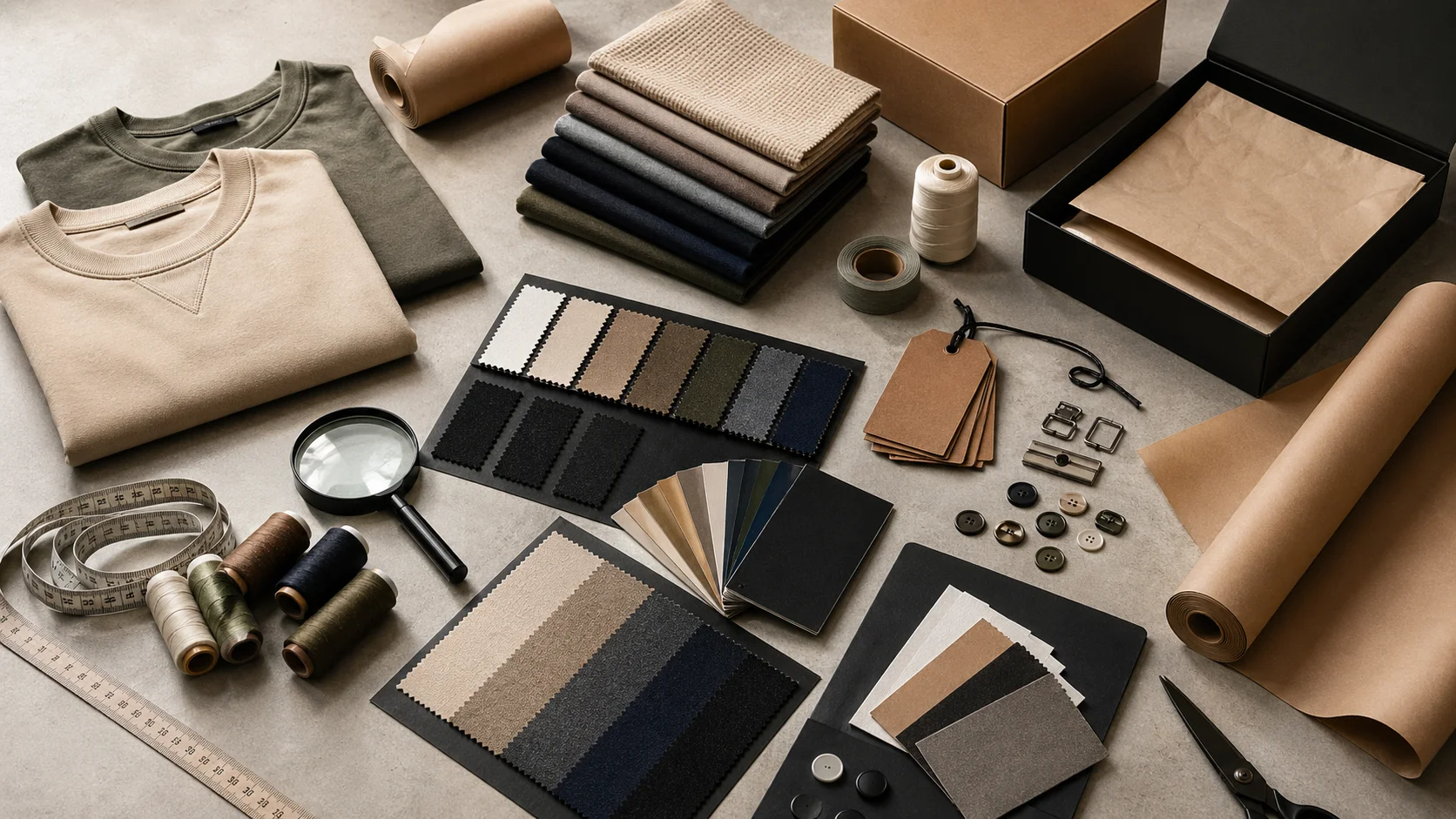
Plastic Free Packaging for Clothing Shipments with checks for samples, fit, MOQ, QC evidence, pricing terms, and delivery risk.
Fast answer: Plastic Free Packaging for Clothing Shipments: Costs, Choices should be judged by production evidence, not by a generic sourcing promise. The buyer needs sample proof, cost breakdowns, QC checkpoints, and delivery buffers in writing.
Ask for recent sample photos, measurement tolerances, fabric or print test assumptions, decoration test notes, packing examples, and a named inspection checkpoint. These details show whether the team can repeat an approved sample at bulk volume.
Separate garment cost, decoration, labels, packaging, sampling, testing, freight, and rush charges. When every cost line is visible, it becomes easier to reduce colorways, adjust size depth, or reserve more time for sampling.
Packaging can change a packing line in the time it takes to make a cup of tea. Polybags disappear, paper mailers appear, tape use shifts, and the whole rhythm of the room changes. plastic free packaging for clothing shipments is never just a material swap; it changes labor, carton fill, and damage risk at the same time. In factories I visited in Vietnam, Turkey, and North Carolina, the first shock was speed. Workers packed 8 to 12 percent slower during week one, then got most of it back after 3 to 4 training shifts. The second shock was waste. Not less, always. Sometimes more.
A tidy unboxing video can hide a weak shipment. I’ve seen premium tees in 120 gsm kraft mailers arrive flat and perfect, while heavyweight hoodies in oversized boxes came back crushed because the brand chose presentation over fit. Paper systems that add 40 to 60 grams of void fill per order can raise carton weight by 9 to 14 percent and push parcel rates up on air routes. In one facility shipping 15,000 units a month, carton utilization fell from 88 percent to 74 percent after the team removed polybags but never resized the box.
Moisture, pressure, abrasion. That’s the trio that matters. Retail-ready and transit-ready are different things. A folded oxford shirt can survive a 2-meter drop test in a snug corrugated mailer. A brushed fleece crewneck can scuff at the seam if recycled tissue shifts in a 48-hour humid lane. According to ISO, package testing covers the full distribution cycle, not shelf appearance. Many sustainability claims fall apart right there.
Paper-based systems can create more total waste if they are overbuilt. Brands add double-walled boxes, thick inserts, and oversized kraft mailers to calm nerves. The result: 18 percent more packaging mass than the original plastic-based packout, plus higher freight charges and more warehouse handling. A brand paying $0.22 for a polybag sometimes replaces it with $0.48 in paper components and $0.06 in extra labor. That is not progress. It is expensive theater.
When I visited a denim factory in Portugal, the team showed me returns data from 90 days before and after a packaging change. Damage-related returns stayed flat at 0.8 percent, but customer complaints about “cheap” presentation rose by 31 percent because the brand had removed every interior layer. Measured design beats moral certainty. plastic free packaging for clothing shipments should be judged by breakage, moisture exposure, and pack density, not by whether the opening video looks elegant. For broader clothing packaging solutions, the right answer depends on the SKU, the route, and the warehouse, not the mood board.
The market is crowded with good intentions and mediocre substrates. In real shipments, the winners are the materials that tolerate folding, stack pressure, and rough handling without demanding a rescue team in the warehouse. I’ve seen paper mailers fail on rainy lanes and corrugated boxes outperform them by a wide margin on cross-border routes. Textile wraps can work beautifully for limited drops of 200 to 500 pieces, then become a labor problem at 5,000 units.
Molded fiber and molded paper inserts do well for accessories, socks, and small folded sets. Kraft mailers in 80 to 120 gsm are fine for tees, light knits, and flat-packed tops under 500 grams, especially in dry domestic shipping. Corrugate still wins for denim, outerwear, and bundled multi-item orders because it absorbs compression better; a 32 ECT box often survives better than a heavier-looking paper envelope. Recycled tissue and fiber-based tape help presentation without adding much weight. Plant-based labels can work, but only if the adhesive holds across 5 to 7 days in transit and the print stays legible after scuffing.
I’ve seen textile wraps succeed in Japan and Italy, where premium packaging labor is cheaper relative to unit price and shipment volumes are predictable. I’ve also seen them become a bottleneck in Bangladesh, where a line producing 8,000 units a day cannot afford 30 extra seconds per pack. For brands with private label clothing services, the packaging format should match the production cadence, not the campaign calendar. If you are also running private label clothing services, packaging choices need to be locked before sampling, not after sales forecasts are approved.
Compostable claims help only when the end-of-life system exists. A mailer certified for industrial composting means little if the destination country has no collection network. Data from WRAP and other recovery groups shows that real-world capture depends on local infrastructure, not printed language. That’s why I treat compostable films and paper-poly hybrids with caution. They may be acceptable for short domestic routes, but they do not solve the waste problem if consumers cannot sort them correctly.
For tees, use kraft mailers or light corrugate. For denim, choose stronger corrugate with fiber tape and a snug fold. For knitwear, test abrasion against uncoated tissue and check pilling after 10 simulated rub cycles. For outerwear, use a box with corner protection and a breathable inner wrap. For accessories, molded paper trays prevent movement better than loose fill. A brand running custom baby clothing manufacturing should be especially careful here; babywear is often low weight but high presentation sensitivity, and parents notice damaged corners immediately.
The cheapest-looking packout is often the most expensive one after freight, labor, and returns are counted. I’ve built cost sheets for brands shipping 3,000 units a month and for others moving 300,000. The numbers change fast. A conventional polybag plus folded insert can cost $0.12 to $0.28 per unit. A plastic free system with kraft mailer, fiber tape, tissue, and label can land at $0.26 to $0.62. That gap looks large until you include freight and damage. On a 100,000-unit program, a 15-gram weight increase adds roughly 1.5 metric tons of freight, which can mean $600 to $2,400 more depending on route and mode.
Low-volume brands feel the unit price first. Boutique orders of 500 to 2,000 units often pay $0.18 to $0.40 more per shipment because minimums are smaller and print setup is spread over fewer pieces. Mid-size brands shipping 10,000 to 50,000 units can compress that premium to $0.08 to $0.16. High-volume retail programs may get paper mailers below $0.20 if they source locally and standardize sizes. Labor matters too. A 7-second increase in pack time becomes serious at 20,000 units a week. That is almost 39 labor hours saved or lost every week.
Freight costs are route-specific. A heavier box hurts more on air freight from Asia to the US than on inland trucking in Germany. A bulkier box also reduces pallet density. I’ve seen carton utilization drop from 91 percent to 79 percent when brands moved from slim poly mailers to oversized corrugate, which then increased pallet count by 12 percent. Data from trade.gov is clear on one point: shipping economics vary by lane, and packaging weight is part of that equation, not a rounding error.
Damage and presentation loss are where “cheap” turns ugly. A ripped mailer can trigger a return even when the garment is fine, especially in premium categories where the box is part of the product. I’ve seen return rates rise from 4.2 percent to 5.1 percent after a brand switched to a thinner paper mailer that saved $0.07 per unit but increased corner tears in wet weather. That single change erased the savings and added customer service hours. A team using cut and sew manufacturing should treat packaging as part of the product spec, not an afterthought tacked onto the PO.
Here’s what most people miss: the most expensive packaging is often the one that saves pennies at the SKU level and then leaks value through freight, labor, and returns. I’ve seen that happen at $0.09 savings per unit and $18,000 in annual hidden costs.
Packaging choices travel through local supply chains, and those chains are uneven. Asia has scale. Europe has tighter certification discipline. North America often has shorter lead times for custom cartons, but less depth in certain specialty papers. I’ve walked factories where paper mailers were sourced 40 kilometers from the plant, and others where the nearest certified converter was 1,200 kilometers away. The difference shows up in price, reliability, and the speed of changeovers.
In China, Vietnam, and India, you can often find paper mills, box plants, and printers within the same industrial corridor, which keeps lead times around 10 to 21 days once artwork is approved. In Poland, Portugal, and the Netherlands, certification language is stronger and recycled-content documentation is easier to audit, but specialty adhesives and certain fiber tapes can be slower to source. In the US and Canada, box availability is solid, yet a custom print run can still take 3 to 6 weeks if the converter is busy or if the plant wants a 5,000-piece minimum. A manufacturer that serves apparel exports from a local factory in China may be able to support bulk packing changes faster than a supplier that relies on imported paper stock.
Factory visits changed my view on “faster” versus “better.” A Bangladeshi plant can pack 12,000 units a day, but if the packaging spec shifts every month, the line loses time. A German plant may move slower at 4,000 units a day, but the packout consistency is tighter and the waste rate lower. Certifications also differ. OEKO-TEX is familiar in many European mills, while recycled-content paperwork can be more fragmented in smaller Asian converters. According to OEKO-TEX, traceability and chemical compliance depend on documented testing, not assumptions. For brands sourcing plastic free packaging for clothing shipments in wholesale programs, that paper trail matters as much as the carton spec.
MOQ for custom mailers is often 2,000 to 10,000 pieces in Asia, 1,000 to 5,000 in Europe, and 500 to 3,000 in North America, depending on print complexity. Lead time for plain stock paper packaging can be 7 to 14 days. Custom print and die cuts can push that to 4 to 8 weeks. Worker training matters too. Plants that pack only apparel tend to handle fold consistency better than general-purpose converters, because their line speed and audit routines are built around garments, not mixed goods.
Proximity matters more than many sourcing decks admit. A factory near a box plant can solve a rush order in 48 hours. A factory dependent on imports can miss a launch by 2 weeks. That is why regional sourcing maps should include paper mills, printer capacity, adhesive suppliers, and backup inventory, not just the garment factory itself. If your program depends on monthly drops, the logistics of packaging may be as important as the cut and sew line.
Good packaging design is engineering, not decoration. The right fold structure can cut abrasion by half. The wrong seal can split at the corner after one cold night in a depot. I’ve seen brands specify 210 gsm paper because it sounded premium, only to discover the added stiffness made folding slower and caused 6 percent more corner tears. The better answer was 160 gsm paired with a wider glue line and a tighter carton spec.
Seal strength should be tested before launch. Ask for a 12 to 15 mm glue line on mailers and a closure that survives 5 open-close cycles during QC. Carton sizing matters more than most buyers expect. Leave too much void and garments shift. Leave too little and zippers imprint on fabric. Moisture protection can come from breathable barriers, desiccant where needed, and route-specific secondary wrapping. A paper system does not have to be fragile, but it does have to be designed with humidity in mind.
For premium branding, use uncoated finishes, embossing, and low-ink coverage rather than plastic lamination. Soft-touch coatings may look rich, but they complicate recycling and can delay suppliers if the coating line is booked out by 2 to 3 weeks. Paperboard with crisp typography often reads more expensive than glossy film anyway. That’s especially true for outerwear and knitwear, where tactile restraint signals quality better than shine. Uncoated stock also improves warehouse handling because labels and barcodes scan cleanly without glare.
Supplier qualification should be blunt. I ask for sample packs, test data, references, and traceability records before I discuss price. Then I compare paper weight, closure type, recycled content claims, and whether the supplier can actually repeat the same spec after a second order. A converter that can print 5,000 mailers once is not the same as one that can repeat the job with exact color and fold tolerances three months later. The best supplier is usually the one with a proven production system, not the loudest sales deck.
Start with compression tests, drop tests, humidity exposure, and ink adhesion. Ask for a 48-hour humidity test at 70 to 80 percent relative humidity if you ship through tropical routes. If the packaging carries brand copy or wash icons, request rub resistance data and verify the ink does not smear after a 1-meter abrasion test. Check whether the supplier can document fiber source, recycled content percentage, and change-control rules. If they cannot show those in writing, the claim is weak.
Red flags are easy to spot. Vague compostable language. No test protocol. No carton spec. A “100 percent eco” claim with no certification number. In my experience, good suppliers answer quickly and specifically. Bad ones answer with adjectives. If your line also supports ecommerce and wholesale, ask whether the packaging will affect pick-and-pack speed by 5 to 10 seconds per unit; that one number often separates a workable design from a pretty mistake. For procurement teams comparing the factory, supplier, and production options in China or elsewhere, ask for MOQ, lead time, and a written quality standard in the same quote.
A switch works best in stages. I’ve seen brands fail because they tried to convert every SKU, every warehouse, and every market in one quarter. Start with one category or one region. Test the packaging on 300 to 1,000 units, then scale if the data holds. The first two weeks should be about sample approval and line trials. By week 3, you should know whether the packout is stable enough for a real launch. This is the practical way to roll out plastic free packaging for clothing shipments without disrupting the entire operation.
Week 1: confirm specifications, MOQ, and print proof. Week 2: run drop, compression, and humidity checks. Week 3: pilot 300 to 500 units through the normal warehouse flow. Weeks 4 to 6: ship real customer orders and compare damage, cost, and returns. If the SKU is a low-risk tee or accessory, that is your best starting point. Hold back heavy denim, coats, and fragile trims until the first data set looks clean. That is how you keep margin intact while learning.
Track carton damage rate, packing time, freight per shipment, return reason codes, and complaint volume. If damage stays under 1 percent, packing time rises less than 8 percent, and freight stays within 5 percent of baseline, the system is probably viable. If the numbers drift beyond that, adjust size, paper grade, or closure method before you scale. Brands using clothing packaging solutions should keep change-control strict. One altered glue line can undo a month of testing.
My practical rule: switch the highest-volume, lowest-complexity SKU first. Save the bulky, moisture-sensitive, or high-return items for later. Measure for 30 days, not 3. Then compare actual landed cost against your original packaging. If the difference is under 3 percent and customer feedback improves, expand by region. If not, revise the spec and retest. That sequence is boring. It also works.
Plastic free packaging for clothing shipments can work well, but buyers need the numbers, not the slogans. I answer the same questions in sourcing meetings every week, usually before the first sample is even approved. The answers below are the ones that hold up in real production.
For most apparel, expect $0.26 to $0.62 per unit for paper mailers, tissue, fiber tape, and labels. Simple tee programs can land near the low end, while denim, coats, and printed premium packs often sit higher. If the supplier needs custom print, add 10 to 20 percent for setup and color management.
A stock-paper switch can move in 7 to 14 days. Custom mailers or boxes usually take 3 to 6 weeks after artwork approval. If you need tooling, unusual closures, or special inks, plan for 6 to 8 weeks. The test cycle should add another 1 to 2 weeks.
Yes, if the design is right. Use tighter carton sizing, humidity testing, and route-specific protection such as breathable wraps or desiccant for long sea lanes. A paper mailer alone is not enough for tropical routes with 70 to 80 percent humidity. Outerwear and knitwear usually need a box, not just a mailer.
Source as close to production as possible. Factories near paper mills, box plants, and printers usually offer shorter lead times and fewer stockouts. In Asia, MOQs can be 2,000 to 10,000 pieces. In Europe, 1,000 to 5,000 is common. North America often supports 500 to 3,000 for standard specs.
Ask for test reports, certification numbers, recycled-content documentation, and humidity or drop-test results. If the supplier cannot share proof within 24 to 48 hours, treat the claim cautiously. Real suppliers answer with data. Weak ones rely on words like “eco,” “natural,” and “compostable” without backing them up.
For wholesale, the best option is usually snug corrugate with fiber tape and an efficient fold plan. It protects multi-item packs better than thin mailers and scales well in bulk production. A supplier should be able to quote custom sizes with clear quality checks and MOQ details.
Yes. China has strong capacity for bulk and wholesale packaging, especially when you need printed mailers, cartons, or inserts. Ask the manufacturer or factory for sample approval, production lead time, and a written quality spec before placing a larger order.
Compare sample quality, price, production consistency, and traceability. The best supplier will explain material choice, MOQ, custom print options, and how they manage quality across repeat orders. If one quote looks cheap but lacks testing, it is usually the riskier option.
Yes, if the structure and finish are designed carefully. Many premium brands use uncoated paper, embossing, and tailored inserts to create a refined look without plastic. The key is protecting the garment while keeping the presentation clean and consistent.
For SEO, the phrase should appear naturally several times without sounding repetitive. In a long article, a moderate density works best, especially when supported by related terms like custom, supplier, factory, production, wholesale, bulk, China, and quality.