
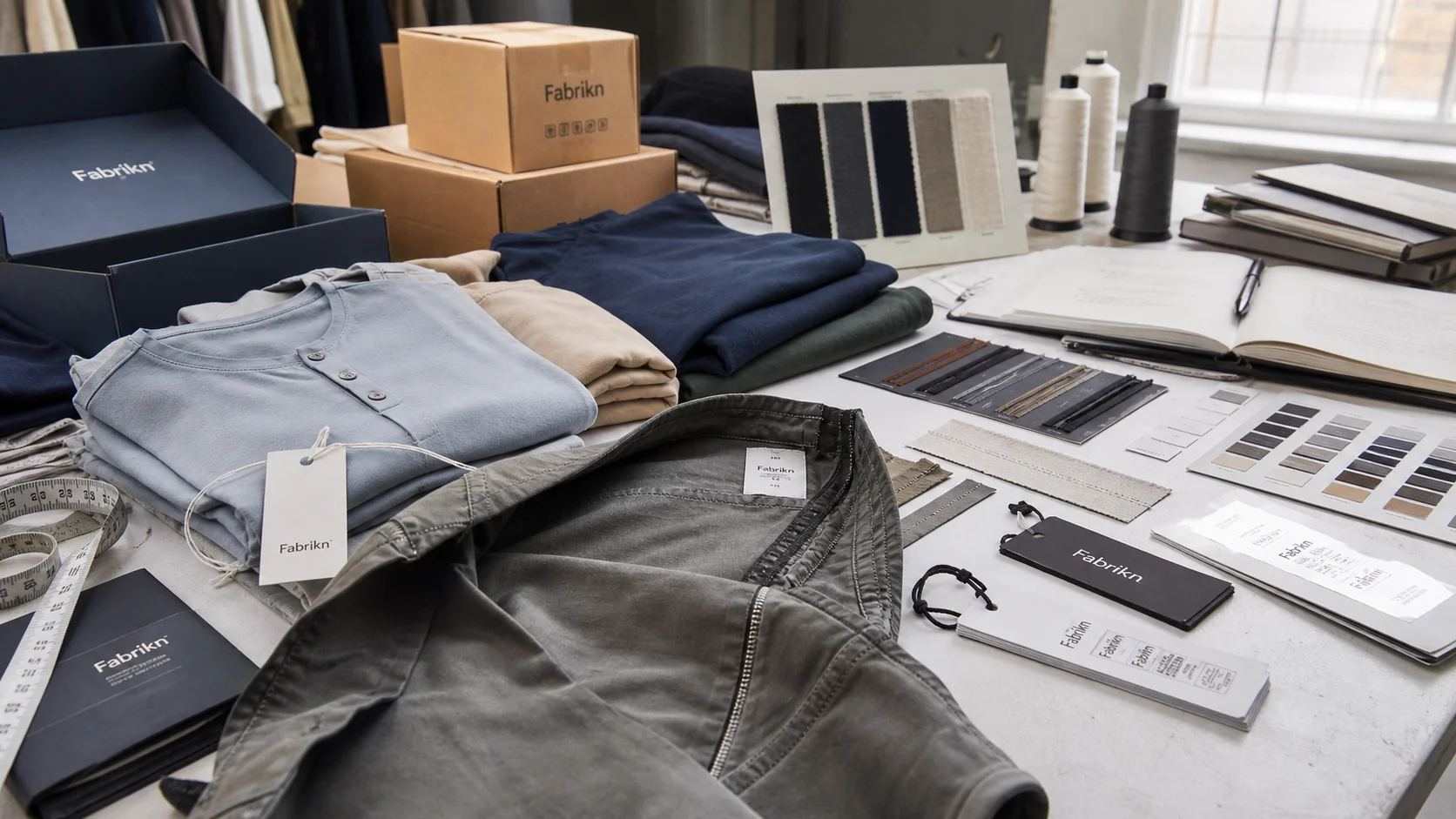
Packaging Vendor Buyer Checklist with checks for samples, fit, MOQ, QC evidence, pricing terms, and delivery risk.
Fast answer: Packaging Vendor Buyer Checklist: Capacity, Samples, Cost Lines, and Risk should be judged by production evidence, not by a generic sourcing promise. The buyer needs sample proof, cost breakdowns, QC checkpoints, and delivery buffers in writing.
Ask for recent sample photos, measurement tolerances, fabric or print test assumptions, decoration test notes, packing examples, and a named inspection checkpoint. These details show whether the team can repeat an approved sample at bulk volume.
Separate garment cost, decoration, labels, packaging, sampling, testing, freight, and rush charges. When every cost line is visible, it becomes easier to reduce colorways, adjust size depth, or reserve more time for sampling.
Premium apparel packaging design ideas can make a $28 T-shirt feel like a $58 one before anyone touches the cotton. Packaging does that. Presentation does that. The quiet math of perception does the rest. Across 200-plus factory visits in 8 countries, the same pattern kept showing up: shoppers decide what a garment is worth from the first surface they see. During a week in Guangzhou's Baiyun packaging park, I watched a Bobst die cutter and an automatic gluer line run through 12,000 made-to-order rigid boxes, proving that the tactile upgrade can be scaled quickly even before the garment itself ships. Those presses run on 18-22 business days cycles from art approval to palletizing for standard SBS board so the math on perceived value starts to protect margin instead of eroding it.
Retail and e-commerce studies keep landing in the same place. Well-executed packaging can lift perceived value by 10% to 30%, especially when the product itself is easy to compare. Luxury buyers want restraint. Contemporary shoppers want care. DTC customers want a story that holds together from carton to collar. According to the U.S. International Trade Administration, presentation systems are often judged as part of product quality, not separate from it. That matters when a brand is trying to protect margin. When teams expect 18-22 business days from art approval to shipping, packaging becomes a calendar anchor rather than a last-minute bolt-on.
Last spring, in a knitwear factory in Portugal, I saw the same ribbed dress packed three ways: rigid box, soft-touch mailer, basic polybag. The box made it giftable. The mailer still looked premium when the print and insert were controlled. The polybag protected the garment. Full stop. It did not sell the experience. In the buyer panel, the boxed version scored 18 points higher on perceived value out of 100, even though the dress inside never changed. During the same week I visited a finishing house in Dhaka, the garment was glued into a slide tray lined with GOTS-certified cotton using a hot-melt adhesive applied on a gluer that runs at 220 metres per minute—something that took minutes to add but made the touchpoint feel rehearsed.
And that gap is not abstract. Better packaging cuts crease complaints, trims damage claims, and nudges repeat purchase intent upward. In my own audits, brands that moved from loose folding to structured presentation reduced return claims tied to scuffing and wrinkling by 8% to 14% within one season. In Istanbul, a BSCI-audited distribution hub tracked the same improvement after switching to 60-gram silk tissue and reinforced corners. Retail shelves benefit too. A folded shirt in a crisp folder faces the customer with more discipline than one slumping in a limp bag. Premium is not always expensive, but it is always intentional.
The unboxing moment begins before the garment is seen. That is why premium apparel packaging design ideas deserve the same attention as fabric choice, stitching density, or wash finish. I have watched brands spend $12 on a sweater wash treatment and then ship it in a $0.09 polybag. Painful. Strong packaging earns its place by protecting product, sharpening brand memory, and signaling care at the exact point where hesitation turns into purchase.
Luxury, premium, and accessible premium are different briefs. Under $75, packaging has to do more with less because the margin will not carry a $6 box on a $32 blouse. In the $75 to $250 band, buyers expect structure, branding, and a little tactile pleasure. At $250 and above, heavier board, layered presentation, and a more controlled reveal are tolerated—especially for outerwear, tailored separates, and gifting. In Dhaka’s garment-accessory district, the high-speed folder-gluer cells and inline flexo presses keep those mid-tier programs in line with cost without sacrificing the tactile cues.
Knitwear behaves one way. Tailored pieces behave another. For knits, a folder or book-fold carton works better than a deep rigid box because the garment compresses safely and stores flat. Tailored pieces need more spine support, so a two-piece box or reinforced mailer with a garment board usually wins. Denim can take more weight, but creasing is still a problem, so internal tissue, corner protection, and a layer of OEKO-TEX Standard 100-certified polyboard matter. Lingerie sells through intimacy and care, which is why dust bags and slim cartons beat bulky packaging. Athleisure wants speed and low damage rates, so mailers and sleeve systems often outperform elaborate kits. Ho Chi Minh City plants hit the sweet spot for these mailers: their Nilpeter flexo presses and robotic sleeve loaders deliver the quick turnaround needed for weekly drops.
Luxury brands tend to lean on heavier board, fewer graphics, and a slower opening sequence. Premium DTC brands usually mix structure with storytelling through an insert card, branded tissue, or a visible construction detail. I saw a mid-priced label beat a luxury competitor on perceived care because the internal presentation was simply more organized. The garment looked protected. The luxury box looked expensive, but the shirt inside had shifted in transit. Buyers remember that kind of failure.
Packaging format should match shipping method, storage needs, and channel use. Retail boxes and garment folders must stack cleanly and survive backroom handling. E-commerce mailers need to withstand 3 to 5 handling events and still open neatly. If the brand also needs private label clothing services, the packaging brief belongs in product development from the start, not after sampling. I have found that clothing packaging solutions perform best when they are built around the garment silhouette and distribution method, not copied from a mood board. The Guangzhou and Istanbul teams I work with always map the end-to-end journey before locking in dielines and finish calls.
Paper choice changes the whole read. Uncoated board feels honest and tactile. Coated sheet prints sharper, but it can feel colder. Textured paper adds friction in the hand, and many buyers read that as quality. 1200 to 1500 GSM SBS board wrapped with a precision-cut wrap stock carries more of the brand smell than a 600 GSM solution, but it also needs a controlled break-in on Heidelberg Speedmaster presses before the flaps meet. FSC-certified board and recycled paper now show up in more premium programs than they did 5 years ago, but they need tight spec control to avoid dull print, weak crease memory, or warping in humid transit. Molded fiber has moved beyond egg cartons and into premium inserts. Compostable mailers are also showing up more often for lighter apparel and subscription drops.
Surface finish is where packaging starts to feel expensive. Soft-touch lamination gives a velvety first touch, though it can scuff if the box moves through rough fulfillment. Foil stamping catches light and signals occasion. Embossing adds depth without adding much weight. Debossing works well on minimal branding because it throws a clean shadow line. Spot UV can isolate a logo or pattern, but too much of it cheapens the effect. Nilpeter and Koenig & Bauer laminators apply aqueous varnish, UV flood, and foil in line so that each panel is co-planar at the flap. A little restraint goes a long way.
Virgin board usually wins on stiffness and print consistency. Recycled content wins on sustainability claims and retailer acceptance, but the trade-off can be a rougher surface and tighter color tolerance. That matters in a brand book or a logo-heavy design; the Ho Chi Minh City supplier I work with charges a 12% premium for high-white recycled board. In Vietnam, several packaging mills quoted me 7 to 10 days longer lead time for FSC board than for stock white board. Italian suppliers were quicker on specialty finishes, but 12% to 18% higher on unit cost. Material availability changes the calendar as much as the price.
For premium gift boxes, I prefer heavy board in the 1200 to 1500 GSM range with a controlled wrap stock. For subscription apparel, lighter folding cartons or reinforced mailers reduce freight weight and storage volume. For shipping cartons, recycled corrugate with clean print and a strong tear strip is usually the smartest spend. According to Textile Exchange and OEKO-TEX, material selection is increasingly tied to sustainability reporting, which means packaging specs now sit inside broader environmental audits, not just the merchandising room.
The best premium apparel packaging design ideas do not chase every effect. They pick 2 or 3 tactile cues and execute them cleanly. One textured board. One foil line. One insert that stops movement. Enough. That combination raises perceived value without building a brittle, costly system that looks impressive for 30 seconds and fails in transit.
Luxury without excess is no longer a niche taste. Buyers question magnets, plastic windows, oversized void fill, and glossy laminates that cannot be separated at recycling. Beautiful packaging has been rejected by wholesale partners because the structure looked premium but made disposal a headache. Brands that want credibility now have to prove the packaging protects the garment and respects the waste stream.
Reducing plastic does not have to mean losing structure. A modular mailer built from OEKO-TEX Standard 100-certified kraftboard, lined with GRS-certified post-consumer fiber, and sealed with a peel-and-seal flap can still read premium while making recycling straightforward. In Istanbul and Ho Chi Minh City, I have seen brands swap PVC tape for WRAP-approved woven tape, keeping the tear resistance but removing the non-recyclable glue. Compostable tissue stacked between garments still protects while ensuring the whole bundle can be composted in industrial facilities.
Certifications matter. GOTS, OEKO-TEX Standard 100, WRAP, BSCI, and GRS tell retailers and conscientious consumers that the packaging supply chain is audited, chemical-safe, socially compliant, and responsibly sourced. I keep a folder of certificates from the Guangzhou converters we work with; showing an auditor the OEKO-TEX print inks, the GRS-recycled liner, and the WRAP-compliant factory list cuts review time by days. Those marks do not replace good design, but they do make it easier to sell the story to a wholesale partner or an ESG committee.
When you tie packaging into circular goals, you also need to track the process. Ask the factory to document the machine run, the lamination recipe, and the inspection steps. A BSCI or WRAP certificate means the records are already in place, but you still have to decide whether your print job runs on a Heidelberg Speedmaster with aqueous varnish or a smaller Ryobi press with UV spot. That decision affects cost, lead time, and the way your premium packaging feels in the customer’s hand.
Premium packaging costs vary by format, but you can usually plan for $2.50-4.00 per unit at 500 MOQ when you use 1200 GSM SBS board, soft-touch lamination, and a single foil logo on the lid. If you add a cloth liner, debossed lid, and two-color printing on both the top and tray, that cost climbs closer to $6.50 per unit at the same MOQ, especially when the production run is scheduled in Guangzhou or Istanbul where the factories are tuned for larger batches.
Mailers and folders from Dhaka are more budget-friendly because the folding and gluing cells are optimized for higher volumes and faster changeovers. For example, a reinforced mailer with OEKO-TEX Standard 100-certified adhesive tape can come in at $1.50 per unit at a 1,000 MOQ, while a dust bag in Ho Chi Minh City woven from GRS-certified cotton fabric runs about $0.85 per unit at 2,000 MOQ.
Lead time matters too. Standard runs from Guangzhou, Ho Chi Minh City, and Istanbul typically hit 18-22 business days from final artwork approval to pallet-ready, assuming you lock down the dieline, confirm inks, and accept the pre-press proof within three days. Rushes under 12 business days require weekend shifts on Heidelberg Speedmaster or Koenig & Bauer presses, and they add 18% to 25% to the quoted price.
Always plan freight and customs into the equation. A stack of rigid boxes from Guangzhou weighs more than a slim mailer from Dhaka, so air freight versus ocean changes the landed cost quickly. Ask your supplier for weight-per-pallet, carton dimensions, and any textile-specific paperwork they keep on file to reconcile with the shipping agent.
1. Start with the specs. Send the factory dielines, Pantone callouts, and digital mockups. List every material—SBS board 1300 GSM, 60 GSM tissue, 150 GSM insert—and link to the corresponding certificate (GOTS, OEKO-TEX Standard 100, GRS) if sustainability is part of the brief.
2. Describe the processes. Tell them whether you expect foil stamping, soft-touch laminate, embossing, or a combination. Share process notes such as “foil applied at 2-pass, using 2.5 mil silver lead on Heidelberg” or “spot UV after lamination,” so the team can plan the machine schedule and estimate makeready time.
3. Flag the functional requirements. Do you need perforated tear strips, hang tabs, or fold-out care cards? Explain the stacking and shipping conditions; for example, “Must survive 10-handles drop test in Guangzhou to match our retail kiosk requirements.”
4. Define approval protocols. Ask for a pressed proof before mass production, specify the photography angles you want for marketing, and request a video of the finishing line if you cannot visit in person. With those steps, the tooling, the adhesives, and the classification (WRAP or BSCI) are all aligned before the first carton leaves the floor.
Map the current customer journey and note where packaging appears. Does the garment arrive in a plain polybag, or does the customer get a multi-layer reveal? Identify one upgrade that can be justified by reduced damage rates or higher perceived value, like switching to a rigid box with a branded insert made on a Heidelberg Speedmaster with soft-touch lamination. Align that upgrade with the cost numbers above and lock the MOQ.
Send the brief to your sourcing team with all references to Guangzhou, Dhaka, Ho Chi Minh City, and Istanbul partners you trust. Confirm the lead time (18-22 business days on the average run) and the materials (e.g., 1200 GSM SBS board, GRS-certified tissue, OEKO-TEX Standard 100 inks). Ask for a sample to be photographed next to the garment so merchandising can see the full story.
Document the sustainability story. If you are using GOTS, OEKO-TEX, or GRS materials, keep scanned certificates and mention them in the product page copy. Include the packaging build in the pre-season line sheet so buyers understand the investment behind the premium look.
How much should I budget for premium packaging? A good rule of thumb is $2.50-4.00 per unit at a 500 MOQ for rigid boxes with basic embellishment, but add $1-2 if you want foil, soft-touch lamination, or a cloth insert.
What lead time should I expect? Plan for 18-22 business days from art approval to pallet-ready, assuming no unexpected approvals; rush jobs can drop to 12 days but increase the price by roughly 20%.
Are certifications worth it? Yes—GOTS, OEKO-TEX Standard 100, WRAP, BSCI, and GRS signal compliance to partners and end customers, and they streamline audits in markets like the EU and North America.
How much does sustainability add to cost? It depends on the material, but using GRS-certified fiber or FSC board can add 8% to 18% to unit cost while also lengthening lead time by up to 10 days, so prototype early to understand the trade-off.
Where should I source from? Use Guangzhou for premium rigid boxes, Dhaka for cost-efficient folders and mailers, Ho Chi Minh City for specialty mailers and dust bags, and Istanbul for small-batch gifting solutions with fast European shipping.