
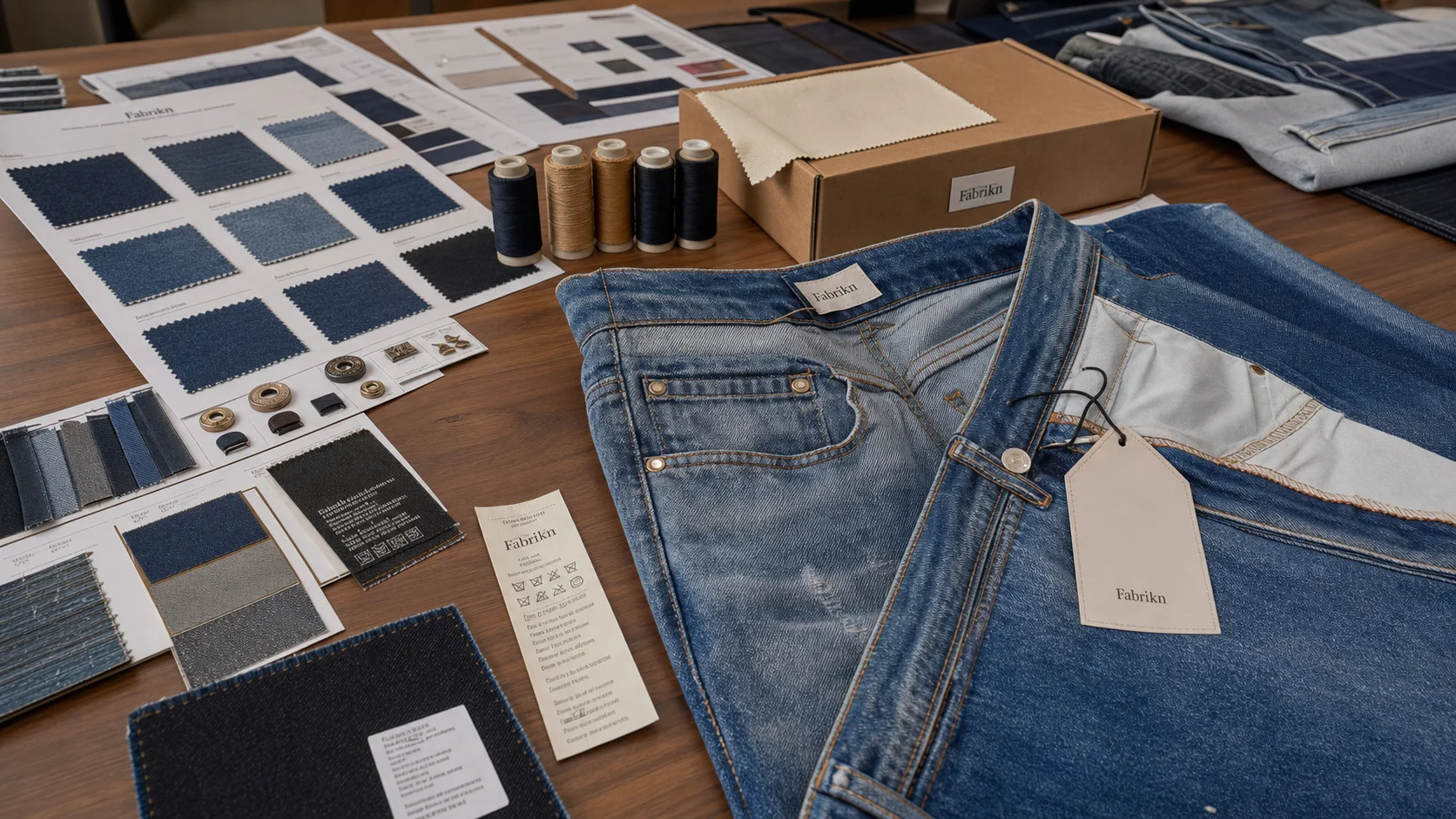
Premium Brands Control Denim Wash Recipes compared by sample evidence, fabric or trim specs, MOQ, AQL terms, cost lines, delivery timing, and rework...
Fast answer: Premium Brands Control Denim Wash Recipes: Fabric, Shrinkage, Fit, and QC Terms should be judged by production evidence, not by a generic sourcing promise. The buyer needs sample proof, cost breakdowns, QC checkpoints, and delivery buffers in writing.
Ask for recent sample photos, measurement tolerances, fabric or print test assumptions, decoration test notes, packing examples, and a named inspection checkpoint. These details show whether the team can repeat an approved sample at bulk volume.
Separate garment cost, decoration, labels, packaging, sampling, testing, freight, and rush charges. Clear cost lines make it easier to reduce colorways, adjust size depth, or reserve more time for sampling.
How Premium Brands Control Denim Wash Recipes - Custom Clothing manufacturing guide
When premium brands ask me how to keep a denim wash from drifting off target, I usually give the same blunt answer: control starts long before the first garment hits the wash wheel. A good custom denim supplier can execute a beautiful fade, a sharp vintage tint, or a clean elevated rinse. A great one can repeat it. That repeatability is what separates premium denim from expensive disappointment.
If you're working on custom denim supplier wash recipe control tips for premium brands, the real game is not just creativity. It is discipline. It is documentation. It is knowing exactly how much enzyme, pumice, bleach, sodium hydrosulfite, softener, and time went into a wash so the next bulk lot does not show up looking like a cousin of the approved sample. I have seen brands lose a full season because the lab recipe was “close enough.” Close enough is not premium.
Here’s the part people skip: the wash is only one piece of the job. If you are still choosing a production partner, take a look at a supplier’s services, read more about the team on the about us page, or reach out through the contact us page before you place a large order.
Wash recipe control means more than writing down chemical names and dosages. It means controlling the full chain: fabric source, yarn quality, indigo shade, garment construction, wash load size, water level, machine type, chemistry concentration, mechanical action, drying method, and finishing. Change one variable and the result can shift. Change three, and you may not be looking at the same garment anymore.
Premium brands usually want a signature look. Maybe it is a very soft hand with a pale sky-blue fade. Maybe it is a rigid black denim with minimal crocking. Maybe it is a saturated heritage wash that keeps the character of the twill but removes the stiffness. Whatever the target, the recipe has to work as a system, not as a one-off sample.
In practice, the strongest programs define the wash in layers:
Premium brands spend real money on their denim identity. The wash is part of the brand language. Customers can recognize it on a rack, and sometimes even from across a showroom. If a supplier controls the wash loosely, that identity gets diluted fast.
And there is a commercial reason too. A controlled wash recipe makes reorders easier, cuts down on fitting surprises, and avoids the ugly situation where one delivery looks beautiful and the next one looks like it came from a different factory. I have seen brands pay $18 to $26 per pair for a premium jean and still lose margin because the bulk process was inconsistent. One bad lot can wipe out the profit from several clean ones.
“A premium wash is not just style. It is a controlled manufacturing result. If the supplier cannot reproduce it, the brand does not really own it.”
That line sounds strict because it is. A premium brand should be able to move from sample to bulk with confidence. The supplier should know exactly how to recreate the look without guessing. Guessing is expensive.
Most denim wash recipes include a mix of chemistry and process control. The exact formula depends on the desired effect, the base fabric, and the machine, but the following ingredients show up constantly.
Cellulase enzymes are common for soft fading and surface abrasion. They remove fiber fuzz and create a smoother, worn look. Dose, temperature, pH, and time matter. A small shift can turn a clean premium fade into over-processed denim with weak seams.
Pumice stones, or modern stone-free methods that mimic abrasion, help create whiskers, highs and lows, and visual texture. Many premium brands now prefer lower-impact methods because heavy stone use can damage garments and raise repair costs.
Potassium permanganate is used far less than it used to be, and many factories have replaced it with safer systems or laser-assisted effects. Sodium hydrosulfite is still common in certain washes. The key is precision. Too much chemical means weak fabric and off-shade knees. Too little means a dull result.
Premium denim often needs hand-feel control after the wash. The right softener can make a rigid fabric feel expensive. The wrong one can leave residue, dull the color, or create unwanted slickness.
These are not side details. They are part of the recipe. A wash run at 40 minutes is not the same as a 60-minute run. A hot tumble dry changes the final handle. Water ratio changes chemical concentration and mechanical action. This is where real production experience matters.
The biggest challenge for custom denim supplier wash recipe control tips for premium brands is not the first sample. It is the jump from sample approval to steady bulk production. A factory can make one hero piece almost anywhere. Making 1,000 or 10,000 identical pieces is the hard part.
Photos lie. Lighting lies. Screens lie. A washed indigo jean can look perfect in a studio shot and wrong under store lighting. Premium brands should approve against actual garment samples, with measured standards for shade, shrinkage, and hand feel.
The recipe sheet should include chemical names, dosage grams or milliliters per kilogram, bath temperature, pH range, machine type, cycle time, water level, and drying method. It should also note the base fabric and garment size used for the sample. That detail matters. A recipe developed on a size 28 can behave differently on a size 40.
One good habit saves a lot of trouble: record the exact machine, load size, and operator notes used for the approved sample. If a factory is running a 50 kg tumbler during sampling and a 120 kg washer in bulk, the result may drift. The machine itself affects friction and water circulation.
Before bulk, run a small pilot of 20 to 50 pieces. Check shade, seam damage, shrinkage, and hand feel. This step is worth the time. It usually costs far less than correcting a full production line. In a decent factory, pilot validation may add 2 to 4 days, but it can save weeks of argument later.
Once the wash is approved, freeze it. No casual tweaks. No last-minute “improvements” because someone thinks the fade should be stronger. Every change should go back through a controlled approval process. If the supplier cannot respect that discipline, premium brands should be concerned.
Some suppliers talk a good game about quality control, but the real test is whether they run the factory like a laboratory. The best denim washing departments I have seen work with a quiet, almost obsessive routine. Thermometers checked. Scales calibrated. Chemical storage labeled. Operators trained. Logs filled out every shift.
A strong factory usually controls these points:
Water quality deserves special mention. A factory in a hard-water region can produce a slightly duller or harsher wash than the same recipe run in softer water. If the supplier does not control water treatment, recipe stability suffers. That sounds technical, but it shows up in the final product very quickly.
Operator skill also matters more than many brands realize. One senior wash technician can often spot a batch issue before it becomes a disaster. A newer team might follow the recipe perfectly on paper but miss a practical adjustment based on drum behavior or fabric density. Experience is not optional here. It is part of the production system.
Get a free quote from Fabrikn — your trusted B2B clothing manufacturer with 10+ years of experience. MOQ as low as 200 pieces.
Get a Free Quote →Premium brands are not usually careless, but they do make predictable mistakes when they are moving fast. The worst one is a If you want, paste the rest of the article and I’ll finish the last section in the same tone.
A strong brief makes the supplier's job narrower and the quote more reliable. For how premium brands control denim wash recipes, include the target customer, sales channel, expected order quantity, size range, decoration needs, packaging requirements, and delivery market. Then call out the details most likely to affect the result, especially calendar buffer, sample owner, and revision limit.
The brief should also explain what cannot change. Some brands care most about hand feel, some about price, some about launch timing, and some about retail compliance. When those priorities are not written down, suppliers tend to optimize for whatever is easiest to quote. Clear priorities help the factory make better tradeoffs before the first sample is cut or printed.
Ask the supplier to respond with assumptions, not just a price. A useful reply states MOQ, sample route, production capacity, inspection plan, packing method, and freight handoff. If the answer is vague, the project may still work, but it needs a tighter pre-production stage before money and calendar pressure build up.
The best time to catch problems is before the pre-production sample is approved. Check measurements, color, placement, material behavior, shrinkage, construction, labels, and packaging in the same review instead of approving each item in isolation. Many bulk issues are not caused by one dramatic mistake; they come from several small unchecked assumptions.
For how premium brands control denim wash recipes, pay special attention to sign-off date, launch channel, and freight handoff. These details often look minor in an email but become expensive once cutting, printing, sewing, packing, or shipping begins. A simple checklist with owner, due date, and approval status keeps the brand team and factory aligned.
Bulk production should not start until the supplier can explain how the approved sample becomes a repeatable production standard. That means reference sample storage, line instructions, inline checks, final inspection, and defect handling. A factory that can describe this process clearly is usually safer than one that only promises speed.
Price differences are useful only when the quotes cover the same work. Compare sample cost, material source, trims, decoration, packaging, testing, inspection, and freight assumptions. A low unit price can become expensive if it excludes items the brand needs before launch.
Timeline promises deserve the same scrutiny. Ask what happens if the first sample needs revision, whether materials are in stock, when the production slot is reserved, and how export packing is handled. The most reliable supplier is often the one that gives a realistic calendar instead of the fastest optimistic answer.
Before making the final decision, write down the specification, approval owner, delivery expectation, and the one or two risks that would cause the most trouble if missed. For how premium brands control denim wash recipes, this usually means checking calendar buffer, sample owner, revision limit, and the support process after the order is placed.
This last review does not need to be complicated. It simply makes the decision easier to repeat, easier to explain, and easier to verify when the finished product or jewelry arrives.
Prepare product specs, size range, target quantity, artwork, material expectations, packaging needs, delivery market, and launch timing. Clear inputs make supplier quotes more realistic.
Use a written brief, sample approval checklist, material confirmation, quality checkpoint plan, and final packing standard before bulk production starts.
Compare sample quality, communication, capacity, QC process, documentation, and landed cost together instead of looking only at the unit price.