
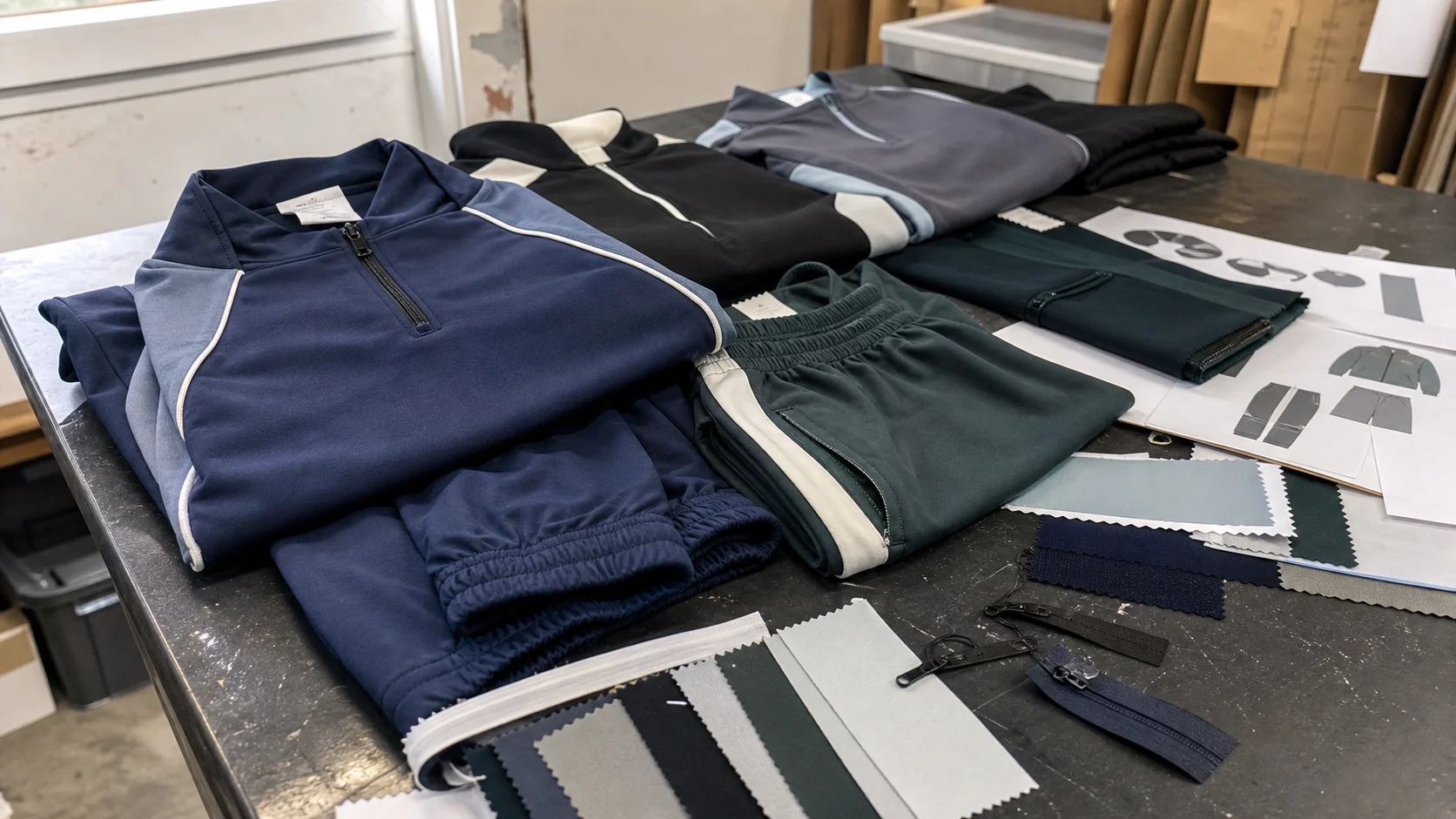
A focused look at how academies can use fit samples to approve private label tracksuits, lock in decoration placement, and avoid costly sizing mistakes...
Private label tracksuits with fit samples for academy team orders sit at the intersection of branding, performance, and repeatable sizing. In the Decoration & Printing category, the clothing itself is only part of the job. Academies need garments that look consistent across age groups, hold up through training, and present a clean identity on court, field, or campus. Fit samples matter because a tracksuit that looks good on a size medium hanger can still fail when it has to fit juniors, coaches, and mixed body shapes in the same order.
For academy buyers, the practical question is not whether a tracksuit can be customized. The better question is whether the supplier can translate brand requirements into a stable production spec, then keep that spec consistent across repeat orders. That means fabric choice, trim selection, decoration method, and sample approval all need to be handled with discipline. A small mistake in collar height, sleeve length, zipper weight, or logo placement can create avoidable returns and rework.
This guide covers the sourcing details that matter when placing private label tracksuits with fit samples for academy team orders. It looks at MOQ ranges, sample approval steps, lead-time dependencies, fabric and trim specifications, decoration choices, and inspection risks. For broader manufacturing support, review the services page, or reach out through the contact us page if the order needs a quotation based on artwork, size breakdown, or packaging requirements. Background on the company is available on the about us page.
Private Label Tracksuits with Fit Samples for Academies - Decoration & Printing manufacturing guide
Academy team orders are rarely one-size-fits-all in practice. A single order may include youth players, adult coaches, and support staff. That mix pushes the tracksuit spec beyond simple appearance. The garment needs enough comfort for warm-ups and travel, enough structure to look uniform in photos, and enough durability to survive frequent washing.
Private label tracksuits also carry brand expectations. An academy usually wants its logo, color palette, and identity marks placed with enough precision to look intentional. The garment should feel like a team system, not a generic blank with a logo dropped onto it. That is where private label planning becomes valuable. The supplier is not only printing or embroidering; it is producing a branded product with repeatable fit and controlled decoration.
Academy buyers usually benefit from a simpler, narrower spec than fashion buyers. The goal is consistency, not trend chasing. A good sourcing brief typically defines the jacket silhouette, pant taper, sleeve and inseam range, pocket layout, fabric weight, trim type, and decoration method. If any of those are unclear, the sample stage becomes slower and bulk risk rises.
Fit samples are not a formality. In academy orders, they reduce the chance of a costly size dispute after production starts. A fit sample shows how the tracksuit behaves on the body, not just on a flat measurement sheet. This matters because fabric stretch, panel shaping, and construction methods can change the way a garment fits by several visible centimeters.
A fit sample should be reviewed against the intended wearer profile. Youth athletes usually need more movement room in the shoulders and knees. Coaches often prefer a slightly more relaxed fit, especially if the tracksuit will be worn over base layers. When the sample is assessed properly, the buyer can decide whether to keep the cut athletic, shift to a straighter block, or adjust the taper in the pant leg.
The most useful fit samples are made from the intended production pattern, not a loose approximation. If a supplier offers a “reference sample” made from different fabric or a different block, the result may look close while still failing in production. That risk is especially important for private label tracksuits with fit samples for academy team orders, where repeatability matters more than one-off appearance.
Fit approval should focus on wearability, size grading, and decoration placement together. A good-looking sample that rides up at the waist or distorts the logo when stretched is not a usable approval.
Fabric is the biggest driver of comfort, price, and lead time. For academy tracksuits, common options include polyester interlock, polyester-spandex blends, brushed back fleece, tricot, and double-knit constructions. Each has a different balance of warmth, drape, stretch, and print behavior.
Polyester interlock is often used when the buyer wants a smooth surface, stable shape, and solid decoration results. It usually works well for sublimation or heat transfer, depending on the construction. Polyester-spandex blends add flexibility and can improve athlete comfort, though they may raise cost and complicate some decoration methods if the fabric has strong stretch.
Brushed back fleece provides a warmer hand feel and is often selected for colder climates or travel wear. It can be comfortable, but it may add bulk and create a less athletic silhouette. Tricot is lighter and tends to produce a clean, classic sportswear look. Double-knit fabrics offer structure and durability, which can be helpful in school environments where garments see frequent use.
Trim selection matters more than many buyers expect. Zipper quality, rib stability, drawcord end finish, pocket bag fabric, and label method all affect the final product. A low-cost zipper that jams once every fifty pieces can still become a production problem if the order is large. Rib cuffs that lose recovery after wash will quickly make the tracksuit look tired.
Color consistency deserves special attention. Dark shades, heathers, and fashion brights all carry their own risk of shade variation. If the academy needs repeat ordering across seasons, the supplier should confirm lab dip or fabric shade references before cutting bulk. That step is slower than skipping straight to production, but it avoids mismatched jackets and pants in later replenishment.
Because this is a Decoration & Printing order, the branding method needs as much review as the garment fit. Private label tracksuits can use embroidery, screen print, heat transfer, sublimation, or a combination of methods. The right option depends on the fabric, design complexity, and how the academy plans to use the garment.
Embroidery gives a premium, durable look and is often suitable for chest logos, sleeve marks, and back neck branding. It performs well on heavier fabrics and structured panels. The tradeoff is weight and cost. Fine detail may also lose clarity if the logo is too small or contains thin lettering.
Screen print works best for simpler logos and flat artwork. It can be cost-effective on larger runs, though print feel and wash durability depend on ink type and fabric compatibility. Heat transfers are useful for names, numbers, and multi-color graphics, especially when artwork changes by team or athlete. Sublimation is strongest when the design is integrated into the garment from the start and the fabric is polyester-based.
For academy orders, decoration placement should be treated as part of the fit sample review. A logo near the shoulder seam may look centered on paper but shift once the garment is worn. Pant side branding can also distort near the knee if the panel lines are too tight. The sample stage should confirm not just the artwork size but how it behaves in motion.
MOQ for private label tracksuits varies by supplier, decoration method, and fabric availability. A practical range for academy team orders is often 100 to 300 sets per colorway, although some factories will quote lower for simple styles or higher for custom fabric builds. If multiple sizes, colors, or decoration variations are split across the order, the effective MOQ per variant can rise quickly.
Lead time depends on more than sewing capacity. Sample approval, fabric booking, trim sourcing, artwork confirmation, and size breakdown sign-off all affect the calendar. A straightforward repeat order with approved materials may move faster than a first-time order that needs custom labels, woven badges, or special color matching. When the fabric is knitted or dyed to order, production timing can extend further.
Academy buyers often underestimate the time needed for sample circulation and internal sign-off. If coaches, purchasing staff, and branding teams all need to approve the fit sample, the review window should be built into the schedule. Rushing that process usually creates more risk than it saves time.
These ranges are not promises. They are planning assumptions. Orders placed before peak season generally have a better chance of holding schedule. Orders that need custom zippers, special fabrics, or individual athlete name sets require extra buffer. That is especially true when the tracksuit also has to align with academy event dates.
A disciplined approval process reduces errors in both fit and decoration. The cleanest approach is to move from a tech pack or clear reference brief into a proto sample, then a fit sample, then a pre-production sample if changes were made. Skipping straight from concept to bulk is rarely wise for academy team orders.
The first sample should confirm the silhouette and basic construction. The second sample should focus on wearability, fit balance, and decoration placement. If the supplier makes any changes after fit approval, the updated points should be recorded in writing before cutting bulk. That may seem slow, but it protects both sides from memory drift and inconsistent interpretation.
Where academy orders are involved, it helps to keep approval notes simple and specific. Broad comments like “make it better” are difficult to translate into production. More useful notes sound like “increase sleeve length by 1 cm,” “move chest logo 1.5 cm lower,” or “change pant hem opening for easier shoe clearance.”
Academy orders often include a broad size spread. That creates a grading challenge because youth and adult bodies do not scale in exactly the same way. A small youth size may need more proportional changes than a simple shrink of the adult pattern. The right grading strategy depends on whether the garment is intended mostly for junior athletes, a full mixed squad, or coaching staff as well.
For team uniforms, it is usually better to build the size chart around chest, waist, hip, and inseam values rather than rely on generic S-M-L assumptions. Garment length can create the biggest complaint if the top is too short or the pants are too long. A slim, tapered style may look sharp on paper, but if it restricts the thigh or knee area, athletes will feel it immediately.
A practical sourcing view is to prioritize function over overspecification. If the academy will reorder often, a consistent size block is more valuable than a highly fashion-driven cut. A moderate athletic fit usually performs better across age groups than an extreme slim fit. It also reduces returns from staff who need to wear the same tracksuit in a more relaxed context.
Even well-planned private label tracksuits can fail in the details. Seam slippage, uneven topstitching, loose threads, shade variation, and decoration misalignment are common bulk risks. Fabric pilling is another issue when low-grade yarn or poor finishing is used. If the tracksuit is brushed, the buyer should ask how the surface handles abrasion and wash cycles.
Inspection should focus on repeatable faults, not just obvious defects. A tracksuit batch can pass visual approval while still having inconsistent waist elastication or sleeve length drift. For academy orders, those problems matter because they show up immediately when athletes line up by size or when the team wears the garments together.
Practical quality control usually includes pre-production review, in-line checks, and final inspection against an AQL standard or agreed pass/fail list. If the supplier cannot explain how decoration alignment, stitching, and measurement tolerances are checked, the buyer should assume the risk is higher than it first appears.
Packaging is easy to dismiss until the wrong size lands in the wrong bag. Academy team orders often benefit from size stickers, team grouping, and clear carton labels. If the order is distributed to multiple age groups or coaching staff, packing by size and by set number can save a large amount of time on delivery.
For private label products, the hang tag, care label, barcode, and outer carton mark all matter. If the academy plans to retail extra stock, packaging should support resale rather than only internal distribution. If the order is strictly for team use, a leaner packaging spec may be more practical and cost-efficient.
Delivery planning should also consider seasonality. Heavy fleece sets take more carton space than lightweight tricot sets, which affects freight cost. Air shipment may be justified for urgent tournaments or start-of-season deadlines, while sea shipment is usually more economical for larger replenishment orders. That tradeoff should be decided early, not after the garments are ready.
The best academy tracksuit is not necessarily the most expensive. Spending should be directed where wear and brand visibility are highest. That usually means fabric stability, zipper quality, and logo execution. Savings are more acceptable in areas that do not affect fit or durability, such as simpler packaging or a reduced number of decoration locations.
It is usually worth paying more for a fabric that keeps its shape and color after repeated washing. It is also worth paying for a sample round that verifies size and placement before bulk. Cutting corners on fit sample approval often costs more later through remakes, negative feedback, or inconsistent team presentation.
A cautious buyer should resist overcomplicating the design. Every extra panel, contrast insert, or trim color creates more cutting and sewing risk. Clean designs are easier to repeat, easier to inspect, and easier to replenish. That is particularly useful for academies that may need the same program order across multiple seasons.
The strongest purchasing decision is often the simplest one: choose a stable fabric, a clear fit block, and one decoration system that the factory can repeat without guesswork.
Private label tracksuits with fit samples for academy team orders are best handled as a controlled sourcing project, not a casual apparel purchase. Fit samples reduce sizing risk, fabric and trim choices shape the product’s value, and decoration decisions determine how the academy brand is perceived. A good order balances performance, appearance, and repeatability.
When the spec is clear, the approval steps are disciplined, and the inspection plan is realistic, academy buyers can secure tracksuits that look professional and hold up through real use. That is the practical standard to aim for: a garment that fits well, prints cleanly, and can be reordered without starting from zero each time.
Get a free quote from Fabrikn — your trusted B2B clothing manufacturer with 10+ years of experience. MOQ as low as 200 pieces.
Get a Free Quote →Polyester interlock, tricot, and polyester-spandex blends are common choices. Interlock and tricot are stable and easy to decorate, while blends offer more stretch. The best option depends on whether the academy wants a lighter training set, a warmer travel set, or a more structured presentation look.
Many suppliers work in the range of 100 to 300 sets per colorway for private label tracksuits, although the exact MOQ depends on fabric, decoration method, and whether custom trims are required. Multiple variants can raise the effective MOQ per style.
Fit samples show how the tracksuit performs on the body, not just on paper. They help confirm size balance, movement comfort, logo placement, and overall silhouette before production starts. This reduces the chance of expensive corrections later.
Embroidery is often the most durable for logos, while sublimation can be very stable on the right polyester fabric. Screen print and heat transfer can also work well if the artwork, fabric, and wash requirements are matched properly. The best method depends on the design and use case.
Lead time commonly ranges from 25 to 45 days after sample approval for standard orders, though custom fabrics, special trims, and high season demand can extend that timeline. Sampling and approval should be planned separately from bulk production.
Common risks include logo misplacement, inconsistent sizing, seam issues, zipper failure, fabric shade variation, and poor wash performance. Final inspection should check both measurements and decoration consistency across the batch.
Yes. Many orders can be packed by size, by team, or by individual athlete name set if the supplier receives a clear packing list. Individual packing adds handling time, so it should be agreed before production begins.