
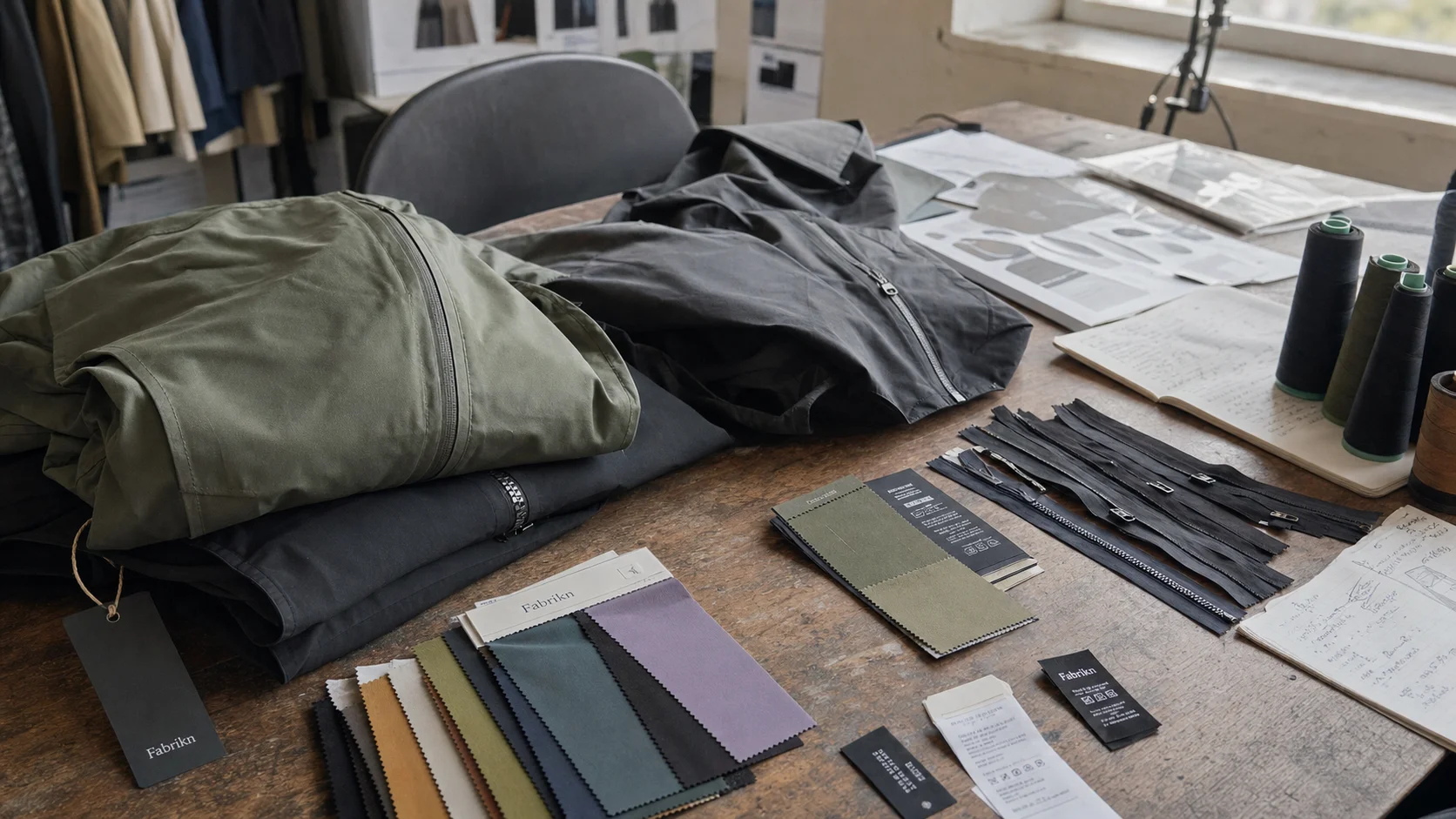
A product-specific SEO outline for sports retailers sourcing private label tracksuits wholesale, covering fabric, fit, branding, production specs, and...
Private Label Tracksuits Wholesale for Sports Retailers - Fabrikn production reference
Private label tracksuits wholesale for sports retailers sits at the intersection of product control, margin management, and brand building. For sports stores, team suppliers, gymwear labels, and online retailers, tracksuits are a practical category because they sell across seasons, support repeat buying, and can be positioned for training, travel, warm-up, and casual wear. The category looks simple at shelf level, but the sourcing decision is more technical than many buyers expect.
A workable wholesale program starts with the right fabric, fit, trim package, and sampling process. It also depends on order size, decoration method, packaging, and the supplier’s ability to hold quality across repeat production. Retailers that treat tracksuits as a generic commodity often end up with inconsistent sizing, weak zippers, poor shrinkage control, or a finish that feels off-brand for their customer base. Private label only pays when the product can carry the retailer’s name without creating avoidable returns.
Tracksuits work well in private label because the customer expects utility first and brand second. That gives retailers room to differentiate through fit, color palette, fabric handfeel, and price point rather than depending on a famous logo. For many buyers, that creates a healthier margin structure than reselling a branded line with fixed pricing pressure.
Private label also lets a retailer tune the product to a narrower audience. A running shop may want lightweight polyester tricot sets with a cleaner athletic cut. A football or teamwear account may need heavier brushed fleece versions for travel and sideline use. A lifestyle-led sports retailer may prefer softer knit tracksuits that cross over into casual wear. One supplier can often make all three, but the spec sheet should not be treated as interchangeable.
There is a practical benefit to assortment control. When you own the label, you can build continuity across seasons, maintain best-selling fits, and reduce the problem of shoppers seeing the same style at a lower price elsewhere. That said, private label only helps if the retailer is ready to manage approvals, minimums, and inventory discipline. It is not a shortcut around product planning.
Tracksuits are usually a jacket and pant set, though some programs also include zip tops, hooded variants, or tapered jogger styling. The main sourcing decision is not the silhouette alone. It is the combination of fabric, construction, trim, and finishing.
Fabric weight matters as much as fiber content. Lightweight tracksuits may sit around 180-220 gsm, while more substantial retail styles often land closer to 240-320 gsm depending on the construction. A buyer should not approve a sample based on appearance alone. The same visual can hide a big difference in density, warmth, and durability.
Decoration should match the intended retail tier. Embroidery gives a more premium, durable feel, but can add stiffness and cost. Heat transfer is useful for sharper branding and lower setup effort, though it must be tested for wash durability and cracking. Screen print can work on smoother panels, but it is less forgiving on stretch or textured surfaces. Woven labels, silicone patches, and flat prints each create a different brand signal, so the decoration package should be selected with the customer in mind.
Spec Area Typical Buyer Focus Common Risk Fabric Feel, warmth, durability Wrong handfeel or poor shrink control Fit Retail appeal, movement, sizing consistency Uneven grading across sizes Zippers Ease of use, longevity Snagging, broken pulls, uneven stitching Decoration Brand presentation Cracking, peeling, misplacementMinimum order quantity varies by supplier capability, decoration complexity, and fabric availability. For private label tracksuits wholesale, a practical MOQ is often in the range of 100 to 300 sets per color/style for simpler programs. Some factories will quote lower for stock fabric and basic branding. Custom fabric development, special trims, or multiple colorways usually push the minimum higher.
Sampling should not be compressed into one round if the product matters to the business. A sensible process usually includes a tech pack review, fabric swatches or strike-offs, a first sample, comments, and a revised pre-production sample before bulk approval. Retailers that skip the last approval stage often pay for it later through size inconsistency or construction issues that were visible earlier.
Lead time depends on whether the supplier is using ready fabric or custom milled material. A straightforward private label program can sometimes move in 30 to 45 days after sample approval if materials are available and production capacity is open. Custom fabric, specialty trims, or more complex branding can stretch that to 60 to 90 days or more. Seasonal timing matters. The best commercial window for tracksuits is often driven by back-to-school, autumn, winter, teamwear calendars, and pre-season buying cycles.
Buyers should treat lead time as a chain of dependencies: fabric booking, lab dip approval, sample sign-off, bulk production, inspection, and packing. A delay in any one step can move the delivery date more than the sewing time itself.
Tracksuits look straightforward, which is exactly why quality misses can slip through. The most common issue is inconsistency between samples and bulk production. A sample may use better fabric, tighter stitching, or more careful finishing than the production run. That is a supplier management issue, not a design issue.
Shrinkage should be checked early. Fabric that feels right before washing may tighten, twist, or lose shape after a few cycles. Colorfastness is another practical test. Deep shades, especially black, navy, red, and bright tones, should be checked for wash and rub performance. Pilling is a concern on brushed fleece and softer blends. Zipper performance should be tested under repeated use, not just on a fresh sample.
Grading can create silent fit problems. If the small and medium look good but the large and XL are poorly proportioned, the retailer may not notice until returns begin. Pants can also suffer from poor rise balance, narrow thigh points, or waistbands that roll. Jackets can become boxy, sleeve-heavy, or too short in larger sizes. That is why size specs need measurable tolerances, not vague approval language.
Inspection should cover appearance, measurements, seam strength, accessory performance, labeling accuracy, and packing. A pre-shipment inspection is usually worthwhile on private label programs because the product carries the retailer’s brand. For higher-volume orders, a third-party inspection or in-line quality checkpoints reduce the risk of receiving a full lot with the same defect repeated.
Wholesale price for private label tracksuits can vary widely based on fabric, country of origin, branding method, and order volume. Entry-level programs using standard materials and simple decoration can be competitive, while premium cut-and-sew versions with custom trim packages cost more but can support a stronger retail ticket.
The right buying decision is not always the cheapest unit cost. A lower-priced tracksuit that shrinks, fades, or fits poorly can destroy margin through markdowns and returns. A slightly higher wholesale cost may be easier to defend if the product wears well, looks cleaner, and supports repeat orders. That matters in sports retail, where consumers often compare feel and function directly in hand.
Retailers should map landed cost before committing. Freight, duty, labeling, polybags, cartons, and inspection fees can shift the final cost materially. A supplier quote that looks attractive on paper can become less compelling once the full inbound cost is added. Private label sourcing works best when the buyer is comparing landed margin, not just ex-factory price.
A good supplier is not just a sewing floor. For private label tracksuits wholesale, the supplier should show control over fabric sourcing, pattern making, grading, sampling, and finishing. Buyers should ask how the factory handles approval stages, what tolerances it works to, and whether it can repeat the same product across later reorder seasons.
It is sensible to request recent material specs, size charts, photos of similar constructions, and a breakdown of what is standard versus optional. A supplier that answers clearly on zipper source, fabric composition, shrinkage expectations, and branding methods is usually easier to work with than one that keeps everything vague until order confirmation.
Strong sourcing decisions also come down to responsiveness. Missed comments, slow sample turnaround, and unclear corrections tend to become bulk problems. Retailers that want a stable private label line should favor suppliers who can manage technical detail, not just quote price.
For more detail on what a development partner should cover, see Fabrikn services, and if you want a direct conversation about a tracksuit program, use the contact page. Retailers comparing vendor background and production approach can also review the about page.
Tracksuits should be bought with channel behavior in mind. Physical sports retailers often benefit from a tighter size run and a clearer use case statement, because shoppers want to touch the fabric and compare fit. Online retailers need stronger photography, size guidance, and color accuracy because returns are more sensitive to visual mismatch.
An assortment can be built around a few commercial positions. A value line can use standard polyester tricot with minimal branding. A mid-tier line can introduce better zipper hardware, improved handfeel, and sharper trims. A premium retail line can focus on heavier knit, softer brushed interiors, tapered shapes, and more polished decoration. The risk is overextending the range with too many near-duplicate SKUs that only differ by color. That ties up cash without adding real customer choice.
Color strategy should stay disciplined. Core colors usually outperform trend-driven experiments in wholesale sportswear, especially when the item is being bought as a uniform, training layer, or clubwear staple. Navy, black, charcoal, grey melange, and select team colors are often the commercial base. Fashion shades can work, but only if the retailer has evidence of demand.
Retailers who treat this checklist as part of procurement rather than admin tend to get better product consistency. The more detailed the brief, the easier it is to compare suppliers on real capability instead of glossy sales language.
Private label tracksuits wholesale for sports retailers is a workable category when the buyer manages it as a technical product, not just a branded garment. The profit comes from controlled spec decisions, disciplined sampling, realistic MOQ planning, and a clear view of landed cost. Fabric, fit, trims, and inspection quality all affect sell-through, return rates, and repeat order potential.
For sports retailers, the best approach is usually conservative at the start. Choose a core construction, test a manageable order, evaluate customer response, then expand into seasonal colors or upgraded versions once the base program proves itself. That is the practical route to building a trackwear line that supports margin without inviting unnecessary risk.
Get a free quote from Fabrikn — your trusted B2B clothing manufacturer with 10+ years of experience. MOQ as low as 200 pieces.
Get a Free Quote →Many suppliers quote around 100 to 300 sets per style or color for simpler programs. Custom fabrics, special trims, or multiple branding methods can raise the minimum.
Standard programs often take 30 to 45 days after sample approval if fabric is available. Custom material or more complex detailing can push delivery to 60 to 90 days or more.
Polyester tricot is common for classic athletic looks and durability. Interlock, double knit, and fleece-based options work better when a softer or warmer retail position is needed.
Check fabric handfeel, fit, measurements, stitch quality, zipper function, label placement, and decoration accuracy. A pre-production sample is the one that matters most before bulk approval.
Use a detailed tech pack, require measurable tolerances, confirm fabric and trim specs early, and inspect bulk goods before shipment. On first orders, that discipline matters more than chasing the lowest quote.