
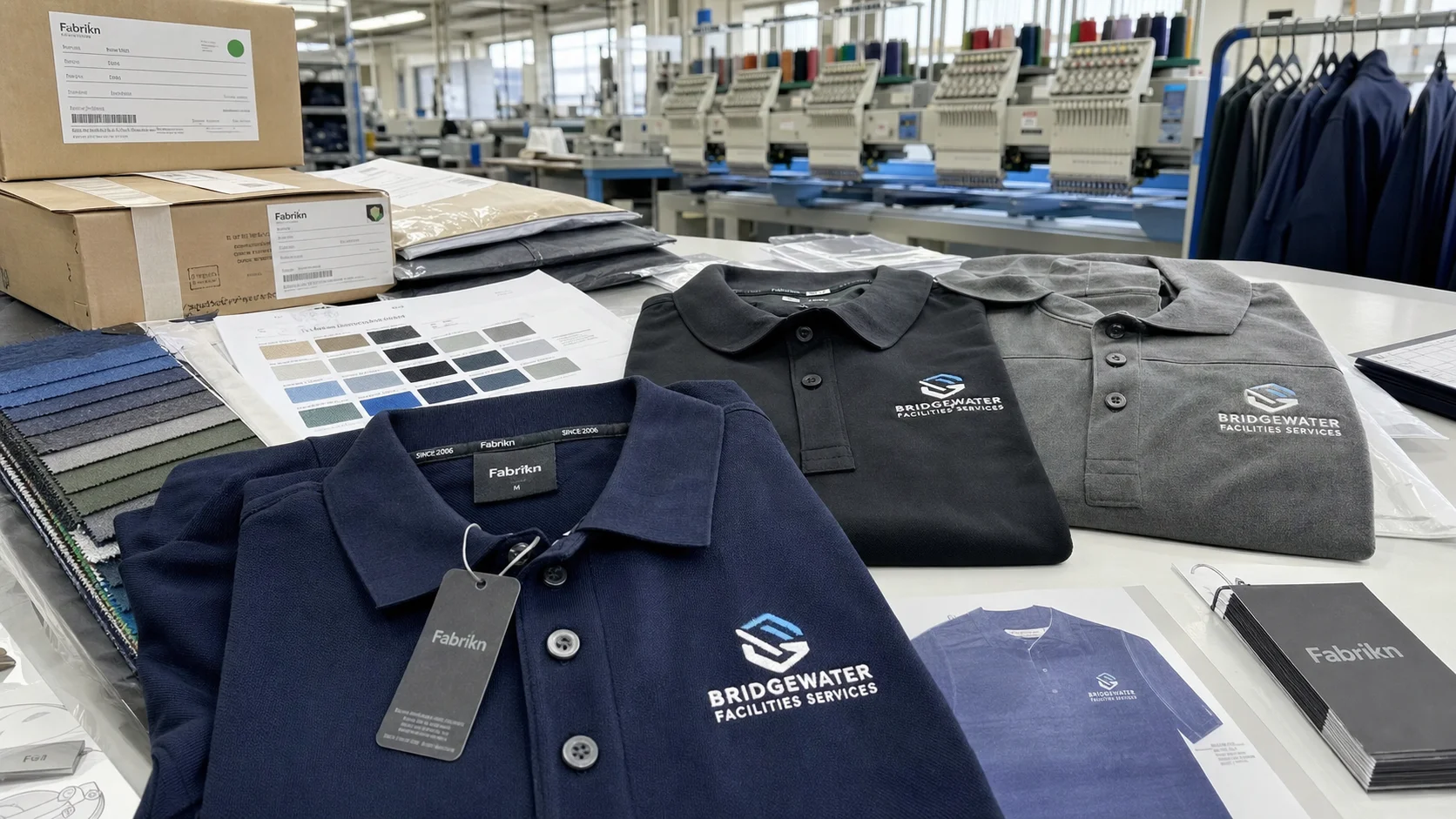
QR Code Hang Tags with checks for samples, fit, MOQ, QC evidence, pricing terms, and delivery risk.
Fast answer: QR Code Hang Tags: Scan Setup, Print, Cost, and ROI should be judged by production evidence, not by a generic sourcing promise. The buyer needs sample proof, cost breakdowns, QC checkpoints, and delivery buffers in writing.
Ask for recent sample photos, measurement tolerances, fabric or print test assumptions, decoration test notes, packing examples, and a named inspection checkpoint. These details show whether the team can repeat an approved sample at bulk volume.
Separate garment cost, decoration, labels, packaging, sampling, testing, freight, and rush charges. When every cost line is visible, it becomes easier to reduce colorways, adjust size depth, or reserve more time for sampling.
I keep seeing the same retail paradox: brands print pages of copy, then watch shoppers ignore most of it on the way to the fitting room. In store visits across Los Angeles, Guangzhou, Dhaka, Ho Chi Minh City, Milan, and Istanbul, the floor truth was blunt. The average apparel item gets about 7 to 12 seconds of attention before a decision is made, yet the tag often carries 120 words no one reads. QR code hang tags for clothing brands are showing up because they turn that wasted print into one scan, one pause, and one better shot at being noticed.
The value is not abstract. A tag can route shoppers to a product page, a fit guide, a fabric proof page, or a coupon, and each path can be measured. I’ve seen brands collect 18% to 31% scan rates on higher-ticket items priced at $68 to $180, while expensive in-store signage near the same rack barely moved the needle. That does not make signage useless. It just means the tag sits at the exact moment of decision, when curiosity and doubt are both high.
What shoppers do after the scan matters more than the scan itself. Some want size details. Some want to know if the sweater is 100% merino wool or a 70/30 blend. Others want proof that “recycled” means something real. When the post-scan page answers one specific question in under 15 seconds, brands see longer dwell time and less hesitation. I’ve worked with teams that used the tag to capture 4,000 to 12,000 email addresses in a season, then tied that capture to a 6% to 14% reduction in returns on complex fit categories.
Hang tags also beat sewn-in labels for certain messages because they are temporary, visible, and easy to change. A care label must survive 20 to 50 washes. A hang tag only needs to survive from warehouse to checkout. That makes it ideal for launch messages, sustainability claims, or category-specific instructions, especially in premium knitwear, denim, and occasionwear where the margin can absorb an extra $0.06 to $0.18 per unit.
The business case is bigger than design. It is packaging economics, conversion, and operational fit. Brands that treat the tag as a data surface, not decoration, get more use from every square centimeter.
I divide the journey into three moments: discovery, checkout, and ownership. The smart part is that one tiny code can serve all three without demanding a separate campaign for each stage. A shopper scans on the sales floor, reads on the mobile screen, and keeps the page or receipt email after purchase. That is a cleaner path than stuffing a tag with four claims, a promo code, and a recycling icon no one can decode in 3 seconds.
During discovery, the code can send shoppers to a product page, a short video on drape or stretch, or a comparison chart against other fabrics. For a cotton tee, that may mean 220 GSM jersey details and shrinkage data after 5 home washes. For a blazer, it may mean construction notes and lining composition. The more uncertain the fit or feel, the more useful the scan becomes.
At checkout, the tag can support the decision with practical proof. I’ve seen better results when a code leads to one page built for one SKU, one region, or one season rather than a generic homepage. A brand selling in Europe might show multilingual care notes and VAT-inclusive pricing, while the same garment in the U.S. can show size conversion and free shipping thresholds. For private label clothing services, that kind of page specificity can protect margin because it reduces pre-sale questions and post-sale confusion.
Ownership is where the long tail appears. The tag can link to care guides, repair booking, warranty registration, authenticity checks, or resale registration. That is especially useful for fashion because the common objections are not mysterious: fit uncertainty, fabric anxiety, sustainability skepticism, and care confusion. A sharp QR destination can answer all four in fewer than 10 taps.
The best-performing tags usually keep the message set tiny. One action. One promise. One code. When I visited factories in Vietnam and Portugal, the labels that tried to do everything were the ones most likely to be ignored, while the plain tags with clear instructions kept earning scans week after week.
Scan rate starts with basic geometry. A code needs enough quiet zone, enough contrast, and enough room away from folds or punched holes. If the artwork places the code too close to the edge, the printer trims into it. If the code is too small, older phones fail. I ask brands to keep the code at least 18 to 22 mm wide for short URLs and larger for complex destination paths, because a 12 mm code may work on a desk and fail under harsh retail lighting.
Placement matters as much as size. The code should not compete with the price, SKU, or branding mark. It should sit where the shopper’s eye naturally lands after picking up the garment. On a denim tag, that may be the lower right corner. On a knitwear card, the center-left often works better. I’ve seen scan rates jump from 9% to 19% simply by moving the code 14 mm away from a foil logo and adding a stronger call to action.
Material choice changes both durability and scan reliability. Coated paper is cheap and crisp. Kraft stock feels earthy, but dark fibers can weaken contrast. FSC paper and recycled cardstock are often the sweet spot for brands selling at $38 to $110, because they balance image, price, and recyclability. Synthetic stock survives moisture and rough handling better, which helps for outerwear or baby apparel. For custom baby clothing manufacturing, I prefer a softer matte finish because parents handle packaging more often and less glare means fewer failed scans.
Finish decisions are not cosmetic trivia. Matte usually scans more reliably than gloss. Spot UV can work if it sits away from the code, but full varnish over the QR often causes problems under store spotlights. Foil can be elegant, yet it may reflect enough light to confuse camera focus. A tag that looks expensive but fails to scan is a bad trade.
Brand voice should stay short and direct. I want copy that says exactly what the shopper gets: “Scan for fabric proof and care.” Or “Scan for fit, wash, and resale.” Not four benefits. Not a paragraph. The goal is to reduce hesitation in less than 5 seconds.
Factory discipline matters too. Poor artwork handoff creates reprints, sometimes 5,000 to 20,000 units at a time, while a well-built dieline with correct bleed, tolerance, and code placement cuts waste and delay. That is why I push teams to approve a sample on the actual stock before committing to the run.
The cost spread is wider than most founders expect. At 1,000 units, digitally printed QR hang tags can land around $0.18 to $0.45 each depending on stock, cutting, and stringing. At 10,000 units, offset or high-volume digital work can drop to roughly $0.05 to $0.14 per tag. At 50,000 units, simple paper tags can go lower still, though specialty finishes pull the number back up fast. That is why price tier matters as much as quantity.
Cost drivers are easy to name and easy to underestimate. Paper stock adds $0.01 to $0.06. Die cutting can add $0.005 to $0.02. Lamination or varnish adds another $0.01 to $0.04. Variable data, if each SKU needs a unique code, can raise setup complexity. Stringing and attachment may add $0.02 to $0.08. Packaging, bundling, and QC checks all cost money too. A premium brand might spend more on cotton string, thick FSC board, and soft-touch coating, while a basics brand usually focuses on speed and unit economics.
I’ve seen brands overspend in the same three places. They pick a custom shape that demands a high die charge. They choose a finish like holographic foil that pushes press runs into specialty pockets without enough volume to amortize. They rely on a boutique laser-cutter in Istanbul for 250 tags, only to see the burr throw off the quiet zone and kill scans.
For a low-volume test run in Guangzhou using 300 GSM recycled cotton-linen board, cold foil accents, and cotton-wrapped steel grommets, the supplier quoted $2.50-4.00 per unit at 500 MOQ with 18-22 business days from signed proof to palletized tags. That price included UV curing on a Heidelberg Speedmaster, a Bobst automatic die cutter, and automated quality checks on a digital inspection table before packaging. The same production line can switch to 210 GSM recycled PET synthetic stock for a rainwear launch if requested, but the tooling changeover and tension control on the Komori 4-color press add another $0.06 per tag.
When you factor in logistics, those lead times matter. A tag shipment from Ho Chi Minh City or Dhaka to New York takes 12 to 15 days by sea with 2 days of customs clearance, so the factory timeline needs to absorb another week of transit buffer. That is why accurate forecasting, tight artwork files, and early approval of adhesives—like OEKO-TEX Standard 100 certified glue—can prevent a ripple of expedited air freight that negates any unit cost savings.
Setting up a repeatable production line means choosing factories that already handle responsible packaging. Partners in Guangzhou, Dhaka, Ho Chi Minh City, and Istanbul routinely stamp GOTS, OEKO-TEX Standard 100, WRAP, BSCI, and GRS certificates on their walls because their sheet-fed lines, laser cutters, and finishing rooms already service apparel brands that demand them. You want to be sure your supplier can produce 3,000 tags in one day on a Heidelberg Speedmaster XL 75, then switch to a Bobst SP 104 for die cutting and Komori 4-color presses for secondary colors without losing the quiet zone or the QR contrast.
Those machines are not toys. The Speedmaster requires a prepress operator to check plate density and register before every run; the Bobst die cutter needs calibrated pressure to avoid crushing the board around the QR code; the Komori press demands just enough drizzle dampening to keep the ink from pooling on a soft-touch coating. Add a UV curing tunnel, a cold foil head, and an inline laser perforator for tear tabs, and you have a balanced line that produces 6,000 tags per shift with consistent readability.
Data capture in the factory keeps the tag useful after it ships. Each batch gets scanned with a handheld verifier tied to the brand’s ERP, and machine operators log scrap, curl, and adhesion strength. That data feeds into the QR destination, too—each code can carry batch metadata so the post-scan page knows the dye lot, the certified material source (like GRS-certified recycled PET), and whether the stringing supplier is WRAP-compliant. Brands can then link to care guides, warranties, and resale portals with confidence that every tag matches the garment it came with.
Launch with a pilot SKU. Order three styles of a knit, a woven, and a denim sample made at the same Guangzhou, Dhaka, or Ho Chi Minh City partner, and keep the file consistent: 300 DPI, CMYK + spot varnish, 4 pt quiet zone, and a stripe of magnetic ink for high-end scanners. Use the same adhesive, grommet hole, and string so you can compare scan rates apples-to-apples.
Run those samples through a retail test for one week in your preferred market—whether that is a boutique in Los Angeles or a pop-up in Milan—and measure two things: scan rate (does the code work under fluorescent light?) and dwell time (does the post-scan page load in under 2 seconds?). If the first design meets your 16% scan benchmark, you can roll 2,000 to 5,000 units into the next production wave with a more aggressive finish or multilingual content tailored for Istanbul or Ho Chi Minh City customers.
Keep a digital twin. Store all QR destinations in a headless CMS, link them to a single API, and update the page on the fly if supply chain claims change (for example, when a particular yarn moves from GOTS to OEKO-TEX Standard 100 certified). That way, you do not need a new print run every time you want to mention a sustainability milestone or a limited-time care video.
Manage inventory with a digital pouch. Track the tags on your ERP with batch-specific barcodes, and sync them with the garment SKU. Include the scan count on your weekly dashboard; it is a leading indicator of engagement before the product is even priced in-store. You can even use the code to reward the shopper with a rinse guide, upcycling tip, or repair booking and then measure how many people actually show up for the service in the 45 days after purchase.
The next wave is smarter tags. Expect to see combined QR + NFC badges printed on 250 GSM recycled cotton-linen card stock, each linked to a bilingual story page hosted on a headless CMS that runs on Shopify Plus, Fabric, or Webflow. Those pages will integrate product provenance, repair schedules, and resale registration, while also feeding the brand’s CRM. The best campaigns will push the QR scan directly into a repair booking widget, so the moment a garment needs a fix, the shopper already has the step-by-step instructions.
Another trend is regional customization via micro-runs. Factories in Guangzhou and Istanbul already run the same die for multiple brands; they just change the finish, string color, or ink set to match the collection. That agility is what lets brands offer premium hang tags with linen rope, rhodium-plated grommets, or braided cotton string from Dhaka without jumping to another supplier.
Finally, there is more accountability. The tags themselves are becoming certified with GRS or OEKO-TEX Standard 100 adhesives, WRAP-audited stringing partners, and BSCI social audits. That assures retailers, especially in Europe, that the entire journey—from pulp to print to shopper—is audited. QR hang tags are no longer just a marketing move; they are a compliance checkpoint.
Can QR hang tags handle limited edition drops? Yes. Run a short batch of 1,000 to 3,000 tags on a Heidelberg Speedmaster paired with a Bobst die, use a serialized QR for traceability, and ship from the Guangzhou or Dhaka facility with serialized packaging. That way, each scan ties back to a limited release number, and you can layer in an invite-only resale portal without overstretching the design.
How do I confirm code readability before mass production? Approve a pre-production sample and verify it with a handheld scanner—it should pass ISO/IEC 18004 standards. Have the factory run that sample on the Komori press using the same inks, varnish, and string, then load the tags into a humidity-controlled room to simulate a warehouse hold.
What certifications should my tag and factory hold? Look for GOTS, OEKO-TEX Standard 100, WRAP, BSCI, and GRS in the factory portfolio, especially if your hang tag mentions sustainability or recycled content. These certifications ensure the materials, adhesives, and labor practices align with the claims you make in the QR-powered stories.
What lead time should I expect? Typically, budget 18-22 business days from final artwork approval to finished pallets on-site if you are sourcing from Guangzhou or Ho Chi Minh City, plus 12 to 15 days of sea freight if you ship to North America. That includes printing, die cutting, UV curing, and inline inspection.
Where should I focus my spend for maximum impact? Invest in high-contrast, single-purpose QR placement, clear copy (“Scan for fit, wash, and resale”), and B2B-friendly finishes like matte lamination or cold foil that complement the garment. Save specialty treatments for higher-ticket items unless you have at least 5,000 pieces to amortize the die and finishing charges.