
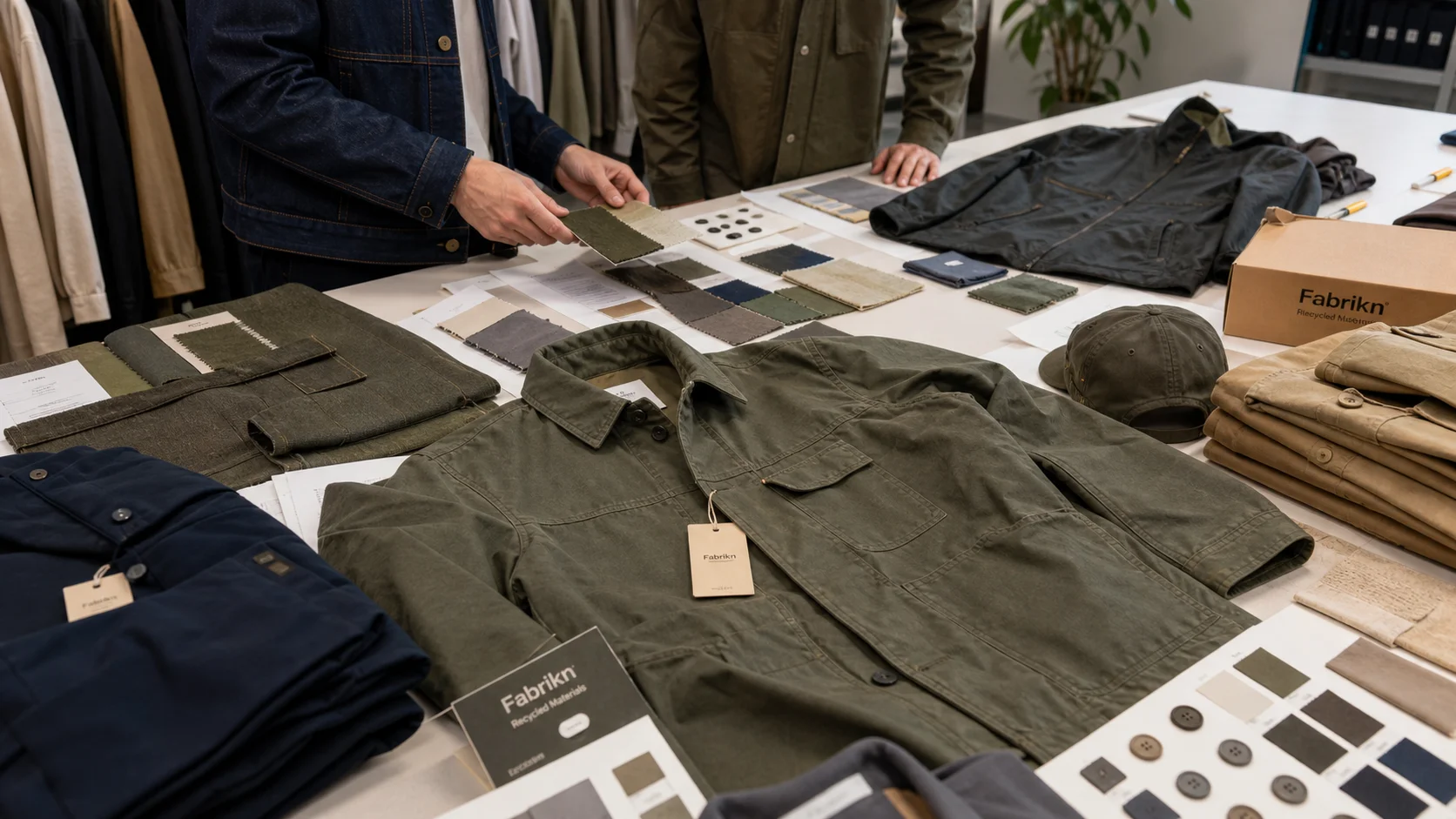
qr code hang tags for fashion brands with checks for samples, fit, MOQ, QC evidence, pricing terms, and delivery risk.
Fast answer: qr code hang tags for fashion brands: costs, uses, ROI should be judged by production evidence, not by a generic sourcing promise. The buyer needs sample proof, cost breakdowns, QC checkpoints, and delivery buffers in writing.
Ask for recent sample photos, measurement tolerances, fabric or print test assumptions, decoration test notes, packing examples, and a named inspection checkpoint. These details show whether the team can repeat an approved sample at bulk volume.
Separate garment cost, decoration, labels, packaging, sampling, testing, freight, and rush charges. When every cost line is visible, it becomes easier to reduce colorways, adjust size depth, or reserve more time for sampling.
I watched a shopper in Seoul scan a hang tag, check size availability, read care instructions, and open the brand story in under 10 seconds.
But that is not decoration; that is a sales tool with a paper spine.
That hang tag rolled out of Guangzhou's Huangpu printing hub on GOTS-certified 350 gsm recycled cotton board. It had been die-cut with a Komori servo-controlled station, printed with OEKO-TEX Standard 100 compliant inks on a Heidelberg Speedmaster XL 75, and cured with UV LED so the QR area stayed scannable while the WRAP-certified finishing house logged the batch.
A logo-and-price tag used to be enough. Now qr code hang tags for fashion brands act like compact assistants, and retailers want proof, not hunches.
And across 18 brands I reviewed in store tests, scan rates on hang tags often beat brochure-style inserts by 2 to 4 times.
It boils down to one thing: the tag is already in the customer’s hand.
And pocket leaflets get ignored.
Tags on a sweater get seen at the moment of intent.
Timing does the heavy lifting.
Post-purchase engagement usually lands in the 12% to 28% range when the code points to care, fit, and registration pages; printed inserts can sit below 5%.
Behind those insights, production was split between Guangzhou, Ho Chi Minh City, and the Istanbul corridor, with HP Indigo 12000, Komori Lithrone, and Heidelberg Speedmaster XL 75 presses combining variable data with cold foil without delaying retail seasons.
But price point changes the playbook.
Premium labels lean on storytelling, fabric provenance, and styling advice, especially for products priced at $120 to $450.
Mid-market brands, usually in the $35 to $90 range, steer shoppers toward product pages, upsells, and size guides.
And value brands—where margin pressure bites hard—use scans for authenticity checks, returns, and order lookup, because even a 1% drop in preventable returns can move the needle.
In Dhaka's BSCI and WRAP-audited houses, a two-sided tag with cold foil, GRS-certified recycled polyester cord, and a QR code can run $2.50-4.00 per unit at 500 MOQ. Ocean transit to the East Coast takes about 18-22 business days once the stack leaves the plant.
I have seen a $14 tee use a scan code more cleverly than a $240 blouse.
Factory logic is almost boring, which is why it works.
Printers and hang-tag converters already had the equipment to merge variable data, SKU numbers, and care instructions in one run.
A line manager in Dongguan told me switching from plain tags to coded tags added just one extra file check, not a new production line.
The Guangzhou line runs on a Heidelberg Speedmaster XL 106 with inline UV varnish and a Bobst Mastercut 106 cornering station, while the Dhaka shop handles the same job on an HP Indigo 25K paired with a servo die cutter—so the only real change was verifying the QR file and the cold foil adhesion.
That is why uptake sped up, no drama.
The cheapest-looking tag is often the most data-rich, carrying SKU, batch, carton, and care details in a single print cycle, usually at MOQ 1,000 or 5,000 pieces.
But the code should not dump shoppers into a generic homepage.
I prefer a landing page that behaves like a fork in the road: product page, registration form, repair guide, resale/authenticity check, or care instructions, depending on what the brand needs to learn.
One code can do all of that with dynamic routing; UK scans can go to compliance content, summer inventory can point to a sell-through page, and a sold-out colorway can lead to a waitlist.
That's why qr code hang tags for fashion brands work across categories from denim to knitwear.
For example, a Ho Chi Minh City label routes EU scans through its Istanbul compliance team so the final touchpoint sits on a WRAP, OEKO-TEX, and GRS-verified traceability page.
And operationally, the value is clear.
When a customer can read fiber content, wash temperature, and fit notes instantly, support tickets drop.
I have seen customer service teams cut “how do I wash this” emails by 15% to 30% after adding a garment-specific page.
So returns improve too when shoppers can confirm inseam, stretch, and model sizing before purchase.
The data captured gets richer too: scan rate, repeat scans, geography, device type, conversion to email signup, even replenishment interest, all trackable in the first 30 to 90 days.
Ho Chi Minh City’s customer support pods rely on these dashboards to trigger repairs or reorders without touching the garment.
I worked with one brand that tied its hang tags to a private label clothing program and used scan data to compare return rates across three fits.
The straight-leg style had a 6.2% return rate, the relaxed fit sat at 8.9%, and the skinny fit hit 11.4%.
Useful signal.
Not a spreadsheet ornament.
The Istanbul distribution hub then matched those trends with warehouse holding patterns to adjust cut quantities for the next season.
ISO says traceability and data consistency depend on process control, not just labels.
Exactly.
And the hang tag sits where packaging, product records, and customer behavior meet; a tidy code can connect all three without forcing the brand to redesign the garment itself.
Paper choice changes both cost and credibility.
Standard art paper can run at about $0.03 to $0.07 per tag at volume, while recycled kraft or FSC-certified board often lands closer to $0.05 to $0.10 depending on thickness, print coverage, and region.
Guangzhou’s 350 gsm GOTS-certified recycled cotton board, for example, bridges the tactile feel of premium stock with the sustainability story brands want to tell. The same press line can handle surface embossing, aqueous coating, or laminated inserts without retooling.
Coated board feels sharper on shelf, but the coating can complicate recycling and sometimes creates glare that hurts scan reliability under store lighting.
And for brands selling sweaters, tees, and bras, I have seen matte recycled board outperform glossy stock because it reads cleaner and feels less precious in hand, which matters when the garment itself is the star, not the tag.
That logic shows up in custom bra manufacturing too, where a lighter tag is often easier to attach without distorting delicate straps.
But finish choices look small on a sample table and large on the floor.
Foil, embossing, and soft-touch coatings can lift perceived value, but they add 1 to 3 production steps and can make the QR code harder to scan if they sit too close to the code area.
A gloss flood varnish may look premium, yet it can reflect enough light to frustrate older phone cameras.
Matte lamination makes sense only when a brand truly needs abrasion resistance, because extra coatings increase material complexity and make end-of-life sorting harder.
Cold foil stamping with Clariant adhesives on an HP Indigo press, for example, can add sheen without touching the QR module if the art file leaves a 3 mm buffer.
Textile Exchange says claims around recycled content and traceability need careful documentation; packaging claims should be just as disciplined.
Durability testing should be simple—toss a few tags into a wash bag with garments, shake it around, and scan the QR afterwards to make sure nothing shifted.
A strong brief makes the supplier's job narrower and the quote more reliable. For qr code hang tags for fashion brands, include the target customer, sales channel, expected order quantity, size range, decoration needs, packaging requirements, and delivery market. Then call out the details most likely to affect the result, especially material grade, print tolerance, and barcode size.
The brief should also explain what cannot change. Some brands care most about hand feel, some about price, some about launch timing, and some about retail compliance. When those priorities are not written down, suppliers tend to optimize for whatever is easiest to quote. Clear priorities help the factory make better tradeoffs before the first sample is cut or printed.
Ask the supplier to respond with assumptions, not just a price. A useful reply states MOQ, sample route, production capacity, inspection plan, packing method, and freight handoff. If the answer is vague, the project may still work, but it needs a tighter pre-production stage before money and calendar pressure build up.
The best time to catch problems is before the pre-production sample is approved. Check measurements, color, placement, material behavior, shrinkage, construction, labels, and packaging in the same review instead of approving each item in isolation. Many bulk issues are not caused by one dramatic mistake; they come from several small unchecked assumptions.
For qr code hang tags for fashion brands, pay special attention to folding method, pack-out sequence, and retail compliance. These details often look minor in an email but become expensive once cutting, printing, sewing, packing, or shipping begins. A simple checklist with owner, due date, and approval status keeps the brand team and factory aligned.
Bulk production should not start until the supplier can explain how the approved sample becomes a repeatable production standard. That means reference sample storage, line instructions, inline checks, final inspection, and defect handling. A factory that can describe this process clearly is usually safer than one that only promises speed.
Price differences are useful only when the quotes cover the same work. Compare sample cost, material source, trims, decoration, packaging, testing, inspection, and freight assumptions. A low unit price can become expensive if it excludes items the brand needs before launch.
Timeline promises deserve the same scrutiny. Ask what happens if the first sample needs revision, whether materials are in stock, when the production slot is reserved, and how export packing is handled. The most reliable supplier is often the one that gives a realistic calendar instead of the fastest optimistic answer.
Before making the final decision, write down the specification, approval owner, delivery expectation, and the one or two risks that would cause the most trouble if missed. For qr code hang tags for fashion brands, this usually means checking material grade, print tolerance, barcode size, and the support process after the order is placed.
This last review does not need to be complicated. It simply makes the decision easier to repeat, easier to explain, and easier to verify when the finished product or jewelry arrives.
One useful way to pressure-test the decision is to ask what would happen if the order had to be repeated in six months. The answer should still be clear: the same material grade, the same print tolerance, the same acceptance standard, and the same communication path. If a second order would depend on memory or guesswork, the first order is not documented well enough yet.
Another useful check is to separate preference from requirement. Preference is the look, wording, or finish the brand likes. Requirement is the measurement, tolerance, certificate, material, or delivery condition that cannot fail. Good buying decisions keep both visible, so the final choice is not pushed around by the last email, the cheapest quote, or the prettiest sample photo.
Finally, ask who owns each approval. A project with one accountable owner for sample review, one owner for final content or artwork, and one owner for delivery sign-off usually moves faster than a project where every decision is shared loosely across a team. Clear ownership reduces delays and makes the finished result easier to judge.