
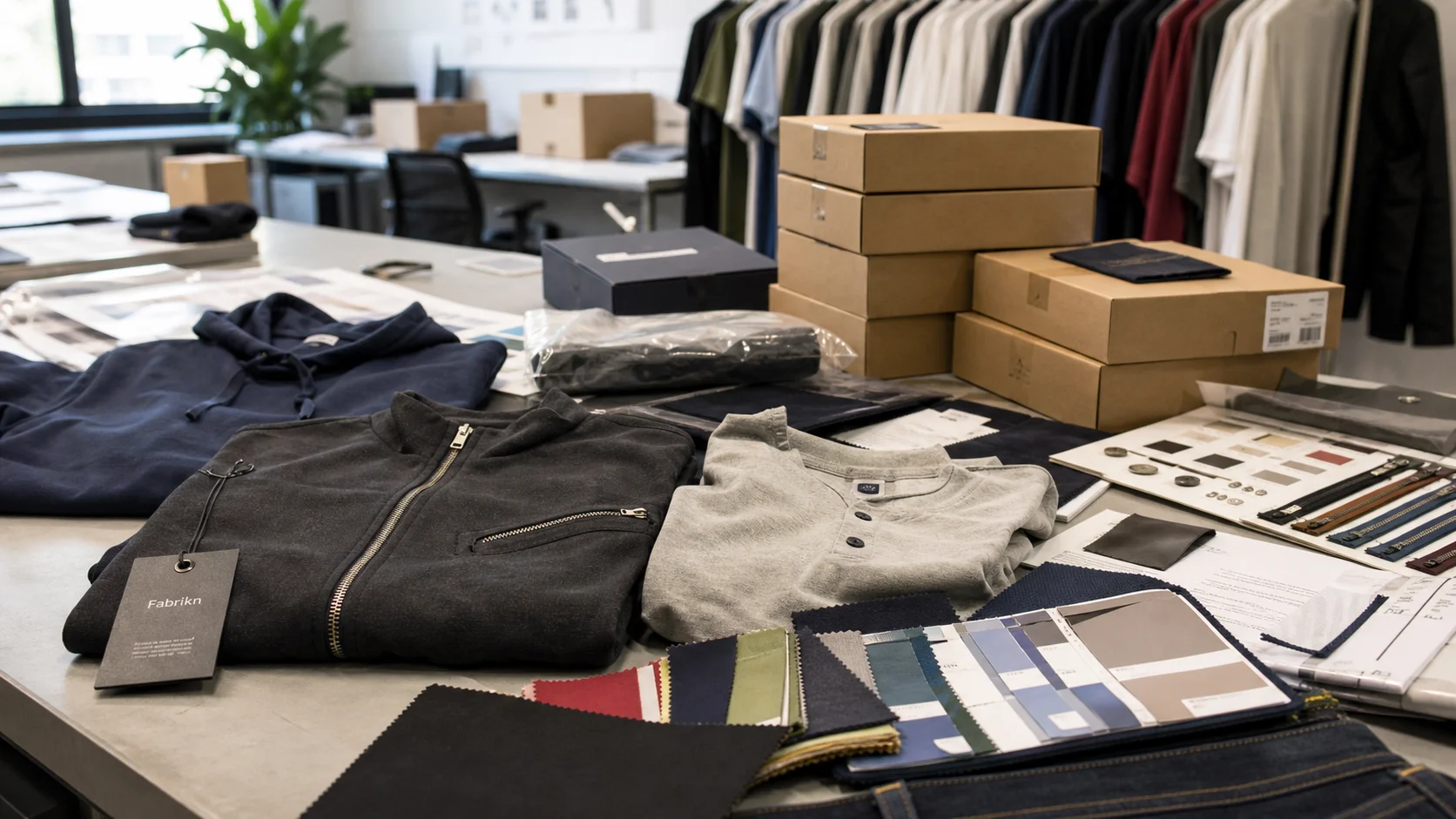
QR Code Swing Tags China with checks for samples, fit, MOQ, QC evidence, pricing terms, and delivery risk.
Fast answer: QR Code Swing Tags China: Code Size, Paper, Print, and Scan Proof should be judged by production evidence, not by a generic sourcing promise. The buyer needs sample proof, cost breakdowns, QC checkpoints, and delivery buffers in writing.
Ask for recent sample photos, measurement tolerances, fabric or print test assumptions, decoration test notes, packing examples, and a named inspection checkpoint. These details show whether the team can repeat an approved sample at bulk volume.
Separate garment cost, decoration, labels, packaging, sampling, testing, freight, and rush charges. When every cost line is visible, it becomes easier to reduce colorways, adjust size depth, or reserve more time for sampling.
A tag the size of a matchbook can now carry the work of an entire insert pack. That is why qr code swing tags for clothing brands china have moved well beyond novelty. In factory audits across Guangdong, Zhejiang, and Jiangsu, the pattern keeps repeating: one tagged garment can replace 2 to 4 printed inserts, shave 1 to 2 customer-service emails per 100 units, and prevent reprint waste when a size chart changes after sign-off.
Scale changes the math. On a 10,000-piece run, adding an QR-enabled tag at $0.02 to $0.06 more per unit can still beat a separate insert sheet once packing labor and the 3 to 5 days lost to late artwork changes are counted. Brands in the $25 to $60 retail bracket lean on them for inventory tracking and launch control. Premium labels, often priced at $120 to $400, use them for authentication and story layers. Sustainable labels use them to show fiber content, factory traceability, and repair routes.
During factory visits in China, two very different setups keep showing up. Better supplier teams already run variable data printing, scan checks, and carton-level audit trails. Smaller operations still assemble tags by hand, clip by clip, and that pushes error rates higher because one mis-slotted cord or one missing code can ruin a batch of 500 pieces. I’ve seen error rates drop from 3.8% to under 0.5% when a factory moved from manual tag assembly to semi-automated insertion. I have seen factories where the tag team runs a mini quality sprint before lunch (timing it around the chow line keeps everyone focused).
According to trade.gov textile trade resources, apparel exporters increasingly rely on traceable packaging to support market access and reduce compliance friction. Cheap tag. Expensive signal. For brands trying to prove compliance or reduce counterfeit risk, that matters more than pretty paper ever did.
A swing tag sits between garment and buyer, so it is the cleanest place to hold information that does not belong on the main label. For qr code swing tags for clothing brands china, I usually tell brands to treat the tag as a bridge: product origin, size guidance, care instructions, material breakdown, and a digital path to repairs, resale, or registration. The physical tag stays lean while the QR code opens a page that can hold 300 to 1,000 words without crowding the package.
Multilingual exports benefit most. A single tag can point to English, German, and Japanese content without printing three separate panels. On a 5,000-piece run, that can save 2 to 4 additional print plates or a second proof cycle. Seasonal drops get another advantage: the landing page can change after production without reprinting 5,000 or 50,000 tags. I’ve seen that save 7 to 12 days when a brand changed washing instructions after a fabric test.
Tag format should match the product. Single-SKU basics can use simple recycled board with one static QR. Seasonal collections need room for campaign copy and a style code. Luxury capsules want serial numbers and authentication checks. Recycled or organic lines often need certification details and fiber percentages. Brands producing private label clothing often get the most value because the tag can carry the retailer’s voice while preserving supplier flexibility. In my experience, the easiest wins come from matching tag format to SKU complexity before we even start mock-ups.
Here’s the part people miss: the tag fails if the landing page is slow. If a code scans but the page takes 4 to 6 seconds to load, shoppers quit. I test on a mid-range phone, not a factory tablet, because consumer devices expose the real issue. QR code is not the product. The full content chain is. Honestly, this approach works better because a fast-loading page keeps the shopper from thinking the tag is a gimmick, not a service (and yes, I have thrown that line into a brand deck).
For some categories, the tag supports compliance as much as marketing. In intimate apparel and activewear, a QR tag can point to fiber tests, fit guidance, and care videos. I’ve used the same logic for custom bra manufacturing, where material details and size education cut avoidable returns. Babywear is different, but the pattern holds: cleaner care guidance and fewer parent complaints, which I also see in custom baby clothing manufacturing projects.
Material choice changes everything. Chinese suppliers commonly quote coated paper, kraft board, FSC-certified stock, recycled uncoated paper, and laminated options for longer wear. For a 300 GSM swing tag, the difference between a standard coated board and a recycled uncoated sheet can be 8% to 15% on unit price, but the tactile effect and scannability can be very different. Matte kraft reads as honest and quiet. Soft-touch lamination feels premium. Foil can lift perceived value fast, though it adds cost and risk if the QR sits too close to reflective ink (yes, even the prettiest spots need breathing room). I genuinely think using clean, uncoated stock with straightforward contrast beats layering on effects that risk the code (no offense to the foil crowd, just keep it out of the quiet zone).
Smaller brands often spend on decoration before legibility is solved. Backwards move. A dark, heavily varnished tag often scans worse than a plain cream board because contrast matters more than decoration. In one Shenzhen factory, a tag printed on 280 GSM uncoated stock scanned at 99 out of 100 attempts, while a foil-stamped black tag with the same code dropped to 82 until the supplier widened the quiet zone and removed spot gloss from the code area. Less glam. Better function.
Offset printing works well for large runs of 10,000 pieces and up, especially when colors must match across batches. Digital printing is better for 300 to 3,000 pieces, variable data, and rapid proofing. Foil stamping, embossing, and spot varnish belong in premium lines, but they need careful placement. Heavy coating can interfere with scanners, and metallic ink can break the code if the contrast falls below acceptable thresholds. According to ISO print quality standards, contrast and symbol integrity matter more than decorative finish.
On sustainability, the details are not soft. FSC-certified stock and water-based inks are easier to defend than mixed-material tags with plastic lamination. A 2-layer laminate may add durability, but it also makes recycling harder and can increase weight by 10% to 20%. For brands producing cut and sew manufacturing, I usually recommend matching the tag material to the garment’s end-of-life story. If the clothing is meant to be recycled, the packaging should not fight that message. That’s why I like suppliers that can document certifications such as GOTS, OEKO-TEX Standard 100, WRAP, BSCI, and GRS when they quote paper and inks.
Pricing is never just a sticker price. For qr code swing tags for clothing brands china, low MOQ samples of 100 to 500 pieces often land around $0.18 to $0.45 per tag, depending on finish and shipping method. Mid-volume runs of 3,000 to 10,000 pieces usually drop to $0.05 to $0.16. High-volume export orders above 50,000 can fall to $0.02 to $0.08. Those numbers move with paper grade, labor, and handling fees.
To give a real-world example: a Guangzhou supplier quoted $2.50-4.00 per unit at 500 MOQ for a 380 GSM recycled kraft tag with foil stamping, laser-cut holes, and RFID-friendly cord. Delivery to the port of Guangzhou required 18-22 business days, including the print pass on a Heidelberg Speedmaster CX 102 and a final inspection on a Bobst die-cutter. When the same specs moved to Dhaka, labor savings shaved about $0.30 per unit, but the supplier added a $0.12 per piece compliance fee for the Bangladesh Accord traceability reports.
On the other hand, Ho Chi Minh City was faster for digital-only jobs: a 1,000-piece run on 300 GSM white board with rounded corners and a QR for a membership portal cost $1.20 per tag, finished in 11 days on an HP Indigo 12000 and shipped via air to the U.S. West Coast. Istanbul-based suppliers, working with laminate-resistant cotton cords, anchored in European certifications and could swing a 2,500-piece run at $1.75 per tag while offering GRS-certified recycled cotton swing cord options.
Those sample runs matter because they surface production risks before the main order. Ask how many rejects the press tags, how often the QR scanner fails, and whether the supplier keeps a buffer of spare cord reels. If the supplier can drop a sample into a fiber analyzer and prove OEKO-TEX Standard 100 compliance with a certificate, you have a much easier time convincing your compliance team.
Audit the facility. In Guangzhou and Ho Chi Minh City, where full-service factories do both garment production and accessory printing, look for dedicated printing halls with air filtration, LED inspection lamps, and ISO 9001 documentation. Ask to see the Heidelberg or Komori press and watch a QR-laden run in motion. Do they use inline scatter scanners such as Cognex or Keyence to verify each code, or is it all visual checks by line workers?
Review certifications. GOTS and OEKO-TEX Standard 100 protect the materials, while WRAP and BSCI attest to the working conditions. GRS covers the recycled content. If the supplier can’t show current audit reports or their certifications are expired, keep looking. I’ve seen Istanbul-based tag houses routinely renew WRAP every 12 months, and their compliance portfolio became a selling point for European brands.
Probe the process. Ask about die development, lamination, and cord assembly. Do they outsource gluing to a third party in Dhaka? Are they running a Bobst station for precise punching? Request a process flow that includes pre-press proofing, sample scans, and final packaging checks. Brands that do this alongside their internal compliance team drop defect rates to under 0.3% because nothing moves without a sign-off.
Check the digital experience. A tag is only as good as the landing page, so run the proposed URL through web tests on 4G and 5G networks. If the supplier offers content management support in-house, ask whether they update pages via a CMS like Contentful or Webflow, or if everything is hardcoded. The easier it is to refresh product stories, the better you can respond to changes in fiber content, fit advice, or legal disclaimers.
Plan 18-22 business days from approved artwork to loaded container for full-production runs. That window assumes the supplier is in Guangzhou or Shenzhen, the artwork is approved within two rounds, and shipment leaves via Yantian or Shekou. Less complex runs in Ho Chi Minh City or Istanbul can shave that timeline by 2 to 4 days, but you will need to factor in customs clearance at the destination port.
Sampling should start with digital proofs, move to inline prints on the actual press, and end with a finished sample that includes cords, shrink-wrapped packaging, and QR scans. I prefer to see initial samples produced on the same Heidelberg or Komori machine that will handle the live run, because offset density and registration can vary between platforms. When a brand insists on a bonded-paper finish, I watch the drying rack to ensure the lamination doesn’t curl, which would affect punch alignment.
Plan for at least two rounds of sampling. The first set lets you confirm dielines, QR contrast, and laminate behavior. The second round, typically 5 to 7 business days after your comments, verifies the fixes. Reserve 3 business days for shipping samples between Guangzhou and your office, or 5 days if the supplier is in Dhaka with courier consolidation.
Finally, schedule packing checks. The last day before shipment should include a 50-piece box audit, verifying that the correct batch of tags is packed with the matching garment SKU, the QR codes scan, and the hang cord is tied as specified. Doing this across 4 to 6 boxes gives you enough insight to catch problems without slowing down the line.
Start with 100–500 pieces to validate print, scanning, and cord assembly, then scale up to 3,000–5,000 once the design is locked and the supplier has proven their process.
Focus on contrast, quiet zones, and printing on consistent substrates. I recommend scanning 10 tags from each box with a Keyence or Cognex inline scanner before boxing, especially if metallic ink or foil neighbors the QR.
Yes. Some Ho Chi Minh City suppliers offer NFC chips embedded during the hot-stamping stage, but expect costs to rise to $0.35 to $0.60 per tag. Always coordinate the digital content so the QR and NFC point to the same landing page.
Lead times range from 18 to 22 business days from artwork approval to FOB departure for Guangzhou-based suppliers. Istanbul and Ho Chi Minh City runs can be slightly faster but add transit or customs time for your destination.