
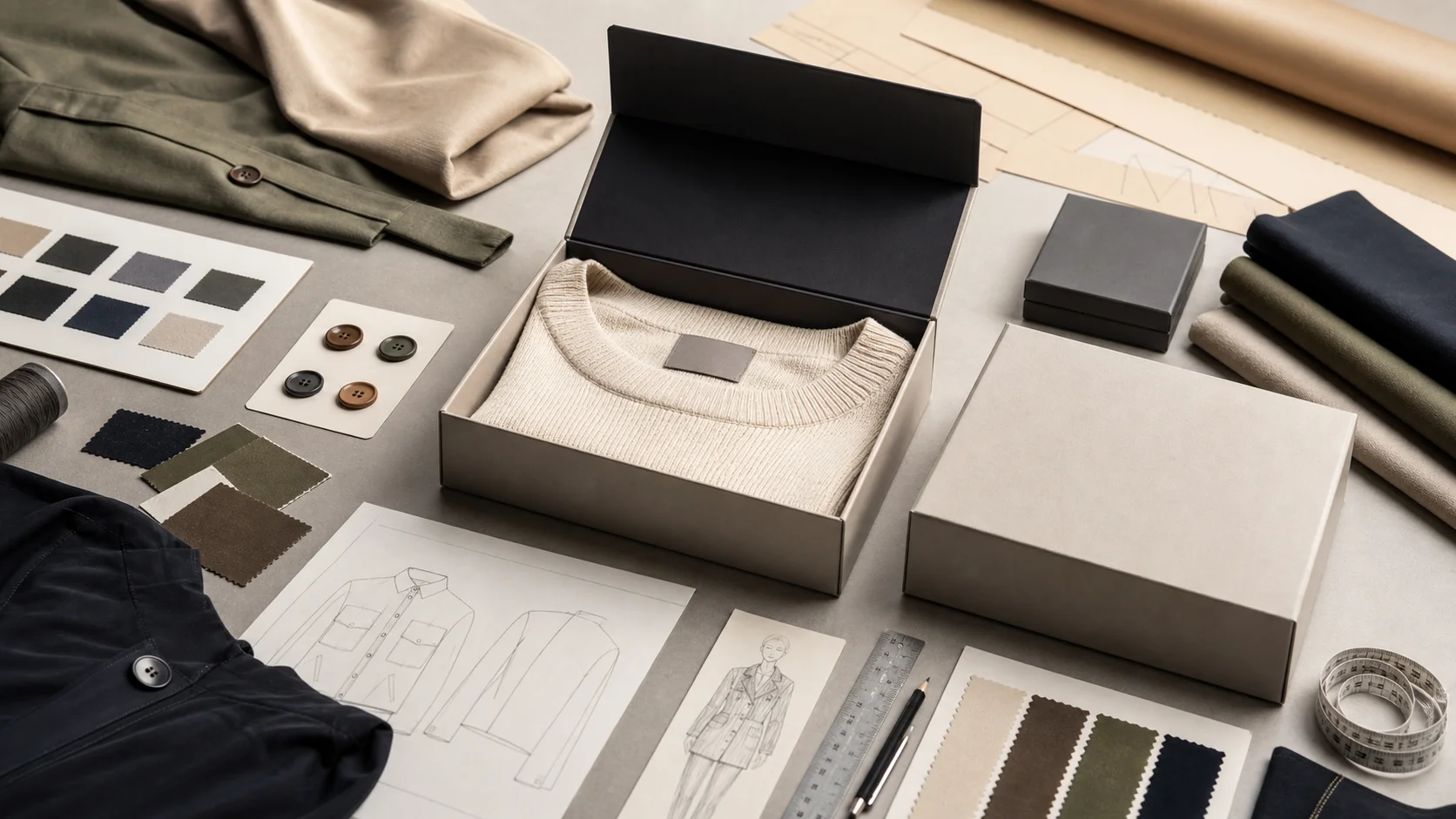
Design Magnetic Rigid Boxes for Capsule Drops compared by sample evidence, fabric or trim specs, MOQ, AQL terms, cost lines, delivery timing, and rework...
Fast answer: Design Magnetic Rigid Boxes for Capsule Drops: Tech Pack, Sample Gate, MOQ, and QC Terms should be judged by production evidence, not by a generic sourcing promise. The buyer needs sample proof, cost breakdowns, QC checkpoints, and delivery buffers in writing.
Ask for recent sample photos, measurement tolerances, fabric or print test assumptions, decoration test notes, packing examples, and a named inspection checkpoint. These details show whether the team can repeat an approved sample at bulk volume.
Separate garment cost, decoration, labels, packaging, sampling, testing, freight, and rush charges. Clear cost lines make it easier to reduce colorways, adjust size depth, or reserve more time for sampling.
How to Design Magnetic Rigid Boxes for Capsule DropsCapsule collections live and die by first impression. The product may be excellent, the styling may be sharp, and the story may be clear, but if the box feels forgettable, the launch loses energy before the customer even opens it. That is why rigid branded boxes with magnetic closure have become such a strong fit for capsule drops. They feel deliberate. They feel premium. They also give you a controlled, repeatable unboxing moment, which matters a lot when a collection is small, limited, and meant to be shared.
I have seen brands spend heavily on creative direction and then underinvest in the packaging. That is a mistake. For capsule drops, packaging is not just protection. It is part of the product narrative, the retail display, the social content, and often the resale value of the item itself. A well-designed magnetic rigid box can turn a simple release into something people want to keep, especially when the board is 2 mm greyboard, the wrap is 157 gsm art paper, and the closure is tuned to sit flush within a 1.5 mm lid gap.
In this guide, I will walk through the practical side of designing magnetic rigid boxes for capsule collections: structure, materials, print, inserts, finishing, production timelines, cost ranges, and the small decisions that separate a box that looks good online from one that performs well in real production. If you are exploring a new packaging program, you can also review our packaging services, learn more about fabrikn, or contact our team for custom support.
How to Design Magnetic Rigid Boxes for Capsule Drops - Packaging manufacturing guide
Capsule drops are built around scarcity, timing, and a sense of cultural moment. The packaging should reinforce all three. Magnetic rigid boxes do that well because they feel structured and intentional the moment someone picks them up. They have weight. They close cleanly. They signal that what is inside deserves attention, and a properly seated pair of 10 mm x 2 mm neodymium magnets gives the lid a crisp snap instead of a loose flap.
Compared with folding cartons, rigid boxes create a more luxurious first touch. Compared with drawer boxes, magnetic closures often feel cleaner for apparel capsules because they do not require the extra pull-tabs or friction-fit details that can complicate production. The box opens like a reveal, which suits fashion, streetwear, collaborations, and limited-edition merch drops. In practice, that also means fewer complaints from fulfillment teams because the lid stays aligned after 3 to 5 open-close cycles during QC.
They also travel well through channels. A strong rigid box helps with:
There is a practical side too. A box that opens and closes reliably reduces complaints and returns tied to damaged packaging. I would rather spend a little more on a good board and proper magnet placement than deal with a weak lid that pops open in transit. That kind of issue looks small on a spec sheet, then becomes expensive fast, especially when the closure tolerances drift by even 1 mm on a run of 500 units.
The best packaging starts with the collection story. Before you choose a paper wrap or foil color, define the personality of the drop. Is it minimalist and architectural? Is it sporty and limited? Is it playful and experimental? The packaging should echo the same language.
For example, a capsule collection inspired by utility wear might use a matte black rigid box with blind debossing, a single bold accent color on the interior, and a custom foam or molded insert. A luxury knit capsule might call for warm neutral tones, soft-touch lamination, and a satin ribbon lift. A collaboration drop could use a more graphic treatment, with strong logo contrast and a message printed inside the lid. If the item is a tee or hoodie, a 2 mm board with a 157 gsm wrap is usually enough; if the set includes a heavyweight knit or a cap in a separate tray, I would move to 2.5 mm board and a reinforced corner construction.
Ask a few practical questions at the start:
Those answers influence everything else. A box for one folded hoodie is not the same as a box for a coordinated set with accessories. I have seen teams try to force one "hero" box size across an entire capsule range, and the result usually feels clumsy. The product should fit the packaging. Not the other way around. If the garment stack is 35 mm high, build the internal depth around that stack plus 5 mm clearance, not a generic box height copied from another line.
Magnetic rigid boxes come in a few common constructions, but the most effective options for capsule drops usually involve a book-style hinged lid or a lift-off lid with hidden magnets. Each has a different feel.
This is the classic premium structure. The lid opens from one side like a book cover, with magnets embedded in the flap and front wall. It creates a clean reveal and is ideal for storytelling, branding, and layered inserts. It is especially strong when the unboxing journey matters as much as the item itself. In production, the hinge is usually wrapped with a scored paper spine, and a 0.3 mm-0.5 mm board relief at the fold helps the lid sit flat without cracking the wrap.
This version is slightly more conventional but still premium. It is useful when you want a sturdy lid and base that stack well in a warehouse or retail environment. It can also be easier to pack for certain apparel shapes, especially when the collection includes folded garments or soft accessories. A lid with 2-point magnet registration often performs better here, particularly when the base is 25 mm to 40 mm deep.
Some brands like a drawer structure with a magnetic wrap band or closure flap. It feels more editorial and can work well for very limited runs. It is also more expensive and usually slower to build, so I only recommend it when the packaging story needs that extra layer of ceremony. The drawer typically requires tighter die-cut tolerances, because a 0.5 mm mismatch can make the pull tab drag or collapse during assembly.
For most capsule drops, I prefer the book-style magnetic rigid box. It gives you the most controllable presentation without becoming too fussy. That said, the box should not be oversized. A box that is too large feels empty and wastes board, paper, and freight space. A good factory will flag this early, often during the first structural sample, because oversized packaging can add 12% to 18% more carton volume in shipping.
The material stack determines how the box performs and how it feels in hand. A premium appearance alone is not enough. The internals need to support the weight, the closure strength, and the final finish.
Component Common Choice Typical Spec Notes Rigid board Greyboard or chipboard 1.5 mm to 3 mm 2 mm is common for premium apparel boxes; 2.5 mm is safer for larger capsule sets Exterior wrap Art paper, specialty paper, or laminated printed paper 120 gsm to 157 gsm art paper over board Soft-touch lamination adds a refined feel; uncoated papers show scuffing faster in transit Magnet Hidden neodymium magnet Usually 10 mm to 15 mm diameter, depending on size Placement must be precise to avoid lid misalignment; many factories use a magnet insertion jig Insert Paperboard, EVA foam, molded pulp, or fabric-lined tray Cut to product dimensions Should hold the product without excessive pressure; EVA density is often 18 to 25 kg/m3 Print finish Offset printing, foil, emboss, spot UV Mixed by design Keep finishes disciplined, not crowded; KURZ foil and blind debossing are common premium choicesThe board thickness should match the weight of the garment and the size of the box. A 2 mm board is a reliable baseline for most capsule boxes. For larger or heavier sets, especially boxed sets with scarves, caps, or accessories, 2.5 mm or even 3 mm may be safer. In production, the magnet must be seated deeply enough so it does not create a visible bump under the wrap. That detail is small, but it matters. A good workshop will recess the magnet pocket by roughly 0.2 mm to 0.4 mm so the paper stays smooth after lamination.
As for wrapping, a soft-touch laminated art paper looks modern and luxurious, but specialty papers can create a stronger brand identity if you want something tactile. Uncoated stock can feel refined too, though it shows scuffing more easily. If the box will move through a busy fulfillment operation, durability should carry real weight in your decision. A lot of Guangzhou factories will recommend laminated Sappi or Fedrigoni-style cover papers for this reason, while higher-touch runs in Ho Chi Minh City often lean toward textured specialty wraps for smaller MOQs.
Capsule packaging should feel like part of the drop, not a generic shipping accessory. The visual direction needs restraint. Too much print can kill the sense of exclusivity. I think too many brands overprint the lid. It looks busy and weakens the capsule-drop feel.
Instead, treat the box like a collectible object. Use graphic elements with purpose:
Strong capsule packaging often uses contrast intelligently. A black lid with a single Pantone 877 C metallic mark, or a cream box with a 1-color inside print, can feel more premium than a full-color flood. If you are using foil, keep the die line clean and allow at least 3 mm of quiet space around the mark so the foil does not look cramped after the wrap is scored and folded.
Typography matters too. Short, intentional copy works best. I prefer one line on the lid and one line inside, usually no more than 8 to 12 words total. That keeps the box feeling editorial instead of promotional. If the run is numbered, place the edition number where it can be stamped or variable-printed after offset so each unit feels more like a collected object.
Finishing is where rigid boxes can either look expensive or try too hard. The best finishes support the concept and improve the hand feel. They do not need to shout.
Common premium finishes for capsule boxes include:
Soft-touch lamination is usually applied after offset printing and before die-cutting, and it can add a subtle premium feel without increasing print complexity too much. Blind embossing works especially well on thicker boards, but the die needs to be dialed in carefully; if the impression is too deep, the inner paper can crack at the edges. Spot UV is useful for logos and micro-patterns, though I recommend limiting it to one or two zones per box so the finish does not feel crowded.
If you are working with a factory that runs Heidelberg Speedmaster or Komori offset presses and then finishes on a Bobst or similar die-cutter, ask for a wet proof and a post-lamination sample. That catches color shift and surface scuff risk before a full run. In premium capsule projects, I usually expect at least 2 rounds of sampling before production sign-off.
Inserts do more than hold the product in place. They control the reveal. They also decide whether the box feels neat or wasteful.
For apparel capsules, common insert choices include:
Paperboard inserts are the most recyclable and easiest to print, but they need careful scoring so the folds do not bow under pressure. EVA gives the cleanest hold for complex shapes, though it feels less sustainable unless the rest of the structure is designed for reuse. Molded pulp is improving fast, and high-grade thermoformed pulp can now support premium presentation if the surface is clean and the compression tooling is done well.
One practical detail people miss: the insert should not grip the product too tightly. A hoodie or knit set should lift out without stretching the fabric. On the other hand, an accessory tray should have enough retention that the item does not shift 5 mm or more during shipping. The right balance often comes from test-fitting the actual production garment, not a placeholder sample.
Rigid magnetic boxes are not fast to produce if you want them done well. A realistic timeline is typically 18 to 22 business days after sample approval for a straightforward run, and 25 to 35 business days if you are using specialty paper, foil, custom inserts, or multiple SKUs. The first sampling round alone can take 5 to 7 days because the factory needs to cut the board, test the magnet polarity, and confirm wrap registration.
The usual workflow looks like this:
In practice, the best rigid box factories in Guangzhou are often strongest on automation, magnet insertion consistency, and high-volume finishing. Dhaka is competitive for brands that also need cut-and-sew coordination or textile-lined inserts, especially when the same vendor handles apparel production and packaging. Ho Chi Minh City can be a strong option for shorter export lanes into ASEAN and for brands that want a slightly smaller, more flexible production team. I also look for WRAP and BSCI audits if the factory is handling labor-intensive manual wrapping or assembly.
A mature factory will use alignment jigs for the magnets, a semi-automatic wrapping line, and a compression check at the end of the assembly table. Ask whether they do pull-force testing on the closure, and ask for a drop test from 1 meter on fully packed cartons. Those are the kind of details that separate a packaging supplier from a real production partner.
Rigid magnetic boxes are highly spec-sensitive. Two boxes that look similar online can price very differently based on board thickness, paper selection, finishing, insert type, and order quantity.
As a rough working range, you might see:
Freight and cartonization can change the landed cost more than people expect. A box that adds 8 mm of unused air space can increase warehouse and shipping expense across an entire drop. That is why compact dielines matter. A smart factory will nest the components tightly so the finished master carton uses less void fill and fewer outer cartons.
Tooling can also matter. If your design needs a custom foil die, magnet jig, or insert mold, expect extra setup cost on the first run. Those are usually one-time charges, but they can make a 500-unit order feel expensive. In most capsule programs, the per-unit price becomes much more attractive once you cross 1,000 to 2,000 units.
Premium does not have to mean wasteful. The best sustainable capsule packaging starts with material discipline. If you can keep the structure mono-material or at least easy to separate, you improve the end-of-life profile without making the box feel cheap.
Good sustainability options include:
For apparel and lifestyle drops, I also look for OEKO-TEX-certified textiles if the box includes a fabric wrap, dust sleeve, or lining. WRAP and BSCI are useful factory compliance markers when the assembly still involves manual labor. Those certifications do not make the packaging sustainable by themselves, but they do tell you something about the factory's supply chain controls and labor standards.
The best sustainability move is often structural. If you can reduce the box footprint by 10% or replace an EVA insert with die-cut paperboard, you save material, freight, and warehouse space at the same time. That is a better story than a box that advertises sustainability but ships with heavy mixed materials that are hard to recycle.
The most common mistakes are usually simple, but they can ruin an otherwise good package.
Another issue I see often is under-specifying the hinge area. If the spine is too tight, the wrap can crack after a few openings. If the lid panel is too loose, the box feels cheap even if the outer print looks expensive. A good sample should be opened and closed at least 10 times by QC so you can see where the wear will show first.
Also watch artwork placement near the wrap seam. A logo that crosses the seam without accounting for wrap turn-in can shift 2 mm to 4 mm and look misaligned on the finished box. That is the kind of problem that slips through on screen and becomes obvious in hand.
Choosing the right packaging partner is as important as choosing the box design. I would look for a supplier that can show recent rigid box work, not just folding cartons. Ask for samples of magnetic closures, hinge construction, and insert engineering.
Good questions to ask include:
For a capsule drop, I would rather work with a factory that is slightly more expensive but understands tight timing, clean finishing, and branded presentation. Ask whether they use white samples, printed pre-production samples, and final golden samples. If the answer is yes, you are probably dealing with a team that understands how fashion packaging actually gets approved.
It also helps to confirm whether they can handle both small MOQs and scale-up. Some factories are strong at 300 to 500 units but struggle when the order jumps to 5,000. Others are the opposite. If your brand plans to repeat the drop or expand the packaging system later, choose a partner that can keep the same closure feel, print tone, and board grade across multiple production cycles.
Get a free quote from Fabrikn — your trusted B2B clothing manufacturer with 10+ years of experience. MOQ as low as 200 pieces.
Get a Free Quote →What is the best size for a magnetic rigid box for apparel capsules? There is no universal size, but many folded apparel capsules land around 280 mm x 220 mm x 70 mm for a single premium garment. The right size depends on the fold count, tissue wrap, and insert depth, so always sample with the actual product.
Can I use a magnetic box for shipping? Yes, but only if the box is packed inside a master shipper or mailer. The magnetic closure is for presentation, not as the only layer of shipping protection. Most brands use an outer corrugated shipper with E-flute or B-flute protection.
Are magnetic rigid boxes recyclable? Partially, depending on the materials. A greyboard box with paper wrap and paperboard insert is easier to recycle than a structure with EVA foam, heavy lamination, or mixed textile elements. If sustainability is a priority, keep the build as simple as possible.
How long does production usually take? A standard run usually takes 18 to 22 business days after sample approval. Specialty finishes, custom inserts, or complex structures can push that to 25 to 35 business days, especially if the factory is also managing offset printing and hand assembly.
What certifications should I ask for? For packaging factories, WRAP and BSCI are useful social compliance indicators. If the package includes textile components, ask about GOTS or OEKO-TEX. If the board or paper is sourced sustainably, FSC documentation is also worth requesting.
What is a realistic MOQ? Many factories quote 500 units as a starting point for custom magnetic rigid boxes, though some can go lower on simple builds. At 500 MOQ, pricing often lands around $2.50-4.00 per unit depending on materials and finishes.
Magnetic rigid boxes work so well for capsule drops because they turn packaging into part of the product story. When the structure is precise, the materials are chosen with intent, and the production is handled by a factory that knows rigid box assembly, the package stops feeling like a container and starts feeling like an artifact. That is the level capsule collections deserve.