
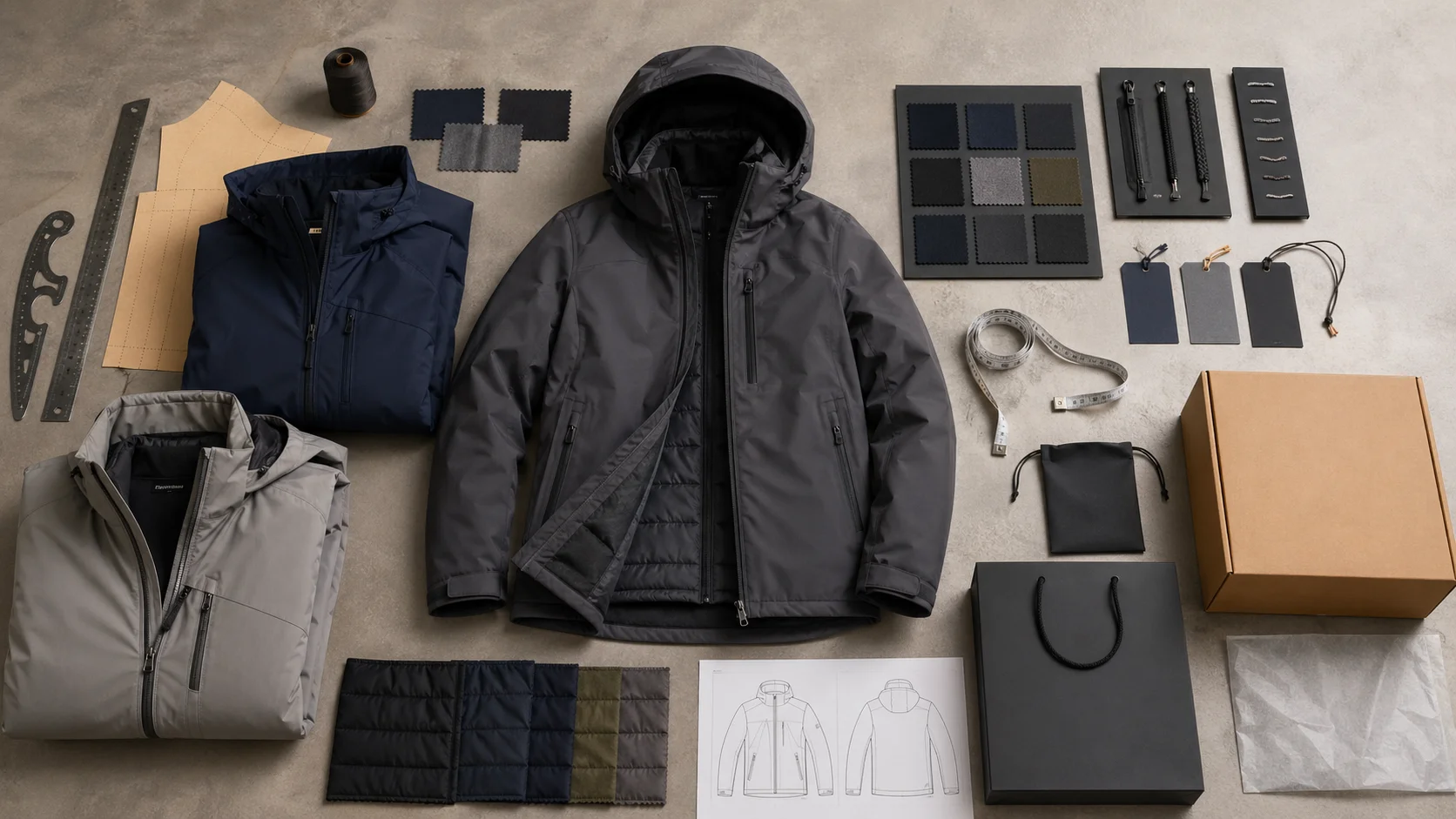
Screen-Printed Poly Bags for Fashion with checks for samples, fit, MOQ, QC evidence, pricing terms, and delivery risk.
Fast answer: Screen-Printed Poly Bags for Fashion: Film, Ink, Seal, and MOQ should be judged by production evidence, not by a generic sourcing promise. The buyer needs sample proof, cost breakdowns, QC checkpoints, and delivery buffers in writing.
Ask for recent sample photos, measurement tolerances, fabric or print test assumptions, decoration test notes, packing examples, and a named inspection checkpoint. These details show whether the team can repeat an approved sample at bulk volume.
Separate garment cost, decoration, labels, packaging, sampling, testing, freight, and rush charges. When every cost line is visible, it becomes easier to reduce colorways, adjust size depth, or reserve more time for sampling.
Fashion packaging has a habit of looking fancier than it needs to be. Brands spend $1.20 to $4.50 on rigid cartons, tissue, and inserts, yet screen printed poly bags for fashion packaging keep winning because they put the logo where buyers can actually see it for far less. A $0.06 bag can outshine a $2.80 box when the print sits cleanly across the front and the film stays flat in the fixture. Contrast that with a 500-unit premium wrap produced off the pressroom floor in Guangzhou, where heavy foil stamping, aqueous coatings, and lamination drive the price to $2.50-4.00 per unit at a 500 MOQ, and it becomes easy to understand why the poly bag still carries the day.
No romance here. Just math. A mass-market basics brand can order 50,000 bags at $0.04 to $0.09 each in a Dhaka facility running 45-micron LDPE on a Reifenhäuser BEX blown film line and keep branding consistent without gutting margin. A mid-market denim label may pay $0.11 to $0.18 per bag for heavier film, two-color printing, and tighter seals achieved with a Kammann 4-color press and a hot-air impulse sealer in Guangzhou. A reliable manufacturer or factory can usually keep that pricing steady across repeat runs, especially when the supplier understands custom packaging goals and wholesale timelines.
Luxury labels often skip poly because of perceived value, but premium underwear and resortwear teams still use screen printed poly bags for fashion packaging behind the scenes, then tuck them into a branded outer system. Island-based Istanbul wholesalers, for instance, combine bold typography with translucent film and then repackage the poly bags into a rigid clutch for retail-ready presentation. Screen printing wins on simple runs because it is fast, opaque, and easy to read from a distance. Labels peel. Inserts crumple. Full-color digital print looks attractive in a sample room, then gets expensive on 10,000 units or more once registration and ink coverage start biting.
A single-color screen print on 1,000 bags may cost less than a custom label applied by hand, especially when labor runs $8 to $18 per hour in higher-wage markets. Factory floors tell a less polished story. Ink adhesion fails on dusty film. Registration drifts by 1 to 2 mm when the operator stretches the bag too hard. Film gauge shifts more than buyers expect, especially when one pallet reads 45 microns and another lands closer to 38. In some Ho Chi Minh City runs, imported ultraviolet (UV) additive inks cure a degree hotter than the sample, so the print flashes differently in bulk unless the curing oven is dialed down.
A neat mockup can turn into a returned sample fast. Buyer psychology matters too. In store, a clean poly bag keeps hang presentation crisp and shows the garment size, barcode, and color through the stack. In e-commerce returns, the same bag cuts abrasion and keeps folded items together when cartons get reused. Packaging is not only wrapping. It is a control system for how apparel arrives, gets handled, and gets sent back.
Most screen printed poly bags for fashion packaging use LDPE or HDPE, and the difference shows the moment you handle the film. LDPE feels softer, with a more pliable hand and better clarity for folded garments. HDPE is crisper, rustles more, and holds its shape better on hang rails or inside shipping cartons. In my visits to Guangzhou and Ho Chi Minh City plants, brands shipping knits and intimates usually lean toward LDPE, while shirt programs and wholesale packs move toward HDPE for sharper stacking. These facilities often run 45-micron virgin LDPE resin from Sinopec through a Reifenhäuser blown film line or 60-micron HDPE from LG Chemical on a Toshiba servo extruder before slitting to custom widths.
Thickness changes everything. A 30 to 35 micron film tears more easily at the seam and can distort print edges. Move to 45 to 60 microns and you get seal strength, less stretching during printing, and better resistance in transit. In the United States, buyers still talk in gauge, but most export factories quote microns because 1 micron is a cleaner basis for comparison. I have seen a Ho Chi Minh City converter balance gauge and clarity by switching from a cylindrical die to a flat die on their cast line, which reduces film memory during curing.
The visual payoff is real: thicker film often gives flatter ink laydown and less ghosting around the logo. Recycled content is where fashion buyers get hopeful and then frustrated. PCR or post-industrial recycled resin can lower virgin plastic use, but it can also add odor, a gray tint, or sealing inconsistency if the supplier blends poorly. When you ask for 20% PCR, insist the supplier can point to a GRS (Global Recycled Standard) certificate for the resin lot and provide a traceable lot number from the Dhaka or Guangzhou resin storage tanks.
If a supplier cannot substantiate the claim, the claim does not count. Standards from organizations like Textile Exchange help set expectations for material sourcing, even when the final packaging is not textile-based. Suppliers that print the bag also often carry OEKO-TEX Standard 100 or GOTS (Global Organic Textile Standard) certification on the inks and adhesives they use, guaranteeing no heavy metals, formaldehydes, or harmful phthalates end up on the film. Finish matters too. Glossy film boosts print contrast and makes color look deeper. Matte film hides scuffs but can dull very fine type.
In Asia, larger mills and converters usually offer a wider menu of recycled blends, anti-static additives, and custom widths than smaller local shops in Europe or North America, where material choice is narrower and price per kilogram can run 10% to 25% higher. If you are comparing clothing packaging solutions, ask for the exact film spec, the resin source, and the seal temperature range before you approve anything. A quality-first supplier will be able to document production settings, confirm whether the bag spec fits your MOQ and bulk schedule, and show you a WRAP or BSCI audit report to prove the audit trail.
Screen printing on poly film starts with a mesh screen, a stencil, and a squeegee that pushes ink through open areas onto the bag. Mesh count matters. Finer artwork may need 120 to 150 mesh, while bold logos can run on 90 to 110 mesh and still look sharp. Cure time matters too, because the ink must bond without warping a thin bag. On a clean line, I have seen good operators hold 160 to 180 bags per hour per station on simple one-color work, especially when they are working on an M&R Gauntlet 12-station automatic press equipped with a flash cure unit.
Spot colors beat halftones for most apparel packaging. A solid black logo on a white or clear bag reads faster, covers better, and tolerates small shifts in alignment. Halftones and gradients can be done, but every extra effect raises the risk of banding, screen clogging, or visible stepping along the edge of a fold. When a buyer asks for a delicate photographic print on a 40-micron poly bag, I usually push back unless the order is large enough to absorb test waste and press time. Yangon-based studios who print photographic gradients often pull the film through a UV-curing oven to minimize dry-back.
Single-side print is the cheapest route, usually with one setup and one pass. Double-side print adds time, handling, and the chance of misregistration by 1 to 3 mm if the bag is not pinned correctly. Multi-pass printing can support fashion graphics with 2, 3, or even 4 colors, but each added color means another screen, another exposure, and another chance for the operator to miss the original sample. Many factories now lock the film to a vacuum table for the second pass to hold the alignment steady.
That is why bold typography and thick lines beat fine scripts on most bag programs. I work with many brands that also source screen printing services for garments and want the packaging to match the same visual discipline. Different substrate. Different production behavior. Poly film moves when heat hits it, and a sample that looks perfect under studio light can shift after curing, folding, and pallet stacking. Machines such as the Kammann K32 combine a soft-touch traction belt with micro-adjustable registration pins to limit this movement and ensure a +/- 0.5 mm repeatability.
According to ASTM, standardized test methods matter precisely because flexible materials react differently under load, temperature, and time. Strike-offs are not a formality. They are the checkpoint. I have seen a first approved sample come back 8% darker in bulk because the ink batch changed and the press operator raised the temperature by 12 degrees to speed output. The cure temperature is often monitored through a thermocouple probe for each press run.
Approve the artwork, the substrate lot, the curing target, and the acceptable delta for the production run. A good sample proves the concept. It does not guarantee repeatability without controls.
The cost structure looks simple right up until the order lands. For screen printed poly bags for fashion packaging, price starts with film, then adds screens, ink, labor, packing, and freight. On a small run of 500 to 1,000 pieces, setup fees can make the unit price look brutally high. A one-color bag might land at $0.18 to $0.38 each ex-factory because the screen and setup fee, often $25 to $80 per color, gets spread across very few units.
At 5,000 to 10,000 pieces, the economics improve fast. I have seen a two-color LDPE bag fall from $0.29 at 1,000 units to $0.09 per bag once the screens are amortized and the press is running steady on a Guangzhou line equipped with a 7-inch shim stack and a pneumatic heat tunnel. A Dhaka facility that runs 12,000 bags weekly can push the unit price under $0.08 by locking in 30,000-sheet rolls of 45-micron film, bulk ink curing at 160°C, and automated bag folding machines that reduce manual labor to $0.02 per unit. Keep in mind the tooling cost of around $120 per color still applies when you rework the artwork, so plan for that in any design change.
Beyond the production floor, factors like reinforced sealing, anti-slip coating, waterproofing, and PVC-free adhesives add $0.01 to $0.03 per unit. The packaging also requires poly bag stuffing, carding, or bundling, which is often performed at a secondary facility in Ho Chi Minh City or Istanbul and can push the labor component up another $0.02. Freight is the final line item—you can expect Guangzhou or Ho Chi Minh City sea shipments to the West Coast in 18-22 business days, at an added $0.07 to $0.11 per unit when the freight is spread across a 20-foot container.
When you compare that to a 500-unit premium wrap with metallic ink, embossing, and die-cutting, which typically costs $2.50-4.00 per unit delivered to the distribution center, the poly bag wins for both visibility and controllable variables.
Choosing the right supplier is about matching your expected volumes, timelines, and compliance requirements. Look for manufacturers in Guangzhou, Dhaka, Ho Chi Minh City, or Istanbul that publish their factory scores and certifications. Ask for the current WRAP, BSCI, or OEKO-TEX Standard 100 certificate covering the inks, adhesives, and lacquer systems used on your order. If you are sourcing recycled content, confirm the GRS paperwork along with the resin delivery note to ensure traceability and that the supplier did not merely relabel a general-purpose lot.
Field visits still matter. When I tour a Guangzhou plant, I check their Kammann registration system and the air-dry booths downstream from the press. In Dhaka, I look for clean extrusion rooms with color monitoring, and in Istanbul, I verify that the hydraulic sealers are adjusted to maintain a 4-6 mm weld on 55-micron HDPE. Demand to see the maintenance logs for the Reifenhäuser or Toshiba lines and to photograph the mesh counts on the stored screens. A supplier that invites you backstage has nothing to hide.
Communication should not feel like a game of telephone. Your vendor should share PDF specs, digital photos of the extrusion finish, and ideally a video showing the machine actually running your job. If the supplier cannot state whether they are using solvent-based or water-based ink, or if they cannot quote your MOQ and lead time in the same conversation, look elsewhere.
Lead time is fixed primarily by the production schedule. From Guangzhou, Dhaka, or Ho Chi Minh City, standard sea shipments to Los Angeles or New York take 18-22 business days once the order leaves the dock, assuming customs has the required WRAP, BSCI, and GRS certificates ready. If you add air shipping, expect 10-12 business days plus a freight premium that can double the per-unit cost. Istanbul can often deliver faster to European distribution centers, but the same compliance paperwork—OEKO-TEX Standard 100 labels on the inks, WRAP on the workers, and BSCI on the wages—must accompany the shipment.
Compliance is not optional. Without WRAP or BSCI, retailers in the EU or North America may hold your shipment at customs. When you order recycled content, the customs team will ask for the GRS certificate to ensure the declared 20-30% PCR is legitimate. Keep digital copies of these documents in the same folder as the invoices and heat-seal profiles so your logistics partner can respond quickly during the audit.
Fulfillment partners appreciate when you book the container ahead of time, specify the carton markings, and string the job through their ERP system so each bag pack is traceable. A one-page compliance sheet that lists the resin supplier, ink manufacturer, and curing target saves time if customs officers in California or Paris come asking.
Step 1: Lock in your material and artwork early. Confirm whether you need 45-micron LDPE, 55-micron HDPE, or a blended 30% PCR resin, and request the melt flow index and seal temperature from the supplier’s extrusion lab. Match that data to the artwork you plan to print—bold, block text works best.
Step 2: Request a strike-off run. Ask the factory to print 20 sample pieces on the exact film being used for your order with the same ink batch and curing profile. Approve the sample by acknowledging color tolerance (Delta E 3 or less) before the press runs at volume.
Step 3: Verify compliance. Require copies of OEKO-TEX Standard 100 for the inks, WRAP and BSCI for the factory, and GRS for any recycled resin. If your retail partners demand GOTS, ensure the associated trims, labels, or tissue paper meet the same standard.
Step 4: Plan logistics. Book your sea or air freight 4-6 weeks ahead, especially during peak season, and confirm that your supplier can palletize the bags with corner guards and stretch wrap so they survive the 18-22 business day sail from Guangzhou or the 19-20 day overland haul from Istanbul.
Q: What is the minimum turnaround time from a Guangzhou supplier? A: Typically 18-22 business days once the artwork, film lot, and inks are approved. Add a few days if you need a strike-off or extra compliance documentation.
Q: Which certifications should I insist on when mixing recycled resin? A: Always ask for the GRS certificate for the recycled resin and verify it against the invoice from the recycler. If the inks and adhesives touch the interior, request OEKO-TEX Standard 100 or GOTS confirmation to prove you are not introducing restricted substances.
Q: How much does shipping add to the per-unit cost for poly bags? A: For a full 20-foot container from Guangzhou or Ho Chi Minh City, sea freight adds about $0.07 to $0.11 per bag once you amortize the freight across 200,000 units. Air freight or partial container loads cost more, so plan accordingly if you need a rush restock.
Q: Are there specific machines I should ask about? A: Yes—look for extruders like Toshiba or Reifenhäuser for the film and automatic presses such as the M&R Gauntlet or Kammann K32 for the printing. These machines are easier to maintain and deliver consistent gauge and registration, which keeps every run close to the strike-off.