
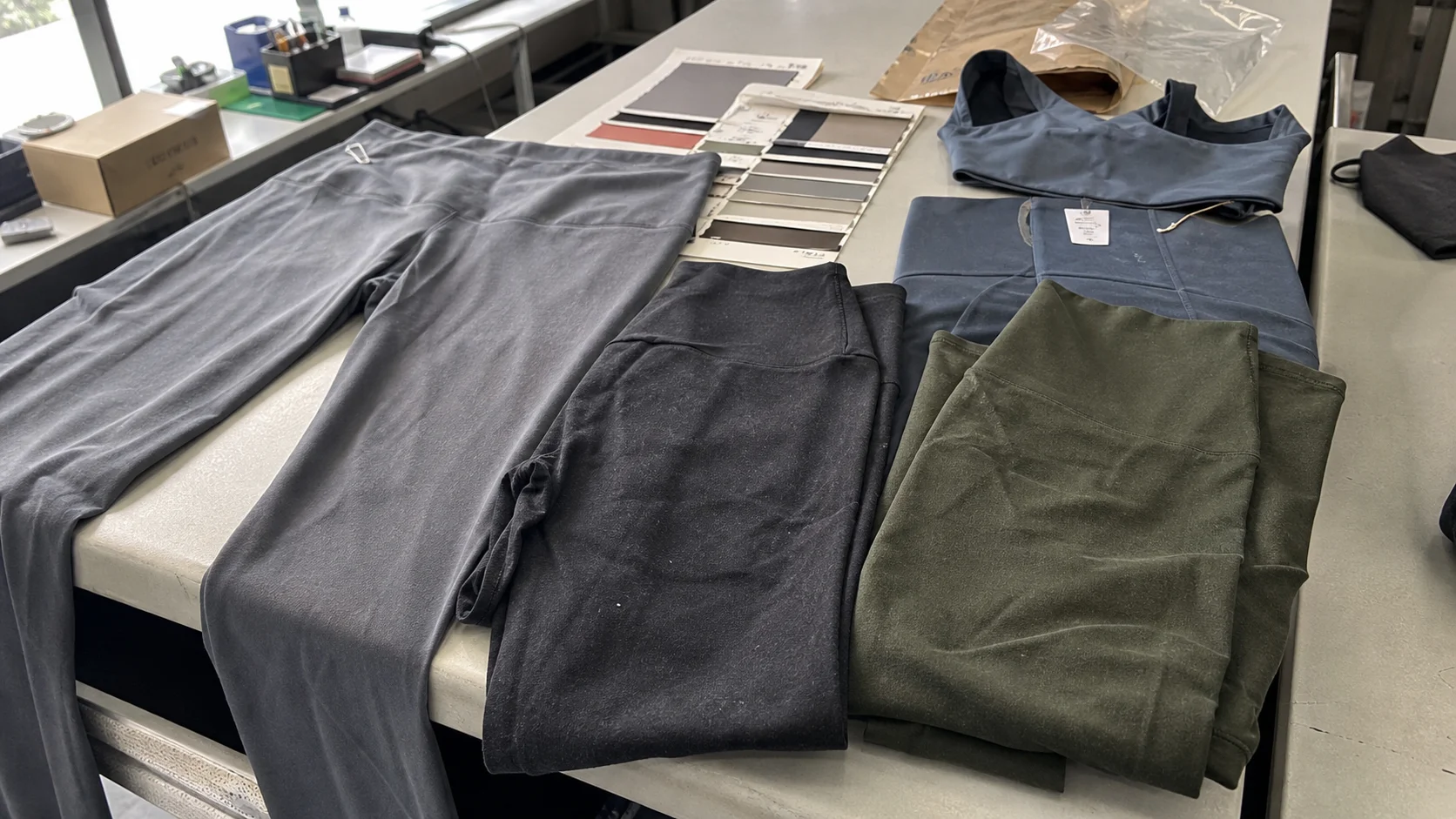
A product-specific outline for buyers sourcing spandex blend leggings manufacturers, covering fabric ratios, compression, seam construction, testing, fit consistency, and production details that affect quality and repeat orders.
Spandex Blend Leggings Manufacturer for Bulk Buyers - Fabrikn production reference
Finding the right spandex blend leggings manufacturer is less about locating the cheapest sewing line and more about securing reliable, repeatable performance across fabric, fit, and finishing. Bulk buyers already know that leggings are not a forgiving product category. A small inconsistency in stretch recovery, opacity, seam construction, or waistband stability can turn a strong-looking sample into a high-return production order.
That is why sourcing leggings at scale requires a manufacturer that understands both garment construction and material behavior. Spandex blend leggings sit in a technical middle ground: they must feel soft enough for retail customers, hold shape during wear, recover after washing, and pass practical quality checks without excessive defect rates. For importers, private label brands, wholesalers, fitness labels, and chain retailers, this balance affects margins directly.
A capable supplier should do more than quote a price per piece. The real value comes from fabric guidance, trim consistency, grading accuracy, sampling discipline, and production controls that protect repeat orders. Buyers who skip those checks often end up paying twice through resampling, delayed launches, discounting, or claims.
If your brand is reviewing production options in the Clothing Manufacturer category, it helps to approach leggings with clear sourcing criteria from the start. FabrikN outlines broader production support through its services, and buyers with active projects can move directly to the contact page once technical requirements are defined.
The phrase spandex blend leggings manufacturer covers a wide range of supplier capabilities. Some factories mainly cut and sew against buyer-nominated fabric. Others manage the full package process, including yarn or fabric sourcing, dyeing, printing, pattern development, labeling, packing, and shipment coordination. Bulk buyers need to confirm which model is being quoted because the risk profile changes considerably.
In practical sourcing terms, a reliable manufacturer should be able to support the following:
Not every supplier handles all of these steps at the same level. A strong cut-and-sew unit may still depend heavily on outside mills for fabric quality. A supplier with attractive pricing may be weak in pattern consistency or final pressing and packing. Buyers should judge the manufacturer as a process manager, not only as a production floor.
There is also a major difference between making basic casual leggings and producing performance-focused compression or activewear leggings. The second category demands tighter process control. Needle choice, seam elasticity, panel alignment, gusset insertion, and heat transfer durability all matter more when the garment is expected to perform during movement and repeated wash cycles.
Fabric selection drives most of the product outcome in spandex blend leggings. Bulk buyers often focus first on the percentage of spandex, but that is only one variable. The base fiber, knit structure, yarn quality, GSM, finishing treatment, and dye process all influence how the garment performs in real use.
Many bulk orders land within familiar blend windows:
Higher spandex content does not automatically mean better quality. Past a certain point, cost increases faster than performance gains for many commercial programs. Buyers should match the blend to the product claim. Lounge leggings, studio wear, shaping leggings, and high-impact training leggings do not need the same material profile.
The tradeoff is straightforward. Lighter fabrics can reduce cost and feel cooler, but they may fail opacity tests in lighter colors or extended sizes. Heavier fabrics usually improve coverage and shaping, but they can push prices up and change fit perception. Soft brushed surfaces can feel premium at first touch while increasing the risk of pilling if yarn quality or finishing is weak.
For bulk buyers, the best fabric is rarely the one with the most impressive sales language. It is the one that performs consistently across shade lots, sizes, and repeat orders.
Leggings should not move into bulk production from a single visual sample. A cautious development process saves money because most production disputes in this category begin with unclear approvals. The supplier and buyer need alignment on fit, fabric, workmanship, branding, and packaging before bulk cutting starts.
Some suppliers may combine stages for simpler programs, but skipping the pre-production sample is risky. In leggings, small pattern changes can alter stretch tension and appearance significantly. A fit that works in one fabric may behave differently once the final mill lot is used.
Wear testing is especially useful for premium or technical leggings. A garment can pass measurement review yet still fail in use if the waistband rolls, the crotch depth feels short, or seam tension causes discomfort. Bulk buyers serving e-commerce channels should treat wear performance as a commercial issue, not only a design detail.
MOQ for spandex blend leggings depends on the supplier model, fabric route, color count, and degree of customization. There is no universal benchmark, but several ranges appear regularly in the market.
Buyers should ask whether the MOQ applies per order, per style, per color, or per size ratio. A quotation can look flexible until the fabric mill minimums appear later. In many cases, the real constraint comes from knitting or dyeing quantity rather than sewing capacity.
A low unit price on leggings can hide costs elsewhere. If the supplier uses unstable fabric, weak elastic, poor colorfastness, or inaccurate grading, the apparent savings disappear through claims and resupply pressure. Buyers in the Clothing Manufacturer category generally do better when they compare total landed reliability rather than only FOB price.
For repeat programs, it is often smarter to consolidate colors into fewer fabric bases and standardize core waistband and label trims. This reduces development time and helps secure more stable pricing. A manufacturer can usually control consistency better when the program is built around repeatable components rather than a wide mix of low-volume custom variations.
Lead time for bulk leggings is driven by fabric readiness more than by sewing alone. Buyers who treat leggings like a simple commodity often underestimate this point. The production line may only need a few weeks, but fabric knitting, dyeing, setting, testing, and trim coordination can add substantial time.
These are practical ranges, not guarantees. Lead time shifts when the order uses custom-dyed shades, printed panels, bonded details, brushed finishes, or mill programs with high minimums. Peak demand periods can also delay booking at both fabric mills and sewing lines.
The most common planning mistake is approving design details too late while still expecting the original shipment date. Once fabric or trims are locked, changes become expensive and disruptive. A disciplined critical path is more valuable than a supplier promising unrealistically fast production.
Leggings carry several quality risks because stretch garments reveal defects quickly during wear. Bulk buyers should define inspection points before production starts rather than only checking finished cartons. Catching problems late usually means rework, delay, or shipment release under concession.
Opacity testing deserves special attention. Buyers often approve fabric on a hanger or table, yet the garment becomes transparent when stretched over the body. This is one of the clearest sources of consumer complaints in leggings. The supplier should understand that opacity must be evaluated under realistic strain, not just in a relaxed state.
For better vendor alignment, buyers can also ask for workmanship standards covering skipped stitches, loose threads, needle damage, print placement tolerance, and acceptable measurement variance. That creates a clearer basis for final inspection decisions.
Even straightforward leggings programs need accurate documentation and labeling. Requirements vary by market, but buyers should at minimum confirm fiber content labeling, care instructions, size labeling, country of origin marking, and any retailer-specific packaging rules.
If the product is sold as performance wear, shaping wear, or eco-focused apparel, marketing language should stay aligned with what the fabric and testing can support. Overstated claims create avoidable compliance and customer service risk.
Packaging may seem secondary, yet it affects warehouse receiving, retail handling, and e-commerce fulfillment. A manufacturer that can control both garment quality and pack accuracy is usually easier to scale with than one that treats packing as an afterthought.
Buyers researching supplier background can review FabrikN’s company information at about us before discussing project details.
The right spandex blend leggings manufacturer is the supplier that can repeat acceptable quality under your actual commercial conditions. That means your target price, your size range, your fabric standard, and your delivery calendar. A supplier that sends a strong sample but cannot maintain shade consistency or measurement discipline in bulk is not the right partner, even if the initial communication is smooth.
Suppliers should answer these questions clearly. Vague replies often signal a trading-style sales approach without enough production control behind it. That does not automatically disqualify a vendor, but it should change how cautiously the buyer proceeds.
For commodity leggings, a buyer may accept simpler construction and stock fabric options to reduce MOQ and move faster. For premium activewear, that shortcut usually creates downstream quality issues. The correct approach depends on the selling channel. Discount retail, promotional programs, marketplace brands, and specialist fitness labels do not need the same manufacturing setup.
It is also sensible to separate nice-to-have features from must-have performance standards. Brushed hand feel, hidden pockets, laser-cut ventilation, and special trims can improve market appeal, but stable fabric recovery, secure seams, and reliable opacity are usually more important. Buyers should protect the fundamentals first.
In many cases, the best manufacturing relationship starts with one disciplined trial program rather than an overly broad launch. A controlled first order reveals whether the supplier can manage approvals, production consistency, and communication under real conditions. That is better evidence than a polished presentation or a very aggressive quote.
For buyers ready to discuss specifications, order volumes, or development support, the most productive next step is to share a clear tech pack and sourcing brief through the contact page. That makes it easier to evaluate whether the manufacturer’s process fits the product and quantity you need.
Get a free quote from Fabrikn — your trusted B2B clothing manufacturer with 10+ years of experience. MOQ as low as 200 pieces.
Get a Free Quote →There is no single best blend for every program. Nylon-spandex is often preferred for premium activewear because of smooth hand feel and strong recovery, while polyester-spandex is common for cost-sensitive and printed programs. Cotton-spandex works well for softer casual leggings. The right choice depends on price target, end use, and required performance.
Typical MOQ can range from around 300 to 600 pieces for basic private label styles using stock fabric, and from 800 to 3,000 pieces or more for custom fabric, custom colors, or specialized activewear construction. Buyers should confirm whether the MOQ applies per style, per color, or per total order.
After sample approval and material confirmation, bulk production often takes about 30 to 60 days. Sampling, lab dips, custom packaging, fabric knitting, and seasonal factory loading can extend that timeline. Fabric readiness is often the main driver.
Common issues include poor opacity, weak stretch recovery, popped seams, waistband rolling, uneven color, twisted seams, and heat transfer peeling. These risks are easier to manage when buyers approve a clear specification set and require inline plus final inspections.
Yes. A pre-production sample in final fabric, color, trims, and branding is one of the most useful control points before bulk cutting starts. It reduces the risk of fit, workmanship, and packaging mismatches.
A strong tech pack should include garment sketches, measurement chart with tolerances, fabric composition and GSM target, seam construction details, waistband specs, logo placement, label artwork, packaging instructions, and color references. The clearer the tech pack, the lower the risk of sampling confusion and production errors.