
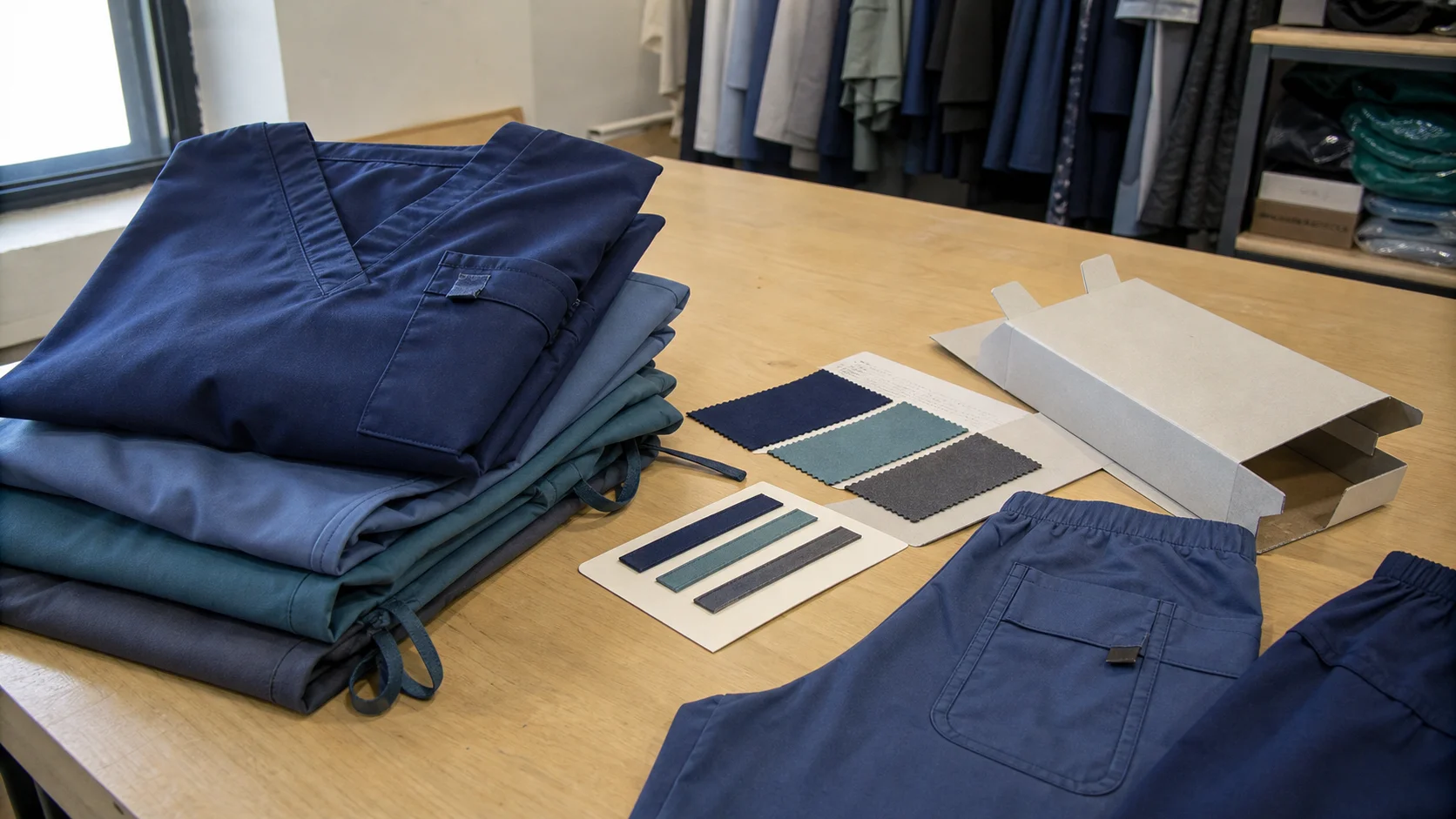
A focused outline for buyers sourcing clinic merchandise built around custom heat transfer scrubs, covering decoration specs, material choices, compliance concerns, sustainability factors, and procurement decisions tied to medical apparel programs.
Custom Heat Transfer Scrubs for Clinic Sourcing - Fabrikn production reference
Custom heat transfer for scrubs clinic merchandise sourcing sits in a practical middle ground between plain uniform buying and fully decorated medical apparel programs. For clinics, outpatient centers, dental groups, aesthetic practices, wellness brands, and hospital departments, heat transfer decoration offers a flexible way to apply logos, staff identifiers, campaign graphics, and branded messaging without committing to the heavier setup costs or design limits that often come with other decoration methods.
That flexibility matters in medical apparel purchasing. Clinic uniform programs rarely stay static for long. Teams expand, departments rebrand, staff roles change, and buyers often need multiple colorways, gender fits, and size runs in one order. A decoration method that can handle these moving parts efficiently is easier to scale. Heat transfer is often that method, provided the buyer controls the specification closely and chooses the right supplier discipline.
From a sourcing standpoint, the key question is not whether heat transfer can work on scrubs. It clearly can. The more useful question is when it works better than embroidery or screen printing, what technical details need to be locked before production, and how to reduce the common failure points such as peeling edges, cracking graphics, inconsistent placement, and poor wash durability.
For clinic merchandise programs under a sustainable fashion category, the discussion also goes beyond decoration alone. Buyers need to assess whether the base scrub fabric includes recycled content, whether the transfer material adds unnecessary plastic weight, how replacement cycles affect waste, and whether the supplier can support right-first-time approvals that prevent excess sampling and rejected stock.
Clinics that treat custom scrubs as branded operational apparel rather than simple promo merchandise usually make better purchasing decisions. That means documenting use conditions, setting a wear-and-wash standard, and matching the transfer method to the actual garment fabric and work routine. A logo that looks sharp on day one but fails after repeated industrial laundering is not a sourcing win, even if the initial unit cost looks attractive.
If the goal is a durable, brand-consistent, and scalable scrub program, heat transfer can be an effective solution. It just needs disciplined specification, realistic MOQ planning, and a supplier who understands decorated medicalwear rather than generic promotional apparel. Buyers comparing development options can also review broader manufacturing support pages such as services and company background at about-us before requesting a production discussion.
Clinics choose heat transfer decoration for several operational reasons. First, it handles small logos and detailed branding well, especially when the artwork contains fine lines, gradients, or multiple colors that would be bulky or expensive in embroidery. Second, it keeps the garment surface flatter and lighter, which is useful on lightweight stretch scrubs where dense embroidery can pull or distort the fabric.
Another advantage is flexibility across short and medium runs. A clinic group may need 80 tops in one branch, 250 mixed sets for a new opening, or staggered reorders by department. Heat transfer is often easier to scale across these order profiles than more setup-intensive decoration methods. It is also useful when buyers need staff names, title markings, or location identifiers added in changing quantities.
Placement is another practical factor. Left chest logos remain common, yet many clinic programs now add sleeve branding, upper back marks, or small transfer labels on pockets. Heat transfer handles these placements cleanly if the supplier has stable pressing controls and garment templates. That makes it suitable for brand-led medicalwear programs where consistency matters.
There is also a comfort argument. Properly selected heat transfers can feel softer and less intrusive than thick embroidered patches, especially on stretch woven scrub tops worn for long shifts. That said, not all transfers perform equally. A thick plastisol-style transfer on a breathable scrub fabric can create a stiff handfeel and reduce comfort. Buyers need to ask for transfer type, thickness, elasticity, and wash rating rather than approving decoration on visual appearance alone.
In clinic merchandise sourcing, heat transfer usually fits one of three buying models.
The first model demands the highest durability and consistency. Staff uniforms are repeatedly washed, exposed to movement, and often purchased in rolling replenishment cycles. Decoration quality needs to remain stable across repeat orders. In this case, the buyer should prioritize tested adhesion, stretch compatibility, and accurate placement standards over the cheapest possible unit price.
The second model blends brand presentation with resale or gifting considerations. Private clinics, med spas, and wellness groups sometimes merchandise branded scrubs for staff and affiliated practitioners. Here, appearance, handfeel, and packaging may carry more weight. A softer premium transfer with a cleaner finish may justify higher cost if the product is customer-facing.
The third model is more cost-sensitive. Temporary campaigns, awareness events, or internal initiatives can sometimes use less demanding decoration standards if the garments are not intended for extended uniform wear. That does not mean low quality should be accepted. It means the buyer can reasonably balance price and expected lifespan with more flexibility.
These three models are often mixed in one procurement calendar. That is where supplier clarity becomes important. A factory or sourcing partner should know which items are core uniform lines and which are campaign pieces, because the trim bill, transfer grade, carton assortment, and inspection criteria may need to differ.
Buyers often compare custom heat transfer and embroidery too early on aesthetics alone. The better approach is to compare them across fabric behavior, logo detail, comfort, maintenance, and reorder complexity.
Criteria Heat Transfer Embroidery Fine logo detail Usually stronger Can lose small detail Stretch fabric compatibility Good if elastic transfer is used May pucker fabric Handfeel and weight Lighter, flatter finish Heavier, raised texture Wash durability Depends heavily on transfer quality and application Usually strong when stitched properly Name and role customization Easier for variable data Slower and sometimes costlier Premium traditional look Clean and modern Classic and formalFor lightweight polyester-spandex or recycled poly blend scrubs, heat transfer often makes better technical sense than embroidery. Dense stitching can distort knit panels, stress pocket edges, and create discomfort on garments worn for long shifts. On heavier woven scrub jackets or lab outerwear, embroidery may still be the better choice if a formal medical identity is part of the brand image.
The purchasing judgment is straightforward: use heat transfer when logo detail, comfort, and scalable customization matter most. Use embroidery when the garment can structurally support it and the buyer values traditional appearance over lightness and flexibility. Some clinic programs split methods by garment type, which is often the most sensible compromise.
Scrub sourcing works best when decoration is specified against the base fabric rather than treated as an afterthought. Buyers should request a clear garment specification sheet covering fabric composition, weight, stretch profile, finish, and shrinkage tolerance before approving transfer application.
Common scrub base fabrics include polyester-cotton blends, polyester-rayon-spandex blends, and recycled polyester-spandex constructions. Typical weights often fall in the 140 to 210 gsm range depending on whether the style is a lightweight fashion scrub, a structured core uniform, or a warmer jacket layer. Heat transfer settings need to match the fabric’s heat sensitivity and stretch recovery.
Key transfer-related specifications to confirm include:
On scrub tops, the most common decoration zones are left chest, sleeve, yoke, and upper back. Pocket placements need extra caution. If the pocket panel stretches or folds under load, a rigid transfer can crack or lift faster. Side stretch panels also need careful review because standard transfers may not recover well in high-extension zones.
Trim compatibility matters too. If the scrub has antimicrobial finishing, water-repellent coating, silicone softener, or heavy enzyme wash, transfer adhesion may change. Buyers should not assume the same logo transfer will perform identically across every fabric finish. Approval should be style-specific, not just artwork-specific.
Because this topic sits under sustainable fashion, sourcing decisions should account for total product life rather than simply whether the garment contains recycled fiber. A scrub made from recycled polyester but decorated with a poor-quality transfer that fails early can create more waste than a conventional garment that lasts significantly longer.
The most practical sustainability priorities in this category are durability, controlled sampling, rational material selection, and reorder discipline.
Durability comes first. If the clinic replaces decorated scrubs prematurely because branding peels or cracks, the environmental claim around the base fabric weakens quickly. The buyer should request wash-test evidence that is relevant to the expected care method. Home laundering and industrial laundering are very different stress conditions. A supplier needs to state which standard the transfer has been developed for.
Controlled sampling is another overlooked issue. Repeated rounds of unnecessary strike-offs, courier shipments, and rejected salesman samples add cost and waste. A tighter approval path reduces this. One digital artwork approval, one transfer strike-off, one decorated fit sample, and one pre-production sample is often enough for a stable program if the supplier’s process control is reliable.
Material selection also deserves scrutiny. Some clinic buyers default to oversized logo applications that add visual weight and polymer content without improving function. Smaller, better-placed branding can support sustainability goals by reducing transfer area while still delivering a professional branded appearance.
Reorder discipline matters as well. Ordering excessively broad size ratios or too many non-core colorways increases dead stock risk. Clinics generally benefit from a narrower core assortment with scheduled repeat ordering. That lowers write-offs and improves inventory efficiency.
Suppliers supporting broader apparel development should be able to discuss these tradeoffs in a grounded way. Buyers ready to scope a program can move from concept to sourcing inquiry through contact-us once the garment brief, target quantity, and decoration requirements are defined.
Most quality problems in custom heat transfer scrub production start long before bulk manufacturing. They begin in vague approvals. Buyers that approve from artwork alone are taking a preventable risk.
A more reliable approval sequence usually looks like this:
For clinic uniforms, a wear-and-wash review is worth adding when the order value is significant. Even a small internal check of a few wash cycles can expose early lifting, shine marks, scorching, or excessive stiffness. It is a low-cost safeguard compared with bulk rejection.
Artwork files should be standardized early. Vector files are normally preferred for logo clarity. The buyer should also specify Pantone references where brand consistency matters. Screen visuals are not enough because transfer output can shift depending on finish, opacity, and substrate color.
Placement approval should use measurements from fixed garment points, not visual descriptions like “slightly above pocket.” For example, left chest artwork may be set by distance from high point shoulder and center front, or by distance from pocket edge where the pocket position is stable. That level of detail reduces carton-to-carton inconsistency.
MOQ for custom heat transfer scrubs depends on whether the buyer is sourcing blank scrubs for decoration, fully custom private label scrubs, or a mixed development program with custom fabric, trims, and branding.
For decorated stock-body scrubs, MOQ can sometimes start around 50 to 150 pieces per style-color if the base garment is already available and only transfer decoration is customized. For fully custom scrub manufacturing, typical MOQ is often closer to 200 to 500 pieces per style-color, with some suppliers preferring higher volumes when size spreads are broad or fabrics are specially developed.
Transfer-specific MOQ is often less restrictive than garment MOQ. A supplier may accept one logo transfer across multiple garment sizes if the artwork and placement remain constant. Variable name personalization can change the cost structure, especially if each unit needs different data. Buyers should confirm whether per-piece customization is priced as setup, run charge, or both.
Lead times vary with several dependencies:
As a general sourcing guide, sample development may take 1 to 3 weeks for straightforward programs and longer if fabric development is involved. Bulk production may range from 4 to 10 weeks after approval depending on order size, material readiness, and supplier workload. Those numbers are only planning ranges, not guarantees. Buyers should always separate nominal sewing time from the full critical path, which includes transfer preparation, pre-production confirmation, finishing, packing, and final inspection.
Rush orders deserve caution. Compressing the timeline often increases the risk of decoration defects because pressing conditions, cooling time, and handling discipline can slip under schedule pressure. In clinic sourcing, late delivery is a problem, but bulk peeling claims are usually worse.
Heat transfer on scrubs is not technically difficult, yet it is easy to execute inconsistently. Most failures come from a small group of preventable issues.
Edges lifting after washing is the most common complaint. The root causes may include wrong press temperature, inadequate dwell time, fabric finish interference, poor pressure control, or unsuitable transfer chemistry for the garment substrate. Buyers should ask whether the supplier validates press settings by fabric type.
Scrubs often include spandex or mechanical stretch panels. A transfer that looks fine on a flat table can crack after wear if elasticity is insufficient. This is especially relevant on fitted women’s scrub tops, jogger scrub pockets, and side panel constructions.
Some synthetic scrub fabrics show shine or heat marking after pressing. Dark colors can reveal this more clearly. A factory should use controlled pressing parameters and protective layers where needed. Buyers approving only from front-facing photos may miss this issue.
Without fixed templates, logo position can drift from piece to piece. That undermines perceived quality even when adhesion is sound. Left chest placements on multiple sizes need grading logic. Simply placing every logo at the same absolute measurement may look unbalanced across XS to 3XL.
White or bright logos on navy, ceil blue, black, and wine scrubs usually reproduce predictably. Brand-critical colors are harder. If the clinic brand depends on exact shades, the buyer should request a physical strike-off review and define acceptable variance.
Some vendors quote strong durability without clarifying test conditions. A claim of “50 washes” means little without knowing temperature, detergent type, tumble drying exposure, and whether the test reflects home care or industrial laundering. Buyers should request the actual basis of the claim.
A clinic buyer does not need a long presentation deck. The useful questions are operational.
It is also worth checking whether the supplier understands garment-first production logic. Inexperienced decorators sometimes treat all apparel substrates the same way. Scrubs are not ordinary promo T-shirts. They involve performance blends, frequent laundering, pocket functionality, and stricter expectations around professional appearance.
Inspection planning should be discussed upfront. For clinic orders, buyers often benefit from final random inspection with added checks for logo placement, adhesion, surface marks, and count accuracy by size. If the order includes multiple departments or locations, carton marking should also be reviewed carefully to prevent allocation errors after arrival.
The cheapest transfer option is rarely the best uniform option. A lower-grade transfer may reduce initial unit cost but raise claim risk, replacement cost, and staff dissatisfaction. That is a poor trade when the garments are part of daily operations.
On the other hand, overengineering can also waste budget. Not every clinic program needs premium silicone badges or oversized branded applications. For many scrub tops, a clean left chest logo in a well-tested elastic transfer gives the best cost-to-performance balance.
Buyers should evaluate cost in four layers:
If a slightly higher-priced supplier reduces resampling, rework, and post-delivery complaints, the total purchase outcome may be better. That is especially true for multi-branch clinics that need stable repeatability over time.
Good clinic sourcing is not about finding the lowest quoted transfer price. It is about matching the right decoration method to the scrub fabric, wash reality, and reorder model.
Buyers sourcing custom heat transfer scrubs should keep the program simple where possible and strict where it matters.
For sustainable fashion programs, the best outcome is often a durable core range with controlled branding, repeatable quality, and fewer rejected units. A modest, well-executed decoration program usually outperforms a complicated one with too many colors, placements, and last-minute changes.
Custom heat transfer can serve clinics very well when it is sourced with discipline. The method suits modern scrub fabrics, allows clean branding, supports variable staff identification, and can align with sustainability goals when durability and inventory control are treated seriously. The strongest buying position comes from clear specs, measured approvals, realistic MOQs, and a supplier evaluation process centered on performance rather than presentation.
Get a free quote from Fabrikn — your trusted B2B clothing manufacturer with 10+ years of experience. MOQ as low as 200 pieces.
Get a Free Quote →For stretch scrubs, buyers usually prefer an elastic transfer system such as a soft PU-based or comparable stretch-capable transfer designed for synthetic blends. The exact best option depends on fabric composition, finish, and wash requirement. A sample on the actual scrub fabric is more reliable than a generic recommendation.
That depends on transfer quality, application control, and care method. Buyers often look for performance that remains acceptable through repeated home laundering, but the correct benchmark should be defined before production. If the scrubs will face industrial laundry, that requirement needs to be declared early because it can change the decoration choice.
Not automatically. Sustainability depends more on garment lifespan, failure rate, material efficiency, and reorder discipline than on decoration method alone. A durable transfer on a long-wearing scrub can be a better environmental choice than a less suitable method that leads to premature replacement.
For decorated existing scrub bodies, MOQ may start around 50 to 150 pieces per style-color in some programs. Fully custom private label scrubs often begin around 200 to 500 pieces per style-color. Actual minimums vary by supplier, fabric development needs, and size/color complexity.
Yes, many suppliers can support variable customization with heat transfer, including names and job titles. The main consideration is cost and workflow. Personalized pieces require careful data control and may extend production handling time.
The main risk is approving decoration without validating durability on the actual garment fabric. Peeling, cracking, shine marks, and inconsistent placement are all common when technical approval is rushed or based only on visuals.