
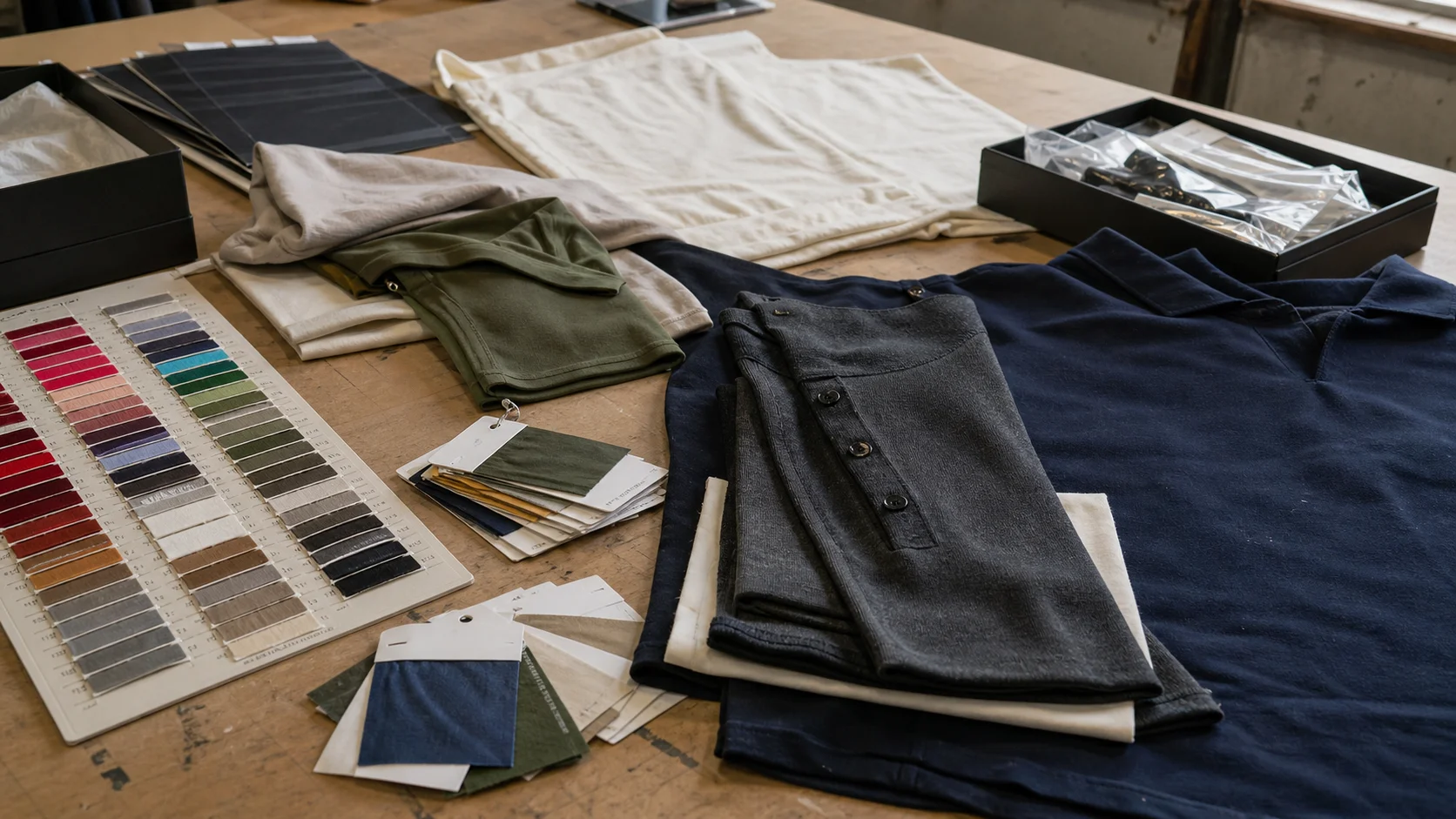
A focused outline for restaurant supply dealers evaluating wholesale chef coat trim options, decoration compatibility, and production details that affect assortment, branding, and reorder planning.
Wholesale Chef Coat Trim Sourcing for Dealers - Fabrikn production reference
Wholesale chef coats are often treated as a basic replenishment item in restaurant supply, but trim sourcing changes the commercial picture more than many dealers expect. In chefwear, trims are not only decorative details. They influence appearance, wash durability, heat tolerance, ease of replacement, branding consistency, and the final landed cost of the garment.
For restaurant supply dealers, trim decisions sit at the intersection of product development and margin control. A coat body can remain standard while trims create tiered assortments for different buyer segments: economy kitchens, hospitality groups, culinary schools, hotel chains, and premium chef-driven concepts. One contrast piping program or custom snap finish can move a coat from commodity territory into a cleaner branded category.
This matters even more in the Decoration & Printing category. Dealers are frequently asked to source chef coats that support embroidery, printed logos, name personalization, or branded label packaging. If trims are specified too late, decoration placement can conflict with plackets, pockets, topstitch lines, sleeve tabs, or contrast panels. That leads to avoidable sample revisions and delayed launches.
The practical takeaway is simple: trim sourcing should be handled early, not after fabric selection and not after fit approval. Dealers that treat trims as a front-end sourcing decision usually get better price clarity, fewer production edits, and more consistent repeat orders. Buyers looking for manufacturing support across development stages often start by reviewing a supplier’s production capabilities at https://fabrikn.com/services/.
In chef apparel, trims cover more than buttons. Any non-body-fabric component that affects function, appearance, or branding should be treated as a trim item in the bill of materials.
Some factories classify thread and labels separately from trims for cost accounting. Dealers should not rely on internal factory classification. For purchasing control, keep all visual and functional components together in one trim sheet. That prevents small components from disappearing into vague “miscellaneous” charges later in the quotation stage.
Restaurant supply dealers do not buy trim the same way a fashion label buys trim. The priorities are more operational. The order has to be commercially repeatable, easy to size-run, and stable enough for institutional replenishment.
Chef coats are washed hard and often. Industrial laundry exposure, bleach sensitivity, high-temperature pressing, and repeated stain treatment can damage lower-grade trims quickly. Glossy decorative components may look strong on a showroom sample but fail after repeated laundering. Matte resin buttons, metal snaps with suitable coating, stable polyester labels, and colorfast piping are generally safer commercial choices than trims selected only for showroom appeal.
Dealers serving chains and schools often need continuity over time. If a factory sources a custom snap or unusual knot button that cannot be restocked easily, the reorder risk goes up. A slightly less distinctive trim with stable replenishment can be the better purchasing decision.
Left chest embroidery is standard, but dealer programs increasingly ask for sleeve logos, back neck branding, and front placket design elements. Trim placement has to leave enough uninterrupted space for embroidery hoops, heat transfer placement, or printed insignia. Decorative decisions that crowd the chest area usually create production friction.
Some trims carry low garment MOQs but high trim MOQs. This is a common trap. A dealer may only need 300 chef coats in a colorway, but the custom piping tape or logo snap may require 3,000 to 5,000 units. That mismatch ties up cash and complicates future color continuity.
Not every trim shifts cost the same way. Dealers should understand where small aesthetic choices create larger production consequences.
Standard plastic buttons are usually the most economical option. Resin buttons with a cleaner finish, logo embossing, or contrast color matching raise piece cost modestly but can still be manageable at volume. Snap-front chef coats often reduce dressing time and support a more modern look, though snap quality becomes critical. Low-grade snaps may loosen, corrode, or distort surrounding placket fabric.
Typical MOQ for stock buttons may align with garment MOQ, often around 200 to 500 pieces per style-color-size run depending on the supplier. Custom logo buttons or custom-finish snaps can push trim MOQ into the 1,000 to 3,000 set range, sometimes higher if tooling or color development is involved.
Piping is one of the fastest ways to upgrade a chef coat visually. It can define collar shape, front placket lines, cuffs, and pockets. It also adds labor. Curved collar insertion, even stitch spacing, and shrinkage balance between body fabric and piping material affect the final look. Poorly chosen piping can twist after washing or pucker at the seam.
For price-sensitive dealer programs, contrast topstitching sometimes delivers a similar visual effect at lower cost and with less sewing risk. That tradeoff is worth considering when the coat is intended for high-volume institutional channels.
Woven main labels, satin care labels, size pips, and brand flags seem minor, yet they influence both compliance and presentation. In export orders, care content, fiber composition, country-of-origin requirements, size translation, and washing symbols must be reviewed carefully. A misprinted care label is inexpensive to overlook and expensive to correct after packing.
Custom woven labels often start at roughly 1,000 to 3,000 pieces depending on size and loom setup. Printed satin labels may allow lower entry volumes, though they can feel less premium. For dealer-owned private label programs, labels are usually worth customizing early because they carry over across multiple SKUs.
These are common in culinary school uniforms, premium kitchen teams, and hospitality brand programs. Embroidered patches can elevate perceived value, but they add separate production steps: patch making, placement approval, and attachment testing. Heat-applied badge systems save sewing time in some cases, yet they need heat resistance validation against the chef coat base fabric and expected laundry conditions.
In the Decoration & Printing category, trim sourcing should support branding rather than compete with it. Dealers often focus on logo application method first, but trim choices influence which method works consistently at production scale.
Embroidery remains the most common decoration method for chef coats because it holds up well and aligns with hospitality presentation standards. Trim placement must leave stable embroidery fields on the left chest, sleeve, or upper back. Thick seam buildup near plackets or pockets can distort embroidery registration. If a coat uses contrast piping on the chest welt or decorative front panels, buyers should confirm logo placement before sample approval.
Screen printing is less common on premium chef coats than on tees or aprons, but it appears in promotional culinary programs, school wear, and event uniforms. Heat transfer graphics are also used for names, departments, or short-run personalization. In both cases, trim materials matter. Certain coated snaps, textured piping surfaces, or uneven front constructions can interfere with heat press contact and graphic adhesion.
If the coat body is a polyester-cotton blend, decoration settings should be tested against the actual trim configuration. A transfer that performs well on a flat fabric panel may fail when pressed too close to seam ridges or trim bulk.
Decoration is not limited to the garment body. Dealers increasingly use branded hangtags, printed polybags, size stickers, and insert cards to differentiate otherwise standard chefwear. These packaging trims are low-cost compared with garment modifications, and they often deliver a stronger shelf presentation per dollar spent.
Suppliers that handle garment manufacturing and trim coordination in one workflow can reduce handoff errors in these programs. Dealers evaluating that type of support may want to review company background pages such as https://fabrikn.com/about-us/ before moving into development discussions.
A disciplined sample process is the safest way to source chef coat trims without bulk surprises. Dealers should expect several approvals, especially when private label branding or decoration is involved.
The tech pack should define coat silhouette, body fabric, color standards, trim placements, closure count, thread color, label set, packaging, and decoration positions. If trim references are vague, the factory will substitute based on local availability. That usually creates inconsistent sample rounds.
If trims need to match body fabric or brand colors, request color submissions before proto sampling. Piping, labels, thread, and buttons can all shift visually under different light sources. Pantone references help, but visual approval against the actual base fabric is still necessary.
The first sample checks proportion, trim scale, placement, and decoration clearance. This stage is not only about fit. It should answer practical questions: Are the snaps aligned? Is the piping width consistent? Does the chest pocket remain usable after embroidery placement? Is the collar trim too stiff for comfort?
After comments are incorporated, a cleaner sample is made with closer-to-bulk trims. Dealers using multi-channel sales often need this stage for photography, sales review, or customer signoff.
This is the bulk benchmark. The pre-production sample should use the approved fabric, final trims, actual labels, actual decoration method, and intended construction. If the supplier cannot provide the real trims at this stage, the order still carries uncertainty.
A sensible buying rule is to avoid bulk cutting before pre-production trim approval is signed. That may add a few days upfront, but it protects the schedule better than remaking finished stock later.
Chef coat trim sourcing works best when dealers separate garment MOQ from trim MOQ and then reconcile both against their reorder model.
These are planning ranges, not universal rules. A dealer should always ask whether the quoted MOQ is a garment sewing MOQ, a dyeing MOQ, or a trim production MOQ. Confusion between those categories causes many first-order cost surprises.
Lead time is rarely driven by sewing alone. Trim readiness often controls the calendar. Custom labels may take one to two weeks. Custom snaps or logo buttons can take several weeks depending on tooling, finish, and approval speed. Imported specialty trims may extend the schedule further if procurement is not synchronized with sample approval.
For standard wholesale chef coats using stock fabric and stock closures, production may fall in a rough 30- to 45-day window after approval, depending on season and capacity. Orders involving custom trims, private label packaging, or multiple decoration methods may push into 45 to 75 days or more. The key point is that trim complexity compounds lead time even when the garment pattern stays simple.
Dealers carrying repeat chefwear lines should think beyond the opening order. If the trim is custom, ask whether the supplier can reserve excess trim for replenishment, whether shade continuity is documented, and whether reorder lots will require a full new MOQ. In many cases, slightly overbuying critical trims on the first run is cheaper than reopening a custom trim program later.
Trim defects are often small at piece level and large at claim level. A dealer may accept a body fabric that is commercially within tolerance, yet reject a whole lot because snaps fail or piping puckers. Inspection should focus on the trim-related risks most likely to trigger returns.
One practical safeguard is to include a trim-specific inspection checklist in the pre-production meeting and final inspection brief. General AQL inspection alone is not enough if the selling proposition of the chef coat is its contrast detailing or branded finishing.
If the trim is a selling feature, inspect it like a core component, not a minor accessory.
Dealers can reduce back-and-forth by building trim details into a concise sourcing sheet. A usable document should cover the items below.
Trim Item What to Specify Why It Matters Buttons or Snaps Material, size, finish, color, logo requirement, attachment method Affects durability, replacement ease, and cost Piping/Binding Width, material, color standard, placement, wash requirement Affects appearance and seam stability Labels Artwork, fold type, material, legal content, size set Affects compliance and branding Thread Composition, ticket size, color codes, contrast areas Affects visual consistency and seam performance Patches/Badges Size, artwork, border type, backing, attachment method Affects decoration durability and labor time Packaging Hangtag, barcode, polybag print, carton marks Affects retail readiness and warehouse accuracyFor more complex private label or decoration-driven developments, it is usually faster to discuss the specification package directly with a supplier rather than trying to manage every uncertainty over email chains alone. Dealers can start that process at https://fabrikn.com/contact-us/.
Not every apparel factory is equally good at chef coat trim coordination. Some are efficient at basic cut-and-sew but weak on trim development discipline. Others can manage private label packaging, labels, piping, and decoration approvals with much tighter control.
For restaurant supply dealers, the best sourcing partner is not automatically the one with the lowest opening quote. The better partner is usually the one that can explain trim alternatives clearly, flag MOQ conflicts early, align decoration with construction, and maintain repeatability on replenishment orders.
When comparing suppliers, ask direct operational questions:
A supplier that answers these questions precisely is usually easier to scale with than one that responds only with a headline price.
In practical sourcing terms, wholesale chef coat trim development is a balancing exercise. Distinctive trims can lift the assortment, support premium pricing, and improve private label presentation. At the same time, every custom element adds purchasing complexity, potential MOQ exposure, and lead-time dependency. Dealers that choose trims with a clear commercial reason tend to perform better than those that overdesign a utility garment.
The strongest programs usually share the same formula: stable body fabric, controlled trim package, early decoration planning, disciplined sample approvals, and realistic reorder logic. That approach keeps chefwear presentable for the end user and commercially manageable for the dealer.
Get a free quote from Fabrikn — your trusted B2B clothing manufacturer with 10+ years of experience. MOQ as low as 200 pieces.
Get a Free Quote →The most important trims are usually buttons or snaps, piping, labels, thread for visible finishing, and any patches or branding elements. These affect both visual presentation and wash durability.
Stock trims may align with garment orders as low as a few hundred pieces, while custom labels, buttons, piping, or badges often require roughly 1,000 to 5,000 units depending on the component and setup method.
Yes. Trims can reduce usable logo space, create uneven decoration surfaces, and affect heat-transfer performance. Decoration planning should be done before trim approval, not afterward.
Use a detailed trim sheet, request color and material approvals early, confirm separate trim MOQs, and require a pre-production sample with actual trims and final decoration before bulk cutting starts.
Not always. Custom trims make the most sense when they support a private label strategy, a premium price position, or a defined customer requirement. For basic replenishment programs, stable stock trims often produce a better margin-to-risk balance.