
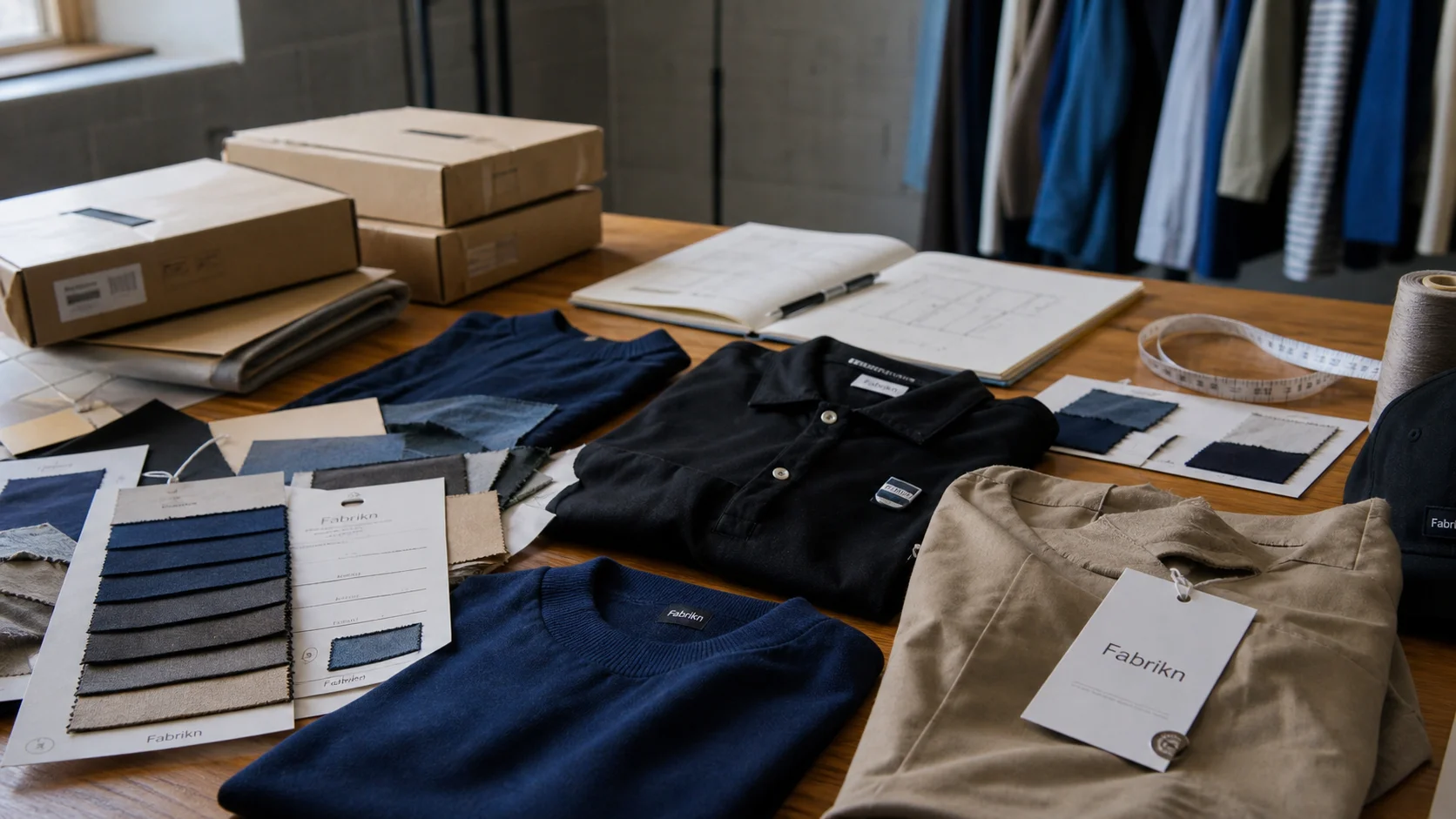
Supplier Communication for Custom Clothing Reorders compared by sample evidence, fabric or trim specs, MOQ, AQL terms, cost lines, delivery timing, and...
Fast answer: Supplier Communication for Custom Clothing Reorders: Tech Pack, Sample Gate, MOQ, and QC Terms should be judged by production evidence, not by a generic sourcing promise. The buyer needs sample proof, cost breakdowns, QC checkpoints, and delivery buffers in writing.
Ask for recent sample photos, measurement tolerances, fabric or print test assumptions, decoration test notes, packing examples, and a named inspection checkpoint. These details show whether the team can repeat an approved sample at bulk volume.
Separate garment cost, decoration, labels, packaging, sampling, testing, freight, and rush charges. Clear cost lines make it easier to reduce colorways, adjust size depth, or reserve more time for sampling.
Supplier Communication Tips for Custom Clothing Reorders - Custom Clothing manufacturing guide
Custom clothing reorders look simple from the outside. The artwork already exists. The fit is approved. The customer has bought before. Easy, right?
Not quite. In my experience, reorder management is where good brands separate themselves from chaotic ones. A reorder can go smoothly, or it can turn into a week of email back-and-forth, shade confusion, missed trims, and a production slot that gets pushed because nobody confirmed the basics in time.
If you are managing custom clothing reorder communication with suppliers, the goal is not just to “place the next order.” The goal is to keep the spec stable, reduce surprises, and make the factory feel confident enough to prioritize your work. That means being clear, fast, and organized from the first message.
If you are still refining your production setup, you may also want to review our services page, read more about our team on the about us page, or reach out through the contact us page when you need a direct production conversation.
Reorders are not just repeat purchases. They are continuity projects. The supplier is expected to recreate a previous result, sometimes months later, sometimes after the fabric mill has changed dye lots, or the sewing line has moved to a different shift, or the original merchandiser has left the factory.
That is why communication is not a soft skill here. It is a production control tool.
I have seen brands lose money because they assumed “same as last time” meant no further discussion. It rarely does. A reorder can still shift in fabric weight, rib construction, print placement, wash shade, label format, or carton pack. The factory may even have a different minimum order quantity for the same style if the original material is no longer stocked.
One of the biggest mistakes I see is vague communication dressed up as confidence. A message that says “please repeat the last order” sounds efficient, but it can leave too much room for interpretation. The supplier needs a clear reference point. The more exact the message, the fewer expensive surprises later.
“A good reorder email should answer four questions immediately: what is being repeated, what has changed, when do you need it, and what proof are you using as the reference.”
Before you contact the factory, pull together the previous order record. Do not rely on memory. Memory is useful, but not reliable enough for production work.
At minimum, you should check:
Some factories keep excellent records. Many do not. In a 300- to 500-piece reorder, a missing detail can cause a 3-5 day delay just in clarification, and that delay can become a 2-3 week miss if fabric or trim needs to be re-approved.
If the previous order was 1,000 pieces and the factory used a 20-person sewing line, the original process may not be the same this time if the quantity is only 300 pieces. That matters. Smaller reorders can be more expensive per unit because cutting, setup, and QC overhead stay the same while volume drops. A hoodie that cost $14.80 FOB at 1,000 pieces might move to $16.20 or even $17.00 at 300 pieces if the factory has to restart from scratch.
The best reorder communication is concise, structured, and easy for a merchandiser to forward to production without rewriting it. I always recommend that brands send a message with a clear subject line and a fixed information block.
Use this as a practical standard:
Do not send a reorder request buried in a long conversational thread. That is lazy communication, and it creates room for mistakes. I say that plainly because I have watched it happen too many times. One rushed “same as before” message can cost more than a proper 10-minute clarification call.
You do not need to be formal to be effective. You need to be complete.
That is enough to start a serious production conversation.
Every reorder is a chance for small upgrades, and every upgrade is a chance for confusion. Be careful here. Even minor changes need to be called out one by one.
If you are changing a neckline, a label type, a rib percentage, or a print location, say so in a bullet list. Do not hide changes inside a paragraph. Factories scan. Merchandisers scan even faster.
When I manage a reorder, I like to separate the message into two parts:
This approach keeps the supplier focused. It also protects you if there is a disagreement later. If the change was written clearly, the paper trail helps everyone.
For example, if the original polo shirt had a 220 GSM pique and the new order needs 240 GSM, that is not a small note. It may affect hand-feel, shrinkage, color absorption, and price. A factory may charge an extra $0.40 to $0.75 per piece depending on the mill quote and local fabric availability. The same goes for embroidery density. A logo that was 6,000 stitches on the first run might increase to 8,500 stitches if the artwork was revised, and that can change both cost and machine time.
Specificity is not being difficult. It is being professional.
These are the three topics that usually create friction. They are also the three topics you should raise early, not after the supplier has already said yes to the order.
For custom clothing reorders, a normal lead time can vary from 10 to 35 days depending on the product and fabric status. If the fabric is already in stock and the line is available, a small reorder may move quickly. I have seen simple jersey T-shirt reorders turn around in 12 to 15 days. A more complex hoodie with garment wash, puff print, and custom labeling can take 25 to 30 days, sometimes longer.
Ask the supplier to break lead time into stages:
That level of detail helps you spot bottlenecks early.
Reorder pricing should not be assumed to match the previous invoice. If the cotton market moved, if the factory changed labor costs, or if your quantity dropped, the old price may no longer hold.
A realistic reorder discussion might include:
One practical example: a custom sweatshirt may have cost $18.50 FOB on the first order at 1,500 pieces. A reorder of 400 pieces could land closer to $20.10 FOB if the factory needs to re-open the fabric booking and restart the line for a smaller run. That is normal. What is not normal is waiting until the PO is signed to discover it.
MOQ becomes tricky on reorders because some suppliers are flexible once a style is established, while others still hold strict minimums on fabric dyeing, trims, or print screens. If you need a small reorder, ask whether the MOQ applies to the garment, the color, or a specific component.
That distinction matters. A factory may accept 250 pieces of a finished t-shirt style but require 500 meters for a custom knitted rib or 1,000 pieces for a private label carton print. Ask the question directly.
Reorder Topic What to Ask Typical Range Lead Time How long for fabric, sewing, finishing, and dispatch? 10-35 days Price Is the old unit cost still valid for this quantity? Often +5% to +15% on smaller reorders MOQ Does the minimum apply to garment units, color, or trim? Varies by factory and material Sampling Do we need a pre-production sample or photo approval? 1-7 days for review, longer if physical sample is neededGood communication is not only about what you want. It is also about how the supplier works.
A factory merchandiser may be handling 20 to 40 active orders. A production manager may be juggling cutting capacity, sewing efficiency, finishing bottlenecks, and export deadlines at the same time. If your reorder message is unclear, it gets pushed down the stack. Not because the factory does not care, but because clarity wins attention.
Here are a few realities to keep in mind:
I have seen brands assume that a supplier will “remember everything.” A serious factory may remember the style, but it will still want confirmation on sizes, packaging, and the current production window. That is not a weakness. It is discipline.
If you work with a partner that handles full production support, you should expect organized communication from the start. Our services page outlines the kind of support that helps brands avoid the usual reorder bottlenecks, from development through final shipment.
After years in B2B clothing manufacturing, I prefer a simple workflow. It is boring. It is effective. Boring is good when money and deadlines are involved.
Pull the invoice, PO, size breakdown, approved sample photos, and QC notes. Check whether there were any recurring issues like loose threads, shade variation, or packing errors.
Keep it short, but do not make it vague. Include exact quantity, delivery date, and any changes.
If a factory says the price changed or the fabric is not available, get that in writing before you approve the order. A short delay here is far better than a costly surprise in bulk production.
Ask for progress at key points, not every day. A useful rhythm is confirmation after material booking, mid-production update, pre-shipment QC, and packing completion. That keeps the supplier accountable without creating noise.
When brands communicate this way, factories respond better. They know the buyer is serious and organized. That often leads to faster replies, fewer mistakes, and better cooperation when a rush order appears.
“The best reorder clients are not the loudest ones. They are the most precise ones.”
There are a few errors that keep repeating across brands, even experienced ones.
The mild criticism I will offer is this: some brands still treat production communication like customer service chat. That approach fails in manufacturing. Reorder management needs records, dates, quantities, and accountable responses. Friendly tone matters, but precision matters more.
If you want a repeatable process, use a checklist before every supplier conversation. It keeps the communication clean and saves time on both sides.
This is the kind of document that helps a supplier say yes faster. It also helps you compare multiple reorder options if you are speaking with more than one factory.
When you need to speak directly with a production partner about a reorder, the easiest next step is often a direct message through our contact us page. A clear brief saves time on both sides.
If you struggle to sound direct without sounding rude, use these phrases.
These lines are polite, but they keep the conversation moving. That balance matters.
The strongest reorder systems are built on records, not memory. Keep every approved spec, sample photo, QC note, and shipping record in one place. A shared drive works. A proper ERP works better. Even a disciplined spreadsheet is better than a pile of old email attachments.
In one factory I worked with, the merchandiser could pull a style history in under two minutes. That saved days on repeated orders because the team already knew the yarn count, the wash process, the approved carton size, and the previous issue notes. Speed comes from structure.
If your brand is growing, think of reorder communication as part of your production system. It is not admin. It is operations.
Supplier communication for custom clothing reorders should be simple, detailed, and written with production reality in mind. Confirm the old order, highlight what is changing, ask for price and lead time in writing, and keep the message organized enough for a factory team to act on quickly.
That is how you protect quality, reduce delays, and keep margins under control. It also builds trust. A supplier remembers the client who communicates clearly. They remember the one who sends complete information on time. Those relationships usually get better pricing, faster replies, and more flexibility when the calendar gets tight.
Reorders should feel predictable. Not effortless. Predictable. That is the real goal.
Get a free quote from Fabrikn — your trusted B2B clothing manufacturer with 10+ years of experience. MOQ as low as 200 pieces.
Get a Free Quote →The most important thing is that the supplier is working from the correct reference. Confirm the style code, approved sample, quantity, and any changes before production begins. A reorder with the wrong reference can create expensive mistakes very quickly.
No. Prices can change because of fabric costs, labor, trims, and quantity. I always ask for written confirmation of the current unit price before approving a reorder.
For most custom clothing items, I would start the conversation at least 3 to 6 weeks before you need delivery. Complex garments, custom dyeing, or low-stock materials may need longer.
Ask the supplier whether the MOQ applies to the garment, the fabric, or the trim. Small reorders often carry a higher unit cost, but they can still be worthwhile if the style is proven and the brand needs consistency.
Keep the approved tech pack, sample photos, order history, QC reports, packing list, invoice, and any written confirmations about changes. Those records make future reorders much easier to manage.
Yes, if the fabric, trims, and approvals are already in place. A simple reorder can sometimes move in 10 to 15 days, while a more complex style may still take 25 to 35 days depending on factory capacity.