
Which Swing Tag Materials Work with Metallic Foil Edges with checks for samples, fit, MOQ, QC evidence, pricing terms, and delivery risk.
Fast answer: Which Swing Tag Materials Work with Metallic Foil Edges should be judged by production evidence, not by a generic sourcing promise. The buyer needs sample proof, cost breakdowns, QC checkpoints, and delivery buffers in writing.
Ask for recent sample photos, measurement tolerances, fabric or print test assumptions, decoration test notes, packing examples, and a named inspection checkpoint. These details show whether the team can repeat an approved sample at bulk volume.
Separate garment cost, decoration, labels, packaging, sampling, testing, freight, and rush charges. When every cost line is visible, it becomes easier to reduce colorways, adjust size depth, or reserve more time for sampling.
Metallic foil edges can look expensive, sharp, and very deliberate. They can also look wrong fast if the base material fights the finish. I have seen beautiful brand concepts fall apart because the tag stock was too porous, too soft, or too thin to hold a clean edge. The result is usually not subtle. It looks tired. It looks like the printer ran out of patience halfway through the job.
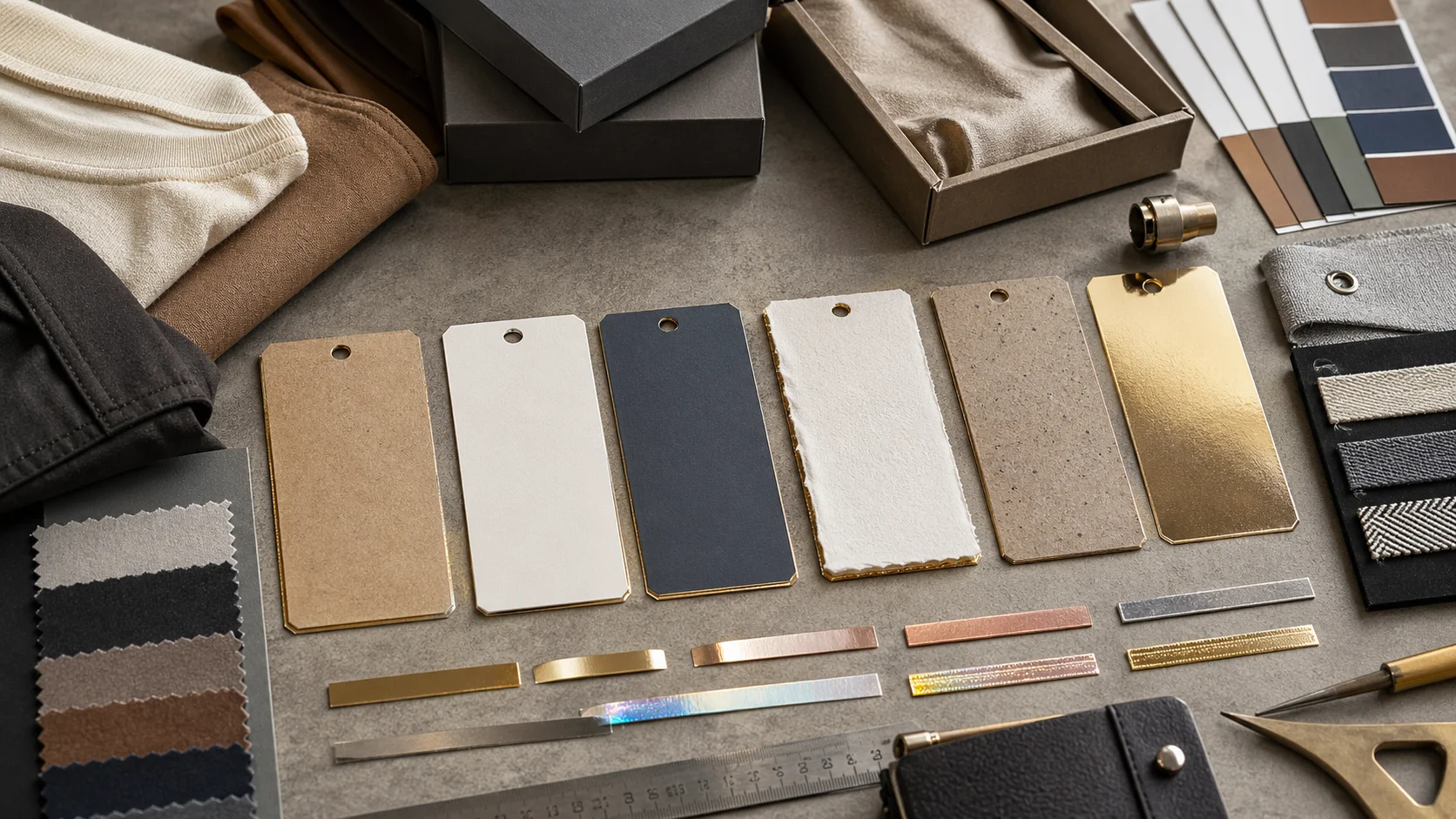
In swing tag production, the edge is not just a finishing detail. It is part of the brand story. A gold, silver, rose-gold, or holographic foil edge says premium, but only when the board underneath supports it. Some materials hold the foil edge crisply and reflect light with real confidence. Others absorb the shine, chip during die-cutting, or make the finish look patchy. On a proper production run, we are usually talking about 0.8-1.5 mm edge build-up after coating, and a clean foil line that still holds after 3-5 handling cycles through folding, packing, and carton insertion.
In this guide, I will walk through the swing tag materials that work best with metallic foil edges, the ones that are risky, how to balance cost with appearance, and what I would recommend if you want a tag that feels properly finished in hand. If you are comparing packaging options for a clothing line, you may also want to review our packaging services, or get in touch through contact us for production advice. For more background on the factory side, about us is worth a look. For reference, many apparel trims programs are produced in Guangzhou, while knitwear and cut-and-sew programs often move through Dhaka or Ho Chi Minh City depending on MOQ, fabric origin, and lead-time pressure.
Which Swing Tag Materials Work with Metallic Foil Edges - Packaging manufacturing guide
Foil edging is unforgiving. The process usually involves edge gilding, metallic edge coating, or a foil application step after die-cutting and edge compression. For the effect to hold, the material needs density, smoothness, and good edge integrity. If the fibers open up too much, the shine breaks. If the board is too soft, the edge flattens or frays. If the surface is too rough, the coating will sit unevenly and the edge will not catch the light cleanly. In practical terms, we usually want a board caliper that stays stable at 0.45-0.65 mm for standard swing tags, or a 350gsm-450gsm sheet with a tight formation and low lint on the cut edge.
The best candidate materials are usually:
What you want is a controlled surface and a stable cut. That is the real test. In a factory setting, we often check this by looking at the edge after die-cutting and again after the foil or metallic treatment. If the edge appears fuzzy under light, the material is already working against you. A well-run line will usually check edge quality immediately after a Bobst or SBL die-cutting pass, then again after a 24-hour cure if a water-based or PU coating was applied before edge finishing.
Coated art paperboard is one of the safest and most consistent choices. It gives a smooth face, a dense edge, and predictable results on hot foil or metallic edge treatments. In my experience, this is the workhorse option for fashion and accessories tags where the brand wants a polished look without going into luxury rigid packaging territory. In Guangzhou, it is common to spec this on FSC-coated C1S or C2S board from 300gsm to 450gsm when the client wants tight control of print color and edge brightness.
A 400gsm coated board can take metallic foil edges very well, especially when the edges are trimmed sharply and the stock is laminated or varnished before finishing. The coating keeps the tag face clean, while the density helps the edge stay crisp. On a well-run line, this material gives the cleanest "high street premium" effect. If you are using a Heidelberg Speedmaster for the print pass and a Kama or Duplo cutter for finishing, the register and edge stability are usually much better than on mixed manual workflows.
Best for:
Black card with metallic foil edges is a classic combination. It works because the dark body makes the metallic edge stand out more dramatically. Gold looks richer. Silver looks colder and more modern. Rose gold becomes softer and more fashion-led. I have seen black card used on premium streetwear runs where the tag itself becomes part of the product styling. A solid black dyed-through board, often 350gsm to 500gsm, usually outperforms surface-printed black sheets by a wide margin because the edge stays dark even after trimming and packing.
The best result usually comes from a solid dyed-through black board, not merely a surface-printed black sheet. Surface prints can scuff at the edge and expose a lighter core, which ruins the illusion. A dyed core keeps the edge consistent, and when the foil is applied cleanly, the contrast is excellent. In production, a clean die knife and tight pressure on the platen are critical, especially if the tags are being packed in bundles of 100 with a ribbon or gun tag fastener.
One honest note: black card can show fingerprints, corner wear, and tiny foil defects more than lighter stocks. It is beautiful, but it is not forgiving.
Soft-touch laminated swing tags are popular because they give a tactile, matte finish that makes metallic foil edges feel more deliberate. The contrast between the velvety face and the reflective edge is strong. That contrast is exactly why buyers remember the piece. The better factories usually apply a BOPP soft-touch film or a water-based velvet laminate before edge treatment, then allow a short cure so the coating does not gum up the edge.
This material works especially well when the brand wants a luxury feel without using thick rigid board. A 350gsm to 450gsm board with a soft-touch laminate often performs well if the edge treatment is controlled. The key is not to overcomplicate the design. Clean typography, enough white space, and a single metallic edge effect usually beat a busy layout every time. For high-volume apparel orders, soft-touch tags are often priced around $2.50-$4.00 per unit at 500 MOQ when foil edging, die-cutting, and stringing are included, with the price dropping materially at 2,000-5,000 units.
Kraft board can work with metallic foil edges, but only when the density is high and the tone of the design is intentional. A natural brown base with a gold or copper edge creates a warm, crafted look. It suits heritage brands, eco-minded labels, and products that want to signal authenticity. In practice, the better kraft specs are usually virgin-fiber or controlled recycled blends around 400gsm-600gsm, because they hold a cut line more reliably than loose, low-density kraft.
The risk is obvious. Standard kraft can be too fibrous, and the edge can look rough after finishing. I would not use a soft, low-density kraft if the edge must look premium. A stronger kraft board, usually around 400gsm or above, performs better. Even then, the finish should be tested on a sample batch first. If the brand wants an environmental certification angle, the base stock can be sourced with FSC or PEFC chain-of-custody and finished in a WRAP or BSCI-audited factory, which is common in Dhaka for export apparel trims.
Textured papers can look excellent with metallic foil edges when they are mounted or made with a backing that gives the tag proper structure. Linen, felt, or cotton-texture papers add depth to the face, while the foil edge adds a controlled touch of luxury. This combination can be very effective for boutique fashion, bridal, and artisanal brands. A cotton-fiber or linen-texture face paper over a dense greyboard or duplex backing often gives the cleanest hand feel, especially when the tag is edge-painted after lamination.
The problem is surface handling. Textured papers are often beautiful on the front but less reliable on the edge alone. If the sheet is too soft, the edge can be uneven after die-cutting. The solution is usually a thicker backing board or a laminated construction. A little extra engineering saves a lot of disappointment. For example, a 120gsm textured face laminated to a 600gsm backing can outperform a single-ply 350gsm textured sheet by a huge margin on edge sharpness.
Uncoated stock is common in packaging, but it is not always the right partner for metallic foil edges. The open fibers soak up moisture and can tear during edge finishing. The result can look rustic in the wrong way. There is a difference between "natural" and "unfinished." Buyers notice it immediately. In humid production environments like Dhaka, this matters even more because sheet moisture can swing by 3%-6% across a shift if the warehouse is not climate controlled.
That said, uncoated stock can still work if the board is dense and the design intentionally leans into a matte, artisanal aesthetic. I would pair it with a restrained metallic edge only on premium craft-led brands. If the idea is elegance, I would look elsewhere. A good pre-press team will usually run a test strip first and check whether the edge fuzz rises after die-cutting and packing.
Thin paper stocks are usually a poor match for metallic foil edges. They lack the body needed to hold the edge effect, and the shine can look superficial rather than integrated. A swing tag should feel substantial in hand. If it bends too easily, the finish will not rescue it. In most factories, anything under 300gsm is treated as a warning sign for standard apparel swing tags, unless the format is very small or the tag is backed onto a heavier insert.
There are exceptions for tiny tags, care labels, or minimalist inserts, but for standard apparel swing tags, I usually avoid anything too light. Even if the print looks good flat, the edge treatment often cracks once the tag is punched, strung, and bundled.
Recycled board is a strong choice in many packaging projects, but quality varies a lot. Some recycled boards have a pleasing tooth and enough density to hold foil edges. Others are inconsistent and can break down at the cut line. If the board has visible speckling and loose fiber structure, the edge finish may not stay clean. The problem usually shows up at the corner radius first, especially on 3 mm-5 mm radius die lines.
I am all for recycled materials when they are made properly. I am not a fan of using "eco" as an excuse for a weak-looking tag. Sustainability should still look considered. If the board is certified, check whether the chain-of-custody is actually documented; GOTS applies to organic textile supply chains, while OEKO-TEX is more relevant for inks, strings, and adjacent textile components than for paperboard itself. In apparel programs, buyers often ask for WRAP or BSCI at the factory level plus documented material compliance.
Not every metallic edge belongs on every material. A few pairings are more trouble than they are worth.
One factory example sticks with me. We ran a 20,000-piece tag order for a contemporary womenswear brand using a 350gsm black card with a gold edge. The first sample on a lighter stock looked cheap and slightly crushed after packing. Switching to a denser dyed core board fixed the problem instantly. Same artwork. Same foil. Very different result. Material choice carried the job. The line was finished with a hot foil press, then trimmed on a 3-side guillotine batch to keep the corners consistent. That kind of result is why a sample test is worth more than a moodboard.
The edge finish is only as good as the production sequence. In most factories, the order is print, dry, laminate or varnish, die-cut, edge seal or compression if needed, then apply the foil edge. If the sheet goes to foil before the ink or coating has fully cured, the edge can pick up dust or reject the foil. A UV varnish can be touch-dry in minutes, but for stable edge work we still like to give it enough time to settle, especially on dense black or soft-touch boards.
Machine choice matters too. A Bobst die-cutter gives a cleaner and more repeatable edge than a worn manual platen, and a proper hot foil stamping machine with controlled heat is much better than a rushed edge pass. On premium swing tags, the die should be sharp enough to minimize fiber pull, and the foil temperature is usually tuned carefully between about 105°C and 135°C depending on the board, adhesive layer, and foil film. If the temperature is too low, the edge will skip. If it is too high, the foil can blur or deepen into the paper texture.
In Guangzhou, many trim factories will also run a small pre-production strip on the same machine that will handle the full order, because edge consistency can shift by operator, shift timing, or even humidity. In Dhaka, the biggest issue is often moisture balance and sheet stacking time. In Ho Chi Minh City, the challenge is often speed and coordination between print and finishing subcontractors. The better plants control all three with in-house sampling, edge inspection under 4000K light, and a simple pull test for abrasion.
For standard apparel swing tags with metallic foil edges, the pricing usually depends on size, board weight, foil type, and whether stringing or punching is included. As a practical benchmark, a simple coated board tag with one metallic edge often lands around $2.50-$4.00 per unit at 500 MOQ, while a more complex soft-touch or black-core version with foil edge, hole drilling, and cotton string can move closer to $4.50-$7.50 per unit at the same quantity. At 2,000-5,000 units, the per-unit cost can come down substantially because the setup and die costs spread out.
Typical lead time is 18-22 business days after final artwork approval, with the first sample usually taking 5-7 business days if the materials are already available. If the board has to be sourced specially, or if the foil color is custom matched, add another 3-5 business days. In busy seasons, especially before fashion week or peak retail launches, factories in Guangzhou, Dhaka, and Ho Chi Minh City often book 1-2 weeks ahead for die-cutting and foil machines, so late approvals can push the job back quickly.
If the order needs certification checks, allow extra time for document review. A WRAP- or BSCI-audited facility may move faster on compliance paperwork, but the actual production slot still depends on machine capacity and material availability.
Keep the edge effect simple. The more complicated the tag, the more likely something will compete with the foil. A strong swing tag with a metallic edge usually benefits from one or two clean type sizes, a clear logo, and a quiet back panel. If the design also includes embossing, spot UV, or multiple foil colors, the production risk jumps fast and the reject rate can rise above 8%-12% on a messy run.
Leave enough margin from the cut line. In practical terms, I would keep important text at least 3 mm-4 mm from the edge, and more if the tag is thick or textured. On black card, even a 0.5 mm shift can be visible under raking light. For rounded corners, use a radius that matches the die cleanly; a 2 mm or 3 mm radius is often safer than a sharp corner on thicker board, because it reduces foil lift.
Do not over-spec the foil color. Gold, silver, rose gold, and holographic are all common, but the exact foil roll matters. A warm gold with a slightly muted reflection often looks more expensive than a bright mirror gold. For fashion and accessories tags, the foil supplier and batch consistency matter as much as the artwork. I have seen two gold foils from different rolls read completely differently under store lighting.
If the brand wants a premium eco signal, pair a certified board with a simple string or tie. Organic cotton string, recycled polyester cord, or unbleached paper twine can all work, but the attachment hole needs a clean punch and enough reinforcement. A 3 mm or 4 mm punch is usually enough for standard tag ties, while heavier multi-loop cords may need a larger eyelet or reinforced hole.
Metallic foil edges can complicate recycling because the finish is not always easy to separate from the paper fiber. That does not make the tag unusable, but it does mean the material story should be honest. If the brand is making sustainability claims, I would recommend using FSC-certified board, low-VOC or water-based inks, and avoiding unnecessary lamination when a varnish will do the job. A clean single-pass structure is usually better than a stacked-up construction that looks premium but is harder to recover.
For textile and apparel brands, the factory certification story often matters as much as the material story. GOTS is relevant when the tag program is tied to organic textile products and associated labeling systems. OEKO-TEX can support confidence around inks, strings, and adjacent components. WRAP and BSCI are frequently requested for social compliance in factories, especially when production runs through Dhaka or larger export plants in Guangzhou and Ho Chi Minh City. If the factory cannot document its system, the sustainability claim gets weaker immediately.
There is also a practical waste note. Foil edge jobs tend to have more setup waste than plain tags because the first few sheets are used for machine calibration. On a typical mid-size run, I would expect 3%-5% waste for setup and inspection, and sometimes more if the board is highly textured or the foil adhesive is finicky. Planning for that waste upfront is part of responsible production, not a sign of poor planning.
Get a free quote from Fabrikn — your trusted B2B clothing manufacturer with 10+ years of experience. MOQ as low as 200 pieces.
Get a Free Quote →Which material gives the cleanest metallic foil edge?A dense coated art board in the 350gsm-450gsm range usually gives the cleanest and most repeatable result, especially when the die-cut is sharp and the foil pass is controlled.
Can kraft board work with foil edges?Yes, but only if the kraft is high-density and not too fibrous. Natural kraft around 400gsm or more is much safer than soft low-grade stock.
Is black card better than white card for foil edges?Black card creates stronger contrast, so the metallic edge looks more dramatic. White card is easier to keep clean, but black usually feels more premium when the edge is well finished.
How long does production usually take?A typical run takes 18-22 business days after artwork approval, with sample approval usually taking 5-7 business days if the materials are in stock.
What certifications should I ask for?For material and factory compliance, ask for FSC where relevant, plus WRAP or BSCI at the factory level. OEKO-TEX can be relevant for strings, inks, and textile-adjacent components, while GOTS matters when the broader apparel supply chain is organic-certified.
Where are these tags commonly produced?Guangzhou is common for fast-turn trim and finishing work, Dhaka for large-scale apparel supply, and Ho Chi Minh City for mixed export production with strong finishing coordination. The best location depends on MOQ, lead time, and whether the tag is being packed with garments or shipped separately.
If you want, I can also tighten the tone to make it feel more like a real factory-side article, or make it more sales-focused for a packaging services page.