
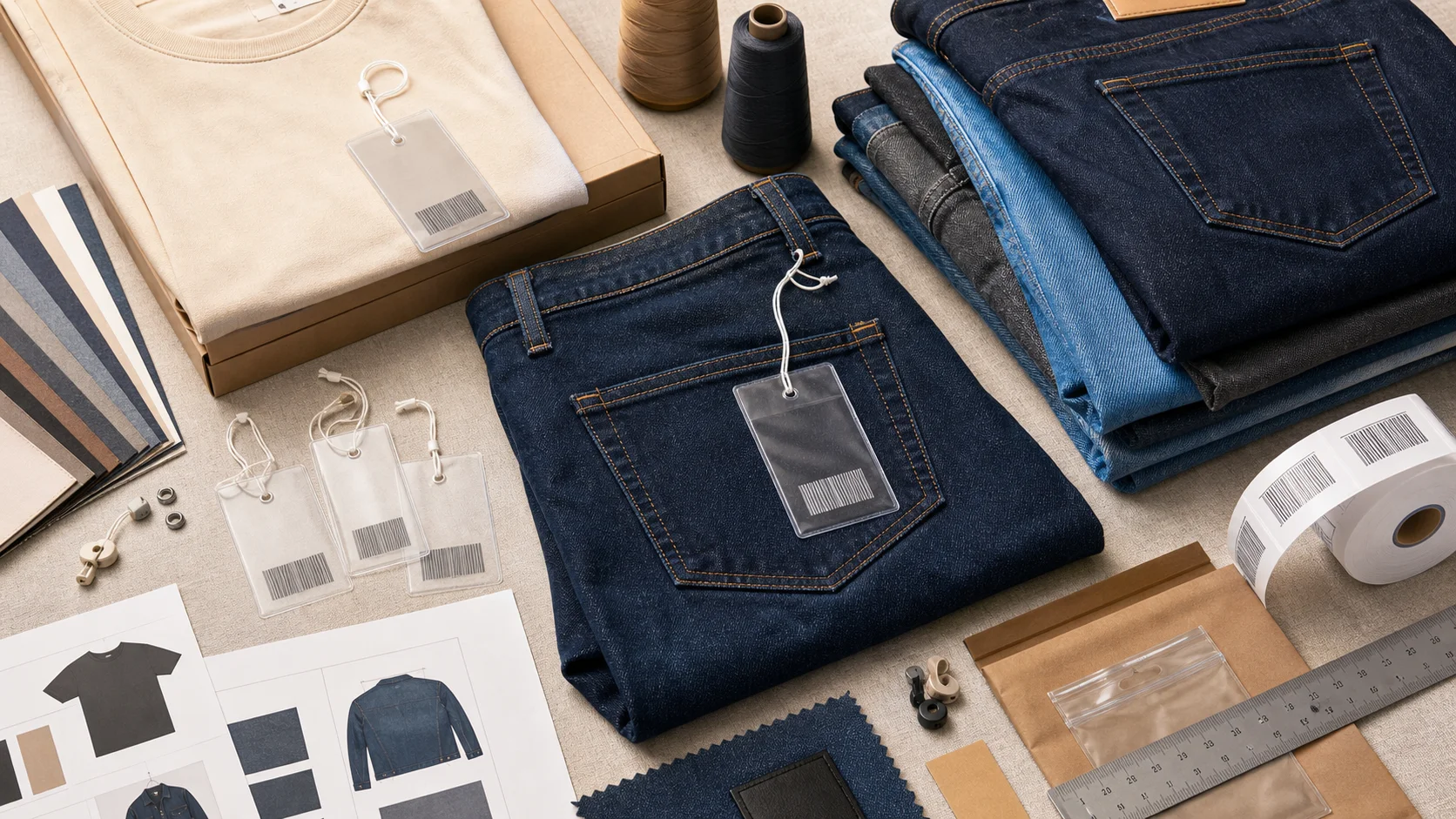
Denim Brands Use Transparent Swing Tags for Barcodes compared by sample evidence, fabric or trim specs, MOQ, AQL terms, cost lines, delivery timing, and...
Fast answer: Denim Brands Use Transparent Swing Tags for Barcodes: Fabric, Shrinkage, Fit, and QC Terms should be judged by production evidence, not by a generic sourcing promise. The buyer needs sample proof, cost breakdowns, QC checkpoints, and delivery buffers in writing.
Ask for recent sample photos, measurement tolerances, fabric or print test assumptions, decoration test notes, packing examples, and a named inspection checkpoint. These details show whether the team can repeat an approved sample at bulk volume.
Separate garment cost, decoration, labels, packaging, sampling, testing, freight, and rush charges. Clear cost lines make it easier to reduce colorways, adjust size depth, or reserve more time for sampling.
How Denim Brands Use Transparent Swing Tags for Barcodes - Packaging manufacturing guide
Denim is a funny category. On the rack, it looks rugged and casual. In the supply chain, it is exacting, expensive, and unforgiving. One wrong label placement, one unreadable barcode, one scratched finish on a premium pair of jeans, and the whole presentation feels cheaper than it should.
That is why transparent swing tags with barcode for denim brands have become such a practical packaging choice. They solve two problems at once: they keep the product presentation clean, and they carry the scannable data stores, distributors, and warehouses need to move goods fast. I have seen brands use them on everything from entry-level jeans to premium selvedge collections, and the result is usually the same. Less clutter. Better shelf appeal. Fewer scanning headaches.
For denim brands, packaging is not just a wrapper around the product. It is part of the brand story, part of the compliance system, and part of the logistics workflow. Transparent swing tags sit right at the intersection of all three.
Transparent swing tags are hanging product tags made from clear or semi-clear materials, usually PVC, PET, or similar plastics. They attach to garments with a string, loop, pin, or fastener, just like traditional hang tags. The difference is visual. Instead of a heavy paper card blocking the garment, the tag lets the fabric and denim wash show through.
That transparency matters in denim. Buyers want to see the texture, the hardware, the stitching, and the wash. A clear tag does not fight the product. It frames it.
When a barcode is added, the tag becomes more than decoration. It becomes a retail and warehouse tool. A clear swing tag can display style name, size, country of origin, care information, and a scannable code without turning the garment into a wall of printed text.
Denim brands use these tags for a simple reason: they help products look polished while staying operationally efficient. That combination is not easy to get with standard paper swing tags.
In my experience, denim buyers care about presentation more than many other categories. Jeans are tactile. The weave, the fade, the rivets, the patch, the topstitching all matter. A bulky tag can cover the very details that justify the price.
Transparent swing tags solve that. They keep the product visible while still allowing barcode scanning at the store level, in fulfillment, and in replenishment systems.
"A denim tag should help the product sell, not compete with it. If the packaging hides the wash, the fit, or the pocket detail, the tag is doing the wrong job."
A small warning: some brands try to cram every legal note, logo variation, social icon, QR code, and product claim onto a tiny clear tag. It gets crowded fast, and the result looks clumsy. A transparent swing tag works best when it feels disciplined.
Good transparent swing tag design is about restraint. Clear material gives you less surface noise, so every detail matters. If the barcode sits too close to the edge, scanners can struggle. If the typography is too light, it disappears. If the logo is printed in a pale tone, it can vanish against the denim underneath.
Many denim brands also add a small paper insert inside the transparent tag. That gives them a place to print brand storytelling, wash notes, sustainability claims, and sizing information while keeping the outside face minimal. It is a smart hybrid format, especially for mid-range and premium collections.
For a brand that wants help with packaging development and supplier coordination, it is worth reviewing a specialist service page such as Fabrikn services. For direct production questions or custom tag quotes, the contact page is usually the fastest route.
Barcode quality is where many projects succeed or fail. A transparent swing tag may look beautiful, but if the code does not scan cleanly at a retail counter or in a warehouse, the whole idea loses value.
Denim brands usually need barcodes tied to style, color, and size. That sounds straightforward. It rarely is. One jean may have six washes, five waist sizes, and three inseams. Then multiply that across a seasonal line. The data structure becomes serious very quickly.
I have seen small barcode issues create big headaches. A code that scans on one handheld device but not another. A tag that prints perfectly on screen but fails under store lighting. A production team that mixes up wash codes during a last-minute reorder. Those problems are not dramatic, yet they cost time and money.
For that reason, barcode proofs should be reviewed with the same care as print color proofs. Do not treat them as a formality. They are part of the product’s operational backbone.
Not all transparent swing tags are equal. The material choice affects cost, feel, print quality, and environmental performance. For denim, the tag also needs to hold up during packing, shipping, floor display, and customer handling without looking cloudy or scratched.
Material Look Durability Typical Use PET Clear, crisp, premium High Fashion denim, retail-ready tags PVC Very clear, flexible Medium to high Budget to mid-range programs Frosted PP Soft translucent finish High Premium minimalist branding Composite clear stock Specialty look, often layered Varies Limited editions, capsule dropsPET is often my first recommendation for denim brands that want a sharper, more premium look. It tends to hold print better and feels more substantial. PVC can be useful for cost-sensitive projects, though some brands prefer to avoid it because of sustainability concerns. Frosted finishes can help hide fingerprints and minor surface marks, which is useful in high-touch retail environments.
Print methods usually include UV printing, silk screen printing, foil stamping, and digital printing. UV is popular for crisp logos on clear material. Foil can look excellent on dark washes and premium capsule collections. Digital printing works well for short runs and multiple barcode variations.
At the factory level, transparent swing tag production is a sequence of small but important steps. It starts with artwork and data files, then moves into material selection, proofing, printing, cutting, and barcode verification. Miss one step and the whole batch can stall.
The first thing a good supplier asks for is not just the design file. It is the SKU list, barcode numbers, material preference, hole position, and finish. That may sound obsessive, but it saves everyone from a back-and-forth later.
Factories that handle denim packaging well usually build in a verification step before final packing. That extra check matters. It catches reversed artwork, incorrect hole punches, and the occasional barcode that looks right but scans badly.
If the tags are going to multiple stores or fulfillment centers, it helps to label cartons by style, wash, and barcode range. It sounds basic. It prevents a lot of tiny disasters.
Pricing depends on size, material, print coverage, quantity, and whether the tag needs special finishing. Short runs cost more per unit. Complex shapes cost more than standard rectangles. Extra print layers cost more too. No surprise there.
For denim brands, the sweet spot is usually a tag that feels premium without becoming precious. A clean PET tag with a barcode and one or two ink colors can stay reasonably cost-effective. Once you add foil, inserts, custom die cuts, or specialty attachments, the budget climbs fast.
Timelines are fairly predictable if the data is ready. Samples can take a few days to a couple of weeks. Full production usually follows after approval, though lead times stretch during peak seasons. Denim launches often move on tight calendars, so it is smarter to lock the tag design early than to treat it as a last-minute detail.
Transparent swing tags sit in a slightly awkward place for sustainability. They are often made from plastic, which makes some brands hesitate. Still, there are ways to make smarter choices.
PET is widely used and can be selected in recyclable formats depending on local infrastructure. Some brands move toward recycled content, lighter gauges, or hybrid designs that combine clear material with paper inserts. Others keep the clear tag as small as possible and avoid unnecessary layers.
That said, sustainability is not only about material choice. A tag that reduces mis-shipments, return errors, and scanning failures also cuts waste. Less rework. Fewer replacements. Fewer garments handled twice. That counts too.
For many denim brands, the honest answer is balance. The tag should look good, scan well, and avoid unnecessary bulk. That is a better target than chasing a perfect solution that does not work on the shelf.
Transparent swing tags are simple in theory, but a few mistakes show up again and again.
Another common problem is style inconsistency across a collection. One tag looks sharp and minimal, the next one is busy, the next one is a different thickness, and the whole line feels patched together. Denim brands spend a lot of energy on fit and wash consistency. Packaging deserves the same attention.
And if a tag is only meant to hold a barcode, keep it focused. Not every piece of packaging needs to do five jobs.
The right supplier should do more than print plastic. They should understand retail operations, barcode standards, and the way denim is sold. That sounds obvious, but it is where a lot of projects go sideways.
Ask for samples. Ask how they test barcode readability. Ask what happens if a print run contains an error. Ask whether they have worked on denim or apparel packaging before. A good supplier answers quickly and clearly. A weak one talks in circles.
It also helps if the supplier can advise on the small things, like hole punch placement, attachment style, and how the tag will sit next to rivets or leather patches. Those details sound minor until the finished jeans are hanging on a rail.
Get a free quote from Fabrikn — your trusted B2B clothing manufacturer with 10+ years of experience. MOQ as low as 200 pieces.
Get a Free Quote →Yes. They can look very polished, especially when the print is restrained and the material has a clean finish. They let the garment do the visual heavy lifting.
They can, but readability matters more than aesthetics. Many brands add a backing area, a frosted patch, or a paper insert behind the barcode to improve scanning.
PET is a strong all-around choice. It is clear, sturdy, and usually prints well. Frosted PP works nicely if the brand wants a softer, more understated look.
Usually, yes. The difference depends on size, material, print method, and quantity. They are often worth it when presentation and scanning reliability both matter.
Sometimes. It depends on the material and the local recycling system. If sustainability is a priority, it is worth asking for recycled-content options or single-material builds.
For denim, the best packaging is the kind people barely notice because it does its job so well. The tag stays out of the way, the barcode scans on the first pass, and the jeans keep the attention where it belongs.