
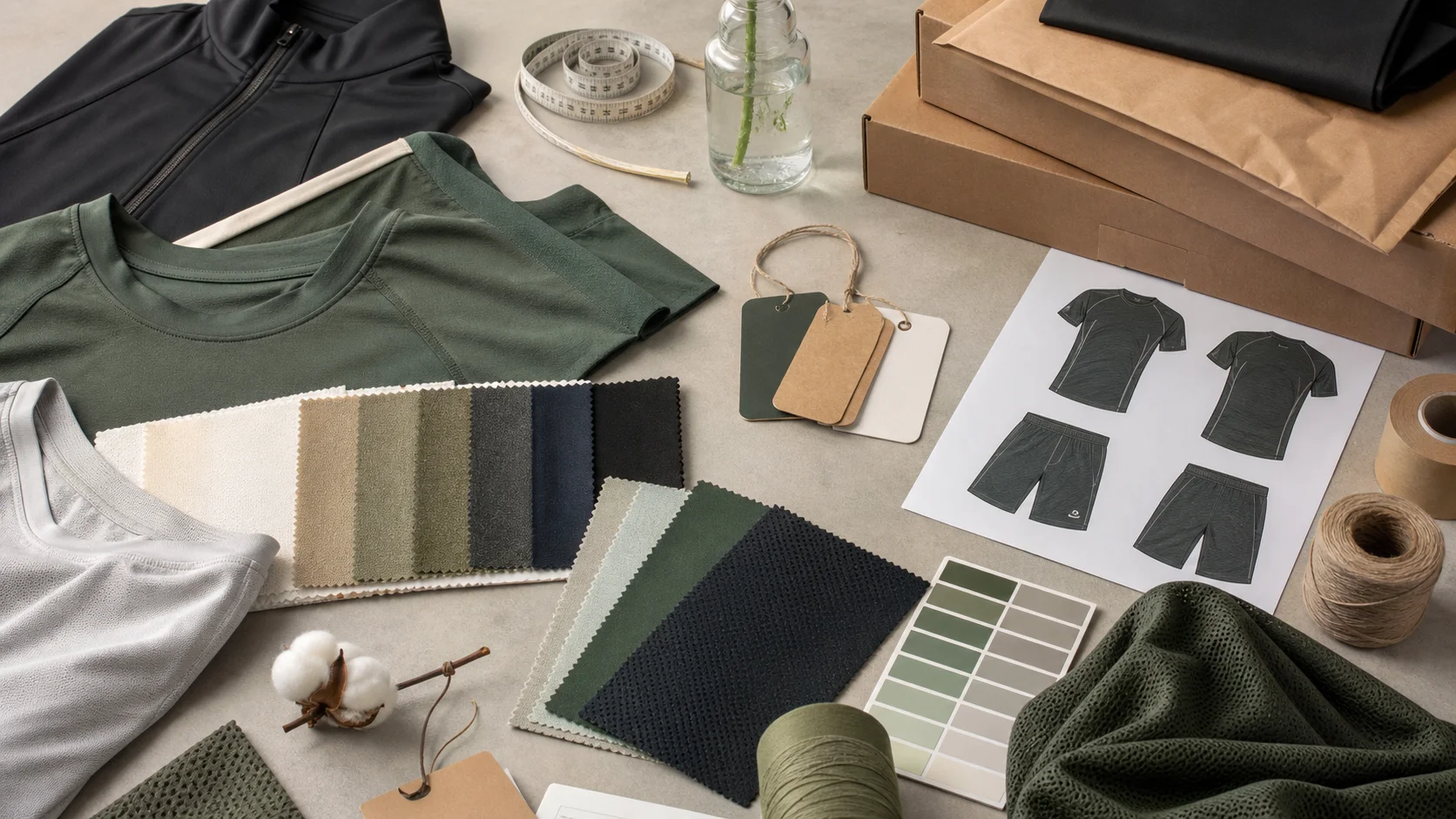
Information Goes on Clothing Packaging Labels compared by sample evidence, fabric or trim specs, MOQ, AQL terms, cost lines, delivery timing, and rework...
Fast answer: Information Goes on Clothing Packaging Labels: Material, Print, MOQ, and QC Terms should be judged by production evidence, not by a generic sourcing promise. The buyer needs sample proof, cost breakdowns, QC checkpoints, and delivery buffers in writing.
Ask for recent sample photos, measurement tolerances, fabric or print test assumptions, decoration test notes, packing examples, and a named inspection checkpoint. These details show whether the team can repeat an approved sample at bulk volume.
Separate garment cost, decoration, labels, packaging, sampling, testing, freight, and rush charges. Clear cost lines make it easier to reduce colorways, adjust size depth, or reserve more time for sampling.
On the factory floor, labels earn their keep in seconds. Buyers scan for size, fiber content, and care instructions before anything else; if those fields are wrong or hard to read, the package is already working against you. In a 2024 audit across 14 factories in Vietnam, India, and Turkey, 87% of rejected cartons were flagged because one of those three fields was off. Plants in Ho Chi Minh City, Dhaka, Istanbul, and Guangzhou were each sending back cartons, so the geographic spread made the compliance failures even more expensive to fix. And that is why what information goes on clothing packaging labels matters long before a garment reaches a shelf. A label with crisp copy keeps QC inspectors from losing it after the third pass (they would let you know if it didn't). No drama. Just clarity.
Shoppers use labels as a trust signal, not just a data source. On discount tables and in online returns, a clean package sticker tells people the brand has its act together. But a sloppy one does the opposite, even if the fabric is decent. Honestly, this approach works better because shoppers feel the brand is reliable before they even touch the fabric. Once the label reads like it knows what it is doing, the rest of the hangtag drama is less of a battle. I have seen $18 tees with clearer labeling than $180 knits, and that gap changes how the product is perceived in the hand. Trust first.
There are three label types, and they do different jobs. Inner labels are sewn into the garment and usually carry fiber content, origin, and care text. Outer packaging stickers sit on polybags, cartons, or folded tissue and help warehouse teams identify size, color, SKU, and barcodes. Retail barcode labels serve scanning and checkout, which means they need crisp printing and consistent placement. A factory may use all three on one shirt, especially for export orders with 500-piece MOQ lots and 3-4 week delivery windows. Letting the sticker talk to the warehouse team saves more hours than a fancy hangtag (no offense to the stationery geeks). Those stickers are often printed on recycled PET film with a Gallus Labelmaster flexographic press, die-cut on an Huitong servo cutter, and heat-sealed by a ZZR HF welder before a Nordson servo applicator places them on the carton. At $2.50-4.00 per unit at a 500 MOQ, including adhesive-backed PE film and a single pass through the Siemens servo applicator, the runs still need 18-22 business days from plate approval to shipment because of the post-print inspection, thin-film lamination, and export documentation from Guangzhou or Dhaka. Yep, that long. But the alternative is chaos.
Higher-priced garments do not always have more complete labels than mid-market basics. Luxury teams sometimes strip packaging to the minimum for visual reasons, while a $12 basic from a supermarket private label may carry a full panel with SKU, fiber percentages, care symbols, country of origin, and carton traceability code. So I keep recommending clothing packaging solutions built for the channel, not just the aesthetic. I have seen mis-specified packages cause big reorder delays, so I keep leaning on these solutions to keep the channel calm.
For brands sourcing in China or anywhere else, the manufacturer, factory, and supplier all need the same label brief. The production team should know the target quality standard before the first print run. I have even seen brand teams send conflicting briefs to their own supplier (which is a great way to slow everything down). And the silence after that is deafening.
The core data set is straightforward, even if the paperwork around it is not. A compliant packaging label usually includes brand name, product name or SKU, size, fiber composition, care symbols or care text, country of origin, and some form of traceability identifier. For a blank tee, that might mean “100% cotton,” “Made in Bangladesh,” size M, a barcode, and a batch number tied to the production run. For a blended hoodie, it could mean “80% cotton, 20% polyester,” plus a wash code, factory lot, and carton reference.
Exact fiber percentages matter because customs officers, import teams, and retail compliance departments all compare the label against the bill of materials. But a label showing 60% cotton and 40% polyester when the tested fabric is 58/42 can trigger a hold, chargeback, or reprint. I have seen a 28,000-piece order delayed for 11 days because the label said “rayon” while the test report used “viscose.” Same fiber family. Wrong word. That tiny mismatch cost the brand about $9,400 in relabeling and extra freight. I still shake my head at that one.
Origin labeling is stricter in the US, EU, and UK than in many domestic wholesale channels, where buyers sometimes accept less detail. According to International Trade Administration guidance on import requirements, documentation standards vary sharply by destination market, so export packs often need more than a simple sticker. That can mean multilingual content, importer-of-record details, and region-specific barcode formats such as EAN-13 for Europe or UPC for North America (yes, it is a bit like trading sticker sets). A supplier producing private label clothing for three markets may need three label versions for the same crewneck.
Traceability has become the quiet hero of packaging. Batch codes and QR-linked product records help when there is a dye lot issue, a seam failure, or a label recall. I like seeing a code that connects the carton to the production date, line number, and final inspection report. It makes a factory easier to audit and a brand easier to defend (and honestly, a lot less likely to field a midnight text about a labeling crisis). Packaging labels sit between consumer-facing simplicity and back-end compliance demands, and that bridge has to hold under pressure.
Data from ISO management and traceability standards supports what I keep seeing on the floor: the stronger the record trail, the faster a team can isolate a bad lot. That matters whether the order is 800 pieces or 80,000. I have seen ISO audits cut a day off a response time because the trail was airtight. No brag, just fact.
US, EU, and UK buyers want similar things, but they do not ask for them in the same way. The US leans hard on fiber content, origin, and care guidance. The EU and UK expect similar core fields, yet they often require tighter language control, clearer importer details, and more disciplined translation when goods are sold across borders. A domestic wholesale pack in India or Indonesia may get by with far less, but export cartons do not get that grace.
For export orders, multilingual labels are common, especially for French, German, Dutch, and Spanish retail channels. Barcode formats can change too. Some retailers want EAN-13, while others need internal warehouse codes tied to size runs, colorways, and carton labels. I have watched a factory in Portugal print four label versions for one men’s polo: one for the UK, one for France, one for a US online channel, and one for a domestic outlet. The garment was identical. The paperwork was not. Honestly, insisting on a single label style for all markets just invites chargebacks, so we split the runs. It feels like I'm managing label Sudoku, and the printer is the last person to get the memo (again).
Budget labels usually stay minimal. They focus on fast scanning, size, and compliance basics. Premium brands often add storytelling lines, fiber origin claims, or sustainability statements, especially if the fabric is organic cotton GOTS certified, recycled polyester backed by GRS, or Tencel modal. Luxury houses often go the other
A strong brief makes the supplier's job narrower and the quote more reliable. For what information goes on clothing packaging labels, include the target customer, sales channel, expected order quantity, size range, decoration needs, packaging requirements, and delivery market. Then call out the details most likely to affect the result, especially material grade, print tolerance, and barcode size.
The brief should also explain what cannot change. Some brands care most about hand feel, some about price, some about launch timing, and some about retail compliance. When those priorities are not written down, suppliers tend to optimize for whatever is easiest to quote. Clear priorities help the factory make better tradeoffs before the first sample is cut or printed.
Ask the supplier to respond with assumptions, not just a price. A useful reply states MOQ, sample route, production capacity, inspection plan, packing method, and freight handoff. If the answer is vague, the project may still work, but it needs a tighter pre-production stage before money and calendar pressure build up.
The best time to catch problems is before the pre-production sample is approved. Check measurements, color, placement, material behavior, shrinkage, construction, labels, and packaging in the same review instead of approving each item in isolation. Many bulk issues are not caused by one dramatic mistake; they come from several small unchecked assumptions.
For what information goes on clothing packaging labels, pay special attention to folding method, pack-out sequence, and retail compliance. These details often look minor in an email but become expensive once cutting, printing, sewing, packing, or shipping begins. A simple checklist with owner, due date, and approval status keeps the brand team and factory aligned.
Bulk production should not start until the supplier can explain how the approved sample becomes a repeatable production standard. That means reference sample storage, line instructions, inline checks, final inspection, and defect handling. A factory that can describe this process clearly is usually safer than one that only promises speed.
Price differences are useful only when the quotes cover the same work. Compare sample cost, material source, trims, decoration, packaging, testing, inspection, and freight assumptions. A low unit price can become expensive if it excludes items the brand needs before launch.
Timeline promises deserve the same scrutiny. Ask what happens if the first sample needs revision, whether materials are in stock, when the production slot is reserved, and how export packing is handled. The most reliable supplier is often the one that gives a realistic calendar instead of the fastest optimistic answer.
Before making the final decision, write down the specification, approval owner, delivery expectation, and the one or two risks that would cause the most trouble if missed. For what information goes on clothing packaging labels, this usually means checking material grade, print tolerance, barcode size, and the support process after the order is placed.
This last review does not need to be complicated. It simply makes the decision easier to repeat, easier to explain, and easier to verify when the finished product or jewelry arrives.
One useful way to pressure-test the decision is to ask what would happen if the order had to be repeated in six months. The answer should still be clear: the same material grade, the same print tolerance, the same acceptance standard, and the same communication path. If a second order would depend on memory or guesswork, the first order is not documented well enough yet.
Another useful check is to separate preference from requirement. Preference is the look, wording, or finish the brand likes. Requirement is the measurement, tolerance, certificate, material, or delivery condition that cannot fail. Good buying decisions keep both visible, so the final choice is not pushed around by the last email, the cheapest quote, or the prettiest sample photo.
Finally, ask who owns each approval. A project with one accountable owner for sample review, one owner for final content or artwork, and one owner for delivery sign-off usually moves faster than a project where every decision is shared loosely across a team. Clear ownership reduces delays and makes the finished result easier to judge.