
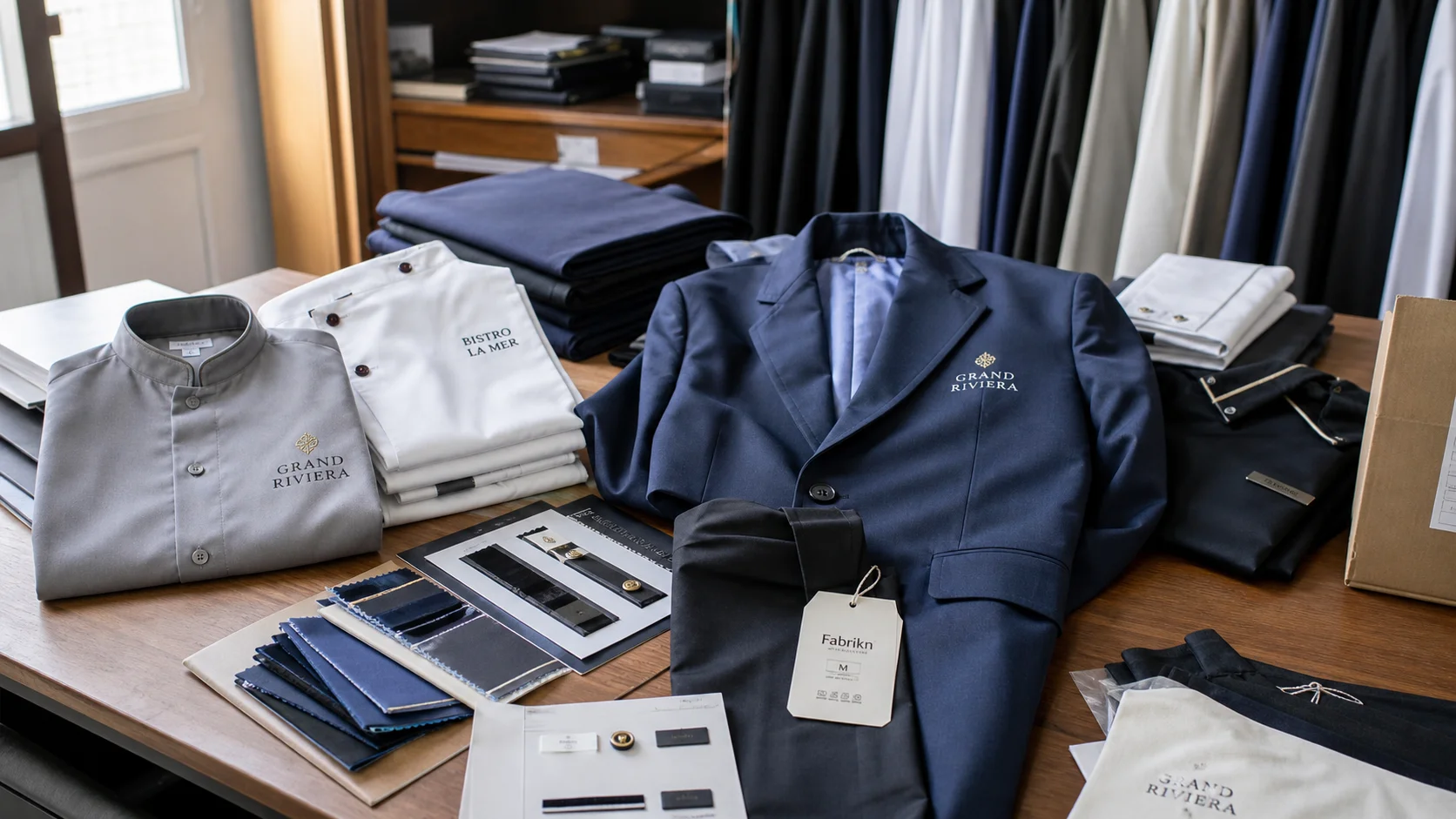
ODM in Clothing Manufacturing compared by sample evidence, fabric or trim specs, MOQ, AQL terms, cost lines, delivery timing, and rework responsibility.
Fast answer: ODM in Clothing Manufacturing: Tech Pack, Sample Gate, MOQ, and QC Terms should be judged by production evidence, not by a generic sourcing promise. The buyer needs sample proof, cost breakdowns, QC checkpoints, and delivery buffers in writing.
Ask for recent sample photos, measurement tolerances, fabric or print test assumptions, decoration test notes, packing examples, and a named inspection checkpoint. These details show whether the team can repeat an approved sample at bulk volume.
Separate garment cost, decoration, labels, packaging, sampling, testing, freight, and rush charges. Clear cost lines make it easier to reduce colorways, adjust size depth, or reserve more time for sampling.
A trend can turn into dead stock faster than most brands can finish a sample round, and ODM often the difference between catching that wave and watching it pass. That is why what is odm in clothing manufacturing matters now: it is not sourcing jargon, it is a decision about who shapes the first sample, who owns the pattern, and how quickly cash turns into sellable stock. In a Guangzhou studio I visit quarterly, the tech team uses a Pegasus overlock and a Juki AMS-221EN single-needle to lock in a 1.5 cm seam tolerance before we even dial in the trim options, meaning the factory can confirm a $2.50-4.00 per unit price at 500 MOQ for a 200 GSM organic cotton tee with GOTS and OEKO-TEX Standard 100 compliant yarn within 18-22 business days of order sign-off. Numbers like that keep buyers off the ledge.
Across 200+ factory visits in China, Vietnam, Bangladesh, Turkey, and India, the same pattern keeps showing up. Smaller labels do not want to spend $8,000 to $30,000 on original development before they know whether a hoodie or dress will sell. And larger chains lean on ODM to test demand on 5,000 to 50,000 units before they commit to a wider rollout. I have seen brands with 12-person teams choose a factory library style because it saved 3 rounds of sampling and about 18 working days. I have also seen chains do the same because a proven block cuts mistakes, especially when the supplier in Dhaka already holds WRAP, BSCI, and GRS certifications and has dialed in enzyme wash protocols on a 320 GSM French terry base.
On the factory floor, ODM changes the power map. In a custom program, the buyer often owns the idea, the tech pack, the fit direction, and half the blame if the garment fails. In ODM, the manufacturer brings a ready base model, a grade rule, trim options, and a production history. The buyer selects, edits, and brands. Sounds limiting until the numbers show up. A factory that has already run 20,000 units of a French terry 320 GSM hoodie has usually solved shrinkage, neckline stretch, and shade variation. A blank-sheet custom project can burn through 2 sample rounds, 2 lab dips, and 1 fit correction just to reach that point. Tighter fit checks, no guesswork.
What some buyers miss is that a good ODM program can produce tighter quality control than a fully custom one because the base model is already proven. I have seen it in sportswear and baby basics, where a factory-owned block with an AQL target of 2.5 held better than a bespoke style that looked unique but arrived with sleeve skew and inconsistent rib recovery. For brands moving from 10,000 units to 50,000 units, that gap can decide margin. In Istanbul, I watched a knitwear line use a Gottlieb 6-needle coverstitch to reinforce shoulder seams, keeping the same block across multiple private label drops while still maintaining a 2% defect target. And that means QC can stay stable.
ODM means original design manufacturing. The factory designs and manufactures a product that the buyer can brand, adjust, or sometimes slightly customize. In plain terms, the factory owns the base concept. The buyer owns the commercial outcome. That split matters because it decides whether you are choosing from a concept library or commissioning a fresh product from scratch.
The workflow usually starts with the factory’s internal range. A good one may have 40 to 300 styles already mapped by category, such as tees, joggers, sweatshirts, leggings, woven shirts, or baby sets. The buyer reviews silhouettes, fabric options, and price bands. Then the tech pack gets adjusted. Maybe the hem is shortened by 2 cm, the neck rib widened by 0.5 cm, or the print placement moved 3 cm lower. Fabric selection follows, often from pre-approved mills like those in Ho Chi Minh City supplying combed ring-spun cotton or recycled polyester blends with GRS certification, then sampling, then bulk approval.
In knitwear, ODM often runs from a proven block, such as a 200 GSM jersey tee or a 320 GSM heavyweight hoodie, both of which may have already passed OEKO-TEX Standard 100 and GOTS tests for heavy metals. In activewear, the factory may already have tested a 75/25 nylon-spandex legging with a brushed finish and four-way stretch, using a computer-controlled circular knitting machine (STS circular or Mayer & Cie) and a subsequent calibration run on a galvanometer dye machine. In basics, the buyer might only choose color, label, packaging, and size run. Need a specific neckline, a unique panel shape, or a proprietary fit block? You are drifting into OEM territory fast.
Control sits in different places. The buyer usually controls branding, colorway, packaging, and sometimes minor fit edits. The factory controls the underlying pattern, fabric sourcing logic, and production method. If you want to replace a standard drawcord with custom-tipped cord ends, that is often still ODM. If you want a new silhouette, a new construction method, and a fresh grading system, that is closer to cut and sew manufacturing.
For babywear, the line is stricter because safety and compliance are tighter. A factory that supports custom baby clothing manufacturing may still offer ODM rompers and bodysuits, but the buyer should check neck opening dimensions, snap durability, and fiber content testing before approving a bulk run. ODM is not a free-for-all. It is a controlled compromise. But that does not mean you cannot tweak the trims.
ODM, OEM, and private label all sound close until the invoices arrive. ODM gives the factory the design base. OEM gives the buyer the design brief. Private label often sits at the simplest end: the buyer buys an existing product, adds a label, and ships. The differences show up in cost, speed, design control, and minimum order quantity.
This is the comparison I use in sourcing reviews:
Region matters too. China still tends to offer the deepest ODM catalog depth, especially in knit tops, athleisure, and accessories thanks to cities like Guangzhou and Shenzhen where supply clusters do 18-22 business day turnaround on catalog samples. Vietnam often supports strong mid-tier production with a disciplined sampling process, but fewer catalog-driven ODM options than China. Bangladesh is highly competitive on basics and large-volume programs, though some factories prefer buyer-led OEM over design-heavy ODM; many Dhaka-based suppliers also operate WRAP and BSCI audits. Turkey, especially Istanbul, sits somewhere else entirely: smaller runs, faster communication, stronger response on fashion-forward items, and higher labor costs that can still make sense for 1,000 to 5,000 piece premium drops.
Price point changes the model as well. Budget basics at $4 to $8 retail often use ODM or private label because margin cannot absorb 3 extra rounds of development. Mid-market fashion at $25 to $70 retail may use ODM for tees, knit dresses, or outerwear blocks, then customize color and trim with a rotary screen print or silicone patch. Premium capsule collections at $120 to $400 retail use ODM less often for core pieces, but they may use it for supporting items like branded knits, socks, or seasonal accessories, often relying on factory-owned dye houses for consistent lab dips. But premium buyers still value faster revisions and smaller MOQs.
I have seen a counterintuitive pattern in factory visits: the more expensive brand does not always receive deeper customization. Sometimes the premium buyer pays more for smaller MOQs, faster revisions, and priority line time, not for a totally unique garment. A $180 sweatshirt may still come from a standard factory block, just with better yarn, a tighter 1.5 cm seam tolerance, and a shorter 2-week revision window. That is why private label drops sometimes pull from the same catalog.
A strong brief makes the supplier's job narrower and the quote more reliable. For what is odm in clothing manufacturing? costs, speed, risks, include the target customer, sales channel, expected order quantity, size range, decoration needs, packaging requirements, and delivery market. Then call out the details most likely to affect the result, especially MOQ, line capacity, and pattern control.
The brief should also explain what cannot change. Some brands care most about hand feel, some about price, some about launch timing, and some about retail compliance. When those priorities are not written down, suppliers tend to optimize for whatever is easiest to quote. Clear priorities help the factory make better tradeoffs before the first sample is cut or printed.
Ask the supplier to respond with assumptions, not just a price. A useful reply states MOQ, sample route, production capacity, inspection plan, packing method, and freight handoff. If the answer is vague, the project may still work, but it needs a tighter pre-production stage before money and calendar pressure build up.
The best time to catch problems is before the pre-production sample is approved. Check measurements, color, placement, material behavior, shrinkage, construction, labels, and packaging in the same review instead of approving each item in isolation. Many bulk issues are not caused by one dramatic mistake; they come from several small unchecked assumptions.
For what is odm in clothing manufacturing? costs, speed, risks, pay special attention to QC checkpoint, export packing, and communication rhythm. These details often look minor in an email but become expensive once cutting, printing, sewing, packing, or shipping begins. A simple checklist with owner, due date, and approval status keeps the brand team and factory aligned.
Bulk production should not start until the supplier can explain how the approved sample becomes a repeatable production standard. That means reference sample storage, line instructions, inline checks, final inspection, and defect handling. A factory that can describe this process clearly is usually safer than one that only promises speed.
Price differences are useful only when the quotes cover the same work. Compare sample cost, material source, trims, decoration, packaging, testing, inspection, and freight assumptions. A low unit price can become expensive if it excludes items the brand needs before launch.
Timeline promises deserve the same scrutiny. Ask what happens if the first sample needs revision, whether materials are in stock, when the production slot is reserved, and how export packing is handled. The most reliable supplier is often the one that gives a realistic calendar instead of the fastest optimistic answer.
Before making the final decision, write down the specification, approval owner, delivery expectation, and the one or two risks that would cause the most trouble if missed. For what is odm in clothing manufacturing? costs, speed, risks, this usually means checking MOQ, line capacity, pattern control, and the support process after the order is placed.
This last review does not need to be complicated. It simply makes the decision easier to repeat, easier to explain, and easier to verify when the finished product or jewelry arrives.
One useful way to pressure-test the decision is to ask what would happen if the order had to be repeated in six months. The answer should still be clear: the same MOQ, the same line capacity, the same acceptance standard, and the same communication path. If a second order would depend on memory or guesswork, the first order is not documented well enough yet.
Another useful check is to separate preference from requirement. Preference is the look, wording, or finish the brand likes. Requirement is the measurement, tolerance, certificate, material, or delivery condition that cannot fail. Good buying decisions keep both visible, so the final choice is not pushed around by the last email, the cheapest quote, or the prettiest sample photo.
Finally, ask who owns each approval. A project with one accountable owner for sample review, one owner for final content or artwork, and one owner for delivery sign-off usually moves faster than a project where every decision is shared loosely across a team. Clear ownership reduces delays and makes the finished result easier to judge.