
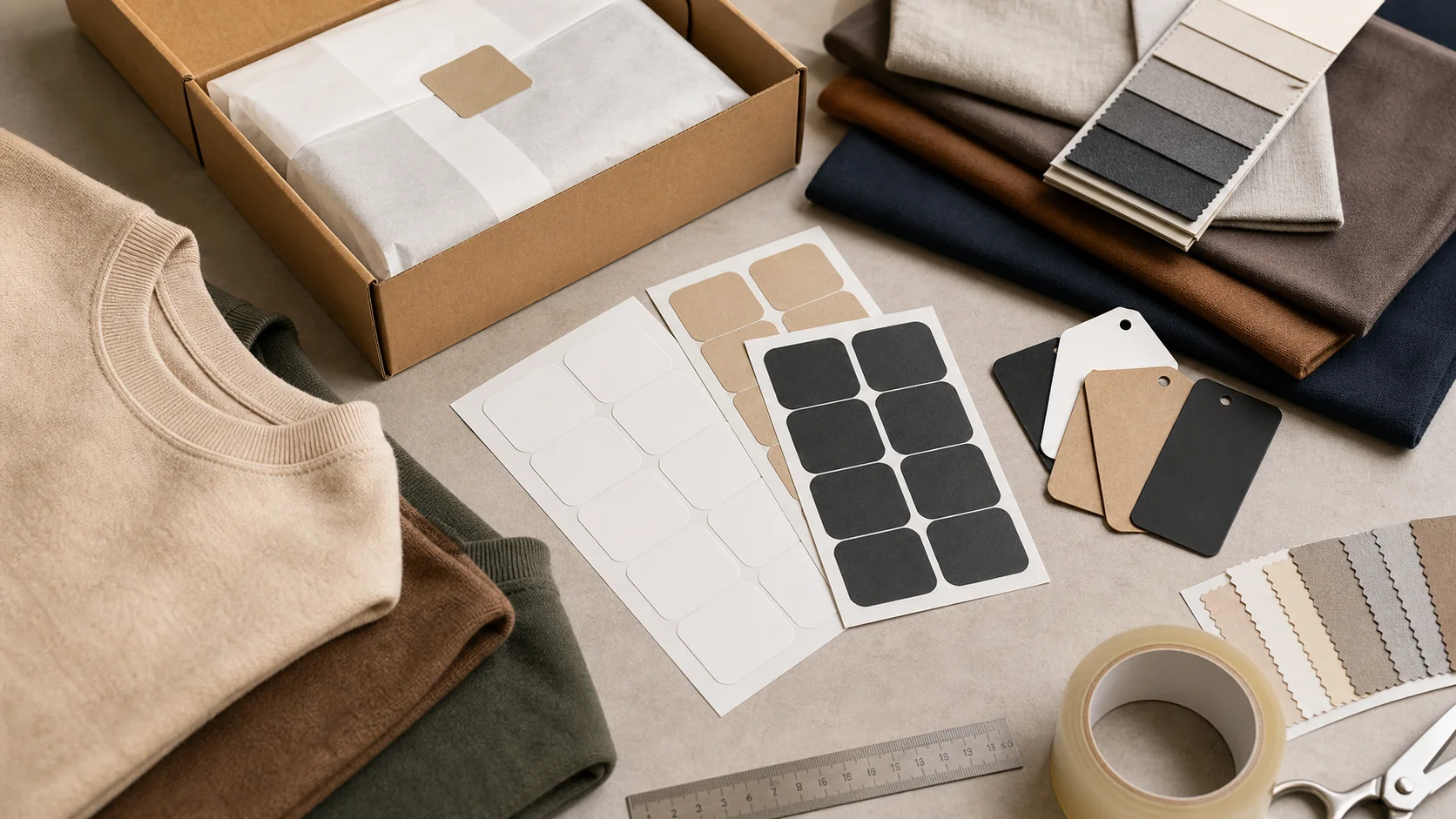
Wholesale Branded Stickers for Apparel Boxes in China with checks for samples, fit, MOQ, QC evidence, pricing terms, and delivery risk.
Fast answer: Wholesale Branded Stickers for Apparel Boxes in China should be judged by production evidence, not by a generic sourcing promise. The buyer needs sample proof, cost breakdowns, QC checkpoints, and delivery buffers in writing.
Ask for recent sample photos, measurement tolerances, fabric or print test assumptions, decoration test notes, packing examples, and a named inspection checkpoint. These details show whether the team can repeat an approved sample at bulk volume.
Separate garment cost, decoration, labels, packaging, sampling, testing, freight, and rush charges. When every cost line is visible, it becomes easier to reduce colorways, adjust size depth, or reserve more time for sampling.
Wholesale Branded Stickers for Apparel Boxes in ChinaIf you are sourcing branded stickers for apparel boxes wholesale China, you are probably trying to solve a very specific problem: how to make a box feel finished, premium, and unmistakably yours without pushing packaging costs through the roof. In real factory quotes, a simple 50 mm logo seal on coated paper can sit around $0.02-$0.05 per piece at 1,000 MOQ, while a foil die-cut version is often $2.50-$4.00 per unit at 500 MOQ when setup and short-run finishing are included. I have spent years working around packaging lines and garment factories, and this is one of those details that looks small on paper but changes the whole unboxing experience in real life.
Good stickers do more than carry a logo. They seal tissue. They hide tuck flaps. They cover a plain lid and make a basic mailer look custom-made. On a busy packing line, they also need to release cleanly from a 4-up or 8-up sheet, or from a 1,000-piece roll wound on a 3-inch core, so the team can apply them quickly without edge curl or adhesive bleed. They also tell the buyer, in one second, that the brand pays attention.
China is one of the strongest places in the world to source these stickers at scale. The print capacity is there. The material choices are broad. The pricing is competitive. And if you work with the right supplier, the turnaround can be fast enough for seasonal launches, retail replenishment, and e-commerce campaigns, with typical production windows of 18-22 business days after proof approval for standard paper labels and 25-28 business days for foil, embossing, or special adhesive builds.
Wholesale Branded Stickers for Apparel Boxes in China - Packaging manufacturing guide
A branded sticker on an apparel box can serve several jobs at once. That is why buyers keep ordering them even when the box itself is already printed. The sticker can be decorative, functional, or both, and on a production line it often doubles as a closure point for tissue paper or a QC seal that shows the box has not been opened since final inspection.
In my experience, the best branded stickers are the ones that do not fight the box. They should feel like they belong there. If the box is matte and minimal, the sticker should usually be restrained. If the box is aimed at a young streetwear customer, a bold shape or metallic finish can work well. Context matters more than trend-chasing, and a 0.2 mm registration shift on a die-cut seal is enough to make a premium box look off if the artwork is too busy.
China remains a practical source for apparel packaging because it combines print capability, material access, and scale in one place. You can find small label workshops and large export factories in the same supply chain, from Guangzhou and Shenzhen to Yiwu and Dongguan. That gives you flexibility on budget and volume, and it also means a buyer can source a plain coated-paper seal from a flexo shop in Guangzhou one week and a hot-foil, embossed version from a larger offset plant the next.
A decent sticker factory in Dongguan, Shenzhen, or Yiwu can typically handle everything from coated paper stickers to waterproof synthetic labels and custom die-cut pieces. A larger plant may run Heidelberg Speedmaster offset presses, Komori Lithrone 5-color lines, or Mark Andy flexographic units under one roof, with die-cutting on a Bobst or Zund flatbed cutter and slitting on an automatic rewinder. That matters when you need different quantities for different SKUs.
“For apparel brands, packaging is never just packaging. It is part of the product story, and sticker quality is one of the first things the customer touches.”
Wholesale sourcing in China also gives you more room to negotiate. A domestic printer may be cheaper for tiny runs, but once you move into the 3,000 to 20,000 piece range, Chinese suppliers often become much more competitive. I have seen branded apparel box stickers land at roughly $35-$80 per 1,000 pieces for simple coated paper jobs and $120-$260 per 1,000 pieces for foil or embossed builds, especially when the brand is willing to standardize size and material. That is where a 50 mm round seal and a custom die-cut label are not in the same cost bucket.
If you are still mapping out your packaging strategy, it can help to speak with a packaging team early. Fabrikn’s services page is a useful place to start if you want to compare sticker production with other apparel packaging options.
The wrong material can ruin an otherwise beautiful package. The right one disappears into the experience and quietly does its job. In practice, the choice usually comes down to whether the box is coated board, kraft board, or soft-touch laminated paper, because each surface changes how the adhesive wet-out behaves over the first 24 hours.
I do have one honest criticism here: too many brands insist on a shiny, high-gloss sticker because it looks expensive in a mockup, then they place it on a matte rigid box and it ends up looking cheap under store lighting. A better rule is to match the finish to the packaging texture, not to the fantasy in the design file. If the lid is soft-touch, a matte laminate or dull varnish usually reads better than a mirror gloss.
Not every sticker works on every box. A soft-touch coated lid, a rough kraft mailer, and a textured linen paper box each behave differently. On rough surfaces, you need stronger glue and sometimes a slightly thicker face stock. On high-gloss surfaces, the adhesive may stick well enough, but the visual issue becomes reflection and edge lift. In practice, a paper label on a rough 2.5 mm corrugated mailer often needs a 10-15% larger adhesive footprint than the same artwork on a smooth SBS carton.
For brands that are still building their packaging stack, a quick conversation with an experienced supplier can save money. If you need a direct starting point, Fabrikn’s contact-us page is the fastest way to request material options and a quote.
Sticker printing is where a simple label becomes a brand asset. The factory choice and print method shape both appearance and cost. The best plants will proof on a calibrated Epson SureColor or similar digital proofing system, then run the production job on offset or flexo once the Pantone targets and die lines are signed off.
The most effective premium sticker I have seen on apparel packaging was not overloaded. It had one clean logo, a muted black base, and a narrow gold foil line. Simple. Expensive-looking. Hard to mess up. That is the kind of detail buyers remember, especially when the factory uses a clean kiss-cut on a 330 mm x 480 mm sheet and the label peels without lifting the backing.
Sticker Type Typical Use Approx. Factory Price in China Usual Lead Time Coated paper logo sticker Basic apparel box sealing $35 - $80 per 1,000 pieces 18 - 22 business days Matte laminated die-cut sticker Premium retail and e-commerce boxes $55 - $120 per 1,000 pieces 20 - 24 business days Vinyl or BOPP waterproof sticker Shipping, humid climates, long handling cycles $65 - $140 per 1,000 pieces 20 - 26 business days Foil or embossed sticker Luxury apparel packaging $120 - $260 per 1,000 pieces 25 - 30 business daysThese are factory-level reference ranges, not retail quotes. Size, shape, color count, and order quantity can move the number quickly. A 50 mm round logo seal is not priced the same as a large custom-cut label with foil and spot UV, and a 4-color CMYK job on 157 gsm art paper will usually price differently from a 1-color black logo on kraft stock.
Buyers often ask for one number. That is not how the real world works. Sticker price in China depends on quantity, material, finish, and how much setup the factory has to do before the first sheet comes off the line. A 500 MOQ can still be cheap on plain paper, but once the job needs a new cutting die, a foil plate, and an extra varnish pass, the cost jumps because the setup is doing more of the work.
As a rough buyer-side benchmark, a 500-piece short run of simple logo stickers may land around $25-$60 total, while the same design in foil or emboss can be closer to $90-$180 total. For roll labels, factories in Guangzhou often quote per 1,000 or per 5,000 pieces because the slitting and rewinding setup is where the economics change. A clean 3,000-piece run is usually the point where unit pricing starts to behave much better than a tiny test order.
Lead time is also more predictable than many buyers think. Standard paper stickers can usually move in 18-22 business days after artwork approval, while special finishes may take 25-30 business days. If a supplier promises the whole job in five days and includes foil, embossing, and export packing, they are probably cutting corners somewhere.
The best supplier is not always the cheapest. You want a factory that understands your box material, your shipping route, and your brand level. A plant in Guangzhou may be better for fast sampling and export paperwork, while a larger converter in Dongguan may be stronger on volume consistency and automatic roll finishing. If you need multiple packaging items at once, a supplier near a garment hub can coordinate better with the box, tissue, and sticker schedule.
In practical terms, ask whether the factory runs inline inspection, has a Pantone matching system, and can show recent jobs on similar substrates. For export programs, I also like to see whether the vendor can provide GOTS documentation for paper-based eco programs when applicable, OEKO-TEX Standard 100 ink or adhesive declarations, and broader social audits such as WRAP or BSCI for the manufacturing site. Those certifications do not guarantee a perfect sticker, but they do tell you the factory understands the paperwork side of international apparel sourcing.
If your supply chain crosses borders, it helps to know how sticker needs differ by market. Buyers in Dhaka often care more about low-cost carton sealing and quick replenishment for export orders, while brands working through Ho Chi Minh City may want a cleaner premium retail look for short-run fashion drops. The smartest factories in China can adjust to either use case if they are given the right pack spec from the beginning.
QC for stickers is mostly about consistency. A good-looking sample means very little if the second batch shifts color or the adhesive fails on humid cartons. The inspection team should check Pantone tolerance, die-cut registration, roll tension, and backing release, not just whether the logo looks centered on a PDF.
The biggest practical QC issue I see is edge lift after application. If the adhesive does not wet out properly in the first 24 hours, the sticker may start lifting at the corners during transit. That is why factories often test by applying labels to actual corrugated cartons and leaving them in a 40 C / 80% RH chamber for a short cycle before approving the run. For premium jobs, the die line should be checked against the printed art with a loupe or digital caliper, especially when the label includes foil or fine text below 5 pt.
Other useful checks include carton count, roll diameter, core size, and pack-out method. A standard export carton might hold 1,000-5,000 labels depending on size, and if the inner polybag is too tight, the corner curl can show up before the job even leaves the warehouse.
The ordering process is straightforward when the factory is organized. You send artwork. They confirm size, material, finish, and quantity. They issue a proof or flat die line. You approve color, cut, and adhesive spec. Then the production slot is booked. For a normal order, that sequence takes about 1-2 days for quoting, 2-4 days for sample/proof review, and 18-22 business days for production after approval.
For a proper order, I recommend asking for three things before you pay the deposit: the substrate spec, the adhesive type, and the finishing method. If the job is on BOPP roll stock, confirm whether it is top-coated or not. If it is a paper job, confirm whether the coating is aqueous, matte film, or UV varnish. Those small details change both the look and the application performance.
Many factories will also offer a test run of 100-300 pieces before full production, especially on custom die-cut or foil jobs. That is a smart move. A tiny adjustment in the die, the glue, or the foil temperature often solves problems before they show up at 5,000 units.
The first mistake is overdesigning the sticker. Busy layouts look expensive on a screen and cluttered on a box. The second mistake is ignoring the box substrate. A soft-touch lid is not the same as rough kraft. The third mistake is underestimating setup cost, especially for foil, emboss, and unusual shapes. A fourth mistake is approving a sample without testing it on the actual carton line speed, because a label that works by hand may fail when a packer applies 200 boxes per hour.
Another common error is assuming all “eco” claims are equal. Kraft paper is not automatically recyclable if the adhesive is wrong, and a bio-based claim is not helpful without a clear substrate spec. If your brand sells into EU or U.S. channels, ask the supplier for the exact paper grade, adhesive chemistry, and any certification documents they can support. That level of specificity protects you later.
I also see brands choose a supplier only because the unit price looks low. That usually backfires when the order needs a second proof, a new die, or a corrected Pantone, because the hidden cost lands in delays, not just invoice line items.
Stickers sit at the very end of the apparel packaging chain, but they touch every upstream decision. If the garment factory in Dhaka ships polybags with a certain seal width, the sticker size has to match. If the distribution center in Ho Chi Minh City uses semi-automatic carton sealers, the box label cannot interfere with the tape path. If the brand’s sourcing team in Guangzhou is consolidating hangtags, tissue, box, and sticker in one export lot, then the packing spec needs to be locked before the carton count is finalized.
In real projects, stickers are often ordered alongside folded boxes, hangtags, and woven labels, because that lets the supplier keep color matching consistent across all packaging components. The best programs treat the sticker as part of the same system, not a random add-on. When that happens, the whole package feels tighter, more deliberate, and more expensive in the right way.
If you are building a larger packaging program, Fabrikn’s services page can help you compare sticker production against box, label, and insert options before you lock the purchase order.
Get a free quote from Fabrikn — your trusted B2B clothing manufacturer with 10+ years of experience. MOQ as low as 200 pieces.
Get a Free Quote →What is the most common sticker material for apparel boxes?Coated paper is still the default for many brands because it is cost-effective and prints cleanly on offset presses like a Heidelberg Speedmaster or Komori Lithrone, especially for simple logo seals.
Can I get waterproof stickers from China?Yes. BOPP and vinyl labels are common, and the better factories will test them for humidity and adhesion on corrugated cartons before shipment.
What MOQ should I expect?For a basic paper sticker, 500-1,000 pieces is common for short runs, while roll labels and premium foil jobs often become more economical at 3,000-5,000 pieces.
How long does production usually take?Standard jobs usually take 18-22 business days after approval. Foil, embossing, special die cuts, or multi-layer constructions often take 25-30 business days.
What certifications should I ask for?For apparel-linked packaging programs, ask for GOTS, OEKO-TEX Standard 100, WRAP, or BSCI documentation where relevant, plus substrate and adhesive specs if the supplier is making eco or skin-contact claims.