
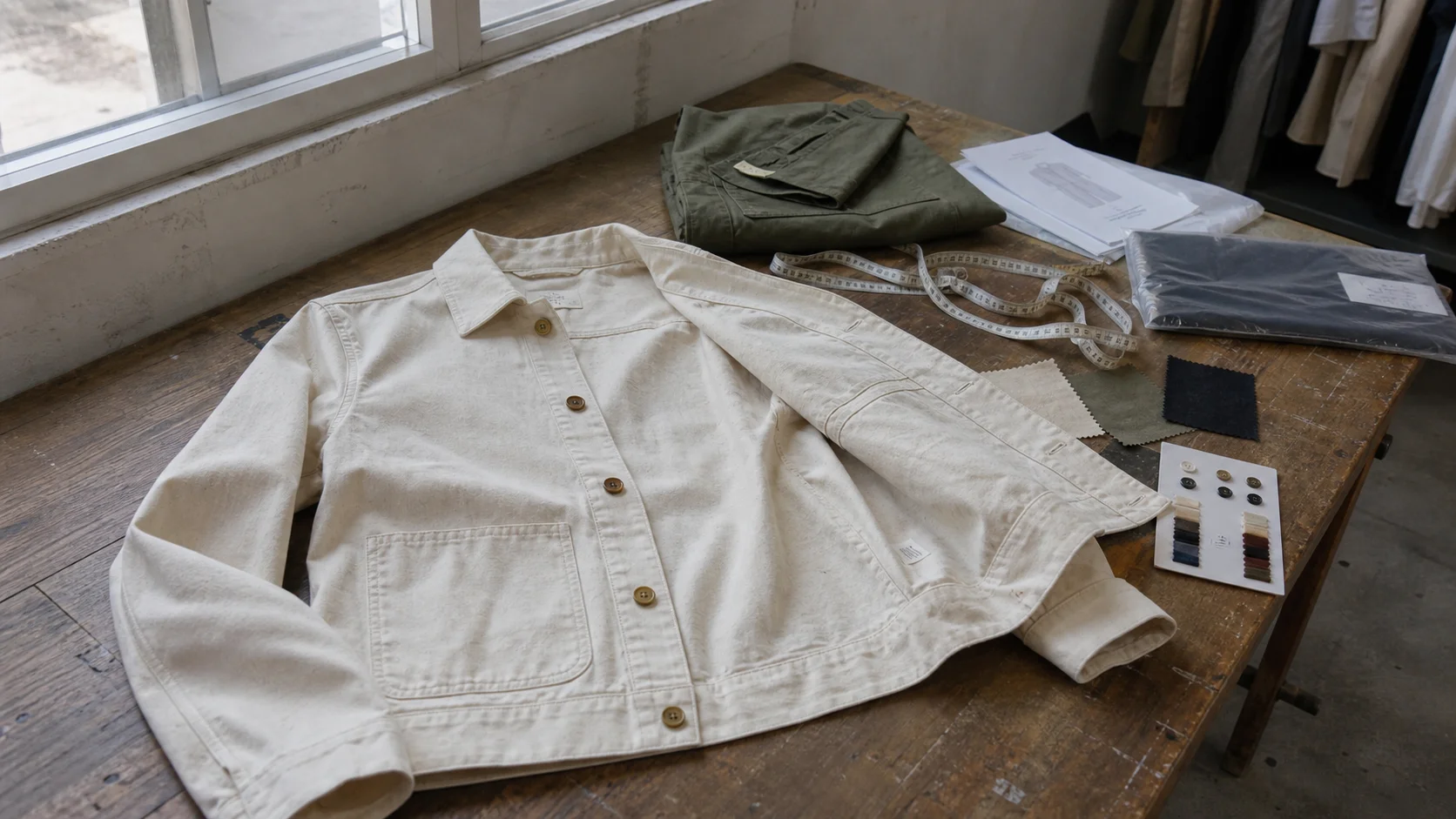
A focused outline for startup apparel brands sourcing trims for wholesale jackets, covering spec development, decoration compatibility, compliance, sampling, costing, and production handoff.
Wholesale Jacket Trim Sourcing for Startup Buyers - Fabrikn production reference
Wholesale jacket trim sourcing is one of the least glamorous parts of startup brand development, yet it has a direct effect on cost, fit for purpose, production timing, and perceived product quality. Many early-stage buyers spend most of their attention on shell fabric, silhouette, and decoration layout. That is understandable. The visible body fabric tends to carry the main design story. Still, trims often decide whether a jacket feels commercial and reliable or looks underdeveloped.
In jacket manufacturing, trims usually include zippers, snaps, buttons, cords, cord locks, drawstring tips, labels, patches, elastic, hook-and-loop tape, ribs, toggles, eyelets, hangtags, and packaging accessories. On technical or outerwear-heavy styles, the trim package can become even more complex, adding seam tape, waterproof zipper types, molded pulls, reflective applications, and reinforcement components. Each item introduces a sourcing decision. Each decision affects minimum order quantity, unit price, testing needs, and production risk.
Startup buyers are especially exposed because their order volumes are usually small, color counts are often high relative to volume, and design expectations may exceed the practical limits of low-MOQ purchasing. A large brand can custom-develop zipper pulls, embossed snaps, and branded stopper molds because it can spread tooling and minimums over large runs. A startup rarely has that leverage. The smarter route is usually selective customization: put budget into the trims customers notice first, then standardize the parts that do not justify heavy development cost.
That is where disciplined sourcing matters. Good trim buying is not about saying yes to every brand detail. It is about deciding which details are worth custom development, which can be sourced from stock, and which should be simplified to protect delivery. Startup teams that make these decisions early usually gain better control over margin and timeline. Startup teams that delay trim decisions often run into sample revisions, color mismatch, missing components, and ex-factory delays.
For brands building their first wholesale outerwear program, trim sourcing should be treated as part of product engineering rather than an afterthought. If you are still mapping production support options, Fabrik’s services page is a useful starting point for understanding how development and sourcing functions typically connect.
Startup buyers sometimes define trim too narrowly and think only about zippers or buttons. In wholesale jacket trim sourcing, the trim list should cover every non-body-fabric component required to complete the style and pack it for sale. A practical bill of materials reduces surprises later.
This wider definition matters because startup costing often gets distorted when trims are fragmented across departments or suppliers. A brand may approve a sample based on a nice-looking prototype trim set, only to learn later that the bulk equivalent requires a different MOQ, longer lead time, or a different finish. That gap between sample trim and bulk trim is one of the most common problems in startup jacket programs.
A disciplined trim matrix should list part name, supplier source, material composition, finish, color code, size, placement, test requirement, MOQ, and lead time. Even if the brand is small, this level of detail saves time. It also makes factory communication cleaner because there is less room for substitution without approval.
Not all trims deserve equal money or attention. Startup buyers usually benefit from ranking trims in three groups: high-visibility trims, functional-risk trims, and standard trims.
These are the components customers see and touch first. On jackets, that often means the main front zipper, zipper puller, chest patch, branded snap, drawcord tip, or a standout woven label. These trims can carry brand identity. They deserve careful review because they influence first impression and perceived price point.
These trims may not be the most visible, but failure creates returns or complaints. Examples include pocket zipper quality, cord lock grip strength, snap attachment security, elastic recovery, and seam tape compatibility. A low-cost trim choice here can erase any savings if garments fail in wear or washing.
These are the components where stock options are often enough. Internal labels, generic zipper tape colors, non-visible reinforcement tape, and some packaging items can often be standardized. Buyers who insist on full customization in this category tend to raise complexity without adding much sales value.
The practical sourcing judgment is simple: customize what sells the style, standardize what does not, and protect function where failure is expensive. That approach usually gives startup brands a better balance between brand identity and operational realism.
Zippers are usually the most important trim on a jacket. Buyers need to decide between coil, vislon, or metal constructions, along with open-end or closed-end usage depending on placement. Outerwear styles often use open-end front zippers and closed-end pocket zippers. For light fashion jackets, standard nylon coil may be enough. For heavier workwear or molded outerwear looks, vislon can create a more robust appearance.
The tradeoff is cost versus image versus performance. Custom zipper tape color, custom pullers, and branded sliders can look strong on a line sheet, but each added feature can raise MOQ and extend lead time. Stock zipper bodies with custom pullers are often a better startup compromise than fully custom zipper programs.
Typical MOQ ranges vary widely by trim supplier, but startup buyers often see stock zipper access at low development quantities while custom pullers, branded molds, or special finishes may start around 500 to 3,000 pieces per style or color. Exact numbers depend on the component and whether tooling is required.
Metal trims affect brand positioning quickly. Matte black snaps, antique brass tack buttons, and branded shank buttons can change the feel of a jacket even when the body fabric stays the same. Yet metal hardware also introduces finish consistency issues. Color tone across snaps, zipper sliders, D-rings, and eyelets can drift if they are sourced separately.
Buyers should ask whether the factory can consolidate hardware from one source or at least control finish matching with approved standards. A common startup mistake is mixing “gunmetal” trims from several sources and assuming they will match in bulk. They often do not. If hardware consistency matters, request a physical trim set approval under the same lighting used for garment review.
Drawcord systems are frequent branding points on hooded jackets. Buyers can choose flat woven tape, round cord, reflective cord, bungee elastic, silicone-dipped ends, metal tips, or heat-shrink finishes. These details look simple but can become MOQ traps. Custom molded toggles or engraved metal tips often require higher minimums than the garment order itself.
For startup runs, stock toggles and dyed-to-match cords are usually safer unless the cord system is central to the brand identity. Even then, test the function. Some decorative toggles grip poorly, and some metal tips create washing or rust concerns if plating quality is weak.
Woven labels, TPU patches, silicone badges, embroidery emblems, and printed care labels are essential for jacket brand presentation. Buyers should match trim choice to price point and wash exposure. For example, a high-build silicone patch can feel premium, but if it is placed on a fold line or high-abrasion zone, cracking or edge lift becomes a risk. A woven patch may be more durable, even if it looks less technical.
Typical MOQs for labels are often manageable for startups, sometimes from a few hundred pieces per design, while custom molded patch developments can move higher depending on tooling and color complexity. It is usually sensible to keep main labels and care labels customized, while limiting highly specialized patch developments to proven core styles.
Functional trims like rib cuffs, waistband ribs, elastic bindings, and hook-and-loop tape can be underestimated. Cheap rib loses recovery. Weak hook-and-loop tape loses grip. Poor elastic can distort after wash. None of these failures help a startup brand trying to establish trust in the market.
Ask for composition details and performance expectations. Rib may be specified by cotton/polyester/spandex ratio and weight. Elastic should be reviewed for width tolerance, rebound, and wash stability. Hook-and-loop tape should be checked for peel strength and noise level if the style is intended for premium casual wear, where harsh-feeling closures may reduce customer satisfaction.
Trim sourcing problems usually begin when approvals are vague. Startup buyers should create a simple but strict trim approval path before bulk production starts.
This process sounds basic, but it prevents a common factory-side shortcut: using one trim for development and another for production because the original option was too expensive or too slow. Startup buyers should explicitly ask whether each approved trim is stock-supported for bulk or whether it is sample-only.
For jackets with decoration or printing elements, approval should extend beyond the trim itself. If a patch is heat-applied, confirm adhesion method, pressing temperature range, and placement tolerance. If a zipper pull includes printed branding, confirm print rub resistance. If reflective trim is involved, review reflectivity performance after washing where relevant.
Pre-production samples are the point where trim control becomes real. If a brand skips the pre-production stage to save time, it accepts higher risk of mismatch in color, logo scale, attachment quality, and trim function. The money saved upfront is often small compared with the cost of late corrections.
MOQ and lead-time planning are where startup jacket trim sourcing either becomes practical or collapses under wishful thinking. A wholesale buyer may have a garment order of 200 to 500 pieces per colorway, while several custom trims require 1,000 pieces or more per color, per size, or per logo version. That mismatch must be resolved early.
Typical startup-friendly ranges can look like this, though actual supplier policies vary:
Trim Type Typical MOQ Range Lead-Time Tendency Startup Buying Note Stock zippers Low to moderate Shorter if in stock Best for first runs unless custom branding is essential Custom zipper pullers 500-3,000 pcs Longer due to tooling Use on core styles only Woven labels 300-1,000 pcs Moderate Usually worth customizing from launch Metal snaps/buttons 500-2,000 pcs Moderate to long Watch finish consistency and attachment quality Custom patches 300-2,000 pcs Moderate to long Tooling or color complexity can raise cost fast Stock cords/toggles Low to moderate Often shorter Strong option for low-volume programsLead time depends on more than the trim factory schedule. It also depends on artwork approval speed, lab dip approval, finish confirmation, tooling creation, raw material stock, and shipment mode. A custom trim with a nominal 20-day production time can still become a 40-day problem if artwork revisions take a week and color approval takes another week.
Buyers should also separate trim cost into three buckets: unit cost, development cost, and delay cost. Startups often focus only on the quoted piece price. That misses the real picture. A cheaper trim with unstable lead time can cost more overall if it holds the line open, delays packing, or forces split shipment. The right buying decision is not always the lowest quotation. It is the option that fits the order scale and protects delivery.
If your team is still comparing sourcing workflows or supplier communication structure, the Fabrik about us page gives useful context on how production-facing support is typically positioned for apparel development.
There are a few trim risks that startup buyers should watch closely because they show up often in jackets and can be expensive to fix late.
Inspection should not focus only on appearance. Functional checks matter. A jacket can pass a visual review and still fail in use if zippers snag, toggles slip, or hook-and-loop tape lacks holding power. For startup orders, a practical approach is to define a trim check sheet that covers appearance, dimensions, attachment, operation, and packing quantity.
Bulk inspection risk tends to rise when the brand has many small custom items sourced from different vendors. Every extra trim source increases coordination pressure. Consolidating trims where possible is not just an administrative convenience. It is a quality control strategy.
Startup buyers usually get better results by reducing trim variety in the first season rather than chasing maximum customization across every jacket style.
Better sourcing outcomes often come from better questions. Buyers do not need technical jargon to manage trim sourcing well. They need clarity on practical points.
That last question matters more than many startups expect. Some trim choices work for a launch order but become hard to repeat later if the supplier discontinues stock colors or raises minimums for reorders. Startup brands should favor trim programs that can be replenished without rebuilding the entire development process every season.
Because this topic sits under Decoration & Printing, startup buyers should pay special attention to how trims interact with branding applications. On jackets, decoration often extends beyond fabric printing and into trim surfaces or trim-adjacent placements. That can include logo-printed zipper pull tabs, heat transfer branding near plackets, screen printing on pockets, reflective printed details, embroidered patches, and molded logo badges.
The main sourcing question is whether the decoration method suits the trim material and the end use of the jacket. A printed logo on a rubberized pull tab may look clean in a showroom sample, but repeated abrasion can wear it down quickly if ink adhesion is poor. A heat transfer applied near a structured placket may distort if the base area is too uneven. An embroidered patch may hold up better than a direct print in high-contact zones such as sleeves or pocket entries.
There is also a sequencing issue. Decoration placement may affect trim attachment order in production. For example, a pocket panel may need printing before zipper installation. A heat-applied badge may need pressing before quilting or after sewing, depending on access and fabric sensitivity. These process dependencies can affect cost and capacity, especially when the factory is handling both trim assembly and decoration.
Startup buyers should request confirmation on these points:
In practical terms, the safest startup route is often to place the boldest brand statement on one or two controlled trim areas rather than spreading complex decoration across many components. Concentrated branding usually looks more deliberate, keeps approvals simpler, and lowers rejection risk.
When development questions become specific and order timelines are tight, it helps to have a clear communication channel with the sourcing team. Brands that need direct project discussion can use Fabrik’s contact us page to organize next-step conversations.
Wholesale jacket trim sourcing for startup brand development is really a discipline of prioritization. The market rewards jackets that feel coherent, functional, and well finished. Buyers do not need the most complex trim package to achieve that. They need the right trim package for their order size, customer expectation, and production reality.
The strongest startup approach is usually selective. Customize the trims that shape brand recognition. Standardize the trims that add complexity without clear selling value. Validate every functional component before bulk. Treat MOQ, lead time, and repeatability as core buying criteria, not side notes. Keep decoration methods compatible with the trim material and garment use. Most importantly, lock approvals with enough detail that the bulk order cannot drift away from the sample standard.
Jacket trims may look like small parts on a specification sheet, but they carry a large share of product risk. Managed well, they help a startup line look more mature and sellable. Managed poorly, they consume margin and delay launch. For wholesale buyers building an outerwear program from the ground up, trim sourcing is not a secondary task. It is part of the product strategy.
Get a free quote from Fabrikn — your trusted B2B clothing manufacturer with 10+ years of experience. MOQ as low as 200 pieces.
Get a Free Quote →Jacket trim sourcing usually includes zippers, snaps, buttons, cords, toggles, labels, patches, elastic, rib, hook-and-loop tape, hangtags, and packaging components. On technical jackets, it may also include seam tape, waterproof closures, and reflective applications.
MOQ depends on the trim type and whether tooling is needed. Many startup buyers see custom trim ranges from roughly 300 pieces for some labels or patches up to 500 to 3,000 pieces for custom zipper pullers or metal hardware programs. Stock trims usually offer more flexibility.
No. That usually creates unnecessary cost and delay. A better strategy is to customize a few high-visibility brand elements and use standard trims for low-impact components. This keeps the product branded without overloading the sourcing process.
Common risks include zipper failure, hardware color mismatch, poor snap attachment, patch lifting, elastic distortion, and decoration durability problems. These issues are often preventable with physical trim approvals, pre-production samples, and functional inspection standards.
Decoration methods must match the trim material and the jacket’s end use. Printed branding on pulls, labels, or patches should be reviewed for rub resistance, wash durability, and production sequence. Some placements are better handled through embroidery or molded branding rather than direct printing.
Keep the trim count controlled, build a clear trim matrix, approve physical submits, confirm MOQ and lead times early, and avoid custom development on components that do not add clear customer value. Simpler trim architecture usually improves execution in first-season wholesale programs.