
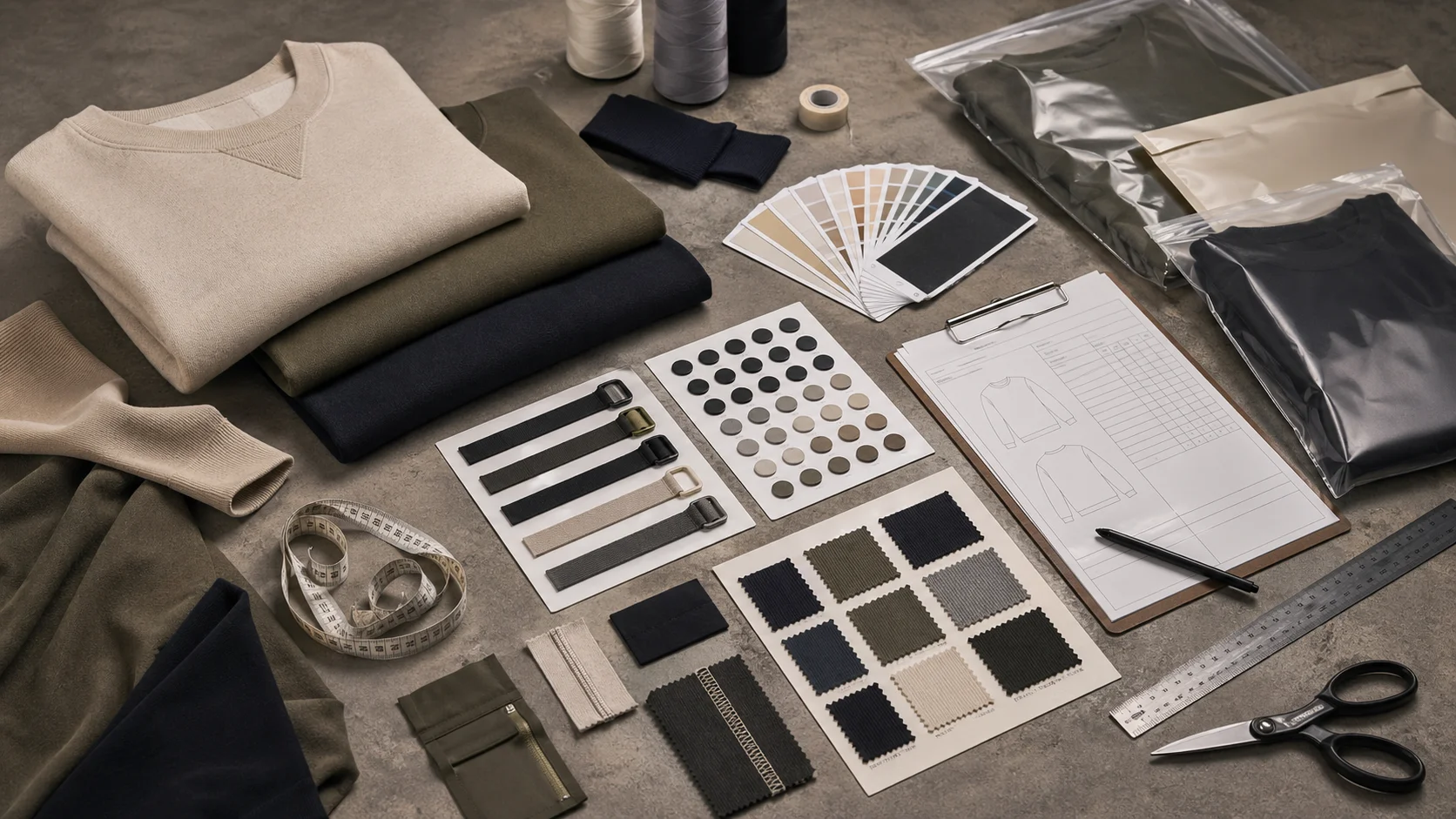
AQL Control Improves Custom Sweatshirt Manufacturing compared by sample evidence, fabric or trim specs, MOQ, AQL terms, cost lines, delivery timing, and...
Fast answer: AQL Control Improves Custom Sweatshirt Manufacturing: Sample Fit, Trim, AQL, and Delivery Risk should be judged by production evidence, not by a generic sourcing promise. The buyer needs sample proof, cost breakdowns, QC checkpoints, and delivery buffers in writing.
Ask for recent sample photos, measurement tolerances, fabric or print test assumptions, decoration test notes, packing examples, and a named inspection checkpoint. These details show whether the team can repeat an approved sample at bulk volume.
Separate garment cost, decoration, labels, packaging, sampling, testing, freight, and rush charges. Clear cost lines make it easier to reduce colorways, adjust size depth, or reserve more time for sampling.
How AQL Control Improves Custom Sweatshirt Manufacturing - Clothing Manufacturer manufacturing guide
When brands come to me looking for a custom sweatshirt clothing manufacturer with AQL control, they usually want the same three things: fewer defects, more predictable delivery, and a product that looks and feels the same in every carton. That sounds simple. It rarely is. Sweatshirts are easy to wear and hard to execute well because they combine fabric shrinkage, stitching stress, print placement, embroidery stability, color consistency, and packaging accuracy all in one garment. In a typical 300gsm brushed fleece program, a 2-3 mm shift in embroidery or a 4% shrinkage swing after wash can change how the entire style fits and presents on shelf.
AQL control, short for Acceptable Quality Limit, gives structure to that complexity. It is not a magic fix. It is a discipline. In a good factory, AQL checking turns quality from a vague promise into a measurable process with clear pass/fail standards at each stage. I have seen the difference first-hand: a factory running 1,200 fleece hoodies a day in Guangzhou without formal AQL gates can miss size drift and label mistakes until the shipment is already packed, while a WRAP- or BSCI-audited factory using AQL 2.5 for majors and 4.0 for minors catches those issues while there is still time to rework them.
If you are comparing suppliers, you can also review the full production capabilities on our services page, learn more about the team on about us, or reach out directly through contact us when you want a quote or sampling discussion. For brands ordering 500 units or more, basic custom fleece hoodies often land around $2.50-4.00 per unit ex-works depending on fabric, decoration, and pack-out requirements, with first bulk production typically taking 18-22 business days after PPS approval.
AQL is a sampling method used to inspect finished goods and determine whether a shipment meets an agreed quality threshold. In plain terms, the factory checks a statistically valid number of pieces instead of opening every single sweatshirt. If the number of defects stays within the allowed limit, the lot passes. If not, it fails or gets reworked. Most apparel programs use a General Inspection Level II sample table, which means the inspection quantity changes with lot size, but the acceptance criteria stay anchored to the agreed AQL number.
For custom sweatshirts, AQL matters because production is full of variables. A brushed fleece hoodie can change slightly after washing and pressing. A heavyweight crewneck can twist if the cut is off grain. An embroidered chest logo can pucker if the stabilizer is wrong. A print can shift 3 mm and suddenly the whole style looks cheap. AQL gives the factory a system to find those problems before shipping, especially on 320gsm French terry, 80/20 cotton-poly fleece, and 1x1 rib knit with 5% spandex.
In most apparel programs, factories use different AQL levels depending on defect severity. Critical defects are usually not tolerated. Major defects have a tighter limit than minor ones. That grading system is important because not every flaw carries the same risk. A loose thread is annoying. A broken seam on a shoulder is a real failure. For example, a needle hole near the hood opening or a wrong fiber content label is treated very differently from a slightly uneven fold line in packing.
Sweatshirts are one of the most deceptively difficult product categories in apparel manufacturing. They look basic. They are not basic to make well. A good sweatshirt has to balance softness, structure, shrinkage control, color accuracy, and comfort. On top of that, customers expect uniformity across sizes from XS to 3XL, sometimes even 5XL. A size curve that grades 1 inch too aggressively at the chest or body length will show up immediately once the full run is laid out on a table.
The most common stress points are easy to miss if you only inspect at the end:
A lot of brands think quality starts at final inspection. My honest opinion? That is too late. By the time a carton is sealed, the real cost of a defect has already multiplied. Recutting, relabeling, and repacking eat profit fast. AQL works best when it is layered into incoming fabric checks, inline sewing checks, finishing checks, and final random inspection. In a factory that runs Juki DDL-9000C lockstitch machines, Pegasus overlocks, and Yamato coverstitch units, the process control matters as much as the final checklist.
A proper sweatshirt factory does not inspect randomly without a plan. It follows a defined sequence. The exact method can vary, but the logic stays the same: inspect the right points, record the defect types, and act before problems spread. In a good setup, QC is tied to the production floor, not just the packing room, and the inspection team works from a written tech pack with measurement tolerances in centimeters, not guesses.
The process starts before cutting. For custom sweatshirt manufacturing, this stage often includes measuring fabric width, checking GSM, looking for barre marks, confirming color shade, and verifying shrinkage results from lab dips or pre-shrink tests. A factory using 320gsm brushed French terry for a premium hoodie should not accept a 280gsm lot by accident. That happens more often than people think. In mills around Guangzhou, Dhaka, and Ho Chi Minh City, incoming fabric is usually checked by roll code, with a 10-point fabric inspection method and shade continuity against the approved bulk strike-off.
During sewing, quality staff check seams, panel alignment, rib attachment, pocket placement, and logo position. This is where AQL logic becomes practical. If a sewing line is producing 800 units in a shift, the inspector might pull a sample from every bundle or every operator output. The goal is to catch repetitive defects early, not after the whole line is finished. On hoodies, the most common inline fixes are hood symmetry, drawcord tunnel alignment, and kangaroo pocket placement within 0.5 cm of spec.
After sewing, sweatshirts are washed, pressed, trimmed, and prepared for packing. This stage catches problems like puckering around embroidery, washing damage, or dimension shifts after tumble drying. AQL inspection at this point is especially useful for shrinkage-sensitive fabrics. A garment steamer, vacuum ironing table, and final trim station will often catch loose threads that a sewing line misses, especially around the kangaroo pocket corners and underarm seams.
The final AQL check usually happens when production is complete and packed in shipping cartons. Inspectors sample cartons from across the lot, pull units at random, and evaluate workmanship, measurement accuracy, labeling, color consistency, and packaging. If the lot fails, a serious factory does not argue. It rechecks, isolates the problem, and fixes it. For many buyers, this is also where carton count, assortment accuracy, and polybag ventilation holes are verified before booking freight.
Inspection Stage What Is Checked Why It Matters Fabric Incoming GSM, shade, shrinkage, defects Prevents bad fabric from entering production Inline Sewing Seams, stitch density, panel alignment Catches process defects before they multiply Finishing Pressing, measurements, print and embroidery quality Confirms the garment still meets spec after finishing Final AQL Random sample from packed cartons Decides whether the shipment is ready to leave the factoryFor a brand ordering custom sweatshirts, AQL is not just about passing inspection. It changes the economics of the order.
First, it reduces expensive rework. If a print location is off by 8 mm, catching that on the line saves hours of repacking later. If the issue is found after freight is booked, the cost rises fast. On a 1,000-piece order, a simple relabel-and-repack problem can add several hundred dollars in labor before you even touch re-freight or delay penalties.
Second, it protects consistency. A sweatshirt collection often relies on repeatable fits across colors and sizes. AQL helps the manufacturer keep the same spec from the first sample through the final bulk lot. That matters even more when one style is cut in multiple fabric bases, such as 100% cotton loopback terry for premium retail and 65/35 cotton-poly fleece for promotional runs.
Third, it improves buyer confidence. Retailers and e-commerce brands hate surprises. When they know a factory uses formal AQL inspections, they trust the order more. That trust can shorten approval cycles and reduce back-and-forth on replacement claims. Factories with GOTS or OEKO-TEX Standard 100 coverage also tend to have tighter documentation on chemical inputs, which helps when a brand needs audit trails for organic cotton or low-impact dyes.
Fourth, it helps with international shipping. Sweatshirts are bulky. Freight costs add up quickly. If 5 percent of a shipment comes back due to quality issues, the logistics hit can wipe out margin. AQL is one of the few practical ways to keep that risk under control, especially when cartons are moving by sea from South China or by consolidation out of Dhaka and Ho Chi Minh City.
I have seen brands move from a 7 percent defect return rate to under 2 percent after switching to a manufacturer that actually enforces inspection gates instead of just saying “we do QC.” That difference is real money, especially when the order includes embroidery, woven labels, and custom polybags that are expensive to redo.
Some defects are obvious. Others hide in plain sight. AQL is valuable because it treats every flaw as data, not just as a one-off annoyance. In practice, the same factory might find a broken bartack on a pocket, a crooked woven main label, and a one-size-short sleeve all in the same lot if the line is not controlled well.
One issue I dislike seeing is factories hiding minor defects by over-ironing or over-folding garments. It can make the carton look perfect while the underlying measurement problems remain. A good inspector checks after pressing and after folding, because a sweatshirt that shrinks from 72 cm to 69 cm in body length after wash is not fixed by presentation. This is also why many factories use measurement boards and pre-shrunk wash tests instead of relying only on visual checks.
A strong factory is easy to recognize once you know what to ask. It has a documented SOP for inline and final inspection, keeps defect photos by style code, and can show you the actual rejection log from the last production run. In Guangzhou, that often means a more sample-driven, fast-turn setup; in Dhaka, it often means stronger bulk CMT capacity and more attention to wash and finishing; in Ho Chi Minh City, many plants are well set up for consistent cut-and-sew with stable export documentation.
The best factories also match the process to the decoration method. Screen printing programs usually rely on controlled flash curing and conveyor dryers, while embroidery programs need the right backing, density, and needle selection on multi-head machines such as Tajima or Barudan units. If a factory says it can handle everything but cannot explain needle size, stitch count, or cure temperature, that is a warning sign.
Certifications matter too, but only when they match the product. GOTS is relevant for organic cotton sweatshirts. OEKO-TEX Standard 100 helps confirm chemical safety for trims and fabric. WRAP and BSCI speak more to social compliance and factory governance. A factory that can show valid certificate numbers, current audit dates, and scope coverage is much stronger than one that just lists logos on a website.
Other signs of a solid factory include separate incoming fabric storage, a calibrated shrinkage wash machine, a metal detector at packing, and a needle control log for the sewing floor. Those details sound small, but they are exactly the details that prevent claims later.
Pricing for custom sweatshirts depends on fabric weight, construction, decoration, and order size. A basic 280-300gsm crewneck in 100% cotton or cotton-poly fleece at 500 pieces might sit around $2.50-4.00 per unit ex-works, while a heavier 350gsm brushed hoodie with puff print, embroidery, woven labels, and individual polybagging can move well above that range. If you add garment washing, enzyme treatment, or specialty dyeing, the cost can jump by another 10-20 percent depending on the wash house and fabric base.
Timelines are just as sensitive. For most programs, sampling takes 7-10 business days for a first prototype, 10-14 days for a pre-production sample if the decoration is complex, and 18-22 business days for bulk production after sample approval for a 500-1,000 piece order. If the fabric must be custom milled or dyed to Pantone match, add another 7-15 days depending on whether the mill is in Guangzhou, Dhaka, or southern Vietnam. During peak season, especially before Q4, those timelines can stretch if the factory is already booked.
The important thing is that AQL helps protect the schedule. If an issue is found during inline sewing instead of at final packing, the factory can usually fix it without missing the ship date. That is the difference between a controlled delay and a missed launch.
If you are sourcing custom sweatshirts, do not ask only whether the factory “does quality control.” Ask how they do it, where they do it, and who signs off. A supplier that can explain AQL sampling, show a live inspection record, and walk you through GSM, shrinkage, and measurement tolerances is much more credible than one that gives a generic yes.
Start with the fabric. Ask whether they can source ring-spun cotton, combed cotton, recycled polyester, or organic cotton jersey and fleece. Then ask whether they can support the decoration you need, whether that is screen print, embroidery, applique, or heat transfer. Finally, ask what certifications they hold and whether those certificates are current. A factory with GOTS for fabric, OEKO-TEX for chemical safety, and WRAP or BSCI for compliance is usually better prepared for export programs than a factory with no audit trail.
You should also ask for real production numbers: minimum order quantity, lead time, sample turnaround, and defect handling process. If the supplier cannot tell you whether their normal MOQ is 300 pieces, 500 pieces, or 1,000 pieces by style, they probably do not run a stable program. For many brands, the best partners are the ones that can combine a 500-piece pilot run with consistent repeat orders, not the ones chasing only large volume.
My advice is simple: choose the factory that can show process discipline, not just polished sales language. If they can explain where the fabric is cut, which machines sew the seams, how defects are classified, and what happens when a carton fails AQL, you are probably talking to the right supplier.
Get a free quote from Fabrikn — your trusted B2B clothing manufacturer with 10+ years of experience. MOQ as low as 200 pieces.
Get a Free Quote →What AQL level is common for sweatshirts?Most sweatshirt programs use AQL 2.5 for major defects and AQL 4.0 for minor defects, with critical defects treated as zero tolerance. That setup is common in export factories that run final inspection before carton release.
What is the usual MOQ for custom sweatshirts?Many factories start around 300-500 pieces per style and color, especially for simple crewnecks or hoodies. If the order includes custom fabric, specialty dye, or complex embroidery, the MOQ is often higher because the setup cost is spread across fewer units.
How long does production take?For most standard programs, bulk production takes about 18-22 business days after pre-production approval. If the fabric is custom knitted or the garment needs washing, the total timeline can extend to 25-35 days.
What materials are most common?Typical sweatshirt fabrics include 100% cotton French terry, 80/20 cotton-poly brushed fleece, 65/35 cotton-poly fleece, and 1x1 rib knit with 5% spandex for cuffs and hems. Premium programs may use combed cotton or organic cotton certified to GOTS standards.
What certifications should I ask for?For product safety and compliance, ask for OEKO-TEX Standard 100. For organic cotton programs, ask for GOTS. For social compliance, WRAP and BSCI are common. Always ask for current certificate copies and scope details, not just logo usage on a website.
Which machines matter most in sweatshirt production?For sewing, common machines include Juki lockstitch, Pegasus overlock, Yamato coverstitch, and bartack machines for stress points. For decoration, multi-head embroidery machines from Tajima or Barudan are common, and screen print lines usually rely on flash cure and conveyor dryer systems.
Do all factories use AQL the same way?No. Some factories only do a final carton check, while better factories inspect fabric, inline sewing, finishing, and packing separately. The more stages that are covered, the less likely you are to get a shipment full of preventable defects.