
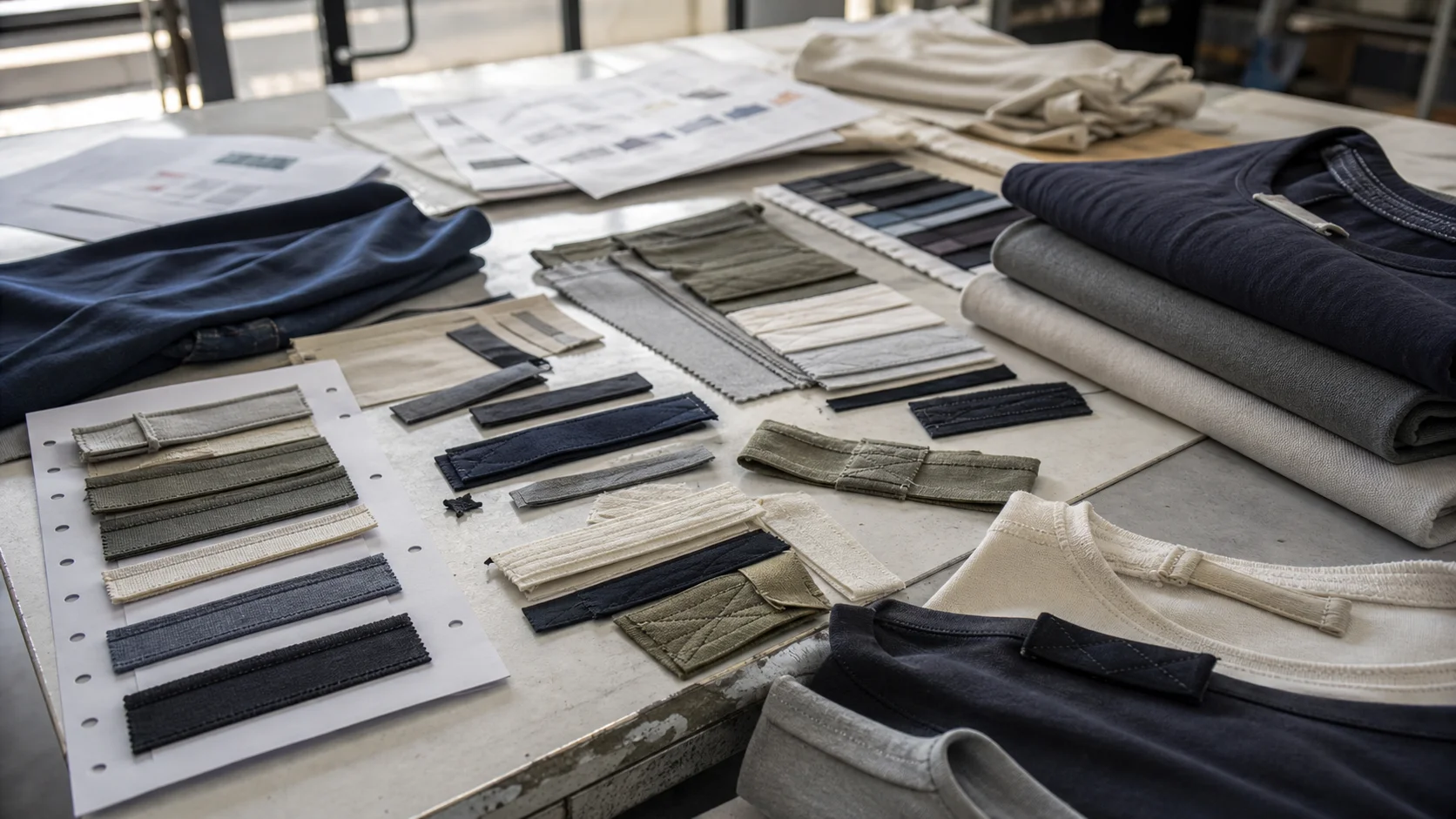
A product-specific sourcing review outline for security contractors evaluating factory-made back neck tabs as branded trim for uniforms, with focus on...
Back Neck Tabs Sourcing Review for Contractors - Decoration & Printing manufacturing guide
Back neck tabs are small trim components, but they carry more sourcing risk than many buyers expect. For security contractors, facilities teams, event staffing companies, and outsourced workforce suppliers, the back neck area is not just a garment detail. It can support branding, size identification, care information, wearer comfort, garment tracking, and a cleaner retail-style finish on uniforms that are washed frequently and worn under pressure.
This sourcing review focuses on back neck tab factory trim sourcing for security contractors, especially where the category overlaps with decoration and printing. A back neck tab may be woven, printed, heat transferred, embroidered, silicone printed, or integrated into a label system. Each option affects cost, minimum order quantity, production timing, wash durability, and inspection risk.
The buying decision should not be treated as a logo placement exercise only. A contractor uniform has different conditions than a promotional T-shirt. Security staff may wear the same polo, softshell, vest, or jacket for long shifts. Neck irritation, label curling, poor color matching, or a printed tab that cracks after laundering can quickly become a complaint. In a multi-site contract, small trim failures also create inconsistent presentation across teams.
For broader apparel development support, buyers can review related production services at fabrikn.com/services/. For supplier qualification or project discussion, the contact route is available at fabrikn.com/contact-us/. Company background can be reviewed at fabrikn.com/about-us/.
Security contractor apparel needs to look controlled, repeatable, and professional. The wearer may be stationed at office towers, retail premises, public events, logistics hubs, construction gates, residential developments, or transport sites. The uniform often needs to identify the person as part of a contracted service without overcomplicating the garment.
The back neck tab can support this in several ways. It can replace a scratchy woven label with a soft printed panel. It can carry brand initials, garment size, contract batch code, care symbols, or internal garment issue references. It can reinforce the impression of a purpose-built uniform instead of an off-the-shelf blank with a logo added later.
That said, the back neck tab should not be overloaded. Security uniform buyers sometimes try to place brand name, size, fiber content, wash care, certification claims, and QR codes in a very small area. This usually creates illegible print, uncomfortable stacking, or extra cost. If compliance information is required, it may be better to split the system: back neck tab for brand and size, side seam label for statutory information, and carton barcode for logistics.
A back neck tab is a good trim choice when it improves comfort, identification, or brand consistency. It becomes a poor choice when it is used to hide an unclear label strategy.
Security contractors also need to consider reorders. Uniform programs are rarely one-time purchases. Staff turnover, contract expansion, and seasonal replacement orders are common. If the back neck tab is custom woven or uses a special heat transfer film, the buyer should confirm repeat availability and archival artwork control. A trim that looks inexpensive on the first order can create problems if the supplier cannot match it six months later.
The right back neck tab depends on garment type, expected wash life, brand requirements, comfort level, and volume. A security contractor ordering 300 polos for one site will make a different decision than a national facilities group ordering 25,000 units across several garment categories.
A printed back neck label is often the simplest option for knitwear, especially polos, T-shirts, base layers, and lightweight sweatshirts. The print is applied directly inside the garment at the back neck. It usually includes size, brand, care reference, and sometimes country of origin or fiber content if the design allows.
The main benefit is comfort. There is no separate label edge rubbing against the wearer. The cost is usually moderate once the artwork and screen or transfer setup are established. The risk is durability. Poor ink selection or weak curing can lead to cracking, fading, or transfer lift after repeated laundering.
For security contractor uniforms, printed neck labels work best when the artwork is simple and high contrast. White or light grey print on black, navy, or charcoal garments is common. Fine text should be avoided unless the factory can prove legibility after wash testing.
A woven tab gives a more permanent and premium look. It can be folded into the neckline seam or attached as a small brand tab. Woven labels are common in jackets, shirts, trousers, outerwear, and structured uniform pieces.
The advantage is durability and crisp brand presentation. The tradeoff is comfort and MOQ. Woven labels usually require a separate label supplier, color yarn matching, cutting and folding specifications, and sewing accuracy. If the tab is placed poorly, it can irritate the neck. If the edges are stiff, wearer complaints are likely.
Woven tabs are better suited for higher-volume programs or garments with longer expected service life. They are less attractive for small urgent orders unless stock labels or generic size tabs are acceptable.
Heat transfer neck tabs are applied using heat and pressure. They can look clean and modern, with good detail and soft hand feel if the transfer is specified correctly. They are often used for performance polos, stretch tops, sports-style uniforms, and garments where a tagless finish is preferred.
The key sourcing issue is compatibility. The transfer film must work with the fabric composition, surface texture, dye chemistry, and wash conditions. A transfer that performs well on cotton jersey may not bond well to a polyester pique or a brushed fleece. High-stretch garments need a transfer that can flex without cracking.
Security contractors should request wash and abrasion performance data or run their own approval tests. If garments will be industrially laundered, domestic wash claims are not enough.
A separate printed label made from satin, cotton tape, or polyester tape is still useful where direct neck printing is not suitable. It can carry more information than a small heat transfer, and it is easier to standardize across different garment bodies.
The downside is wearer comfort. Satin labels can feel sharp at the edge if cut poorly. Cotton labels may shrink or distort. Polyester labels can be durable but may feel stiff. For contractor uniforms, soft edges, proper folding, and controlled attachment are more important than decorative complexity.
Silicone and raised prints can create a premium back neck branding effect, particularly in outerwear, technical tops, or performance uniforms. They can look robust and modern. The cost is higher, and the production process requires tighter control.
This option is usually not the first recommendation for standard security contractor polos unless the brand positioning justifies it. Raised trims can create bulk at the neck and may not be comfortable on warm-weather uniforms. They are more useful on jackets, tactical-inspired pieces, or higher-value supervisory apparel.
Back neck tab sourcing sits inside the decoration and printing category because the trim often depends on print method, ink selection, transfer performance, or woven artwork conversion. Buyers should not approve a tab from a flat artwork file alone. The final result depends on substrate, scale, production equipment, and finishing.
Screen printing can be used for direct neck labels or printed tape labels. It is cost-effective at volume and produces solid color coverage. It works best for simple designs with limited colors. Small text and care symbols need careful mesh selection and print pressure control.
For security uniforms, screen printed neck labels are practical when the size range is stable and the factory can manage size-specific prints without mixing errors. The buyer should confirm whether each size requires a separate screen or whether the artwork uses a tick-box system. Size mix mistakes are a common production risk.
Heat transfer printing is flexible for smaller runs and detailed graphics. It can be pre-produced by trim suppliers and applied during garment assembly or finishing. The application conditions should be documented: temperature, pressure, dwell time, peel method, and cooling time.
Contractors should be cautious with transfers on dark synthetic fabrics. Dye migration can discolor light prints, particularly on polyester. A blocker layer may be required, which can make the print thicker. The buyer should ask for a production-like sample, not just a transfer sheet.
Digital transfer can support multi-color branding or QR-style markings, but it is not always the best choice for tiny back neck tabs. Fine detail can blur, and wash durability varies by supplier. Digital methods are useful when order quantities are low or artwork changes frequently between contracts.
The tradeoff is unit cost and consistency. If the contractor has ongoing reorders, a more standardized screen or woven solution may become cheaper and more stable after the first order.
Woven tabs require artwork to be translated into yarns. Thin lines, gradients, small letters, and complex emblems may not reproduce cleanly. A good factory or trim supplier will provide a woven layout or strike-off before bulk production.
For security brands with detailed crests or shields, woven neck tabs may require simplification. That is not a quality failure; it is a technical limitation. Buyers should lock an approved label artwork version and avoid changing the logo at the final production stage.
A garment factory may be strong at sewing but weak at decoration control. Back neck tab sourcing requires coordination between the garment factory, printing unit, trim supplier, and quality team. For security contractors, the factory should demonstrate control over repeat orders and size-level accuracy.
Capability Area What to Check Why It Matters Artwork handling Vector file control, size grading, color references, version approval Prevents wrong logo, wrong size text, and inconsistent reorders Trim sourcing Approved label or transfer suppliers, documented specs, backup options Reduces risk if the first trim source delays or discontinues material Application process Heat press settings, print curing, sewing placement, operator training Controls wash durability, alignment, and comfort Size control Size-specific label management and bundle separation Prevents medium garments receiving large labels or mixed carton contents Inspection system Inline checks, final AQL inspection, wash test records where needed Finds failures before shipment instead of after uniform issueBuyers should also check whether the factory performs the neck tab decoration in-house or subcontracts it. Subcontracting is common and not automatically a problem. The risk is poor communication. If the decoration unit receives outdated artwork, incomplete color notes, or incorrect fabric panels for testing, the buyer may only see the issue after bulk garments are finished.
A practical purchase order should list the approved trim type, artwork file reference, placement measurement, color standard, size range, care label relationship, and packaging instructions. The back neck tab should not be left as a vague “brand label inside neck” note.
Back neck tab performance depends heavily on the garment fabric. Security contractor garments often use dark colors, durable knits, polyester-rich blends, and functional finishes. These are useful for uniform performance but can complicate decoration.
Common fabrics include cotton pique, polyester pique, cotton-poly jersey, interlock, fleece, softshell, ripstop woven, Oxford shirting, and high-visibility compliant materials. Each behaves differently under heat, pressure, washing, and abrasion.
Polyester garments may create dye migration issues. Cotton-rich garments may shrink, which can distort printed labels if the print area is not stabilized. Stretch fabrics require flexible inks or transfers. Brushed fleece can reduce adhesion because the print contacts a raised surface rather than a flat knit face.
For woven tabs, confirm yarn type, label density, edge finish, fold type, background color, logo color, and cut method. Heat-cut woven labels can feel scratchy if the edge is exposed. Ultrasonic cutting may be cleaner but can cost more.
For printed tape labels, confirm tape material, width, thickness, edge softness, print ink, and wash standard. Cotton tape may suit natural garments but can shrink. Polyester satin offers sharp print but may feel less comfortable. Recycled polyester labels are available from some suppliers, but MOQ and certification documentation should be checked before promising them to a client.
For direct print and heat transfer neck tabs, the buyer should confirm ink or film type, hand feel, elasticity, wash temperature rating, tumble dry tolerance, and resistance to cracking. If garments are likely to be washed at high temperature, the approval test should reflect that condition.
Security contractor uniforms are often laundered more aggressively than casualwear. A staff member may wash the same polo repeatedly every week. Some organizations use central laundry services. If industrial laundering is expected, standard domestic wash testing may understate the risk.
Back neck tabs often use small areas of white, grey, black, silver, navy, or brand accent colors. Buyers should provide Pantone references where color matters, but they should also understand that woven yarn, screen ink, and transfer film will not always match perfectly across different materials.
A reasonable approval standard should distinguish between brand-critical visible decoration and internal neck information. If the back neck tab is mostly internal, exact color matching may not justify added cost. If the tab is part of a premium presentation or resale product, tighter tolerance may be needed.
Minimum order quantities vary by factory, trim type, supplier country, artwork complexity, and whether the trim is made as part of a full garment order. The ranges below are typical planning references, not guaranteed quotes.
Back Neck Tab Type Typical MOQ Range Best Use Case Main Tradeoff Direct printed neck label 100 to 500 garments per style/color, sometimes lower for digital setups Polos, T-shirts, sweatshirts, tagless comfort Durability depends on ink, curing, and fabric compatibility Heat transfer neck tab 300 to 1,000 transfers per artwork/size group Performance tops, small-to-mid uniform programs Application control and wash testing are critical Woven back neck tab 1,000 to 5,000 labels per design, sometimes more for custom yarn colors Outerwear, premium uniforms, long-running programs Higher setup and label inventory management Printed satin or cotton label 500 to 3,000 labels per design Mixed garment categories and detailed label information Comfort depends on material and edge finish Silicone or raised print tab 500 to 2,000 pieces, often with higher setup cost Technical outerwear or premium contractor ranges Cost and bulk may not suit basic uniform programsPrice should be reviewed as a total system cost. A low-cost woven label may still require extra handling, sewing time, and inventory control. A heat transfer may have higher unit cost but lower sewing complexity. A direct printed neck label may be efficient, but only if the factory can prevent size mix-ups and maintain wash durability.
For small contractor orders, stock labels and simple printed neck information may be more practical than fully custom trims. For larger programs, custom trims are usually justified because they support consistency, brand control, and reorder management.
Contractors should also ask how unused trim is handled. If a trim MOQ is 5,000 labels but the garment order is 1,200 pieces, the remaining 3,800 labels may sit in inventory. This can be useful for reorders, but only if the artwork, brand identity, and sizing system remain unchanged. If the client changes branding, the leftover trim becomes waste.
A reliable sampling process prevents expensive bulk errors. The buyer should not approve a back neck tab based only on a PDF mockup. Scale, hand feel, placement, and durability need physical review.
The first step is to confirm artwork format, color references, text content, size range, placement, and legal or care information requirements. The buyer should decide whether each size has a unique label or whether one label carries multiple size indicators.
This is also the right stage to remove unnecessary information. If the back neck tab becomes crowded, legibility suffers. A simple brand mark, size, and short care reference often works better than a full compliance panel.
For woven labels, request a strike-off. For direct print or heat transfer, request a print test on the actual or closest available garment fabric. A test on a different fabric is useful only as a rough visual reference.
Check the print sharpness, opacity, softness, stretch recovery, and hand feel. For security garments in dark colors, check whether the print stays clean and does not pick up dye migration.
The trim should be reviewed on an actual garment sample. Placement is important. If the tab sits too high, it can rub the neck. If it sits too low, it may look poorly positioned or interfere with the inner back neck seam tape.
For collared polos and shirts, the back neck area has seam bulk. For jackets, the collar stand and lining can affect label visibility and comfort. The buyer should review a worn-position sample, not just a flat garment on a table.
Wash testing should reflect the expected use. For basic domestic programs, 5 to 10 wash cycles may reveal early cracking, peeling, bleeding, or curling. For higher-risk programs, 20 or more cycles may be appropriate. Industrial laundry programs need a separate test standard.
Wear testing is also useful for comfort. A label that looks acceptable after washing can still irritate the wearer. Security staff often work long shifts, and neck discomfort can quickly become a practical issue.
Once approved, the buyer should retain a sealed sample or clearly documented reference sample. The factory should use the same reference for bulk production and final inspection. If there are multiple sizes, colors, or garment categories, each variation should be controlled separately.
Lead time for back neck tabs depends on artwork approval, trim type, raw material availability, production capacity, and shipping method. In uniform sourcing, neck tab delays can hold up the whole garment order because the trim is needed before final assembly or finishing.
Stage Typical Timing Dependency Artwork confirmation 1 to 3 working days Buyer provides final logo, size data, color references, and wording Printed label or transfer sample 3 to 10 working days Ink or film availability, sample room capacity, fabric access Woven label strike-off 5 to 14 working days Yarn colors, loom schedule, artwork conversion Bulk trim production 7 to 21 working days MOQ, color count, finishing process, supplier workload Garment application During sewing or finishing Trim arrival before production line needs itUrgent programs should use the simplest approved method. Direct printed neck labels or stock label systems may shorten the schedule. Custom woven tabs can still be fast in some supply chains, but they are more exposed to artwork conversion and yarn availability delays.
Lead time also changes with size complexity. A contractor ordering XS to 5XL across men’s and women’s fits may need many size-specific neck labels. The more variations, the more sorting and application control is required. If the buyer does not need individual size labels in the neck, a generic brand tab plus separate size sticker or side label may reduce delay.
Seasonality matters. Uniform orders often cluster before new contracts, event seasons, or financial year rollouts. Decoration suppliers can become congested. If the contractor needs a fixed launch date, trim approval should happen before bulk fabric cutting whenever possible.
Back neck tab defects are easy to miss during casual inspection because they are small and internal. They become expensive when garments are already issued to staff. A practical inspection plan should include both visual checks and functional checks.
Inline inspection should happen before the garment is fully packed. This is especially important for size-specific tabs. Inspectors should check bundle labels against garment size and neck tab content. If the factory waits until final inspection, the cost of sorting can be high.
For heat transfers, inline checks should include adhesion and appearance after cooling. Some transfer defects are not obvious immediately after pressing. Edges can lift when the garment cools or after the first stretch.
Final inspection should check a statistically reasonable sample by size and color. The buyer can use AQL methods, but the checklist should include trim-specific points. A general garment inspection checklist may not catch incorrect artwork or size label errors unless those points are written clearly.
For security contractor orders, carton-level accuracy is also important. If garments are being distributed to multiple sites, a label error can create operational disruption. The final inspection should compare garment size, neck tab size, polybag sticker, carton mark, and packing list.
Where timing allows, bulk production should include wash testing from actual production pieces. Pre-production wash tests are helpful, but bulk conditions can differ. Ink batch, curing temperature, transfer pressure, and operator handling may change.
A basic wash test can catch early peeling, cracking, or label curl. It will not guarantee long-term performance, but it reduces the chance of obvious failures reaching the wearer.
The best back neck tab choice is not always the most premium-looking option. Contractors should select the trim based on uniform purpose, contract length, reorder frequency, and wearer conditions.
For basic security polos with tight budgets, direct printed neck labels or simple heat transfers are usually sensible. They reduce scratchiness and keep the garment clean. The buyer should invest in wash testing rather than elaborate artwork.
For jackets, softshells, and higher-value outerwear, woven labels or durable printed labels can make more sense. These garments stay in service longer and often carry more brand value. A slightly higher trim cost is easier to justify when the garment itself is more expensive.
For small urgent orders, avoid custom trims that create long lead times. A standard size label with external logo decoration may be the better commercial choice. For large national programs, custom neck tabs are usually worth developing because they improve consistency and reduce confusion across reorders.
For high-turnover staff programs, the tab should support easy issue and replacement. Size readability matters. Garment tracking may matter. A beautiful internal logo that makes size hard to read is not a good operational choice.
One important tradeoff is between flexibility and consistency. Heat transfers and direct prints can be flexible for varied orders. Woven labels can be more consistent over a long program but require more planning and inventory control. Contractors with frequent contract-specific branding changes may prefer printed solutions. Contractors with stable corporate uniforms may benefit from woven trims.
Another tradeoff is comfort versus information density. A tagless back neck print feels better, but it may not carry all required information clearly. A sewn label can carry more data, but it may irritate the wearer. Splitting information across neck, side seam, and packaging often gives the cleanest result.
Cost should be reviewed against failure risk. Saving a small amount on a poor transfer or rough label is not worthwhile if the contractor receives complaints, has to replace issued garments, or loses presentation consistency on-site. The back neck tab is a low-cost part of the garment, but it is close to the wearer and easy to notice when it fails.
A clear technical specification helps the factory quote accurately and produce consistently. The following fields are useful when requesting prices or samples for back neck tab trim sourcing:
Specification Field Recommended Detail Garment type Polo, T-shirt, sweatshirt, jacket, shirt, fleece, or softshell Fabric Composition, weight, construction, color, finish, and stretch level Trim type Direct print, heat transfer, woven tab, printed tape, silicone print Artwork Vector logo, text, size data, color references, approved file version Placement Distance from back neck seam, center alignment, relation to seam tape Durability target Domestic wash, industrial wash, tumble dry, stretch, abrasion expectations MOQ and reorder plan Initial quantity, forecast reorder quantity, trim inventory handling Inspection requirements Size accuracy, artwork match, wash test, adhesion, comfort, carton matchingThis level of detail prevents vague quotations. It also makes supplier comparison easier. A factory quoting a direct neck print with no wash testing is not equivalent to a factory quoting a tested transfer system with documented application settings. A woven tab price without fold type and edge finish is incomplete.
Before placing a back neck tab order, contractors should ask direct questions. The answers reveal whether the supplier understands uniform production or is treating the trim as a basic decoration item.
A supplier that cannot answer these questions may still be capable, but the buyer should not rely on assumptions. Security contractor uniforms are operational products. They need a controlled trim system, not just a decorative approval.
Back neck tabs are worth specifying carefully for security contractor apparel because they affect comfort, brand consistency, and production control. The safest route is usually a simple, durable, well-tested trim rather than an elaborate internal decoration.
For small and urgent contractor orders, choose low-complexity solutions with short setup times. For long-running uniform programs, invest in custom trims, sealed samples, and reorder documentation. For garments exposed to heavy washing, place durability ahead of visual novelty.
The purchasing judgment is straightforward: approve the back neck tab as a performance trim, not just a branding detail. Confirm the material, decoration method, MOQ, sample process, lead time, and inspection method before bulk production. That discipline reduces complaints, avoids rework, and keeps contractor uniforms consistent across sites and reorders.
Get a free quote from Fabrikn — your trusted B2B clothing manufacturer with 10+ years of experience. MOQ as low as 200 pieces.
Get a Free Quote →A back neck tab is a label or printed trim placed inside the rear neckline of a garment. It may show brand identity, size, care details, or internal uniform information. In security contractor apparel, it is commonly used on polos, T-shirts, jackets, sweatshirts, and shirts.
For comfort-focused polos and T-shirts, direct printed neck labels or heat transfers are often the best choice. For jackets, shirts, and longer-life uniforms, woven or sewn printed labels may be more durable. The best option depends on fabric, wash conditions, order volume, and reorder plans.
Typical MOQs range from 100 to 500 garments for direct printed neck labels, 300 to 1,000 transfers for heat transfer labels, and 1,000 to 5,000 pieces for woven labels. These are planning ranges only. Actual MOQ depends on supplier, artwork, colors, material, and production location.
They can be durable if the transfer film matches the fabric and the application settings are controlled. Buyers should request wash testing on the actual fabric. Polyester, stretch fabrics, and dark colors need extra care because adhesion and dye migration risks are higher.
Yes, wash testing is strongly recommended. A small print or label can look fine on a new sample but fail after repeated laundering. Security uniforms are often washed frequently, so testing should reflect real use conditions.
The most common risks are wrong size labels, crooked placement, poor print adhesion, cracking, peeling, scratchy woven edges, color mismatch, and outdated artwork. Size-specific label mix-ups are especially important in uniform programs with many sizes.
Care instructions can go on the back neck tab if the information remains legible and compliant. If the tab becomes crowded, it is better to place full care and fiber content on a side seam label and use the back neck area for brand and size.
Contractors should keep approved artwork files, trim specifications, placement measurements, color references, and sealed samples. They should also confirm whether leftover trims will be stored and whether the supplier can repeat the same trim in future production.