
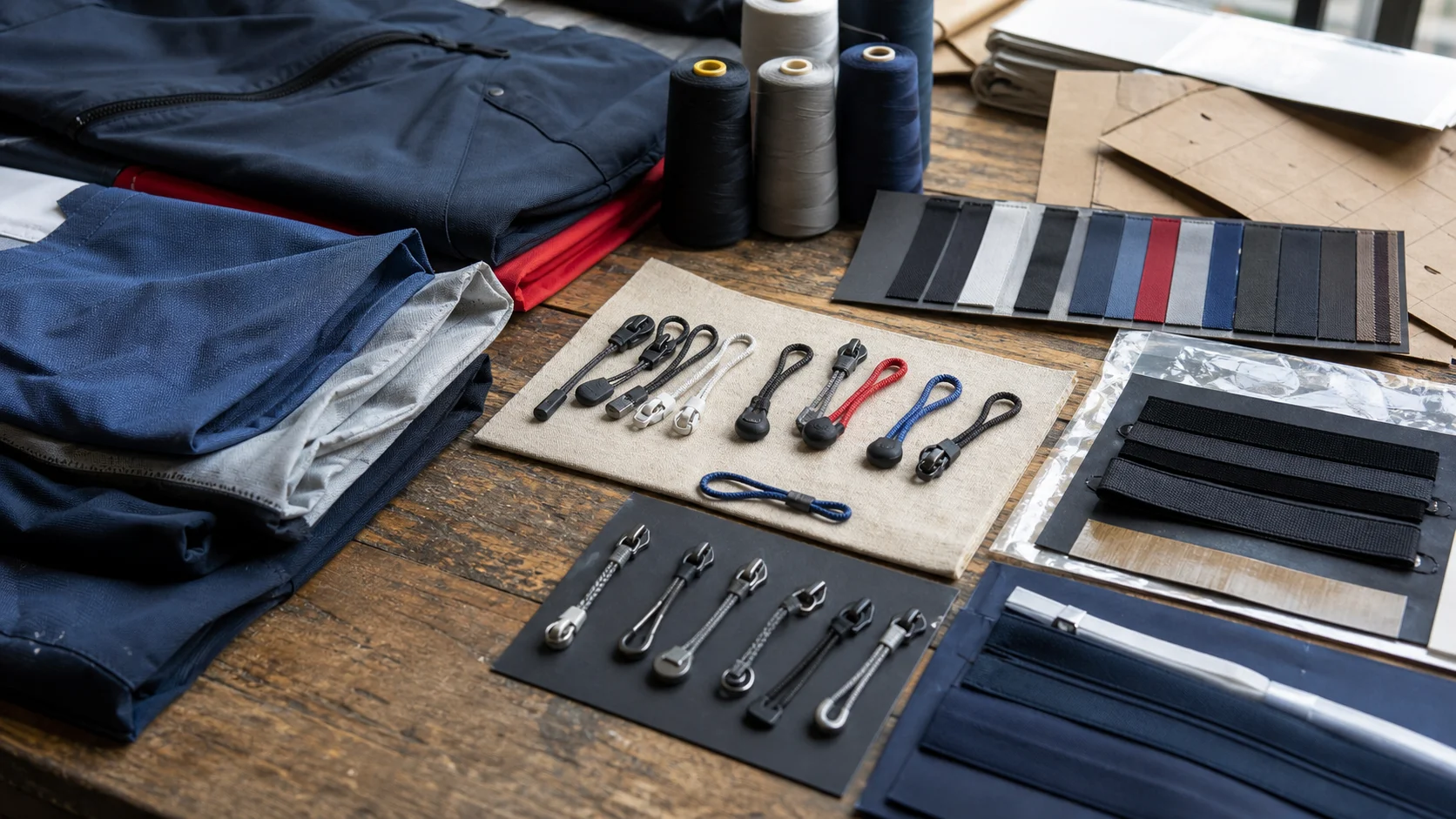
A distributor-focused outline for evaluating zip puller charm orders, from material and attachment specs to decoration methods, packaging, QC, compliance,...
Zip Puller Charm Order Review for Trim Buyers - Fabrikn production reference
Zip puller charms look simple on a line sheet, but they can create real order risk when the specification is loose. For distributor buyers, the problem is rarely the idea of the trim. It is the conversion of a small decorative component into a repeatable, factory-ready, inspection-ready purchase order.
A zip puller charm may be used on jackets, hoodies, bags, luggage, kidswear, sportswear, workwear, promotional products, or fashion accessories. It can be a brand detail, a functional grip, a seasonal decoration, or a low-cost way to upgrade a basic zipper. The buying decision often sits between decoration, trim, and accessory sourcing. That makes ownership unclear unless the order review is disciplined.
This sourcing review focuses on what distributor buyers should check before placing a zip puller charm order: material, size, attachment method, logo execution, minimum order quantity, sample approval, lead time, inspection risk, and commercial tradeoffs. It is written for B2B buyers who need to quote, approve, and deliver trim without surprises at bulk stage.
The main purchasing rule is straightforward: do not buy zip puller charms from a photo alone. Buy them from a controlled specification, approved sample, and attachment test.
Zip puller charms are part decoration and part hardware. That dual role is why they deserve more review than a flat woven label or a standard hangtag. A charm must look correct, hold the branding, attach cleanly to the slider, survive handling, and avoid damaging the garment or bag.
For distributors, the product can be attractive because the unit price is usually manageable, the perceived value is high, and the item is easy to present in trim boards. The risk is that a low-cost component can delay a full garment order if the charm does not pass color, fit, corrosion, pull strength, or child safety checks.
Typical applications include:
Buyers should decide early whether the trim is primarily decorative or functional. A decorative charm may only need to move freely and look consistent. A functional puller needs grip, flexibility, strength, and comfort in hand. The two are often confused during quoting, which leads to under-specified orders.
If the charm will be part of a broader garment or accessory program, it should be reviewed alongside other trims. Color standards, logo usage, metal finish, packaging, and testing language should not contradict the rest of the BOM. Buyers managing multiple trim categories can review related sourcing support through Fabrikn services when building a broader trim and decoration workflow.
A strong zip puller charm order starts with a specification sheet. The supplier may provide a quote from a reference photo, but that is not enough for bulk production. A buyer-side specification protects the distributor, the brand customer, and the assembling factory.
For trim buyers, the most common mistake is approving the front design while ignoring the attachment. The attachment is what connects the charm to the actual product. It must match the zipper slider hole size, the pull direction, the use case, and the factory assembly method. A nice charm with the wrong ring size becomes a production problem.
Dimensions should be given in millimeters, not vague descriptions like “small” or “standard.” Many zip puller charms are between 20 mm and 80 mm in visible length, depending on product category. Bags and luggage can use larger pullers. Apparel often needs a lighter and more compact piece so it does not swing heavily, hit the garment surface, or feel bulky.
Thickness matters as much as length. A PVC puller that is too thin may tear at the hole. A metal charm that is too thick may look premium but become heavy and costly. A leather or PU puller that is too thin may crease and lose shape after use. The specification should state both finished thickness and tolerance where practical.
Weight is often missed in order review. For outerwear and accessories, a puller can improve perceived value when it feels solid. For lightweight garments, children’s products, or athletic apparel, excess weight can be a defect. Distributor buyers should request weight per piece when quoting metal or oversized charms, especially for air freight or high-volume programs.
Order Detail Why It Matters Buyer Review Point Size Affects function, look, and assembly Confirm with slider, garment, or bag sample Material Controls durability, cost, and compliance Match material to end use and market Attachment Highest fit-risk area Test on actual zipper hardware before bulk Logo Method Drives tooling and color accuracy Approve artwork proof and physical sample Packing Impacts factory efficiency and loss control Specify count, label, and carton markingThe right material depends on the target price, brand position, product use, and compliance requirement. There is no single best option. Each material has tradeoffs.
Metal charms are common for fashion bags, premium outerwear, lifestyle accessories, and branded promotional items. Zinc alloy is often used for custom shapes because it can be molded and plated. Brass, stainless steel, and aluminum may also appear depending on the design and performance target.
Metal gives a premium feel and supports plating, engraving, enamel color fill, and fine logo edges. The tradeoff is cost, weight, plating risk, and possible sharp-edge concerns. Buyers should check nickel requirements, corrosion resistance, plating uniformity, and edge finishing. For products that may contact skin, the compliance review should be tighter.
PVC and silicone are useful for colorful, flexible, molded branding. They are common in sportswear, kidswear, outdoor bags, promotional accessories, and casual apparel. These materials can support raised logos, recessed logos, multiple colors, and soft hand feel.
The tradeoff is tooling accuracy, color consistency, and potential odor or surface contamination if the material control is weak. PVC can be cost-effective and vivid, but buyers should confirm the applicable chemical restrictions for the destination market. Silicone can feel cleaner and softer but may price higher depending on grade, color count, and complexity.
Leather and PU pullers work well for bags, casual jackets, and lifestyle accessories. They can be cut, stitched, debossed, heat stamped, printed, or combined with metal rivets. The look is softer than metal and more apparel-friendly than thick plastic.
The tradeoff is batch shade variation, edge finishing, tearing at the attachment point, and sensitivity to humidity or abrasion. Real leather also needs more careful sourcing because thickness, grain, finish, and color can vary. PU may be more consistent and cost-friendly, but buyers should check cracking, peeling, and edge durability.
Cord and webbing pullers are common for sports, outdoor, tactical, workwear, and casual bags. They are lighter and functional. A rubber, plastic, or metal end tab can be added for branding. Reflective yarn, jacquard text, heat transfer logos, or silicone tips may also be considered.
The tradeoff is that the logo area may be limited. Cord thickness must match slider hole size, and knotting or heat-cut ends must be controlled. If the puller is used in outdoor or wash-heavy products, colorfastness and abrasion should be reviewed.
Finish should be defined clearly. “Gold” is not a sufficient specification. Buyers should specify shiny gold, light gold, antique gold, brushed gold, rose gold, or another approved reference. The same applies to nickel, gunmetal, black nickel, matte black, and antique finishes.
For molded plastic and silicone, Pantone references are helpful, but buyers should understand that color matching on different materials is not identical to printing on paper. Material surface, pigment, gloss, and thickness can shift appearance. A physical color approval is safer for brand-sensitive orders.
Zip puller charms sit in the Decoration & Printing category because the buyer is often purchasing brand expression, not just function. The artwork process should be managed with the same discipline as labels, patches, transfers, and printed packaging.
Artwork should be submitted in vector format where possible. Fine text, tiny gaps, thin outlines, and tight color separations may not reproduce well at charm scale. If a logo is 35 mm wide and includes small trademark text, the buyer should expect either simplification or a larger charm size.
The distributor should ask the supplier for a production artwork proof before tooling or sampling. The proof should show size, logo placement, colors, attachment point, backside treatment, and any mold lines or stitching. Approval by email without a controlled PDF or technical drawing is weak protection.
Color control depends on material and process. Metal plating is controlled by finish reference. Enamel and plastic colors can be referenced to Pantone, but physical approval is still important. Leather, PU, webbing, and cord should be checked against swatches under consistent light.
For multi-color charms, ask whether color is printed, molded separately, filled, or painted. Molded-in colors generally hold better than surface printing, but they may require more complex tooling. Printed colors may be cheaper for simple designs but can fail abrasion or alcohol rub tests if the ink system is not suitable.
Buyers often focus on the front face and miss the backside. The back may be plain, textured, branded, recessed, printed, stitched, or plated. If the charm flips during use, the backside becomes visible. A rough back or sharp edge can also damage fabric.
Edge finishing is a key inspection point. Metal charms should not have burrs. PVC and silicone should not have excess flashing. Leather and PU edges should not shed fibers, crack, or expose uneven layers. Cord ends should be sealed cleanly and consistently.
MOQ for zip puller charms depends heavily on material, tooling, color count, and supplier setup. Buyers should treat any MOQ as a commercial estimate until the design is confirmed.
Charm Type Typical MOQ Range Key Cost Drivers Custom metal charm 500 to 3,000 pcs Mold, plating, weight, enamel, logo detail PVC or silicone molded puller 1,000 to 5,000 pcs Tooling, color count, size, material grade PU or leather puller 500 to 2,000 pcs Material, cutting die, logo method, stitching Cord or webbing puller 1,000 to 5,000 pcs Cord type, end tab, printing, assembly labor Stock puller with simple logo 100 to 1,000 pcs Available inventory, decoration method, setup chargeThese ranges are not fixed rules. A supplier may accept lower quantities with a setup charge, simplified artwork, or stock components. Very small orders may be possible, but unit cost can rise sharply. For distributor buyers, a low MOQ is not always the best deal if the supplier compromises consistency or skips proper sampling.
Custom metal, PVC, and silicone charms often require tooling. Tooling may be quoted separately or absorbed into unit price at higher volume. Buyers should clarify ownership, storage period, remake cost, and revision policy. A small artwork change can require a new mold if the logo shape or size changes.
Printing plates, cutting dies, debossing molds, engraving programs, and color setup fees may also apply. These charges should be listed on the quotation so the distributor can protect margin. Hidden setup cost is one of the fastest ways to lose money on a small trim order.
Distributor buyers should request price breaks at practical quantities, not random large numbers. For example, ask for 1,000, 3,000, 5,000, and 10,000 pieces if those match likely customer demand. Include tooling, sample cost, bulk price, packaging cost, and freight assumptions separately.
Buyers should also confirm whether the unit price includes assembly of ring, cord, rivet, hook, or end tab. A quoted “charm only” price can look attractive but may exclude the actual puller assembly needed by the garment factory.
The cheapest quote is often acceptable for a short-run promotional program with low wear expectations. It is not the right choice for a premium jacket, luggage program, children’s item, or repeat replenishment style. Distributor buyers should decide where the order sits: promotional, mid-market, premium, or technical. That decision should guide tolerance, testing, packing, and supplier selection.
Sampling is the main control point before bulk. A zip puller charm should not move into production only because a digital mockup looks correct. Material behavior, hand feel, attachment fit, color, and logo legibility must be judged physically.
For repeat orders, buyers should still compare new samples or first bulk pieces against the previous approved standard. Mold wear, plating bath variation, material lot changes, and artwork file mistakes can occur between orders.
A prototype may be handmade, 3D printed, manually painted, or produced using temporary tooling. It is useful for shape review but may not represent bulk finish. A production sample should use the intended production process, material, attachment, and finish. Buyers should not confuse the two.
If the supplier provides a sample that is “for look only,” the buyer should ask what will change in bulk. Will the color be different? Will the logo be sharper after production tooling? Will the attachment ring be replaced? Every difference should be documented.
Distributor buyers should clarify who approves the sample: the brand customer, the garment factory, the product developer, or the distributor’s own trim team. If the factory must attach the puller during garment production, the factory should review fit and handling. A brand approval alone does not confirm assembly compatibility.
For buyers needing supplier communication, trim review, or order planning support, the Fabrikn contact page is a practical starting point for discussing project requirements and sourcing scope.
Lead time for zip puller charms can vary widely. A stock item with simple printing may be quick. A custom molded, plated, or multi-component puller can require more time. Distributor buyers should not quote delivery based only on bulk production days.
Rush orders are possible in some cases, but they reduce room for correction. If the logo color is wrong, the plating fails, or the ring does not fit, the order may need remaking. A rushed trim order can become more expensive than a planned one.
Buyers should build the trim schedule backward from the garment or accessory production date. If the factory needs pullers before final assembly, late trim delivery can hold finished goods. A small charm can become the critical-path component when it is custom and approved late.
Inspection for zip puller charms should be practical and targeted. The goal is not to over-test a low-cost trim. The goal is to catch failures that will cause rejection, rework, customer complaints, or safety issues.
The puller should be tested on the actual zipper slider or a confirmed equivalent. The ring or cord must pass through the slider hole without forcing. It should move freely without locking at an awkward angle. If the item is a functional pull tab, a basic pull strength check should be agreed before production.
Pull strength requirements vary by product and market. A light decorative charm may not need the same requirement as a luggage puller. The buyer should avoid vague instructions like “strong enough.” Use a defined test method or at least an agreed internal standard, especially for bags, outerwear, and children’s products.
Inspectors should compare bulk against the sealed approved sample. For metal, check plating shade, gloss, spots, scratches, and edge finish. For molded pullers, check color, flashing, deformation, and logo depth. For printed pullers, check ink adhesion, registration, and clarity.
AQL inspection can be used, but the defect classification should be set before inspection. A sharp burr may be a critical or major defect. A slight color shade variation may be minor or major depending on brand tolerance. Distributor buyers should not leave defect judgment entirely to the inspection company without product-specific guidance.
Compliance needs depend on destination market, product category, and end user. Nickel release, lead, cadmium, phthalates, azo dyes, REACH, CPSIA, Prop 65, and other rules may be relevant in certain contexts. Buyers should not assume a trim is compliant because it is small.
Children’s products require stricter caution. Small detachable parts, sharp edges, choking hazards, and restricted substances must be reviewed. If the puller can be removed by a child, the risk profile changes. Buyers should request applicable test reports only from qualified labs and confirm that the report covers the actual material and finish ordered.
Packing is a low-glamour detail that affects factory efficiency. Zip puller charms can tangle, scratch, lose rings, mix colors, or arrive with inaccurate counts. A good packing specification prevents avoidable production-line waste.
For metal charms, scratch protection matters. For cord pullers, tangle control matters. For small plastic pieces, count accuracy matters. For multiple colors or logo versions, segregation and carton marking are critical.
Labels should include item code, purchase order number, color, size, quantity, batch number if available, and carton number. If the pullers will be delivered directly to a garment factory, the factory’s trim code should appear clearly. This reduces receiving errors and speeds up production allocation.
Distributors should also ask whether spare pieces are included. A small overage may be helpful for assembly loss, replacement, and inspection samples. The overage policy should be stated clearly so the buyer does not assume extra inventory that is not included.
Carton weight should be reasonable, especially for metal trims. Heavy cartons increase handling damage and warehouse complaints. Export cartons should be strong enough for the chosen freight method. If cartons contain mixed SKUs, the packing list must identify each inner bag or compartment clearly.
Air freight may be preferred for urgent trims, but it can erase margin on heavy metal pullers. Sea freight is more economical for larger orders but needs earlier planning. Courier shipments are practical for samples and small orders, but customs paperwork should still describe the goods accurately.
A good zip puller charm order is not just about decoration. It is about controlling a small component that touches brand presentation, garment assembly, compliance, and delivery timing. Distributor buyers should be direct about tradeoffs.
Choose metal when premium appearance, durability, and brand value justify the cost and weight. It works well for bags, outerwear, uniforms, and lifestyle goods. Avoid metal when the product is very lightweight, child-focused without proper safety review, or highly price-sensitive.
Choose PVC or silicone when color, flexibility, and molded logo impact matter. These materials are strong for sports, outdoor, youth, and promotional products. Watch for odor, color variation, flashing, and compliance requirements.
Choose PU, leather, cord, or webbing when the puller needs to feel soft, light, or textile-based. These options can be more comfortable on apparel and bags. Review edge durability, tearing, colorfastness, and attachment strength.
Stock components make sense when the budget is tight, timing is short, or the brand does not require a unique shape. A stock puller with a simple logo can reduce tooling cost and sample time. The tradeoff is less brand exclusivity and possible limitations in color, size, or finish.
For distributor buyers, the best purchase is usually not the lowest unit price. It is the option that meets the brand’s visual requirement, fits the zipper hardware, passes reasonable inspection, arrives on time, and leaves enough margin after tooling, packing, freight, and rework risk.
Before placing the order, confirm these five points:
A distributor can sell zip puller charms as a value-added trim, but only if the sourcing process is tighter than the product size suggests. Small decorative trims can carry large consequences when they arrive wrong. Strong order review is the difference between a simple upsell and a costly rework.
For buyers comparing trim sourcing partners, it is useful to understand the supplier’s broader background, communication process, and production coordination approach. The Fabrikn about page provides context for buyers reviewing fit before starting a sourcing discussion.
Get a free quote from Fabrikn — your trusted B2B clothing manufacturer with 10+ years of experience. MOQ as low as 200 pieces.
Get a Free Quote →A zip puller charm is a decorative or functional attachment added to a zipper slider. It may carry a logo, improve grip, or add design value to garments, bags, luggage, and accessories.
Typical MOQs range from 500 to 5,000 pieces depending on material, tooling, logo method, and supplier setup. Stock options may allow lower quantities, while custom molded or plated designs often require higher volume.
Buyers should provide size, material, artwork, color standard, attachment method, finish, quantity, packing requirement, delivery destination, and any compliance or testing requirements.
Yes. A physical sample should be approved before bulk production, especially for custom shapes, molded logos, metal plating, color matching, and zipper attachment fit.
The biggest risk is usually attachment compatibility. A charm can look correct but fail if the ring, cord, hook, or molded loop does not fit the actual zipper slider or does not hold during use.
There is no universal best material. Metal is good for premium appearance, PVC and silicone are strong for colorful molded branding, PU and leather suit softer fashion trims, and cord or webbing works well for sports and outdoor products.
A practical timeline may include 1 to 5 working days for artwork proof, 5 to 15 working days for tooling, 7 to 20 working days for samples, and 10 to 35 working days for bulk production. Timing depends on approval speed, design complexity, quantity, and testing.
Inspection should cover size, color, logo accuracy, surface finish, edge safety, attachment strength, plating quality, printing adhesion, odor, contamination, packing count, and carton labeling.
They sit in both areas. The charm is a trim component, but logo, color, molding, printing, engraving, and finish place it firmly within Decoration & Printing review.
Yes. Stock charms can reduce lead time and tooling cost. The tradeoff is less customization, fewer finish choices, and possible limitations in matching the brand’s exact design requirement.