
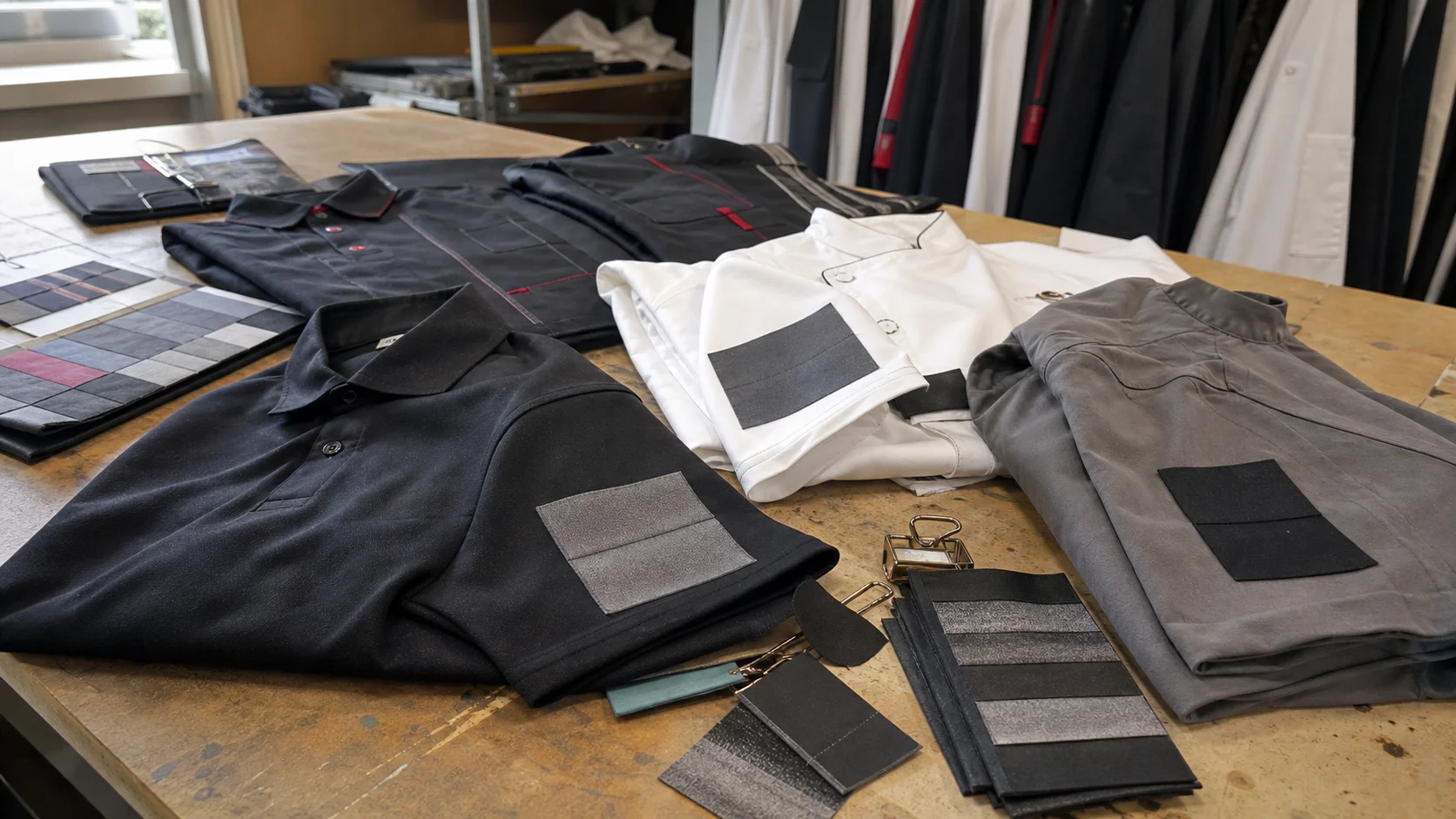
A practical production outline for restaurant groups that need consistent back neck tab decoration, fit stability, and wash-performance control across uniforms.
For restaurant groups, a back neck tab is a small detail with a big compliance risk. It sits close to the neckline, carries brand or care information, and is handled through repeated wash cycles. If the tab shrinks unevenly, curls, distorts, or pulls the collar out of shape, the garment can look off-brand before it ever reaches the floor. In food service, where uniforms are washed often and expected to look consistent across many locations, shrinkage control needs to be planned at the factory stage, not corrected after delivery.
This article sets out a practical shrinkage control plan for back neck tabs used in restaurant group apparel. It covers fabric selection, trim compatibility, sampling, testing, production controls, and final inspection points. The goal is simple: reduce dimensional change, keep the tab legible and tidy after laundering, and protect the uniform’s overall appearance across the life of the garment.
Back Neck Tab Shrinkage Control Plan - Fabrikn production reference
A back neck tab is typically a woven label, printed label, folded fabric tab, or decorative/functional brand element placed at the back neckline. In restaurant uniforms, it may carry a logo, size, care instruction, or simply act as a clean brand marker. The detail looks small, but it sits in a high-visibility area and is exposed to heat, detergent, tumble drying, and repeated handling.
Shrinkage creates several problems. A tab may pucker the neckline, become shorter than specified, lift at the edges, or distort the print alignment. In a multi-unit restaurant program, one location wearing slightly distorted uniforms while another receives better-looking stock is enough to create inconsistency. That inconsistency becomes more obvious when shirts, aprons, chef jackets, or polos are ordered in multiple replenishment rounds.
For this reason, shrinkage control should be treated as a specification issue, not only a finishing issue. The factory needs a clear target for the tab material, construction method, wash performance, and attachment method.
Restaurant groups usually buy uniforms in recurring programs. That means the garment is not a one-time promotional item. It is a working uniform expected to survive frequent laundering, often in commercial wash conditions. This raises the bar for repeatability.
There are three sourcing realities that matter here:
For restaurant groups, the best result is usually not the cheapest tab option. It is the option with the best balance of wash stability, clean appearance, and easy production control. That may mean slightly higher trim cost, a more controlled pre-shrinking process, or a simpler construction detail.
The shrinkage profile starts with material selection. A back neck tab can be made from woven polyester, cotton, cotton-poly blends, satin polyester, printed heat-transfer material, or folded self-fabric. Each option behaves differently in washing.
Polyester is usually the lowest-risk choice for shrinkage. It offers good dimensional stability, especially when the tab is woven or printed on a stable substrate. For restaurant uniforms that go through repeated laundering, polyester-based labels often hold shape better than cotton. That said, the handfeel can be firmer, and some woven polyester labels may feel scratchy if not finished properly.
Cotton can provide a more natural feel and a softer look, but it carries higher shrinkage risk. If the tab is cut from cotton tape or self-fabric, pre-shrinking becomes important. Cotton tabs may also distort at the stitch line if the thread, tape, and garment body shrink at different rates. This is common in hot washes and tumble drying.
Printed tabs can be efficient for brand artwork and care information, but ink adhesion and substrate stability must be checked carefully. A print may survive visually while the base material contracts. This can make the print look compressed or misaligned. Heat transfers also need confirmation on wash durability, edge lift, and cracking after repeated cycles.
Self-fabric tabs are common in fashion and casualwear, but they require more careful shrinkage matching if used in uniforms. If the garment body is a poly-cotton jersey and the tab is a different fabric direction or finish, the risk of distortion increases. Self-fabric can work well if the same fabric family is used and both components are tested together.
A practical shrinkage control plan begins before bulk production. The sample stage should not be treated as a box-ticking exercise. It is where material behavior, needle damage, stitch balance, and wash response can be checked.
Ask how often the uniform will be washed, at what temperature, and whether industrial laundering is expected. A tab that performs adequately in domestic washing may fail in commercial wash conditions. Restaurant groups often need performance that is closer to workwear than casual apparel.
Define whether the back neck tab is woven, printed, folded, edge-stitched, heat-transferred, or sewn into a seam. Each structure changes shrink behavior. A folded woven tab with topstitching will not behave like a bonded print patch. Keep the construction consistent across sampling and bulk.
Before bulk approval, define the test method. It may be a limited home-launder test, a commercial wash simulation, or another agreed standard. The important point is consistency. Without the same method, shrinkage claims become hard to compare.
Record tab width, height, and any positional movement after wash. If the tab is attached to a garment, measure the neckline area as well. A tab may shrink only slightly on its own, but the seam may pucker when combined with a shrink-prone collar or facing.
Do not approve the tab alone. Thread, adhesive, facing tape, interlining, and garment fabric all affect final performance. If the tab is stable but the thread contracts, the issue may show up as seam tunneling or waviness around the attachment point.
For sourcing teams that want to compare production options, the services overview at fabrikn.com/services/ is a useful starting point. It helps frame decoration and print methods before sampling moves into bulk.
A factory shrinkage control plan for back neck tabs should cover raw material inspection, pre-treatment, in-process controls, and final auditing. The main objective is to keep every component as close as possible to the approved sample.
Check incoming tab fabric or label rolls for width consistency, shade consistency, weave distortion, and roll tension issues. If the material is supplied in bulk rolls, edge curling or uneven tension can affect cutting accuracy. Even a stable polyester label can behave badly if it is stored under poor conditions or cut with dull tooling.
For cotton-rich materials, confirm whether any pre-shrinking treatment was applied. If not, the factory should expect greater variability after washing. This needs to be reflected in the tolerance plan.
Where needed, the factory should pre-shrink the tab material before cutting or assembly. That may include steam conditioning, compaction, controlled washing, or relaxing the roll before use. The exact method depends on the trim type and the garment program. The point is to remove avoidable dimensional movement before the tab is attached.
Pre-shrink treatment adds time and cost, but it can save a lot more by reducing rework and rejection risk later. For restaurant group orders, consistency usually matters more than a small trim saving.
Cut tabs with controlled grain direction and fixed dimensions. If the tab is woven or cut from fabric tape, grain misalignment can increase distortion after washing. This matters more with narrow parts, because small deviations become visible quickly.
Use stable cutting tools and verify cutter sharpness. Frayed edges or compressed cuts can worsen shrink behavior and make the tab look uneven after laundering.
The way the tab is attached has a direct effect on shrinkage appearance. Dense stitching can create tension and cause puckering. Loose stitching can allow the tab to twist or fold. The needle size, thread type, stitch density, and seam allowance should be standardized.
Thread selection deserves close attention. A high-shrink thread attached to a low-shrink tab can pull the part out of shape. A good practice is to test the thread and the tab material together under the same wash cycle.
Heat can alter dimensions, especially when tabs are printed, fused, or bonded. Press temperature, dwell time, and pressure should be controlled. Excess heat can shrink a label, distort print edges, or create a shiny patch on the neckline. Underheating may leave adhesive unstable, which becomes a separate wash risk.
Traceability matters when restaurant groups buy repeated deliveries. The factory should identify trim lots, fabric lots, and production dates. If a shrinkage issue appears in replenishment stock, traceability helps isolate whether the cause was material, process, or finishing.
Control point What to check Typical risk if ignored Incoming tab material Width, shade, tension, pre-shrink status Uneven wash response and cutting drift Cutting Grain direction, dimensions, edge quality Twist, fray, or size variation Stitching Thread type, tension, stitch density Puckering or seam distortion Heat finishing Temperature, pressure, dwell time Adhesive failure or material shrinkage Final inspection Shape, position, legibility after wash Non-uniform look across the orderTesting should be realistic enough to catch service failures without becoming so complex that it delays production unnecessarily. For restaurant groups, the most useful checks are usually dimensional stability, edge condition, print durability, and attachment integrity.
Measure the tab before and after washing. The acceptable tolerance depends on the program, but the key is to set it in advance. A narrow back neck tab can appear visually acceptable with a small percentage change, yet still cause neckline puckering. Visual tolerance and numeric tolerance should both be considered.
If the tab is printed, check whether the artwork remains aligned and legible after wash. Shrinkage can compress letters or logos, making them look thicker or less clear. In some cases, the print survives while the substrate shrinks, which still creates an off-quality appearance.
Look for curling, fraying, and seam waves. A tab may pass a simple size check yet still fail visually if the edges curl or the stitching ripples. Restaurant uniforms are often judged by neatness, and a poor edge finish is easy to spot.
Test the tab together with the final garment fabric. This matters because the body fabric may shrink at one rate, the collar facing at another, and the tab at a third. The combined effect can distort the whole neckline area even if each component seems acceptable on its own.
If your team is reviewing the supplier side of the project, the company background page at fabrikn.com/about-us/ can help frame who handles decoration, printing, and production coordination.
The most common failure is not catastrophic shrinkage. It is unevenness. One tab edge may shrink slightly more than the other, or the tab may contract just enough to show tension marks. That kind of defect is especially visible under bright restaurant lighting.
Other risks include:
Inspection teams should check both the sample and the first production output. First-article approval is especially important when the decoration method, fabric lot, or sewing line changes. A good-looking sample does not guarantee identical bulk behavior unless the process is controlled.
Lead time for a back neck tab program depends on several moving parts. Material sourcing is one. Sampling and approval is another. Pre-shrink treatment, printing, sewing capacity, and final inspection can all add time. If the product uses custom artwork or specialty trims, the schedule becomes more sensitive.
In practice, a clean program usually needs time for:
Buying teams should avoid compressing the sample window too much. A rushed approval may save a week and create months of replacement issues. For restaurant groups, consistency across reorder cycles is usually the better commercial outcome.
When selecting a supplier for back neck tabs in restaurant uniforms, the question is not only whether they can make the part. The real question is whether they can control it repeatedly.
A strong factory should be able to explain:
Typical MOQs vary by construction. Simple printed tabs or woven labels may be available at lower quantities, while custom woven constructions, specialty finishes, or integrated garment programs often need higher minimums. For restaurant groups, the economic sweet spot is usually a mid-sized run that allows consistent setup without excessive inventory risk. The exact MOQ should be checked against decoration method, packaging format, and whether the tab is standalone or sewn into a full garment order.
There is also a tradeoff between cost and risk. A lower-cost tab option may look fine in the showroom and still fail after repeated wash cycles. A more stable material or a more controlled production process may cost more upfront, but it reduces complaints, replacement costs, and brand inconsistency. In uniform sourcing, the cheaper trim is not always the cheaper program.
For restaurant group uniforms, the safest approach is to specify the tab as part of the performance standard, not as a decorative afterthought. If the back neck detail matters to brand presentation, it should be tested like a functional component.
If you are comparing production support, you can review services, request project guidance through contact us, or check the company overview at about us before issuing a development brief.
A back neck tab may be small, but in restaurant group apparel it carries a lot of visible risk. Shrinkage control depends on good material selection, realistic wash testing, careful sewing, and disciplined factory controls. The best results come from treating the tab as a technical component rather than a decorative extra.
For sourcing teams, the practical approach is clear: define the wash environment, choose a stable material, approve samples with the full trim package, and insist on process control in bulk. That is the most reliable way to protect fit, presentation, and repeat order consistency.
Get a free quote from Fabrikn — your trusted B2B clothing manufacturer with 10+ years of experience. MOQ as low as 200 pieces.
Get a Free Quote →Polyester or a stable polyester blend is usually the safest choice for shrinkage control. Cotton can work, but it needs more careful pre-shrinking and testing.
There is no universal number. The acceptable range should be set according to the garment, wash method, and brand standard. Visual appearance matters as much as the measured percentage.
Both. A separate tab test shows the trim’s basic behavior, but the full garment test reveals how the tab interacts with the collar, thread, and neckline construction.
Common causes include differential shrinkage, tight stitch tension, incompatible thread, poor grain direction, or excessive heat during finishing.
Higher MOQs can make it easier for a factory to standardize cutting, printing, and finishing. Lower MOQs may be possible, but they sometimes come with more limited material or setup options.
Material type, artwork, dimensions, stitch method, wash test results, and visual inspection after laundering. The tab should be approved together with the garment body whenever possible.
Restaurant uniforms are washed more frequently, reordered more often, and judged against a tighter brand standard. Small differences become obvious fast.