
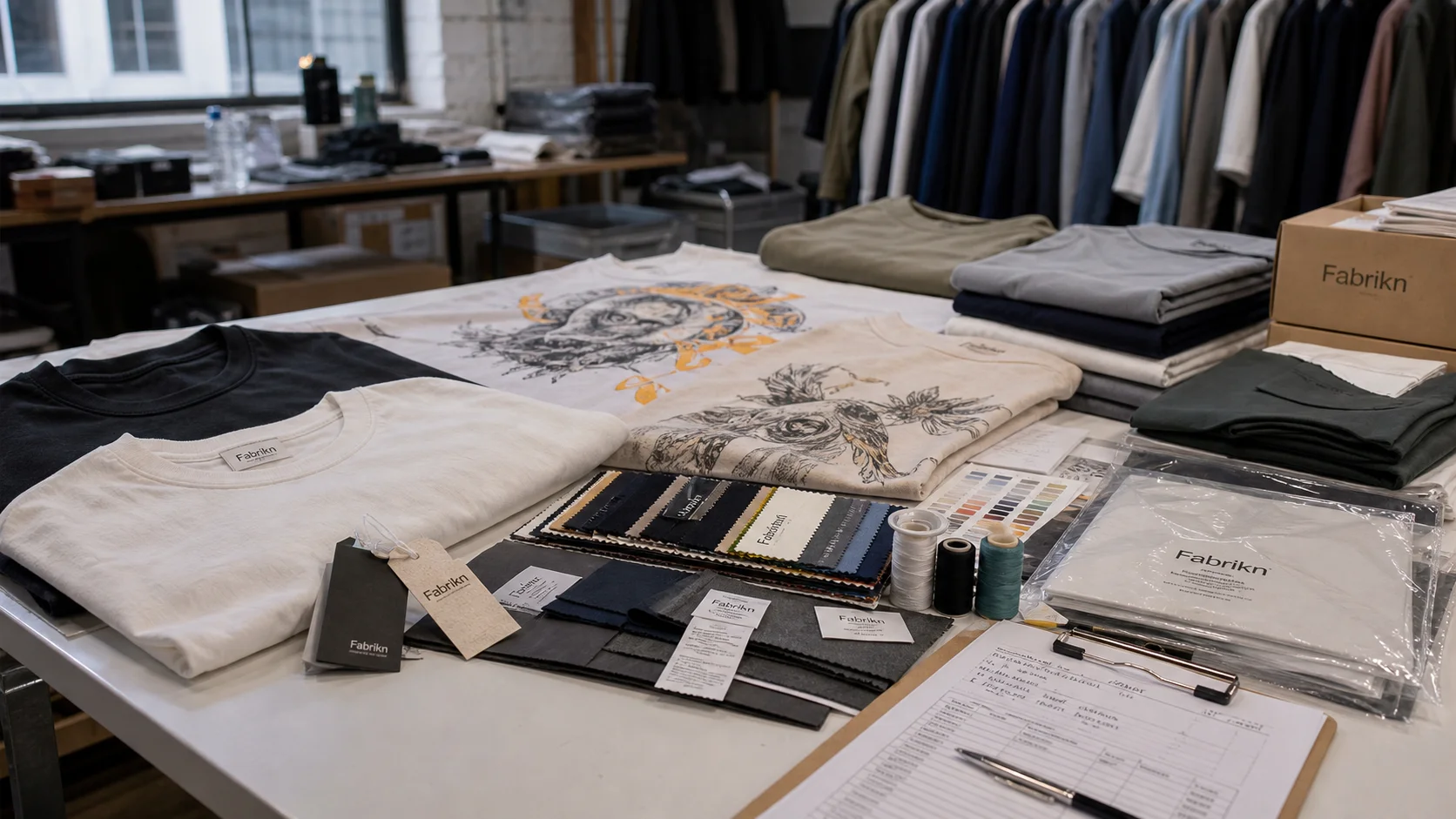
Barcode and Price Labels for Clothing Packaging compared by sample evidence, fabric or trim specs, MOQ, AQL terms, cost lines, delivery timing, and rework...
Fast answer: Barcode and Price Labels for Clothing Packaging: Material, Print, MOQ, and QC Terms should be judged by production evidence, not by a generic sourcing promise. The buyer needs sample proof, cost breakdowns, QC checkpoints, and delivery buffers in writing.
Ask for recent sample photos, measurement tolerances, fabric or print test assumptions, decoration test notes, packing examples, and a named inspection checkpoint. These details show whether the team can repeat an approved sample at bulk volume.
Separate garment cost, decoration, labels, packaging, sampling, testing, freight, and rush charges. Clear cost lines make it easier to reduce colorways, adjust size depth, or reserve more time for sampling.
One unreadable label can stall 48 units at receiving, trigger 20 minutes of manual entry, and spark a pricing dispute that hangs around for weeks. I watched it happen on a sales floor; the problem started with barcode and price labels for clothing packaging that looked perfectly acceptable from two feet away. That’s the trap. Small piece, big blast radius.
On factory visits to Guangzhou and Ho Chi Minh City, budget labels often pass a visual check and fail in real retail conditions. A roll printed on 70 gsm paper may look fine in the showroom, then curl in 85% humidity during ocean freight and smear in a receiving scanner after 3-4 weeks in transit. In one mid-market program out of Istanbul, a $0.018 label ended up costing more than $0.07 once reprints, delayed stock entry, and 6 returned cartons were counted. Not rare.
The price tier matters. A $2.50 retail tee often gets the weakest packaging discipline, while a $120 coat is more likely to be tested, approved, and scanned properly on the first pass. Yet the cheaper line gets treated harder in stores. It moves faster, gets folded more, and passes through more hands. At scale, even a 2% scan failure rate can mean dozens of units sitting unreceipted, while a clean label program can cut markdown delays by 1-2 days and reduce store labor during intake. For reference, GOTS-certified cotton basics shipped from Dhaka often stay on the hanger longer when packing slip data and price labels align, so the brand’s $2.50-4.00 per unit price tier at 500 MOQ sees the most operational risk.
After 200+ factory visits across 8 countries, one thing stands out: labels are not decoration. They’re part of the packaging system, and they affect omnichannel inventory accuracy, markdown speed, and the time it takes a store to put product on the floor. For brands working with clothing packaging solutions, barcode and price labels for clothing packaging should sit beside carton specs and hangtag approvals, not after them.
A label has five jobs before it ever looks good. It identifies the item, carries the price, supports stock control, flags promotions, and keeps traceability intact. In apparel, that usually means SKU, UPC or EAN, size, color, price, country of origin, and in some cases care symbols or fiber notes. If a retailer wants currency, markdown code, or lot reference, the artwork changes again. I’ve seen brands reprint 12,000 labels because one buyer wanted the size above the price instead of below it.
The format matters. UPC-A, common in North America, uses 12 digits. EAN-13, common across Europe and many export programs, uses 13 digits. Both scan quickly when the quiet zones are respected and the bars print with enough contrast. In warehouses, a decent 2D code or a clean linear barcode can shave 1-2 seconds per scan, which sounds trivial until a store handles 800 units a day. A 5% error rate is a labor problem, not just a print problem.
Hang tags, adhesive labels, and sewn-in alternatives each serve a different point in the workflow. Hang tags work well for premium apparel and giftable items because they travel with the garment and preserve branding. Adhesive labels suit polybags, cartons, and folded packs where the retail team needs a fast scan. Sewn-in tags are permanent and useful for care and origin data, but they are poor substitutes for retail pricing. For private label clothing, I usually see the strongest programs use a combination: a hang tag for pricing, an adhesive for logistics, and a care label for compliance.
Here’s what most people miss: the cheapest label stock is often the most expensive once reprints, chargebacks, and returns are counted. A factory can save $140 on paper stock, then spend $420 on rework because the adhesive bled in stacking and the barcode failed at checkout. Cheap isn’t cheap if it forces a second run.
Paper stock is the lowest-cost option, usually around $0.010-$0.025 per label in volume, and it works for short domestic runs where humidity is controlled. Synthetic stocks such as texturized polypropylene or 140 gsm GRS-certified recycled PET cost more, often $0.020-$0.055 per label, but they resist scuffing, moisture, and oil. Thermal labels print fast and keep tooling simple. Thermal transfer labels, printed on a Roland VersaStudio BN-20W or Toshiba B-EX4T3, hold up better for long transit, warehouse stacking, and retail back rooms where cartons sit for 30-60 days.
Adhesive choice is where many buyers under-spec. Removable acrylic adhesive with 0.9-1.2 N/25mm initial tack is usually better for fashion items that must not leave residue on fabric, tissue, or polybag surfaces. Permanent gummed adhesives or hot-melt options are stronger for carton labels and some multi-pack logistics tags. In tropical humidity, a weak adhesive can lift in 48 hours, observed during a Dhaka stadium hangar audit when humidity spiked to 92%. In cold-chain storage for premium outerwear, adhesive can lose tack if it is applied at 5-8°C and then moved into a warm store. Not theory. I’ve peeled failed labels off sample coats in Guangzhou, Ho Chi Minh City, and northern Italy.
Matte finishes generally improve scanner readability because they reduce glare, especially under LED retail lighting. Gloss looks better on shelf, but it can interfere with quick scans if the printer lays down too much varnish or if the barcode sits near a fold line. For brands shipping long ocean freight, the label needs to survive abrasion from cartons, tissue, and repeated handling. A finish that feels premium in a showroom can fail after 1,000 kilometers in a container.
Before committing to volume, test rub resistance, peel strength, and barcode contrast. I ask factories for 10 samples, then a 72-hour humidity check at 80-85% RH, plus a scan test from 30 cm and 50 cm distance. For custom baby clothing manufacturing, I’m even more cautious because soft goods often ship in lighter packaging, and adhesive residue on infant items creates an instant rejection risk.
When sourcing for a manufacturer or factory, ask the supplier for material datasheets, OEKO-TEX Standard 100 certification, and print proofs before bulk production. That matters most for custom and wholesale programs moving in bulk from China, where production speed can hide quality gaps if QC is not locked down.
Direct thermal is the cheapest setup for short runs. At 5,000 labels, a simple black-and-white job can land around $35-$90 total, excluding shipping, depending on size and shape. Thermal transfer rises a bit because it needs ribbon, but the print holds better. At 50,000 labels, unit cost often falls into the $0.012-$0.030 range for standard rolls. Flexographic printing makes sense when the artwork is fixed, colors matter, and the order size starts at 100,000 units or more. Setup fees can run $120-$600, and plate costs can add another $80-$300.
The hidden costs usually disappear in the first quote. Artwork changes, plate fees, color matching, proofing, and spoilage can add 8-18% to the total order. If a retailer changes the price field layout after approval, a supplier may charge a $25-$75 amendment fee, then reset the proof cycle by 2-4 days. I’ve seen 500,000-label programs lose all their unit savings because the brand revised SKU data three times in one month.
Short runs suit independent brands and seasonal launches. A 2,500-piece capsule may only need 3,000 labels, and speed matters more than a fraction of a cent. High-volume programs for chain stores are different. They reward disciplined data hygiene, locked artwork, and stable SKUs. For a 250,000-label program, a price difference of $0.004 per label equals $1,000. That’s real money, but so is a 5% spread in scan fails: 12,500 missed reads can trigger 18-22 business days of rework, especially if the cartons are coming from Istanbul or Dhaka.
Choosing suppliers across Guangzhou, Ho Chi Minh City, Istanbul, and Dhaka brings different trade-offs. Chinese digital converters can hit 5,000-unit runs with Mimaki or EFI Vutek presses in 5-7 days plus 1-2 days of QA, while Southeast Asian converters often quote 12-15 business days with an emphasis on thermal transfer durability. Turkish printers are strong at flexo and can deliver gloss and tactile finishes for premium departments, but they usually ask for 30-45 day lead times because of customs paperwork. Bangladeshi vendors excel at woven label and care label adjuncts, so pairing their adhesive label run with a Dhaka-based woven supplier ensures compliance with care data.
Ask for certifications before issuing a PO. WRAP and BSCI audits are essential for any supplier touching garments in the final mile, while GOTS and GRS validate the sustainability story on cotton strikethrough labels. A strong label vendor will provide ISO 9001 process controls, in-line verifier data for barcode contrast, and field data from carton-level testing. Don’t accept blind promises.
For inventory-critical programs, send your label artwork and SKU matrix to three suppliers, request die-cut samples within 72 hours, and compare their spool lengths. A 500-label test run from Guangzhou may cost $25 and prove adhesive reliability, while a Dhaka supplier might quote 6 days for the same test but include logistical handling. Have them quote shipping to your distribution center—air vs sea—and include possible demurrage if a reprint is required. Verify they can deliver 18-22 business days for reorders so you can plan JIT replenishment.
Retailers demand proof that labels scan correctly at point of sale. Provide a GS1 certificate for the UPC or EAN, record your contrast ratio (typically 60% or higher), and include verifier printouts from a Zebra ZQ500 or Honeywell PX4i. If you ship to Europe, the retailer may want GRS or OEKO-TEX Standard 100 validation tied to the label facestock. In North America, Walmart and Target expect a BSCI-compliant vendor and often request WRAP certification when labels are applied inside their distribution centers.
Scanning accuracy is not guesswork. Run each SKU through at least three scanners (zebra fixed mount, handheld, and POS laser) and log the fail rate. Send those spreadsheets to the retailer during onboarding so they understand the 99.4% pass rate. When a label fails, trace it to the material (e.g., 120 gsm GRS recycled PET), the ribbon density (e.g., 9 dots/mm), or the finish (matte vs gloss). That level of data is what keeps retail execution teams calm.
Don’t forget the shipping paperwork. Include a packlist that cites the label lot number, adhesive type, and certification batch. If you’re using a synthetic facestock with GRS claims, the auditor may want to see the mill certificate, the conversion certificate from the printing house, and the verification report. Missing any step can delay a store door drop by days.