
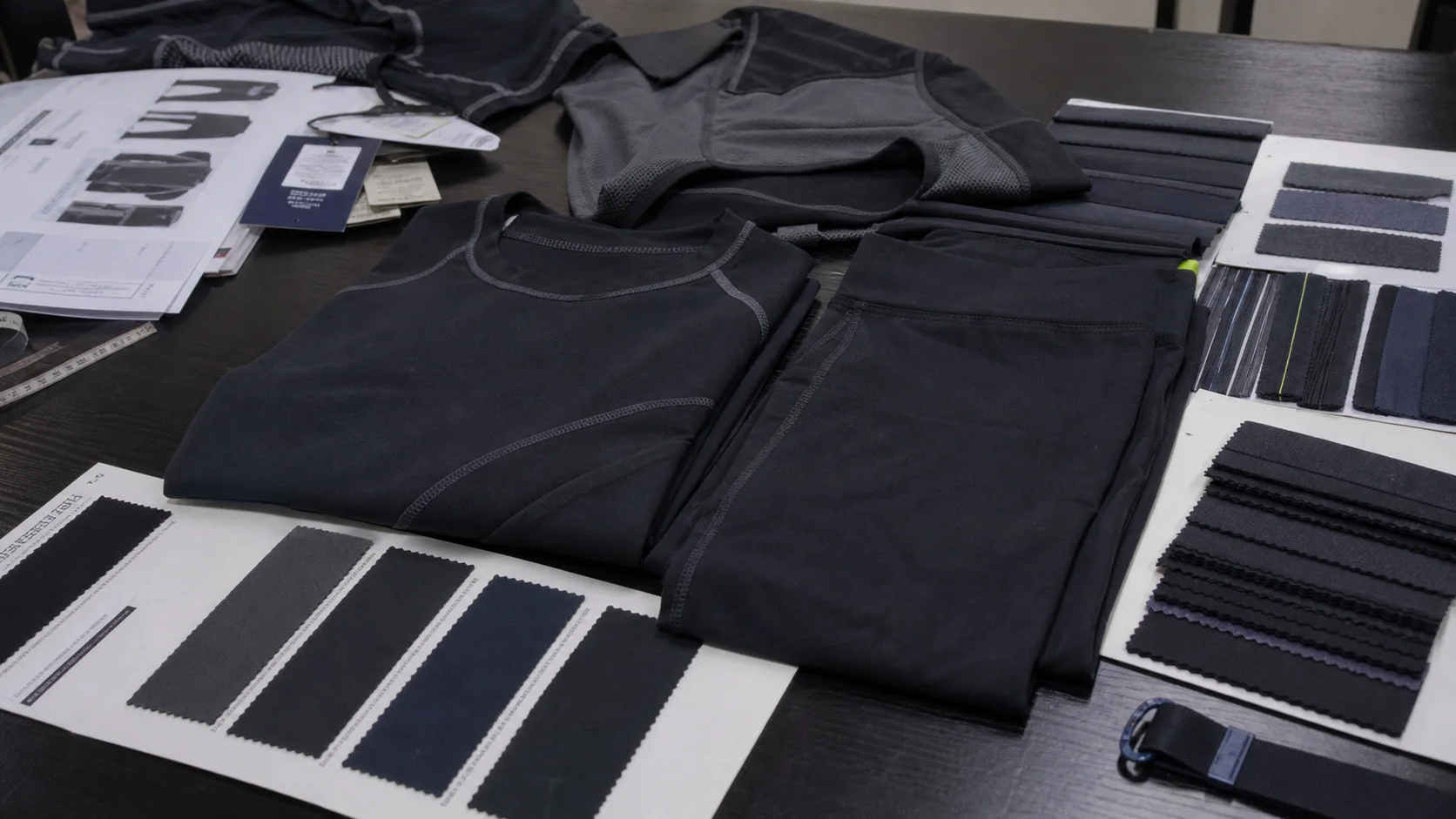
A practical buying outline for evaluating base layer set suppliers, MOQ tiers, decoration choices, size runs, fabric specs, and landed pricing for cleaning...
Base Layer Set MOQ Pricing Review for Cleaning Crews - Activewear & Teamwear manufacturing guide
Buying base layer sets for cleaning crews is not the same as buying fashion activewear. The product has to support long shifts, repeated washing, movement, and uniform consistency across a team. The sourcing question is practical: how low can the minimum order quantity go, what price is realistic, and what compromises appear when the buyer pushes for smaller runs?
For cleaning companies, facility service providers, janitorial teams, hotel housekeeping departments, and outsourced maintenance crews, base layer sets can serve several roles. They can sit under polo shirts, softshell jackets, coveralls, or branded workwear. They can help with warmth during early-morning exterior work, moisture management in heated buildings, and modesty under lighter uniforms. In colder regions, thermal base layers can become part of the official winter kit.
The phrase “base layer set supplier MOQ pricing review for cleaning crews” points to a narrow but important buying issue. MOQ is not just a number on a quote sheet. It affects fabric access, dyeing method, size breakdown, logo method, packaging, inspection cost, and reorder flexibility. A buyer who only compares unit price may miss the bigger cost of poor fit, fabric shrinkage, or inconsistent color across repeat orders.
This review looks at the purchasing side: typical MOQ ranges, how suppliers build pricing, what specifications matter, and where cleaning crew buyers should be cautious. It is written for B2B buyers comparing private label, contract manufacturing, or custom uniform supply options in the Activewear & Teamwear category.
Direct purchasing judgment: for cleaning crews, a slightly higher unit price with stable fabric, controlled shrinkage, and reliable replenishment is usually better than the lowest MOQ offer with unclear fabric source and weak quality control.
Cleaning work involves repetitive movement: bending, reaching, lifting, kneeling, pushing carts, operating floor machines, and moving between indoor and outdoor areas. Base layer sets can make uniforms more functional when selected correctly. The wrong product, though, becomes a complaint driver. Too tight, too warm, too synthetic-feeling, or too slow to dry after laundering will cause teams to avoid wearing it.
Cleaning crews may use base layers for several practical reasons:
The buyer should define the working environment before discussing MOQ. A crew cleaning offices after hours has different needs from a team servicing food processing areas, schools, hospitals, hotels, or exterior sanitation zones. If the base layer is meant for warmth, brushed fleece or thermal knit may be required. If the priority is sweat management, a lighter polyester-spandex jersey may be more suitable.
Uniform programs often fail when one garment is expected to solve every condition. For national or multi-site cleaning operations, it may be better to specify two versions: a lightweight year-round set and a warmer winter set. MOQ pricing will be higher at smaller volumes per style, but usability improves. Dead stock from a single unsuitable product can cost more than splitting the program carefully.
A base layer set usually includes a long-sleeve top and a bottom. The top may be crew neck, mock neck, quarter-zip, or compression-style. The bottom may be ankle length, 7/8 length, or fitted thermal pant. For cleaning crews, the most common set is a simple long-sleeve crew neck top with elastic-waist bottom.
Suppliers may quote base layer sets in different ways. Some quote per piece, meaning the top and bottom have separate unit prices. Others quote as a packed set, meaning one top and one bottom in one polybag or retail carton. Buyers need to clarify this early because MOQ and pricing can change when tops and bottoms have different size ratios.
Set Type Typical Use Buying Note Lightweight jersey set Indoor cleaning, year-round layering Good for movement; check opacity and pilling. Thermal waffle set Cold storage, winter shifts, exterior support Warmer but may shrink if cotton-rich. Brushed fleece base set Cold environments and low-activity periods Comfortable, but bulkier under uniforms. Compression-style set High-movement teams or athletic uniform programs Fit complaints are more likely if sizing is not tested.Cleaning crew buyers should be careful with “compression” wording. A fitted garment can be useful, but true compression fit is not comfortable for every worker and may create size exchange issues. For teamwear, a close-but-not-restrictive fit usually works better than athletic compression unless the workforce has specifically requested it.
MOQ depends on whether the supplier is using stock fabric, custom-dyed fabric, custom trims, private label packaging, or a fully bespoke pattern. The more customization required, the higher the MOQ tends to be. Cleaning crew orders often sit between basic uniform supply and custom activewear manufacturing, so the best MOQ is usually found by limiting unnecessary customization.
Typical MOQ ranges for base layer sets are commonly seen as follows:
Order Type Typical MOQ Range Best Fit Pricing Caution Blank stock base layers 50-200 sets Small crews, trial programs, urgent needs Limited color and size control. Stock fabric with custom logo 100-300 sets Regional teams, franchise locations Logo setup fees can raise landed cost. Custom color using available fabric quality 300-800 sets Established uniform programs Dye lot control and lab dip approval matter. Custom fabric construction 800-1,500+ sets Large cleaning groups or distributors Fabric MOQ may exceed garment MOQ. Fully custom set with labels, packaging, trims 500-2,000+ sets Private label teamwear programs Development cost must be spread over enough units.These ranges are not fixed promises. They vary by fabric mill, country of production, season, exchange rate, factory capacity, and the buyer’s willingness to accept stock colors. A supplier quoting 50 sets for full custom color, custom pattern, custom label, and custom packaging may be relying on surcharges or substitutions that need to be understood before placing a purchase order.
For cleaning crews with 20 to 80 workers, a low MOQ stock-based order can make sense as a pilot. For crews with 100 to 500 workers, it is usually worth negotiating a better construction and a planned replenishment schedule. For multi-site cleaning businesses, larger MOQ orders can reduce unit cost, but only if size ratios and employee turnover are managed carefully.
Base layer set pricing is built from several cost layers. Fabric is usually the largest component, followed by sewing labor, trims, logo application, packaging, quality control, and freight. MOQ affects all of these. A low MOQ means setup time, pattern work, cutting loss, and admin cost are divided across fewer units.
Common pricing drivers include:
As a broad buying reference, stock or semi-custom synthetic base layer sets may price in a moderate promotional uniform range when ordered at a few hundred sets. More technical fabrics, brushed interiors, antimicrobial finishes, recycled yarn claims, or custom packaging can push pricing upward. Buyers should be cautious with extremely low quotes because the savings often come from lighter fabric, loose tolerance control, weak stitching, or poor packaging.
MOQ and unit price should be reviewed together with expected garment life. If a cheaper set loses shape after 10 washes, the real cost per wear is poor. Cleaning crew uniforms are laundered frequently, sometimes in commercial conditions. Durability has a direct financial impact.
Fabric specification is where many base layer set purchases succeed or fail. Buyers should ask for clear fabric details before approving pricing. A quote that says “polyester spandex” is not enough. The specification should include composition, weight, knit type, stretch direction, finish, color, and performance expectations.
For cleaning crews, polyester-spandex blends are common because they dry faster and hold shape better than many cotton-rich options. Cotton blends can feel more familiar and comfortable, but they may absorb moisture and take longer to dry. Nylon-spandex can feel smoother and stronger, although it may increase cost. Merino or wool-blend base layers are usually too expensive for high-turnover cleaning crew programs unless the working environment requires premium thermal performance.
Trim choices should stay simple. Elastic waistbands, neck binding, cuffs, labels, and thread quality all matter. Scratchy labels, weak waist elastic, or tight cuffs will create complaints. Printed neck labels can reduce irritation, but they must withstand repeated washing. Woven labels look more traditional but may be uncomfortable in close-fitting tops.
Performance finishes should be treated carefully. Antimicrobial or odor-control claims can be attractive, but buyers need documentation and wash durability data. If the garment is used in regulated environments, claims must be reviewed more strictly. A vague “antibacterial fabric” claim is not enough for a professional uniform specification.
Sizing is one of the biggest risks in base layer set sourcing. Cleaning crews are not a single athletic body type. A uniform program must fit a broad workforce, including different heights, body shapes, and comfort preferences. A set that looks neat on a sample mannequin may be too tight in real work conditions.
Buyers should review the size chart in actual body measurements and garment measurements. Both are useful. Body measurements help allocate sizes to employees. Garment measurements help check production consistency. Important points include chest, waist, hip, sleeve length, inseam, thigh, rise, shoulder width, and garment length.
For teamwear programs, the safest fit is often described as “athletic regular” rather than compression. It should sit close enough to layer under uniforms but not so tight that it restricts bending or kneeling. The bottom should not slide down during work. The top should not ride up when workers reach overhead.
Do not accept a standard size ratio without checking workforce data. Many suppliers propose a general ratio such as S-XXL spread evenly or based on retail assumptions. Cleaning crew teams may require more L, XL, 2XL, and 3XL units depending on demographics. If extended sizes are required, confirm whether they carry surcharges and whether the pattern is properly graded rather than simply scaled.
A reasonable pilot should include size testing across a small group before full production. The best feedback comes from movement: bending, squatting, reaching, lifting, and wearing the set under the actual outer uniform. Static fitting is not enough.
Branding on base layers should be modest. Since the garment is usually worn under another uniform piece, large logos may not be necessary. Many cleaning companies choose a small chest logo, printed neck label, or no external logo at all. The decision should depend on visibility, employee identification needs, and budget.
Branding Method Pros Risks MOQ Impact Heat transfer logo Clean look, good for small marks May crack or peel if low quality or overheated in laundering Low to moderate Screen print Cost-effective at volume Less flexible on stretch areas Moderate Embroidery Durable and premium Can irritate skin and reduce stretch comfort Low to moderate Woven label Good for private label identity Can scratch if placed poorly Moderate Reflective print Useful for exterior or low-light work Requires wash testing and careful placement Moderate to highFor cleaning crews, branding should not compromise comfort. Embroidery on a tight base layer can be irritating, especially on the chest or back neck. Heat transfers can work well, but the buyer should ask for wash testing and stretch testing. Reflective elements may be useful if crews work around parking lots, loading docks, or exterior routes, but they should not be added only for appearance.
Private label packaging is often less valuable for internal uniforms. If the sets are issued by a company to employees, bulk packing by size may be cheaper and easier. Retail-style individual packaging only makes sense for distribution, resale, franchise kits, or controlled employee issue programs.
Buyers comparing development support can review service scope before requesting quotes. A supplier’s ability to manage fabric, fit, sampling, and production coordination matters as much as the first unit price. For general manufacturing support, see Fabrikn services.
A disciplined sample process protects the buyer from avoidable problems. It also gives the supplier clear approval points. Skipping samples may be tempting for a low-margin uniform order, but base layers touch the skin and are washed often. Mistakes are visible quickly.
For cleaning crews, the fit sample should be worn under the actual uniform top or jacket. The buyer should check sleeve layering, waistband comfort, rise, opacity, and whether the top stays tucked or sits correctly during movement. If the garment will be washed commercially, a wash trial should happen before production approval.
Sample charges vary. Some suppliers charge sample fees that are refundable after bulk order confirmation. Others charge separately for pattern, courier, logo setup, and fabric sourcing. Low MOQ orders may not have much room for waived development cost. Buyers should judge sample cost against risk. Paying for proper samples is often cheaper than replacing uncomfortable uniforms.
Approval comments should be written clearly. “Make it better” is not a production instruction. Better comments include “increase sleeve length by 2 cm,” “reduce waist elastic tension,” “change neck opening to match approved sample,” or “improve opacity under bright light.”
Base layer set lead times depend on fabric availability, sampling rounds, logo method, production capacity, inspection schedule, and freight route. Buyers should not treat a quoted lead time as guaranteed until all approvals are complete and materials are secured.
Typical lead-time ranges may look like this:
Stage Typical Timing Dependency Initial quotation 2-7 business days Specification clarity and supplier workload Fabric swatch sourcing 5-14 days Stock fabric availability Fit sample 7-21 days Pattern complexity and trim readiness Lab dip or custom color 7-20 days per round Dye house schedule and approval speed Bulk production 30-60 days MOQ, fabric knitting or dyeing, sewing capacity Inspection and packing 2-7 days Order size and defect handling Freight Varies widely Air, sea, courier, customs, and destination handlingStock fabric orders can move faster, especially if the buyer accepts available colors and trims. Custom color orders take longer because lab dips must be approved and bulk dyeing must be scheduled. Custom fabric construction can add weeks before sewing even begins.
Cleaning companies often need uniforms before seasonal changes, contract launches, or new site mobilizations. That timing should be discussed at the quote stage. If a crew starts work in four weeks, a fully custom base layer set may not be realistic. A better choice may be a stock-based set now, followed by a custom program for the next replenishment cycle.
Buyers should confirm whether quoted lead time starts from deposit payment, final sample approval, fabric approval, or purchase order confirmation. These are different milestones. A supplier saying “45 days” may mean 45 days after all approvals and materials are ready, not 45 days from the first email.
Inspection should match the way the garment will be used. Base layer sets for cleaning crews need more than a quick visual check. The main risks are fit inconsistency, seam weakness, shrinkage, twisting, fabric defects, color variation, and logo failure after washing.
For cleaning crews, the crotch seam and underarm seam deserve special attention because of repeated movement. Waistbands are another common failure point. A weak elastic may pass initial inspection but fail after several washes. Buyers should request production samples from bulk goods, not only the showroom sample.
Color consistency matters if base layers are visible at the neck or sleeve. Black is common, but black dye lots can still vary. Navy and grey can be harder to match across replenishment orders. If a uniform program needs long-term consistency, the buyer should ask how the supplier controls fabric lots and reorders.
Care label accuracy is not a small detail. Cleaning crew uniforms may be washed by employees at home or through a laundry service. Care instructions should be realistic. If the garment cannot tolerate tumble drying but the workforce commonly uses dryers, that mismatch will create shrinkage and returns.
MOQ pricing should be judged against the uniform program’s operating needs. The best price is not always the lowest price per set. A reliable base layer set should reduce complaints, last through repeated washing, and be reorderable without major changes.
Low MOQ is useful when testing fit, launching a small crew, or evaluating employee acceptance. The tradeoff is usually higher unit cost, limited customization, and less control over fabric continuity. High MOQ is useful when the buyer has stable demand, known size ratios, and a clear specification. The tradeoff is cash commitment and inventory risk.
A practical buying approach is to separate pilot, rollout, and replenishment:
Cleaning crew buyers should avoid over-customizing the first order. Custom colors, custom packaging, reflective trims, and premium finishes all sound attractive, but they raise MOQ and increase failure points. A strong basic set with good fabric, good fit, and durable seams is usually a better first purchase.
The buyer should also think about employee turnover. Cleaning services can have frequent staff changes. That means uniforms need ongoing availability, not just one-time production. If the supplier cannot support replenishment, the buyer may end up mixing different base layers across the team.
If a supplier cannot answer these questions clearly, the buyer should slow down. A vague quote may still be workable for blank stock goods, but it is risky for a custom uniform program. Technical clarity protects both parties.
Buyers evaluating a manufacturing partner may also want to understand company background, sourcing model, and service range before sharing a full tech pack. For broader context, visit Fabrikn about us. To discuss base layer set development, MOQ feasibility, or sampling requirements, use the Fabrikn contact page.
Different cleaning crew buyers should approach MOQ pricing differently. A small local janitorial company does not need the same order structure as a national facilities provider. The wrong sourcing model can either overburden cash flow or leave the buyer without enough product for consistent uniform issue.
Buyer Scenario Recommended Approach Main Tradeoff Small cleaning company Use stock or semi-custom base layers with minimal branding. Higher unit price but lower inventory risk. Regional cleaning contractor Run a fit-tested semi-custom order with planned replenishment. Needs better forecasting and size data. Large facilities provider Develop a controlled fabric and size program at higher MOQ. Lower unit cost but higher inventory commitment. Uniform distributor Negotiate private label specifications and packaging. Requires stronger quality control and stock planning.Small buyers should not chase factory-direct custom production if they cannot meet the MOQ comfortably. In that case, the better commercial decision may be to buy approved blank sets and add a small logo locally. The unit cost may look higher, but the total risk is lower.
Larger buyers should not accept consumer-grade base layers without testing. The garment may look acceptable on arrival but fail under repeated laundering. A proper bulk order should include a clear specification, approved sample, size set, and inspection plan.
A request for quotation should be specific enough to get comparable pricing. If one supplier quotes 160 gsm polyester jersey and another quotes 240 gsm brushed thermal fabric, their prices cannot be compared fairly. Buyers should send a clear RFQ rather than asking only for “best price.”
A good RFQ makes pricing more honest. It also exposes suppliers who are not suitable for the order. If a supplier responds without addressing fabric, MOQ basis, sampling, or lead time, the buyer should ask for clarification before comparing the quote.
The unit price on a supplier quote is only part of the buying decision. Landed cost includes freight, duties, customs clearance, inspection, payment fees, testing, warehousing, and internal distribution. For cleaning crews spread across multiple sites, distribution cost can be significant.
Buyers should ask whether the quote is EXW, FOB, CIF, DDP, or another trade term. Each term changes who pays for transport, insurance, import handling, and risk transfer. A low EXW price can become expensive once pickup, export handling, freight, and import costs are added.
Packaging also affects landed cost. Individual polybags may protect garments and simplify issue by employee, but they increase packing cost and waste. Bulk packing by size is cheaper but requires sorting. Set packing is convenient, yet it can create problems if tops and bottoms need different size ratios.
For cleaning crew programs, the most practical packaging is often one set per polybag with size visible, then cartons separated by size or mixed according to site allocation. This adds some cost but reduces distribution errors. The right choice depends on how uniforms are issued.
Some buyers request recycled polyester, low-impact dyes, or reduced packaging. These choices can be worthwhile, but they affect MOQ and pricing. Recycled yarn may require higher fabric MOQ or longer lead time. Certification claims need documentation, not just marketing language.
Compliance requirements depend on destination market and use case. Fiber content labeling, care labeling, country of origin marking, and restricted substance compliance may apply. If the garment is sold onward, packaging and labeling requirements become more important. If it is issued internally, the buyer still needs accurate product information for employee use and import compliance.
Chemical exposure is another practical point. Cleaning crews may work around disinfectants, detergents, bleach solutions, and other chemicals. Base layers are not protective PPE unless designed and certified for that purpose. Suppliers should not present ordinary activewear fabric as chemical protection. If protection is required, the buyer needs a separate PPE specification.
Base layer set MOQ pricing for cleaning crews should be reviewed with a uniform buyer’s discipline, not a retail apparel mindset. The product must fit real workers, survive frequent washing, and support consistent team presentation. MOQ matters, but it should not be isolated from fabric quality, size planning, sampling, inspection, and replenishment.
The strongest purchasing path is usually simple: start with a practical fabric, test fit before rollout, keep branding modest, confirm wash performance, and negotiate MOQ around realistic demand. Small teams should prioritize flexibility. Larger teams should prioritize consistency and long-term reorder control.
A supplier offering the lowest MOQ may be useful for a trial, but not always suitable for a full uniform program. A supplier asking for higher MOQ may be reasonable if custom dyeing, fabric knitting, or size-set development is involved. The buyer’s job is to understand what the MOQ is paying for.
Best buying conclusion: choose the base layer set that cleaning staff will actually wear, that operations can reorder, and that finance can justify over repeated wash cycles. That is the real MOQ pricing review.
Get a free quote from Fabrikn — your trusted B2B clothing manufacturer with 10+ years of experience. MOQ as low as 200 pieces.
Get a Free Quote →A typical MOQ may range from 100 to 300 sets for stock fabric with logo customization, 300 to 800 sets for custom color, and 800 to 1,500+ sets for custom fabric construction. Exact MOQ depends on fabric, color, size range, trims, and packaging.
Compression base layers are not always the best choice for cleaning crews. A close athletic regular fit is usually safer because it supports movement without feeling restrictive. True compression fit can create sizing complaints across a mixed workforce.
Polyester-spandex jersey or interlock is a common practical choice because it dries quickly and supports movement. Thermal waffle or brushed fabrics may be better for cold conditions. Cotton-rich blends can feel comfortable but may dry more slowly and shrink more if not controlled.
Buyers can reduce MOQ by using stock fabric, choosing standard colors, limiting branding, avoiding custom packaging, and keeping trims simple. The main tradeoff is less uniqueness and less control over long-term fabric continuity.
Buyers should approve fabric swatches, a fit sample, logo or trim samples, and a pre-production sample. For larger orders, a size set is strongly recommended to check grading across sizes before bulk production.
The main risks are shrinkage, poor stretch recovery, seam failure, fabric pilling, twisting after wash, logo peeling, inaccurate sizing, and mismatched top-bottom packing. Waistbands, crotch seams, underarms, and cuffs need careful inspection.
Private label packaging is not always necessary. For internal uniform issue, bulk or simple set packing may be more cost-effective. Retail-style packaging makes more sense for distributors, franchise kits, or resale programs.
Stock fabric orders may move faster, while custom color or custom fabric orders take longer. A common production window is 30 to 60 days after approvals, but sampling, lab dips, inspection, freight, and customs can extend the full timeline.
Some suppliers allow different size ratios, while others require matched sets by size. Buyers should confirm this early because cleaning crew employees may not always wear the same top and bottom size.
Buyers should ask whether the MOQ is based on sets, pieces, color, size, or fabric lot. They should also confirm fabric source, shrinkage target, size tolerance, sample process, logo durability, packing method, and reorder availability.