
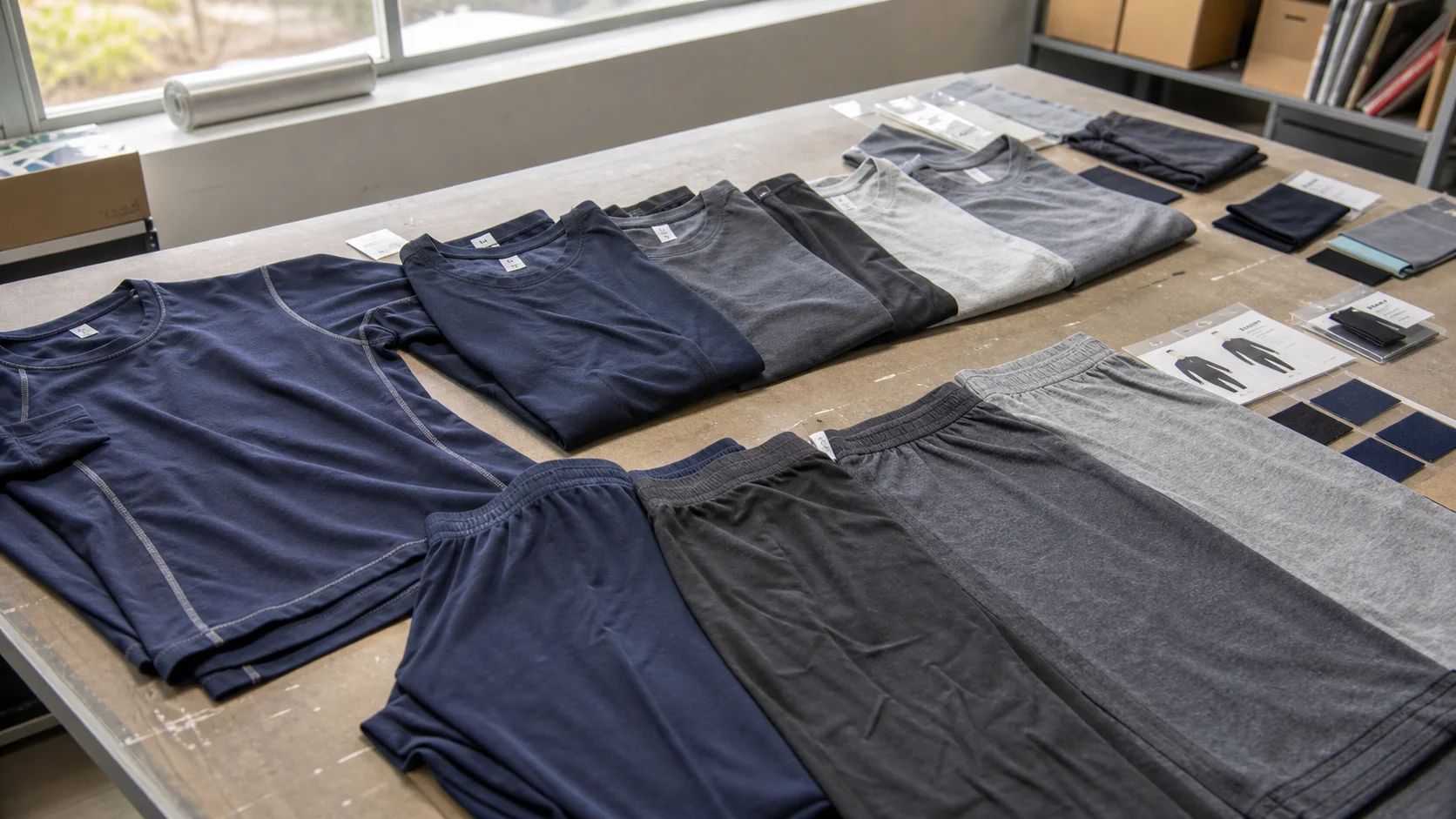
A product-specific SEO outline for evaluating base layer set supplier size grading, fit consistency, and production specs for cleaning crew uniforms.
Base Layer Set Size Grading Review for Buyers - Fabrikn production reference
Category: Activewear & Teamwear
Buying base layer sets for cleaning crews is not the same as ordering generic thermal underwear for retail. Cleaning staff bend, reach, kneel, carry supplies, move between indoor and outdoor zones, and often wear uniforms over the base layer for long shifts. Size grading must support mobility, coverage, comfort, and consistency across repeated bulk orders.
For sourcing teams, the key question is not only whether the supplier can make XS to 5XL. The real question is whether the size range, grading rules, fabric recovery, inseam lengths, sleeve lengths, rise, and fit tolerance will work for a mixed workforce without creating complaints, returns, or unusable inventory.
This review is written for buyers evaluating a base layer set supplier size grading review for cleaning crews. It covers practical garment specifications, MOQ expectations, fit sample approval, inspection risks, and the tradeoffs buyers should consider before confirming bulk production.
Cleaning crews need base layers that stay close to the body without restricting movement. A base layer that is too tight can pull across the shoulder, ride up at the waist, or feel uncomfortable under a uniform. A base layer that is too loose can bunch under workwear, reduce warmth, and look unprofessional if visible at the neckline or cuffs.
Size grading is the system used to increase or decrease garment measurements across sizes. Good grading keeps the fit balanced as the size range expands. Poor grading often shows up in the extremes: smaller sizes with sleeves that are still too long, larger sizes with insufficient hip room, or tall workers finding the set too short in the torso and inseam.
For cleaning crew procurement, the cost of poor grading is not only a fit complaint. It can mean higher replacement orders, mismatched tops and bottoms, lower adoption by staff, and difficulty maintaining a consistent teamwear program. If base layers are part of winter uniform kits or cold-storage cleaning uniforms, fit failure can become an operational issue.
A supplier’s size chart is only useful if it is backed by a graded spec sheet, fit samples, fabric testing, and clear tolerances for bulk production.
Cleaning crews work across many environments. Some teams clean office buildings after hours. Others handle hotels, schools, healthcare facilities, warehouses, food-service areas, or transport hubs. The base layer set must fit the actual working conditions rather than a generic sportswear profile.
Buyers should define the environment before approving the size chart. A lightweight moisture-wicking set may work for indoor crews moving continuously. A warmer brushed thermal set may suit teams working in unheated facilities, loading areas, or refrigerated spaces. Crews that transition between warm indoor rooms and cold outdoor entrances may need breathable fabrics more than maximum insulation.
Movement is also important. Cleaning tasks involve overhead reaching, squatting, twisting, pushing carts, and carrying equipment. Tops should not ride up when the wearer reaches above shoulder level. Bottoms should not pull sharply at the crotch or slide down under work trousers. A base layer that fits while standing may fail during actual cleaning tasks.
For buyers managing uniform programs, size grading should also consider workforce diversity. Cleaning crews often include a wide range of body shapes, heights, ages, and fit preferences. A unisex size chart may reduce SKU complexity, but it can create fit gaps, especially in hip, waist, bust, rise, and sleeve areas. Men’s and women’s cuts usually improve fit but increase stock planning requirements.
A base layer set normally includes a long-sleeve top and full-length bottom. Before reviewing grading, buyers should define construction, fabric, trims, and intended fit level. The supplier cannot grade accurately if the product brief is vague.
Cleaning crew buyers should avoid over-designing base layers unless there is a clear reason. More panels, zippers, branding placements, and trims increase sampling time and inspection points. A practical set with good fabric, stable fit, and durable seams often performs better than a feature-heavy style that is harder to reproduce consistently.
The right size range depends on the workforce and buying model. For small private-label retail orders, a narrow size range may be acceptable. For cleaning crew uniform supply, buyers should plan broader coverage.
Program Type Typical Size Range Buyer Notes Small team order S-2XL May work for limited teams, but can exclude staff at both ends of the range. Standard workforce uniform XS-4XL A practical range for many cleaning service buyers. Inclusive corporate program XXS-5XL or 6XL Requires careful grading, fit testing, and inventory planning. Men’s and women’s separate fits Women’s XS-4XL; Men’s S-5XL Better fit coverage, but higher SKU count and MOQ pressure.For many B2B buyers, XS to 4XL is a sensible starting point. Larger sizes should not simply be scaled up mechanically. Once sizes move beyond 2XL, body proportions change more noticeably. Chest, waist, hip, bicep, thigh, rise, and garment length all need thoughtful grading.
Buyers should also decide whether tops and bottoms will be sold as fixed sets or mix-and-match separates. Fixed sets are simpler for packing and distribution, but they assume the wearer uses the same size for top and bottom. That is not always true. Cleaning crews may include wearers who need a larger bottom than top or the reverse. If fit satisfaction matters more than packing simplicity, separate top and bottom sizing is worth considering.
A proper grading review starts with the base size. Suppliers often develop samples in size M or L. The buyer should confirm which body profile the base size is intended to fit and how each size will grade from that point.
Do not review grading only by looking at a finished size chart. Ask for a full measurement specification showing points of measurement, grading increments, and tolerance. The supplier should be able to explain how chest, waist, hip, length, sleeve, inseam, thigh, and rise increase or decrease by size.
A practical buyer should look for balance. The garment should be close-fitting, but not compression-tight unless that is the intended product. Cleaning crews generally need comfort and coverage more than athletic compression. A base layer that looks sleek on a mannequin may be too restrictive for an eight-hour cleaning shift.
Fabric choice changes the meaning of every measurement. A base layer made from high-stretch polyester-spandex jersey will fit differently from a cotton-rich thermal rib or a brushed polyester fleece knit. Buyers should review size grading together with fabric composition, weight, stretch, and recovery.
For cleaning crews, synthetic blends are often the most practical. They dry faster, handle repeated laundering better, and are usually more cost-effective for bulk teamwear. Cotton-rich base layers may feel familiar but can hold moisture during active work. Merino blends can perform well, but the price and care requirements may not suit high-turnover uniform programs.
Stretch recovery must be checked carefully. A fabric can stretch well during fitting but fail to recover after use or washing. Poor recovery leads to bagging at the knees, elbows, waistband, and seat. Buyers should request stretch and recovery data where possible, especially for programs that require repeat orders.
Fabric shrinkage also affects grading. If a supplier provides measurements before wash only, the buyer may face problems after laundering. A good spec should clarify whether finished garment measurements are before wash, after wash, or based on a controlled wash standard. For cleaning crews, after-wash fit matters more than showroom fit.
Base layer sets need a clear measurement standard. The buyer should define points of measurement, measurement method, and acceptable tolerance. Ambiguity leads to disputes during inspection.
Tolerances should be realistic. For stretch knits, common tolerances may range from about ±1 cm for small openings to ±2 cm for major width and length points, depending on the measurement and size. Larger tolerances may be acceptable for some areas, but they must not create visible size jumps or fit failures. Buyers should not accept vague statements such as “normal tolerance” without a written standard.
Sampling is where buyers catch most size grading problems before they become expensive. A supplier that skips proper size-set sampling may save time at the front end but create risk in production.
For cleaning crew base layer sets, the size-set sample is especially important. Buyers should not rely only on size M. At minimum, review one small size, the base size, one plus size, and the largest size. For an XS-5XL program, checking only M and XL leaves too much risk.
Wear trials are useful if time allows. A short movement test can reveal issues that a flat measurement table misses. Ask testers to reach overhead, squat, bend forward, twist, and walk. Check whether the top rides up, the waistband rolls, the knees bag, or the crotch pulls. This is not a substitute for technical measurement, but it gives practical evidence before bulk approval.
Buyers working on new uniform programs can use supplier development support through resources such as Fabrikn’s services to structure tech packs, samples, and production requirements before placing larger orders.
MOQ depends on fabric availability, color, size range, branding, and supplier setup. Base layer sets are often made from knitted fabrics that may have MOQ requirements at the fabric mill level. Custom colors, special GSM, brushing, antimicrobial finishes, and private-label trims can all increase the minimum order.
These ranges are typical planning references, not guaranteed supplier quotes. Buyers should confirm MOQ by style, color, size, and packaging method. A supplier may advertise a low MOQ but require compromises such as limited sizes, stock colors, simplified labels, or shared fabric lots.
A realistic timeline for a new custom base layer set may be 6-10 weeks after final sample approval for standard production, with additional time for development and sampling. More complex programs can take longer. Repeat orders using approved fabric and patterns should be faster, but only if fabric and trims remain available.
Inspection for base layer sets must go beyond visual checks. Stretch garments can look acceptable on the table while failing measurement, recovery, or seam durability standards.
Buyers should specify acceptable quality levels and inspection points before production starts. For uniform programs, set packing accuracy is a major risk. A carton labeled size L should not contain size M bottoms mixed with size L tops. Barcode or size sticker controls may be needed for larger rollouts.
Wash testing is also worth attention. Cleaning crews may launder garments frequently, sometimes using harsh cycles. If the base layer is expected to handle industrial or commercial laundry, the buyer must say so early. Many standard activewear fabrics are developed for domestic washing, not aggressive laundry processing.
A capable supplier should answer grading and fit questions clearly. If the supplier only discusses price and lead time, the buyer may need to push for more technical detail.
Buyers can also contact the production team through Fabrikn’s contact page when they need help turning a base layer concept into a manufacturer-ready specification.
The cheapest base layer set is rarely the best buy for cleaning crews if the fit is unstable. A low unit price can be erased quickly by reorders, staff complaints, size exchanges, and short garment life. The more practical target is a reliable set with controlled grading, durable stretch, consistent packaging, and repeatable production.
Unisex sizing can work when the buyer needs simple ordering, limited budget, and fast distribution. It reduces pattern count and SKU complexity. It may be acceptable for a basic thermal layer worn under loose uniforms.
The tradeoff is fit. Unisex bottoms often fit some wearers poorly at the hip, rise, or thigh. Smaller wearers may find sleeves and legs too long. Larger wearers may need more shaping than a straight graded unisex block provides.
Separate fits are better for larger programs where comfort and long-term use matter. Women’s fits can improve hip shaping, waist placement, rise, and sleeve proportion. Men’s fits can better manage shoulder, chest, and inseam expectations.
The tradeoff is higher MOQ and more inventory planning. Buyers must forecast size ratios more carefully. If the workforce changes often, excess stock in less-used sizes can become a cost issue.
Mix-and-match sizing is useful when employee fit satisfaction is important. It allows a worker to choose, for example, a medium top with a large bottom. This is often more realistic than fixed-size sets.
The tradeoff is packing complexity. The supplier must manage separate SKUs for tops and bottoms, and the buyer must handle distribution more carefully. For large organizations, the improvement in fit may justify the extra administration.
Premium fabric is worth considering when crews work in cold environments, wear the garments daily, or need better moisture management. Better stretch recovery, lower pilling, and improved comfort can reduce replacement rates.
The tradeoff is upfront price and MOQ. If the program is short-term, seasonal, or budget-restricted, a solid midweight polyester-spandex blend may be a more sensible choice than a premium merino or high-end nylon blend.
Buyers who want to understand supplier capability, sourcing structure, and product development options can review Fabrikn’s background before starting a custom activewear or teamwear project.
The following specification is a practical starting point for many cleaning crew programs. It should be adjusted based on climate, uniform layering, budget, and workforce profile.
Specification Area Recommended Direction Product Long-sleeve top and full-length bottom base layer set Fit Close body fit, not compression fit Fabric Polyester-spandex jersey or brushed polyester-spandex Weight 180-240 GSM for general use; 240-280 GSM for colder conditions Stretch Four-way stretch preferred for active cleaning tasks Seams Flatlock or stretch overlock seams depending on budget Top hem Slightly extended length to prevent ride-up Bottom rise Mid-rise with enough back rise for bending Waistband Enclosed elastic or soft exposed elastic with controlled tension Size range XS-4XL minimum for many workforce programs; expand if needed Sampling Fit sample, revised fit sample, size-set sample, pre-production sample Testing Shrinkage, colorfastness, pilling, seam strength, stretch recoveryThis type of specification keeps the product commercially realistic. It avoids unnecessary features while focusing on the parts that affect wearer comfort and repeat order consistency.
Size ratio planning is often underestimated. Buyers may request an even size breakdown across XS to 4XL, but workforce sizing rarely works that way. A more accurate ratio should be based on employee size data, previous uniform orders, or a pre-order size survey.
For a general adult workforce, middle sizes usually carry the highest volume. Larger sizes should not be treated as rare exceptions, especially in inclusive uniform programs. If the buyer under-orders 2XL to 4XL, the program may look complete on paper but fail during distribution.
A cautious approach is to place a trial order or collect size requests before bulk allocation. For fixed set packing, buyers should expect some mismatch between top and bottom needs. For larger workforces, ordering a small buffer of separate tops and bottoms in common exchange sizes can reduce disruption.
Base layers for cleaning crews often require minimal branding. Large logos can feel uncomfortable under uniforms, and thick embroidery is generally unsuitable for close-to-skin garments. Printed neck labels, small hem logos, or heat transfer branding are more common.
Care labels must be clear. If the garment uses spandex, high heat drying can damage stretch recovery. If the base layer is brushed, pilling risk may increase with rough washing. If the buyer expects commercial laundering, labels and testing should reflect that requirement.
Packaging should be designed for distribution. Each set should show size clearly on the polybag or carton label. If tops and bottoms are packed together, the supplier should confirm that the same size is included unless mix-and-match packing has been specified. For branch-level delivery, carton assortments should be agreed before final packing.
A base layer set supplier should be judged on more than sewing capacity and price. For cleaning crew programs, the supplier must show control over size grading, stretch fabric behavior, sampling discipline, and bulk inspection. The right set should support movement, layer cleanly under uniforms, and hold fit after repeated washing.
Buyers should be especially careful with unisex grading, extended sizes, waistband tension, rise, sleeve length, inseam, and fabric recovery. These are the areas where complaints usually appear first. A complete graded spec sheet, size-set sample, and clear inspection standard are not optional extras; they are the foundation of a reliable teamwear order.
The best purchasing decision is usually a balanced one: practical fabric, inclusive but manageable size range, realistic MOQ, and enough sampling time to catch fit issues before bulk production. That approach gives cleaning crews better comfort and gives buyers fewer problems after delivery.
Get a free quote from Fabrikn — your trusted B2B clothing manufacturer with 10+ years of experience. MOQ as low as 200 pieces.
Get a Free Quote →Many cleaning crew programs should start with at least XS to 4XL. Larger organizations may need XXS to 5XL or 6XL depending on workforce data. Buyers should avoid narrow size ranges unless they have confirmed employee sizing in advance.
Unisex sizing can be acceptable for simple, budget-driven programs, but it has fit limitations. Separate men’s and women’s fits usually improve comfort, especially in hip, rise, shoulder, and sleeve proportions.
Fixed sets are easier to pack and distribute, but they assume the wearer needs the same size on top and bottom. Mix-and-match sizing improves fit but increases SKU and packing complexity.
Polyester-spandex jersey or brushed polyester-spandex is often practical because it offers stretch, moisture management, and reasonable durability. Cotton blends may feel comfortable but dry more slowly. Merino blends perform well in cold conditions but cost more and require more careful care instructions.
Typical MOQs may range from 300 to 800 sets for stock fabric and simple private labeling. Custom colors, wide size ranges, separate men’s and women’s fits, or premium fabrics can push MOQ to 1,000 to 3,000 sets or more.
After final sample approval, standard production may take around 6 to 10 weeks, depending on fabric availability, order size, testing, trims, and packaging. Development and sampling time should be planned separately.
Buyers should approve a development sample, fit sample, revised fit sample if needed, size-set sample, and pre-production sample. A shipment sample is also useful for future repeat orders.
Key risks include measurement variation, poor stretch recovery, weak seams, waistband inconsistency, shrinkage, pilling, color mismatch between tops and bottoms, and incorrect set packing.
Cleaning crews move constantly and wear base layers under uniforms for long shifts. Poor grading can restrict movement, cause ride-up, create discomfort, and lead to higher replacement demand.
The review should include the base size, full graded spec sheet, measurement tolerances, fabric stretch and recovery, size-set samples, wearer movement checks, shrinkage testing, and inspection standards for bulk production.