
A focused buying outline for warehouse procurement teams comparing insulation specs, warmth ratings, mobility tradeoffs, and durability requirements for...
Best Insulation Specs for Workwear Coats - Fabrikn production reference
Warehouse procurement teams usually do not need the warmest coat on the market. They need the right insulation spec for the job, the climate, the shift length, and the labor profile. A coat that is too heavy slows movement and drives complaints; in many warehouse programs, body insulation above 180 gsm starts to feel bulky for pickers, reach-truck drivers, and carton handlers working 8- to 10-hour shifts. A coat that is too light creates cold-stress risk, higher turnover, and constant replacement requests. The best insulation specification is the one that balances thermal performance, mobility, wash durability, and cost per wear, typically using 80-120 gsm fill for heated indoor work, 120-160 gsm for dock-to-yard movement, and 180-220 gsm or layered systems for freezer-adjacent work.
For workwear coats used in warehouses, insulation choice is not just a fabric decision. It affects minimum order quantities, sampling rounds, trim compatibility, seam performance, final bulk lead time, and inspection risk. Common sourcing ranges for custom insulated workwear coats are 300-500 pieces per color for stock shell fabrics and 800-1,200 pieces per color when custom dyed shell fabric, branded lining, or special padding is required. Procurement teams that lock the spec too early often end up paying for overbuilt garments that workers reject. Teams that under-spec insulation usually save on the first PO and lose money later through returns, claims, and renegotiation.
In procurement terms, insulation spec is the set of measurable requirements that define how much warmth a coat provides and how consistently it performs in production. For workwear coats, this usually includes fill type, fill weight or thickness, body mapping if used, lining structure, outer shell construction, and temperature-use assumptions. A practical spec might read: 150 gsm recycled polyester sheet padding in the body, 120 gsm in sleeves for mobility, 210T polyester taffeta lining, 300D oxford polyester shell with PU coating, 5 cm horizontal quilting pitch, and a front resin zipper size #5 or #8 depending on coat weight.
A strong spec does more than name a material. It should state whether the coat is intended for ambient warehouse work, dock work, freezer zones, morning deliveries, or outdoor loading. One coat can rarely cover all of those scenarios well. The more precise the use case, the easier it is to control cost and prevent overbuying. Buyers commonly ask suppliers to quote against target use temperatures such as 10-15 C indoor picking, 0-10 C dock work, or -18 C freezer loading, while recognizing that activity level, base layers, wind exposure, and shift duration change the real comfort range.
Buyer judgment matters here. A warehouse coat is a utility garment, not a fashion product. Thermal rating, durability, and repeatability across bulk production deserve more weight than style language. Where the user population is mixed, it is often better to buy two insulation levels than one compromise garment that no one likes. A common sourcing split is a lighter 100-120 gsm jacket for supervisors and indoor pickers, plus a 160-200 gsm coat with longer back length for dock teams, rather than forcing one SKU across every role.
Polyester fill is the most common insulation choice for warehouse coats because it is affordable, widely available, and easier to source at scale. It comes in different loft levels and weights, and it can be specified as continuous sheet padding, needle-punched padding, quilted fill, or stitched-baffle construction. Typical workwear quotes often use virgin or recycled polyester padding in 80 gsm, 100 gsm, 120 gsm, 150 gsm, 180 gsm, and 200 gsm increments. For many general warehouse environments, polyfill offers the best cost-to-warmth ratio, commonly adding about $2.50-4.00 per unit at 500 MOQ versus an uninsulated shell, depending on coat length, lining, quilting labor, and trim package.
The tradeoff is bulk. Higher fill weights can make sleeves stiff, reduce reach, and create complaints from operators handling cartons or pallets all day. Polyfill also depends on correct quilting density. If stitching spacing is too wide, fill migration becomes a real issue after wear and washing. Buyers should specify quilting pitch, such as 5-7 cm channels for sheet padding or closer quilting around underarms and elbows, and ask the factory to confirm whether quilting is done on a multi-needle quilting machine before assembly or by single-needle lockstitch during garment construction.
Fleece-lined coats are not the same as insulated coats, but they are often used in milder warehouse settings. They provide light warmth, a softer hand feel, and simpler construction. Common linings include 180-220 gsm anti-pill polyester fleece, 160-200 gsm microfleece, or brushed tricot in areas where bulk needs to stay low. The spec is usually easier to control, and MOQ pressure can be lower than for heavily quilted garments, especially when using stock black, navy, or charcoal fleece.
This option is useful when employees move between indoor and sheltered outdoor work. It is weaker in cold docks, long standing shifts, and sub-freezing environments. Buyers should not mistake comfort for thermal performance. A fleece lining can feel pleasant at fitting stage and still underperform on a winter loading bay. During sampling, procurement should check sleeve drag over long-sleeve uniforms, fleece shedding at seams, and whether the lining is caught cleanly into the armhole and hem without twisting.
Down offers strong warmth at low weight, which is why it is valued in technical outerwear. In warehouse procurement, it is used less often because it is more expensive, more sensitive to moisture, and harder to justify for workwear abuse. Down-blends can reduce cost, but they still bring more sourcing risk than synthetic fill. If a buyer considers down, the spec should state fill power, down/feather ratio, fill weight per size, and baffle leakage requirements; common commercial references include 80/20 or 70/30 down-feather blends and 550-650 fill power for cost-controlled programs.
Down is usually a poor fit unless the workforce needs high warmth with low bulk and the garment will be protected from heavy contamination. If a coat is expected to face frequent washing, wet conditions, or rough handling, synthetic insulation is usually the safer commercial choice. Buyers should request documentation only as needed, such as Responsible Down Standard paperwork, fill composition test reports, or IDFL-style lab reports, and should treat those as buyer requirements rather than assuming any supplier already holds a certification.
Some coats use bonded thermal padding or layered linings rather than classic fill. These can create a cleaner profile and better mobility. They are often seen in hybrid workwear where warmth must be moderate and movement remains important. Typical constructions include polyester shell bonded to TPU membrane plus microfleece backer, 3-layer softshell at 280-320 gsm, or thin thermal laminate paired with 60-100 gsm padding in the body.
Procurement teams should ask for thermal layer construction details, not just marketing terms. A supplier may describe a coat as “high warmth” while using a thin bonded layer that performs well only in mild conditions. Clear spec language helps prevent disputes later. Useful requests include bonding method, membrane type, peel-strength target, hydrostatic pressure target if water resistance matters, and whether seams are plain stitched, taped with a hot-air seam sealing machine, or left untaped for breathability and cost control.
Warehouse climate is the first filter. A coat for a temperate distribution center is not the same as a coat for cold-chain storage or outdoor freight handling. Procurement should classify the work environment before setting insulation weight. A practical intake sheet should capture lowest expected temperature, time spent outside per shift, forklift cab exposure, door-open frequency, wind at dock doors, whether workers are standing or moving, and whether uniforms include base layers or hooded sweatshirts underneath.
For heated warehouses where employees move constantly, light insulation or fleece-lined construction is usually enough. Typical polyfill ranges often land around 80 gsm to 120 gsm for body insulation, depending on shell fabric and lining. This level gives warmth without making the garment feel restrictive. Common sourcing specs are 210T polyester taffeta lining, 240-260 gsm polyester-cotton twill or 150-180 gsm polyester pongee shell, and #5 resin zipper with inner storm flap for basic draft control.
For teams that go from dock to yard to indoor aisles, medium insulation is usually the better compromise. Many buyers start around 120 gsm to 160 gsm polyfill, with a durable outer shell and a lining that resists snagging. This range is often the practical middle ground for winter workwear procurement. Buyers commonly specify 300D oxford polyester with PU coating, 150 gsm body padding, 120 gsm sleeve padding, adjustable hook-and-loop cuffs, and a drop-tail back length 3-5 cm longer than the front to reduce cold gaps while bending or climbing into equipment.
Cold-chain use requires more caution. A coat intended for freezer loading or prolonged exposure to low temperatures may need 180 gsm or higher, or a multi-layer system that includes a shell, insulation, and thermal lining. Some operations are better served by separate freezer jackets rather than a standard warehouse coat. For -18 C freezer areas, buyers commonly request 200-240 gsm body insulation, storm flap with snap closure over a #8 zipper, insulated hood, knit storm cuffs, and reinforced elbows or lower sleeves where coats contact pallet wrap, racking, and forklift controls.
The mistake most procurement teams make is buying one insulation level for every role. A receiving clerk, a dock operator, and a forklift driver do not need the same thermal profile, even if their job titles sit under the same budget line.
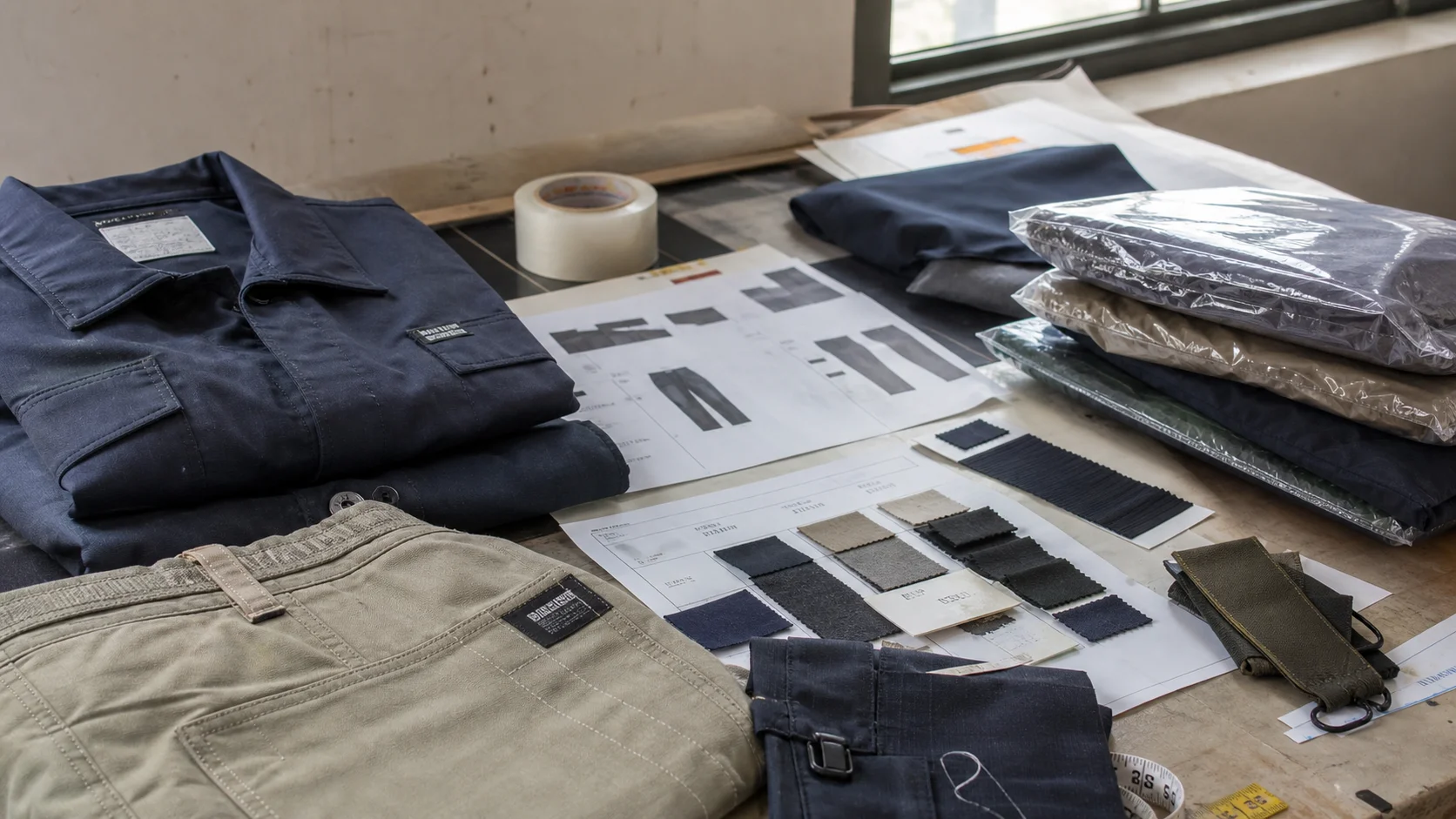
Good procurement specs remove ambiguity. They tell the factory exactly what to build and the inspection team exactly what to check. For workwear coats, the most useful spec elements are practical and measurable. A complete tech pack should include bill of materials, graded measurement chart, quilting layout, seam construction, tolerance table, logo placement, care label content, packaging method, and inspection criteria before the pre-production sample is approved.
Fabric and trim spec are not minor details. A strong insulation layer can still fail if the shell fabric pills, the zipper jams, or the cuffs open too easily. Buyers should confirm fabric weight, yarn count where relevant, coating type, and zipper grade before proceeding to bulk. For example, a 300D oxford shell with PU coating will behave differently from a lightweight 150D pongee shell, especially at pocket mouths, sleeve hems, and shoulder seams exposed to straps or carton edges.
For warehouse coats, it is often wise to request abrasion resistance guidance, especially for elbows, shoulders, and lower hem zones. If a coat is likely to rub against shelving, pallet edges, or equipment, reinforcement panels can extend service life. Typical reinforcements include 600D polyester oxford, 500D nylon, or doubled shell panels at elbows and lower sleeves. That extra cost is easier to justify than replacing failed coats mid-season, and it can usually be inspected by checking panel placement, stitch density, and bar-tack positions during inline inspection.
Fabrikn keeps useful sourcing pages available for buyers who need broader production support. See the services overview, the about-us page for company background, and the contact-us page for direct inquiry handling. Buyers can also use those discussions to request material test reports, care label review, restricted substance documentation, or buyer-specified certification evidence when their internal compliance team requires it.
Get a free quote from Fabrikn — your trusted B2B clothing manufacturer with 10+ years of experience. MOQ as low as 200 pieces.
Get a Free Quote →Sampling should not be treated as a formality. Insulated coats behave differently from lightweight outerwear, and mistakes are easier to hide in early samples than in bulk. A typical approval path includes tech pack review, material confirmation, proto sample, fit sample, size-set sample, and pre-production sample. Some programs also need wash testing or cold-chamber review. Common timing is 7-10 business days for a proto sample using available materials, 10-15 business days for a revised fit sample, and 18-22 business days for a pre-production sample when custom quilting, dyed shell fabric, or branded trims are involved.
In the first sample round, procurement should check warmth feel, weight, range of motion, zipper action, cuff closure, hem coverage, and whether the insulation shifts at stress points. A coat can look well made on a hanger and still fail in use because the sleeves bind or the torso is too short when a worker reaches overhead, bends to scan cartons, or sits in a forklift. Useful checkpoints include 10-12 stitches per inch on main seams, clean zipper top stops, pocket bag attachment strength, even quilting channels, no padding caught in zipper teeth, and no loose fill visible at seam joins.