
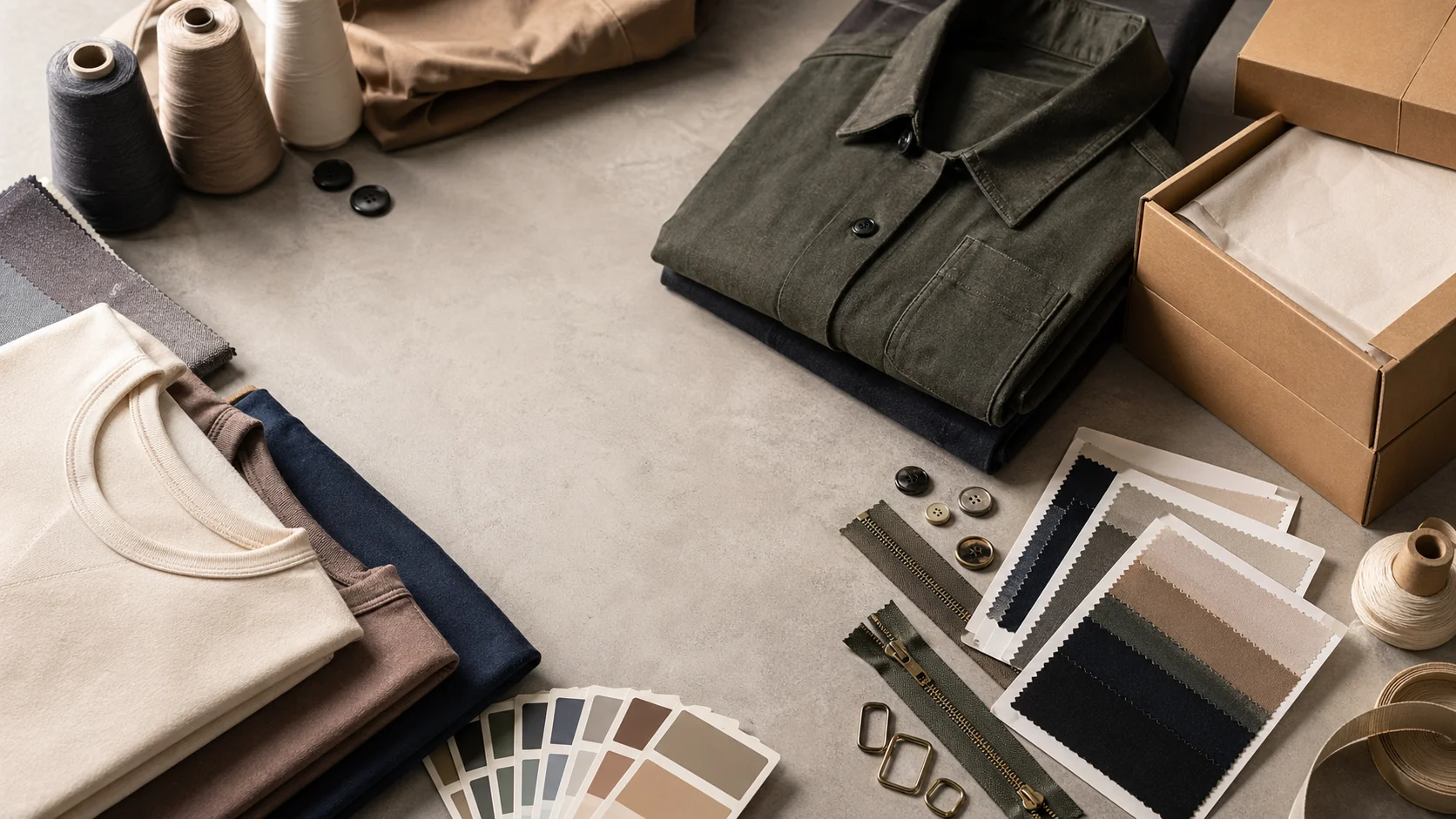
MOQ for Custom Hoodies with checks for samples, fit, MOQ, QC evidence, pricing terms, and delivery risk.
Fast answer: MOQ for Custom Hoodies: Fabric, Fit, Sampling, and QC should be judged by production evidence, not by a generic sourcing promise. The buyer needs sample proof, cost breakdowns, QC checkpoints, and delivery buffers in writing.
Ask for recent sample photos, measurement tolerances, fabric or print test assumptions, decoration test notes, packing examples, and a named inspection checkpoint. These details show whether the team can repeat an approved sample at bulk volume.
Separate garment cost, decoration, labels, packaging, sampling, testing, freight, and rush charges. When every cost line is visible, it becomes easier to reduce colorways, adjust size depth, or reserve more time for sampling.
If you are planning to launch, replenish, or test a custom hoodie line, one of the first questions you will face is: what is the best MOQ for custom hoodies? MOQ, or minimum order quantity, can make or break your production strategy, especially if you are a brand owner, startup founder, merch buyer, or wholesale distributor trying to balance quality, price, and inventory risk.
The short answer is that there is no single “best” MOQ for every business. The ideal MOQ depends on your budget, design complexity, sales forecasts, customization method, and growth stage. For some brands, a low MOQ of 50 to 100 pieces is perfect for market testing. For others, 300 to 1,000 pieces or more may deliver better pricing, more production efficiency, and healthier margins.
In this article, we will break down what MOQ means for custom hoodies, why manufacturers set minimums, how to choose the right quantity for your business, and how to negotiate a better order size without sacrificing quality. If you are considering custom hoodie production, you can also explore our services or reach out through our contact page to discuss your project.
MOQ stands for minimum order quantity. It is the smallest number of units a manufacturer is willing to produce in one order. For custom hoodies, MOQ may apply to the total order, a single color, a design variation, a size run, or a combination of these factors.
For example, a factory may accept an overall order of 100 hoodies, but require at least 50 pieces per color. Another factory may set the MOQ at 300 units because the hoodie requires custom fabric, private labeling, embroidery, screen printing, or special packaging.
MOQ is not just an arbitrary rule. It reflects the cost structure of apparel production, including material sourcing, labor, setup, machine use, printing screens, embroidery digitization, cutting, sewing, quality control, and packing.
Manufacturers use MOQ requirements to keep production efficient and profitable. When a factory runs a custom hoodie order, it must allocate materials, labor, machine time, and administrative resources. Small orders often cost more per unit because setup expenses are spread across fewer garments.
Here are some of the most common reasons MOQ exists:
That said, not all manufacturers set the same MOQ. Some specialize in startup-friendly low MOQ production, while others focus on high-volume wholesale and private-label programs. To understand whether a supplier fits your needs, it helps to review their capabilities and company background, such as on the about us page.
The best MOQ for custom hoodies is the lowest quantity that still gives you a strong balance of cost, quality, flexibility, and profit. In practical terms, the best MOQ depends on your business model.
Here are some common benchmarks:
If you are launching your first product, the best MOQ is usually one that lets you test demand without tying up too much cash. If you already know your hoodie design sells well, a higher MOQ can reduce cost per piece and improve margins.
In many cases, the sweet spot for custom hoodies is between 100 and 300 units. This range is often large enough to lower production costs while still manageable for inventory planning. However, brands with strong pre-orders or proven sales may benefit from larger runs.
There is no universal formula for choosing MOQ, because several variables influence what quantity makes sense for your hoodie project.
If you are a startup, low MOQ is usually safer. It allows you to validate your design, test different colors, and avoid excess inventory. Established brands can often support higher MOQs because they already understand demand and replenishment timing.
Higher MOQs usually mean a larger upfront investment. Even if the unit price drops, your total cash outlay rises. The best MOQ is one you can afford without stressing your operating budget or reducing your ability to market and ship the product.
A simple pullover hoodie with one embroidery placement is easier to produce than a heavyweight hoodie with custom dyeing, appliqué, multiple print locations, and branded trims. More complex designs often require higher MOQs to justify setup costs.
Custom fabrics, organic cotton, brushed fleece, heavyweight blends, and specialty washes may require bulk purchasing. If you want premium materials, the MOQ may naturally increase.
Screen printing, embroidery, puff print, applique, digital printing, woven labels, and custom hang tags all affect MOQ. Some methods are economical in bulk, while others are more flexible for smaller runs.
Multiple colors can increase the practical MOQ because each color often needs separate fabric dye lots, production planning, or size allocations. If you want several colorways, you may need to spread your total order across variants.
Hoodies sold in multiple sizes require a size breakdown. A 100-piece order may sound reasonable, but if you need six sizes and several colors, the MOQ per variation can become restrictive.
Wholesale, retail, DTC, and corporate merch all have different inventory needs. A brand selling online may prefer smaller runs to reduce dead stock, while a wholesale buyer may need larger quantities to meet store requirements and margin goals.
To choose the best MOQ, it helps to compare the advantages and disadvantages of low and high minimum order quantities.
The right answer is not always the cheapest order or the biggest order. The best MOQ is the one that matches your current sales strategy and future demand potential.
If you are unsure where to begin, use a simple decision framework to identify your ideal order size.
Estimate how many hoodies you can realistically sell in the next 60 to 120 days. Include historical sales data if you have it, or base your estimate on website traffic, email list size, social media engagement, and pre-order interest.
Before placing an order, determine the minimum number of units you need to sell to recover production, shipping, packaging, and marketing costs. If a 100-piece order is too risky, try a smaller run or a more basic version of the hoodie.
Choose a size curve based on your audience. For example, if your customer base is heavily skewed toward medium and large, do not overcommit to extra small or extra large. Likewise, avoid too many colorways if your order volume is limited.
If possible, run a small launch first. A limited batch gives you real-world feedback on fit, quality, and demand. Once you know what works, you can move to a higher MOQ for your next production run.
Is this a seasonal item, a permanent catalog product, or a one-time promotional hoodie? A limited-time campaign may justify a lower MOQ, while a core product line often performs better at a higher quantity.
Even if your chosen MOQ is sensible, there are several ways to lower risk and improve your results.
When sourcing hoodies, supplier partnership matters as much as quantity. A capable manufacturer can help you refine the right MOQ, suggest more efficient construction options, and align the order with your budget and brand goals.
To get the most value from your MOQ, you should approach manufacturing with a clear brief and realistic expectations.
Provide details on fabric weight, fit, sizing, color, print or embroidery placement, trims, packaging, and labeling. The more precise your request, the easier it is to quote accurately and avoid delays.
Do not only ask for the total order quantity. Ask how MOQ is applied to each color, size, and design variation. This helps you understand the true production requirement.
Some suppliers produce great samples but weaker bulk orders. Make sure the factory can maintain consistency at scale.
MOQ often affects production timeline. Larger orders may need more time for sourcing, cutting, sewing, decorating, and shipping.
If you plan to reorder, your first MOQ should be chosen with future scaling in mind. A good supplier relationship can make your next order easier, faster, and more cost-effective.
For most brands, the best MOQ for custom hoodies is between 100 and 300 pieces, because this range often provides a practical balance between cost efficiency and manageable inventory. However, the real answer depends on your goals. If you are testing a new concept, 50 pieces may be better. If you are scaling a proven bestseller, 500 or more may be the smarter move.
In other words, the best MOQ is not the lowest number you can get, and it is not necessarily the highest volume that unlocks the best price. It is the order size that supports your business model, protects your cash flow, and gives you enough product to succeed in the market.
If you are evaluating custom hoodie production and want help choosing the right order size, Fabrikn can help you assess your options, from sampling to bulk manufacturing. Learn more about our approach on the about us page, review our services, or contact our team through the contact page.
Get a free quote from Fabrikn — your trusted B2B clothing manufacturer with 10+ years of experience. MOQ as low as 200 pieces.
Get a Free Quote →MOQ means minimum order quantity. It is the smallest number of hoodies a manufacturer will produce in one order.
For most startups, 50 to 100 pieces is a practical starting point. It allows you to test demand without overcommitting budget or inventory.
Not always. Lower MOQ reduces risk, but it often comes with a higher unit price. The best MOQ balances affordability, flexibility, and margin.
Manufacturers set MOQs to cover setup, sourcing, labor, and production costs. It helps them run efficient and profitable production batches.
Sometimes yes, but many factories apply MOQ per color or per variation. Always confirm how the order is counted before finalizing production.
You can reduce MOQ by simplifying the design, limiting color options, choosing standard materials, and working with a manufacturer that supports smaller production runs.
The most cost-effective MOQ is usually the smallest quantity that still gives you a reasonable unit price and enough product to meet expected demand. For many brands, that is around 100 to 300 pieces.
Choose based on both. A low price is not helpful if you cannot sell the inventory, and demand is not enough if the order is too expensive to support.
Yes. Fabrikn works with brands that need support across custom clothing manufacturing, including planning, sourcing, and production guidance. Visit our services page or contact us to discuss your project.