
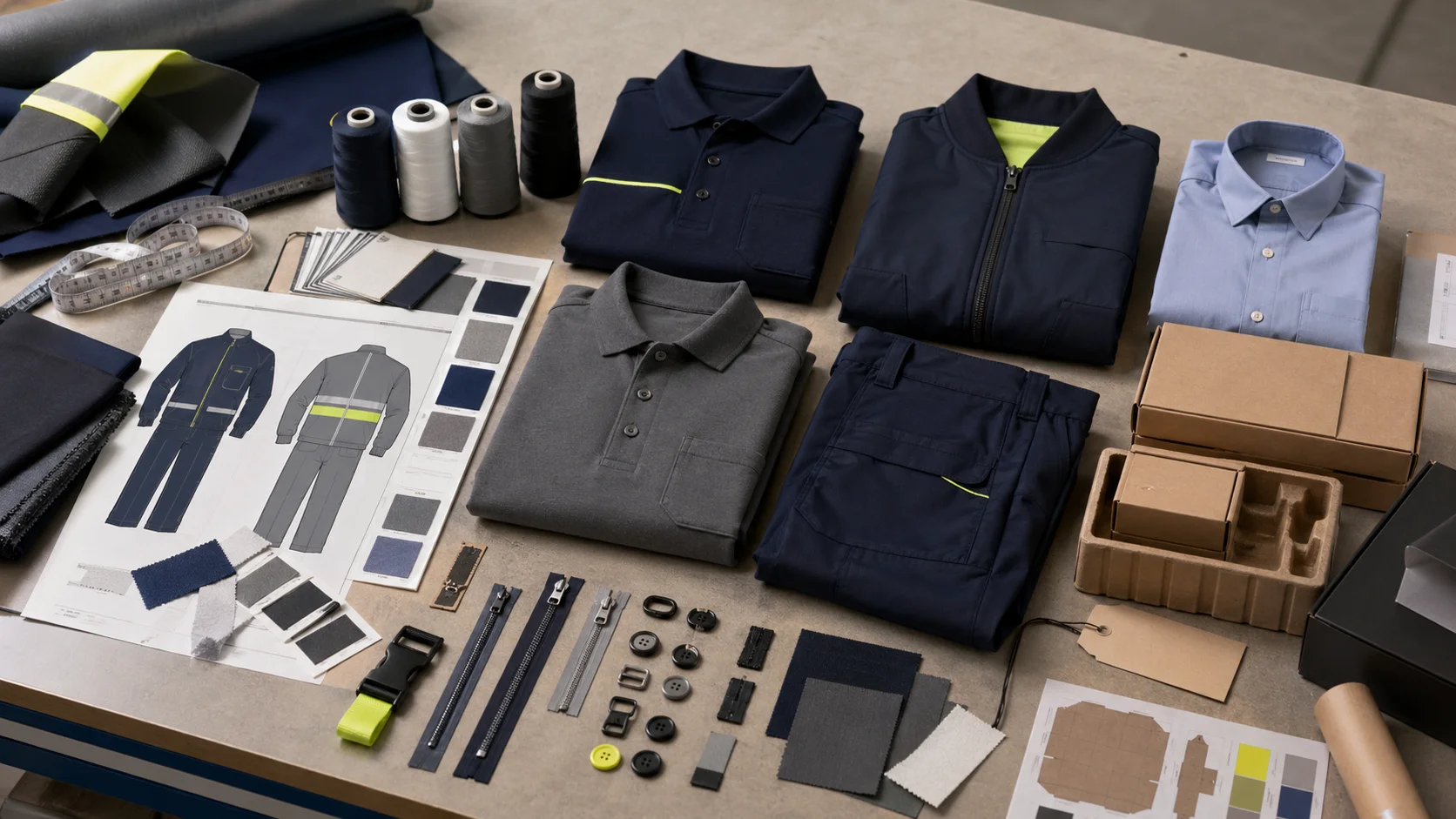
Packaging Inserts for Clothing Unboxing with checks for samples, fit, MOQ, QC evidence, pricing terms, and delivery risk.
Fast answer: Packaging Inserts for Clothing Unboxing: Material, Print, Packing Flow, and Cost should be judged by production evidence, not by a generic sourcing promise. The buyer needs sample proof, cost breakdowns, QC checkpoints, and delivery buffers in writing.
Ask for recent sample photos, measurement tolerances, fabric or print test assumptions, decoration test notes, packing examples, and a named inspection checkpoint. These details show whether the team can repeat an approved sample at bulk volume.
Separate garment cost, decoration, labels, packaging, sampling, testing, freight, and rush charges. When every cost line is visible, it becomes easier to reduce colorways, adjust size depth, or reserve more time for sampling.
I’ve watched brands spend $0.60 on a rigid mailer, $0.18 on a printed sleeve, and only $0.03 on the piece customers actually touch first. That imbalance explains why the best packaging inserts for clothing unboxing often carry more emotional weight than the box art itself. First touch. First judgment.
Apparel buyers move fast. In factory after factory, I’ve seen the same sequence: open the parcel, glance at the card, then decide whether the brand feels worth a second order, a social post, or a return. A clean insert can calm fit worries, explain care, and back up authenticity in ten seconds. A glossy exterior cannot do all that alone.
What surprised me most across 200+ factory visits in 8 countries is that luxury brands often use simpler inserts than mid-market brands. A $220 knit from Italy may arrive with a single understated care card and a narrow belly band, while a $38 sweatshirt from a U.S. DTC label arrives with three cards, a coupon, and two stickers. Restraint can signal confidence. Over-explaining can signal panic.
Regional habits differ too. U.S. brands usually prioritize messaging, QR codes, discount prompts, and founder stories. European suppliers more often push material efficiency: fewer components, smaller trim waste, and formats that fit a flat pack in two or three folds. Not a moral victory. A cost and operations decision.
When I visited a knitwear plant in Portugal, the packaging room had one worker handling 1,200 units per shift with a single paper band and a care insert. In a Los Angeles warehouse, another team needed four people to assemble layered cards, tissue, stickers, and a return reminder for the same 1,200 pieces. The European setup was faster, cheaper, and harder to get wrong. The U.S. setup was more expressive, but it also created more opportunities for mismatch.
Here’s what most people miss: an insert is not decoration. It is a retention tool, a damage-control tool, and a pricing signal. If the insert feels thoughtful, customers assume the garment was made thoughtfully too. That belief can hold even when the outer packaging is plain, which is why the smartest brands test insert strategy before they order a fancier carton.
The core insert set is small, but each piece has a different job. Tissue paper protects finish and friction points. Belly bands hold folded apparel in place and make opening feel deliberate. Thank-you cards build loyalty, care cards reduce mistakes, stickers add low-cost brand recall, and hang tags help retail lines move from shelf to parcel without a redesign.
For tees, tissue and a simple card usually do the job. For knitwear, a belly band plus a care card works better because heavier folds can shift in transit. Activewear needs practical guidance on fabric care and fit, especially if the garment uses compression knits, bonded seams, or recycled polyester with a 220 GSM hand feel. Accessories need less instruction and more visual consistency, so small cards or stickers often outperform large inserts.
Some inserts look premium and do very little. A thick foil card can impress for four seconds, then end up in the bin. A plain care card on 350 gsm FSC board can answer the one question that prevents a return: how do I wash this? That is why I rank inserts by impact, not by shine.
Practical buyer ranking, from highest value to lowest:
In my experience, the best packaging inserts for clothing unboxing depend on garment type more than brand mood board. Tees and hoodies need simplicity. Premium tailoring can use one refined card and one band. Subscription apparel boxes often perform best with a repeatable set: tissue, note, care card. If you already run clothing packaging solutions, the insert mix should be designed with packing speed, not just aesthetics, in mind.
The fastest gains usually come from removing clutter. A single, well-written insert can do more than four branded pieces that all say the same thing.
Price point changes the answer fast. A $15 tee has maybe $2.50-4.00 of total packaging budget if the brand wants margin left for freight and returns. A $180 cashmere sweater can support heavier board, a more complex note, and better print finishes. The wrong insert at the wrong price tier either looks cheap or eats margin. Both hurt.
For low-volume boutique runs, the economics are brutal in a very specific way. Custom printed cards might cost $0.22-0.60/unit, but the setup fee can run $80-300, with 7-14 days lead time and 250-1,000 piece minimums. Semi-custom tissue often starts at $0.05-0.14/unit with lower setup, but the brand loses some control over color and messaging. Generic recycled tissue and paper bands are usually the least risky choice when orders are under 500 units per SKU.
At high volume, the pattern reverses. A subscription brand shipping 20,000 parcels a month can justify a custom die-cut card at $0.04-0.09/unit because the unit economics improve once the press is running. Tooling might be $150-500 for a die, and lead time could stretch to 15-25 days, but that cost disappears over tens of thousands of packs. Large runs also make consistency more valuable than novelty. A 1 mm fold error multiplied by 30,000 shipments becomes a warehouse problem, not a design detail.
Here is the counterintuitive finding: the cheapest insert is not always the most economical. I saw a mid-market denim brand switch from a plain care slip to a slightly heavier 300 gsm instruction card with better fold marks and clearer wash guidance. Insert cost rose by $0.03 per order, yet returns linked to care confusion dropped by 8% over 90 days. That saved more than the packaging increase cost, and it improved reviews.
For premium brands, heavier paper stock works because tactile cues matter. Think 300-400 gsm for cards, 28-35 gsm for tissue, and matte aqueous coatings rather than full lamination if recycling matters. For value brands, stay under tight per-order limits. A simple band at $0.04 and a small card at $0.06 can be enough if the brand story is already clear elsewhere.
Brands with babywear or kidwear often need extra care guidance and compliance language, which is why teams building custom baby clothing manufacturing programs should treat inserts as part of product safety communication, not decoration. For private label basics, a leaner package usually wins; that is why private label clothing services often pair one care card with one branded band and stop there.
My practical rule: spend more on inserts when they reduce returns, not when they merely look expensive. Spend less when scale is still uncertain. A 300-piece pilot does not need a four-piece insert set.
Paper beats plastic for most apparel inserts, but the details matter. In Guangzhou, I toured a fold room where a Heidelberg CD 102 press printed thank-you cards on 350 gsm offset that carried dual certification: OEKO-TEX Standard 100 for the vegetable-based inks and GOTS-certified cotton thread used to tie belly bands. That supplier also held WRAP and BSCI audits, so even the string tagging the care card met social compliance.
Recycled fibers are popular, but not all recycled stocks behave the same. In Dhaka, a converter running a Mitsubishi folder gluer used GRS-certified 100% recycled board for care cards destined for an activewear brand. The 28 gsm tissue came from Ho Chi Minh City, where a Bobst die cutter trimmed each 76 x 101 mm insert after a light aqueous coating cured under UV. The coating kept smudges off without triggering recycling friction, a critical detail when the parcel ships worldwide via sea freight.
Adhesives also deserve attention. I saw an Istanbul-based workflow using water-based, low-VOC glue applied by a Nordson robotic dispenser to affix belly bands. The glue tack profile ensured the strip held through high-humidity Fulfillment centers yet peeled cleanly without leaving a waxy residue on premium knits. That process was documented in the plant’s ISO 9001 manuals alongside the press logs.
Substrates need to align with story. A linen-textured card in Ho Chi Minh City can feel luxurious, but if it is not paired with consistent dielines and the right folding jig, the insert slows the line. That is why I recommend smaller runs of custom board — say 5,000 units — through a kraft board mill in Guangzhou where the machine park includes a Heidelberg Polar 92 cutter for clean edges and a varnish station for spot gloss. Use that to test before scaling up to 50,000 units from the same supplier.
Certification matters beyond marketing too. A brand I consulted for insisted on OEKO-TEX Standard 100 plus GRS for their recycled tissue, GOTS for their organic cotton care tags, and a WRAP-certified binder line in Istanbul for their hang tags. Those credentials helped them secure placement with a department store that required annual social audit proof.
Choosing a supplier means aligning materials, machines, and certifications. The smart brands start by mapping their insert BOM: paper weight, coatings, adhesives, print finish, and packaging method. Next, they match that BOM to a supplier reach. Do you need a Guangzhou printer with a Heidelberg press, a Dhaka converter with inline foil stamping, or a Ho Chi Minh City facility that can handle both Die Cutter and laser-etched QR codes?
Ask for sample sets that include color-matched tissue, a belly band with clear registration marks, and a care card printed with Pantone inks to test in your own packing lab. This gives you a real-world sense of how a Hamburg-style conveyor belt or a Dhaka manual pack table will handle the inserts during assembly.
When vetting vendors, verify certifications. Many factories in Istanbul now achieve GRS, OEKO-TEX Standard 100, and WRAP in the same facility. This allows the insert orders to align with apparel certifications, which streamlines documentation for retail partners in the U.S. and EU.
Volume expectations should guide tooling decisions. A brand planning 5,000 inserts per month can usually justify a $250 die from a Guangzhou toolmaker. But if you are testing a new design with a 500 MOQ, opt for digital cutting and keep the cost at $2.50-4.00 per unit. Once you scale to 25,000 units, the die cost per unit drops below $0.05, and the production line can run at 18-22 business days from approval to pallet pickup.
Always line up contingency options. If your main cut-and-glue line in Ho Chi Minh City hits a 22-day lead time, having a Dhaka or Istanbul secondary partner with a shorter queue ensures you meet launch schedules without sacrificing certification compliance.
Production timelines for inserts must sync with garment manufacturing. I’ve seen brand managers miss shipment schedules because the inserts were still in pre-press when the shirts left the dye deck. That’s why I track two clocks: one for materials (paper, ink, adhesives) and one for production (print, die-cut, fold, pack).
Standard lead times in Guangzhou and Ho Chi Minh City hover around 18-22 business days for a new insert set that includes sample approvals and color matching. In Dhaka, expect 20-25 days once the run size passes 5,000 units due to machine maintenance schedules, while Istanbul facilities often quote 14-18 business days if you use their in-house coating and finishing lines.
Line fit is another concern. Insert assembly must slot into your picking, folding, and packing cadence. Most contract packaging lines use a modular system: packing tables with 4-6 operators, a hanging insert station, and a final QC pass before polybagging. The difference between a 16-second cell cycle and a 22-second one can add $0.65/unit in labor on a 10,000-unit run. That’s why I insist on pre-launch trials using actual packaging inserts and the same PPE used in production.
Consistency on the unboxing side depends on documentation. Request a tech pack that includes dieline files, material specs, and the exact machine used (e.g., Bobst Expertcut 106, Heidelberg Speedmaster SM 52, Polar 78 guillotine). Share these with your pack line operators so they can replicate the same hand feel every time.
A documented process also helps when scaling to new markets. If you launch in the U.S., EU, and Japan, you can replicate the same insert by shipping the master dieline files to certified suppliers in Guangzhou for the Americas, Ho Chi Minh City for Asia-Pacific, and Istanbul for Europe. That keeps the unboxing experience consistent even when distribution centers are continents apart.
1. Start with a materials spreadsheet that lists paper specs (e.g., 300 gsm recycled board, 28 gsm GRS tissue, GOTS-certified cotton twine), finishes (aqueous coat, matte laminate, spot UV), and adhesives (water-based, low-VOC).
2. Confirm supplier capabilities in Guangzhou, Dhaka, Ho Chi Minh City, and Istanbul for each insert type. Look for partners running Heidelberg, Bobst, and Mitsubishi equipment, plus certifications (OEKO-TEX Standard 100, GOTS, WRAP, BSCI, GRS) aligned with your garment certifications.
3. Order a pilot lot (500-1,000 units) to test on your packing lines. Use that run to measure packing time, error rates, and customer feedback from an initial drop.
4. Scale thoughtfully. Once you validate better retention or reduced returns, increase volume in 5,000-unit increments while closely monitoring lead times (18-22 business days typical once approvals are complete) and storage capacity.
5. Document everything: dielines, machine settings, operator instructions, cleaning routines, and inspection criteria. This preserves the experience as you expand to new countries or fulfillment centers.
Q: How much should I spend on inserts? A: Aim for 2-5% of your carton value. For a $15 tee, stay within $0.60-0.80 total. For luxury knits, you can go up to $2-3 if the insert reduces returns or drives loyalty.
Q: What certifications should I look for? A: Seek suppliers with OEKO-TEX Standard 100 for inks and adhesives, GOTS for cotton-based tags, GRS for recycled content, and WRAP/BSCI for social compliance. This ensures your inserts match your garment storytelling.
Q: Do inserts have to be printed locally? A: Not necessarily, but proximity matters. Guangzhou and Ho Chi Minh City provide competitive lead times and machine availability. Dhaka can be more affordable for basic cards, while Istanbul is ideal for European distribution because of shorter freight lanes and EU compliance.
Q: How do I keep unboxing consistent across regions? A: Share the same dieline files, machine specs, and QC checklists with each supplier. Request digital proofs, track lead times (typically 18-22 business days after approval), and audit run samples regularly.
Q: What’s the most overlooked insert? A: Care cards. When done right — think 300 gsm recycled board, clear icons, and wash symbols matched to OEKO-TEX fabric specs — they reassure customers, reduce returns, and justify the first repeat order.