
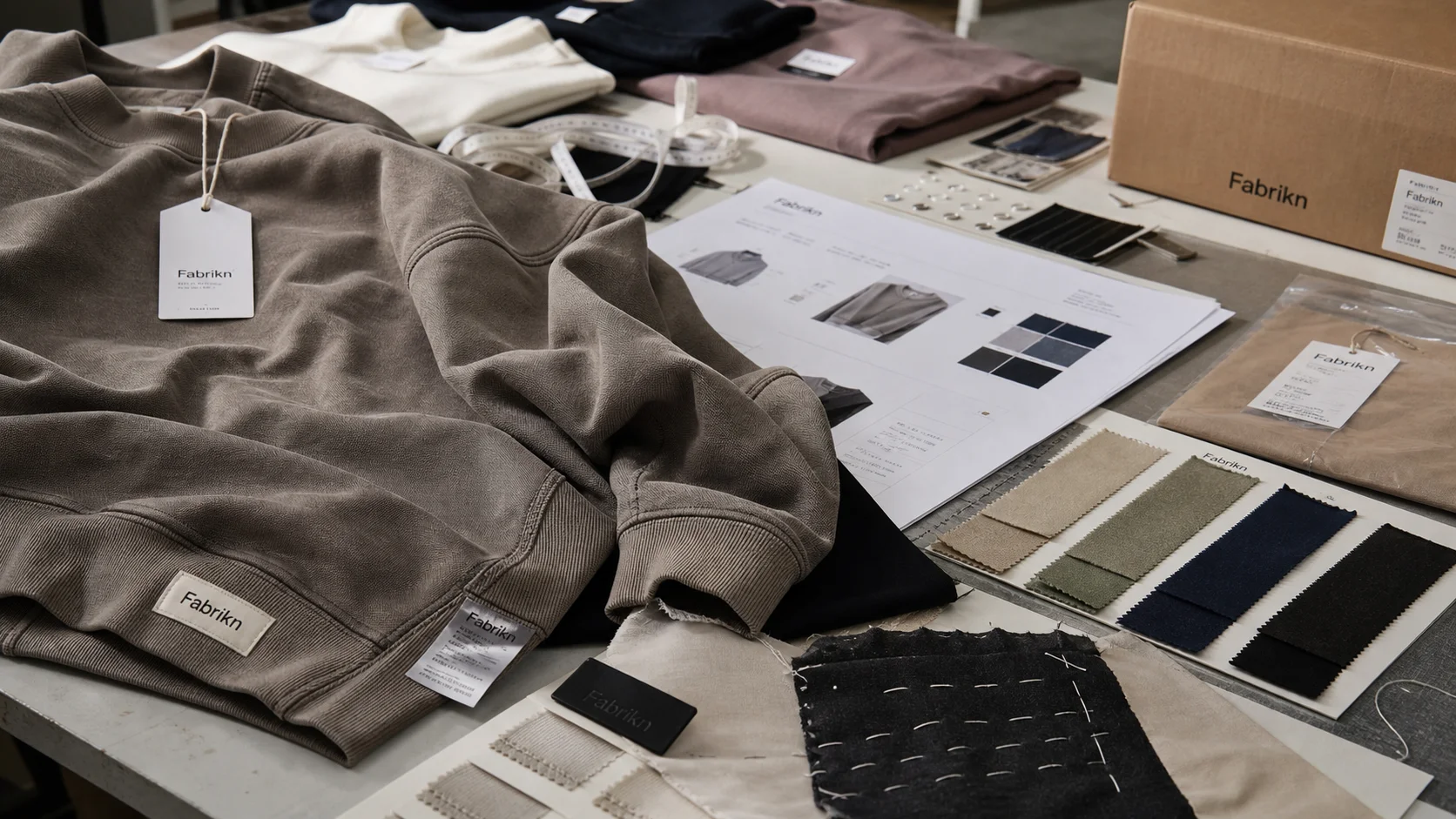
Pricing Models for Fashion Ecommerce with checks for samples, fit, MOQ, QC evidence, pricing terms, and delivery risk.
Fast answer: Pricing Models for Fashion Ecommerce: Samples, Cost Lines, QC, and Delivery Risk should be judged by production evidence, not by a generic sourcing promise. The buyer needs sample proof, cost breakdowns, QC checkpoints, and delivery buffers in writing.
Ask for recent sample photos, measurement tolerances, fabric or print test assumptions, decoration test notes, packing examples, and a named inspection checkpoint. These details show whether the team can repeat an approved sample at bulk volume.
Separate garment cost, decoration, labels, packaging, sampling, testing, freight, and rush charges. When every cost line is visible, it becomes easier to reduce colorways, adjust size depth, or reserve more time for sampling.
Pricing is one of the most important growth decisions in fashion ecommerce. The right pricing model can improve conversion rates, strengthen brand perception, increase average order value, and protect margins as your business scales. The wrong model can create confusion, compress profits, and make it harder to compete in a crowded market.
For fashion brands, pricing is especially complex because shoppers are influenced by design, trend timing, product quality, seasonality, and brand identity. A t-shirt, hoodie, dress, or outerwear piece may all require different pricing logic depending on your target customer and sales channel. That is why growing brands need a practical framework for choosing the best pricing models for fashion ecommerce.
This guide explains the most effective pricing models, when to use them, and how to build a pricing strategy that supports long-term growth. Whether you sell DTC, wholesale, or both, understanding these models will help you make smarter commercial decisions and build a stronger brand.
In fashion ecommerce, pricing does much more than determine revenue. It sends a signal about quality, brand position, and customer expectations. A price that is too low can make a product seem less valuable, while a price that is too high can reduce conversion unless the product, brand story, and customer experience fully justify it.
Fashion also has unique margin pressures. You may deal with sampling costs, production minimums, fabric changes, size runs, shipping expenses, returns, seasonal markdowns, and inventory risk. Because of this, pricing must account for both direct costs and the full lifecycle of a product.
Growing brands often focus too much on competitor prices and not enough on their own economics. But the best pricing models for fashion ecommerce balance market demand with profitability. That balance is what supports healthy cash flow, sustainable scaling, and future collection investment.
Before deciding what works best, it helps to understand the main pricing models used by fashion ecommerce brands. Most successful businesses use a mix of these rather than relying on just one.
Cost-plus pricing starts with the total cost of making and delivering a product, then adds a markup percentage. This is one of the simplest pricing models and is widely used in apparel because it creates a clear path to margin.
For example, if a hoodie costs $18 to produce and your business applies a 2.5x markup, the retail price would be $45. This model is useful because it is easy to calculate and helps ensure basic profitability.
However, cost-plus pricing alone does not always reflect market value. A premium hoodie with superior fabric, fit, and branding may justify a higher price, while a highly competitive basics product may need more careful positioning.
Value-based pricing is based on the perceived value to the customer rather than only the production cost. This model is especially powerful for fashion brands with strong identity, unique design, high-quality materials, or emotional brand appeal.
Customers often pay more for clothing that aligns with their lifestyle, status, or personal style. If your brand creates a stronger emotional connection than competitors, you may be able to price above the market average and maintain healthy demand.
This model works best when your brand has a clear story, consistent visual identity, and strong product differentiation.
Competitive pricing means setting your prices based on what similar brands charge. This model is common in fashion ecommerce because shoppers often compare similar items across multiple websites before buying.
Competitive pricing can help you stay relevant in a crowded category, especially for staple products such as t-shirts, hoodies, leggings, and denim. It can also reduce friction for customers who are already familiar with category norms.
The risk is that overly competitive pricing can lead to race-to-the-bottom behavior. If your brand competes only on price, margins may weaken quickly and it becomes difficult to invest in growth.
Premium pricing places a product above the market average to reflect superior quality, design, exclusivity, or brand positioning. This model is common among elevated fashion brands, designer labels, and lifestyle brands that want to stand out rather than compete on volume alone.
Premium pricing can support stronger margins and reinforce a high-end brand image. But it requires consistency across product quality, packaging, website presentation, and customer service. If the experience does not match the price, conversion and retention may suffer.
Penetration pricing uses lower introductory prices to attract customers and gain market share quickly. New fashion brands may use this model to build awareness, generate early reviews, and move inventory in a crowded market.
This approach can work well for launch collections or newly introduced product lines, but it should be used carefully. If prices are too low for too long, customers may resist later increases and the brand may struggle to rebuild margin.
Dynamic pricing adjusts product prices based on demand, seasonality, inventory levels, or promotional timing. Large ecommerce businesses often use dynamic pricing strategies to respond to market conditions in real time.
In fashion, dynamic pricing can be useful for managing seasonal stock, clearing aged inventory, or optimizing performance across product categories. It can also help brands respond to external trends or competitive shifts.
For smaller brands, dynamic pricing should be applied thoughtfully to avoid confusing customers or diluting brand trust.
Psychological pricing uses pricing tactics that influence perception, such as ending prices in .99, .95, or .00 depending on the intended effect. For fashion ecommerce, psychological pricing can help products feel more accessible or more premium, depending on how it is used.
For example, a product priced at $79.00 may feel more elevated than one priced at $74.99. On the other hand, a sale price of $49.99 may feel more attractive to budget-conscious shoppers.
This model should support your positioning rather than define it entirely.
Not every pricing model fits every fashion brand. The best approach depends on your stage of growth, target customer, and product mix. For most growing brands, the strongest pricing strategies combine several models rather than using one in isolation.
For basics and repeatable items such as tees, sweatshirts, socks, and activewear staples, a cost-plus foundation combined with competitive benchmarking is often the most practical model. This ensures you cover production and fulfillment costs while staying aligned with customer expectations.
This approach is especially helpful when customers have many similar options available. A price that is far above market may reduce conversions, while a price that is too low may signal weak quality.
Use this model when your products are part of a recurring purchase cycle and differentiation is modest.
If your brand has a strong aesthetic, a compelling mission, or a loyal audience, value-based pricing is often the best fit. Customers are not only buying a garment; they are buying identity, belonging, and brand meaning.
This is ideal for elevated casualwear, curated capsules, contemporary womenswear, premium menswear, and limited-edition drops. In these cases, pricing should reflect the product’s emotional and functional value, not just the cost of production.
Brands with strong social proof, influencer traction, or a distinct design language often benefit most from this model.
When you launch exclusive collections, premium pricing can create a sense of desirability and help protect your brand image. Limited-edition fashion products often perform better when they are priced as special, not discounted.
This model works because scarcity and exclusivity increase perceived value. It is especially effective for drops, collaborations, elevated outerwear, and high-quality statement pieces.
Premium pricing also helps brands maintain margin when production costs are higher due to smaller runs or special materials.
New fashion brands sometimes need penetration pricing to generate early sales and gain market trust. If you are entering a competitive category, a lower launch price may help reduce the barrier to first purchase.
The key is to use this model intentionally and temporarily. Build a plan for when and how prices will increase as the brand matures, product quality improves, or demand strengthens.
Without an exit strategy, penetration pricing can become a long-term drag on margin and perceived value.
Brands with seasonal collections or larger inventory volumes can benefit from dynamic pricing to optimize sell-through. This model is useful for end-of-season markdowns, flash sales, bundle offers, and demand-based adjustments.
For example, if a jacket line is moving slowly in the last month of the season, dynamic pricing can help recover cash more efficiently than waiting for inventory to age further. Similarly, top-performing products may warrant fewer discounts, preserving margin where demand is strongest.
This model works best when supported by clear rules and internal discipline.
Selecting the best pricing model for fashion ecommerce starts with asking the right questions about your brand, product, and customer.
Answering these questions helps you identify whether your pricing should be driven more by costs, market comparisons, or customer perceived value. Most brands need a hybrid strategy. For example, a premium basics label may use cost-plus to establish a margin floor, competitive pricing to stay market-aware, and value-based pricing to justify a higher retail point.
As a growing brand, the goal is not simply to be cheap or expensive. The goal is to be appropriately priced for the value you deliver.
Fashion pricing is shaped by more than production cost alone. To build a profitable model, you need to factor in several business realities.
Your pricing must include fabric, trims, labor, sampling, freight, tariffs, packaging, and warehousing. If you ignore any of these costs, your margins may look healthy on paper but shrink in practice.
Larger production runs usually lower unit cost, while smaller runs increase cost per unit. This matters for limited collections and niche brands. Your pricing should reflect the scale at which the product is made.
DTC, wholesale, marketplaces, and social commerce often require different pricing structures. Wholesale pricing typically needs more margin room because retailers expect a significant markup. DTC pricing may allow for stronger retail margins but also carries marketing and fulfillment expenses.
A customer shopping for premium essentials expects different pricing than one looking for fast fashion. Your target audience’s expectations should guide how you position every collection.
Fashion is highly seasonal. Cold-weather goods, holiday items, and trend-based styles may require different pricing logic depending on when they launch and how quickly they sell.
Your pricing should match the experience you create across product design, photography, packaging, and customer support. If the brand feels premium, prices can usually reflect that. If the experience feels generic, pricing power may be limited.
Even strong fashion brands make pricing mistakes that limit growth. These are the most common ones to watch for.
Competitor research is useful, but it should not be your only pricing input. If you price only to match the market, you may overlook your own cost structure and value proposition.
Many brands calculate product cost but forget to include logistics, payment processing fees, returns, and marketing costs. This can make a profitable item appear unprofitable after launch.
Frequent discounting trains customers to wait for sales. Over time, this can weaken brand perception and reduce full-price sell-through.
Not every item should be priced the same way. Core basics, hero products, and seasonal statement pieces may each need a different pricing approach.
Pricing should evolve as costs, demand, and market conditions change. Brands that set prices once and never revisit them often lose margin over time.
A scalable pricing strategy should support profitability today and flexibility tomorrow. Here is a practical approach for growing fashion brands.
A strong pricing strategy is not static. It should be reviewed after each launch cycle so you can learn what customers are willing to pay and where margin can be improved.
If your brand is still refining its product range or manufacturing setup, it can help to work with a partner that understands how product development, production quality, and pricing all connect. You can explore Fabrikn’s services to see how manufacturing support can strengthen your overall business model.
At Fabrikn, we work with fashion brands that want to build better products and stronger businesses. Pricing does not exist in isolation. It is influenced by the quality of your garments, your production consistency, your lead times, and your ability to scale reliably.
When your manufacturing process is aligned with your brand goals, pricing becomes easier to manage. Better cost control, dependable quality, and thoughtful product development all create more room for a sustainable margin structure.
If you are planning a new collection, exploring better production options, or looking for a long-term manufacturing partner, our team can help. Visit our contact page to start the conversation, or learn more about our company on the about us page.
The best pricing models for fashion ecommerce are the ones that reflect your brand, support your margins, and match customer expectations. For most growing brands, a hybrid approach works best: use cost-plus pricing to protect profitability, value-based pricing to capture brand equity, competitive pricing to stay market-aware, and dynamic pricing to manage inventory strategically.
The key is not choosing a single perfect formula. It is building a pricing system that evolves with your product mix, sales channels, and growth stage. When pricing is done well, it becomes a growth engine rather than a guessing game.
Fashion brands that take pricing seriously are better positioned to scale with confidence, preserve brand value, and build long-term customer loyalty.
Get a free quote from Fabrikn — your trusted B2B clothing manufacturer with 10+ years of experience. MOQ as low as 200 pieces.
Get a Free Quote →There is no single best model for every brand. For many growing fashion ecommerce businesses, a hybrid strategy works best. Cost-plus pricing provides a profitability base, while value-based and competitive pricing help align with market demand and brand positioning.
Premium pricing works well if your products offer strong design, quality, exclusivity, or brand appeal. It is most effective when the customer experience matches the price and the brand has clear differentiation.
Wholesale and DTC pricing usually need different margin structures. Wholesale prices must leave room for retailer markups, while DTC pricing needs to cover marketing, fulfillment, and returns. Many brands create separate pricing logic for each channel.
Prices should be reviewed regularly, especially after each collection cycle or major market change. Seasonal inventory, cost increases, and competitive shifts may all justify pricing updates.
Discounting is not always bad, but frequent or deep discounting can hurt perceived value and train customers to wait for sales. It is best used strategically for inventory management, seasonal transitions, or targeted promotions.
Improving margins often starts with better cost control, smarter product mix, and stronger brand positioning. Brands can also test premium pricing on hero products, reduce unnecessary discounting, and optimize production for more efficient unit economics.