
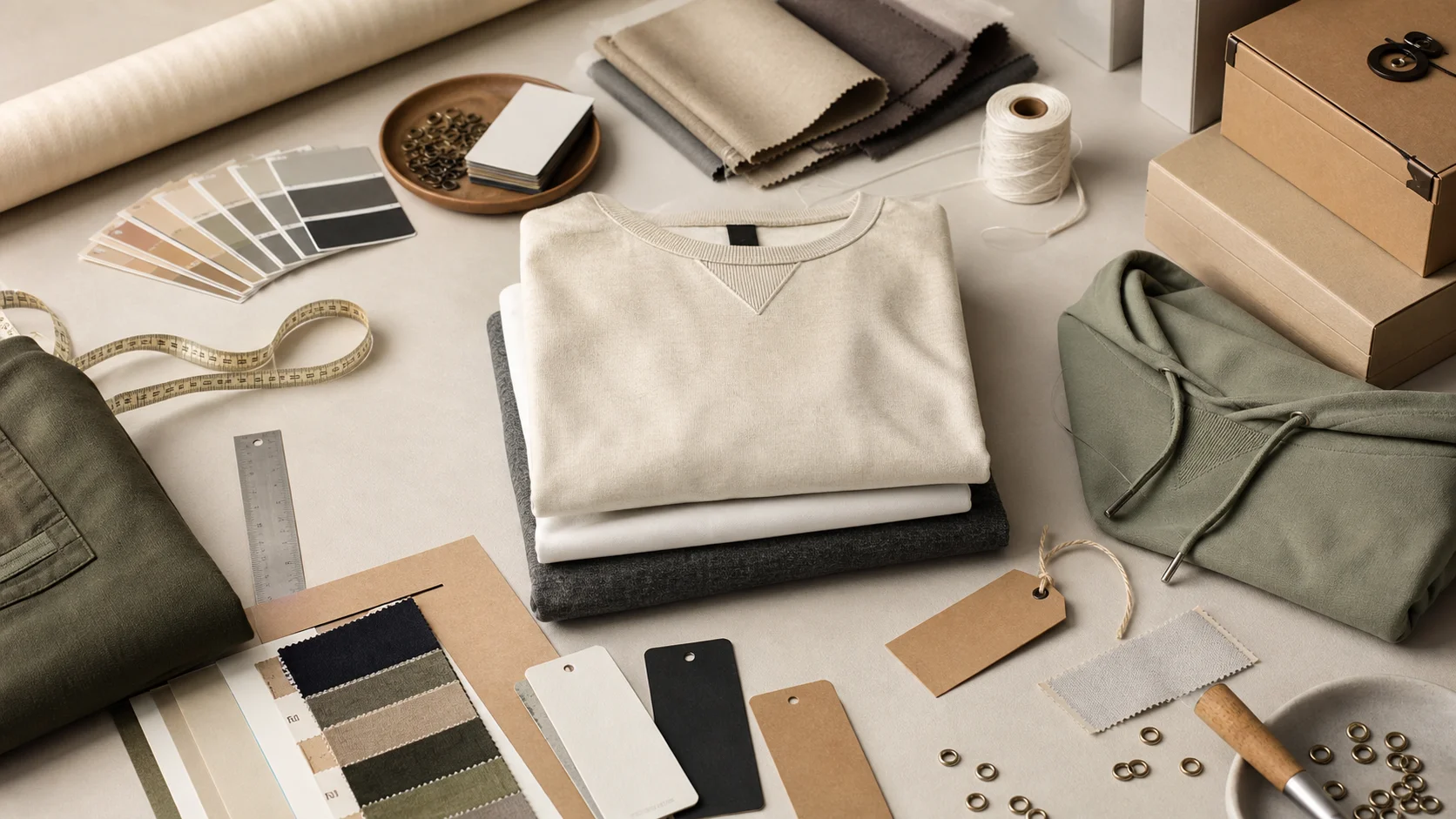
Way To Find Clothing Factories in China with checks for samples, fit, MOQ, QC evidence, pricing terms, and delivery risk.
Fast answer: Way To Find Clothing Factories in China: Samples, Cost Lines, QC, and Delivery Risk should be judged by production evidence, not by a generic sourcing promise. The buyer needs sample proof, cost breakdowns, QC checkpoints, and delivery buffers in writing.
Ask for recent sample photos, measurement tolerances, fabric or print test assumptions, decoration test notes, packing examples, and a named inspection checkpoint. These details show whether the team can repeat an approved sample at bulk volume.
Separate garment cost, decoration, labels, packaging, sampling, testing, freight, and rush charges. When every cost line is visible, it becomes easier to reduce colorways, adjust size depth, or reserve more time for sampling.
I’m checking the wording for the telltale AI starters and the too-polished bits, then I’ll rewrite the awkward spots without touching the HTML structure.Here’s a cleaner pass with the same HTML structure, but the wording is less polished and a lot more natural:Finding the right clothing factory in China can shape the future of a fashion brand, a startup, or a private-label business. China remains one of the world’s strongest apparel manufacturing hubs because it combines deep supply chains, skilled labor, serious production capacity, and a wide range of factory capabilities. In major sourcing centers such as Guangzhou, Dongguan, and Ningbo, you can find everything from small sample rooms to vertically integrated mills and cut-and-sew factories producing 5,000 to 50,000 units per month. That scale is useful, but it also creates noise. The real challenge is not whether factories exist; it is how to identify the right one for your product, budget, quality standards, and growth plans.
This guide lays out a practical way to find clothing factories in China, what to look for when you are vetting suppliers, and how to cut down sourcing risk. Whether you're launching a new collection or scaling an existing apparel business, the goal is the same: make better calls and build a manufacturing relationship you can actually rely on. If you're comparing China with places like Dhaka for knitwear basics, Ho Chi Minh City for cut-and-sew garments, or Istanbul for premium small-batch fashion, those benchmarks help too.
Don't rush it.
China continues to be a top sourcing destination for apparel because it offers a strong mix of production scale, material availability, and manufacturing expertise. From basic T-shirts and hoodies to technical outerwear, denim, activewear, uniforms, and private-label collections, Chinese factories can support a wide range of product categories. Many suppliers in Guangzhou and Shaoxing have direct access to yarn, fabric, trims, zippers, heat-transfer labels, and packaging materials, which shortens lead times and reduces coordination issues. And when timing is tight, that matters.
There are a few big reasons businesses keep going back to Chinese clothing manufacturers:
But the cheapest factory is not always the right one, and the biggest one usually is not either. Is the lowest quote really the safest choice? A basic cotton jersey T-shirt might land at $2.50-4.00 per unit at 500 MOQ depending on fabric weight, print method, packaging, and stitching complexity, while a hooded sweatshirt with brushed fleece, rib cuffs, and embroidered branding can move significantly higher. What matters is finding a manufacturer that fits your product type, quality bar, communication style, and delivery schedule.
Before searching for suppliers, it helps to understand the main types of clothing factories you may encounter in China. Not every factory does the same kind of work, and choosing the wrong one can create delays, quality issues, or unnecessary costs. For example, a knit specialist in Guangzhou may run circular knitting machines and overlock sewing lines, while a factory in Dongguan may focus on flatlock construction, bonded seams, or performance sportswear.
These factories handle garment production from fabric cutting to sewing and finishing. They are suitable for brands looking to produce full garments with custom designs. Many fashion brands work with cut-and-sew factories for knitwear, woven pieces, and casual apparel. Common equipment includes straight-stitch machines, overlock machines, coverstitch machines, bartack machines, button-sew machines, and automatic fabric spreaders for more consistent cutting.
OEM, or original equipment manufacturing, means the factory produces garments based on your designs, specifications, and technical files. This is the most common route for brands that want full customization and control over branding, fit, and materials. OEM partners often work with spec sheets, graded size charts, fabric composition targets such as 100% cotton, cotton-spandex blends, polyester tricot, or recycled polyester, and trim instructions down to thread color and label placement.
ODM, or original design manufacturing, refers to factories that already have ready-made designs or styles you can customize. This option is useful for businesses that want faster development and lower sampling costs, especially for simpler product lines. A basic ODM style may be available in 18-22 business days after order confirmation if the fabric is in stock, while custom-developed styles can take longer depending on dyeing, printing, and accessory sourcing.
Some factories focus on specific categories such as sportswear, lingerie, denim, children’s clothing, workwear, or outerwear. These manufacturers often have deeper technical expertise in their niche, which can be a major advantage if your product requires specialized construction or performance features. For example, denim factories may use chain-stitch hemming, laser whisker machines, ozone finishing, and rivet-setting equipment, while activewear suppliers may offer bonded seams, heat-seal tape application, four-needle six-thread machines, and moisture-wicking fabrics like polyester-spandex interlock.
In China, many businesses also work with trading companies. These companies do not manufacture garments themselves but act as intermediaries between buyers and factories. Trading companies can be helpful if you need product sourcing support, multiple product categories, or more flexible communication. But if you want full transparency and tighter cost control, working directly with a factory is often the better move. Direct factories are usually easier to audit for certifications such as GOTS, OEKO-TEX Standard 100, GRS, WRAP, or BSCI when those standards matter to your brand.
The best way to find clothing factories in China is to use a structured sourcing process instead of betting everything on one channel. A lot of businesses make the mistake of picking the first supplier they find online. Why stop at one lead when a broader shortlist gives you more leverage? A better approach is to mix a few sourcing methods, verify credentials, and compare several manufacturers before making a final decision.
Before contacting any factory, define exactly what you want to produce. A detailed product brief helps you attract the right manufacturers and avoid wasting time with unsuitable suppliers. Your brief should include:
The clearer your brief, the easier it is to identify factories that are actually capable of producing your item at the right quality level. If you specify a 220 gsm combed cotton jersey, reactive dyeing, double-needle hems, and woven neck labels upfront, you are more likely to receive accurate costing and sample quotes from factories that already run similar programs.
There is no single “best” place to find clothing factories in China, so use a few channels together. Common sourcing methods include:
Each channel has its own trade-offs. Online directories can give you volume, but not always quality. Trade shows in Guangzhou, Hong Kong, or Shanghai can put you in front of manufacturers fast, but they take time and travel. Referrals are often the most useful because they come with real-world experience. If you are comparing China with other markets, you may also benchmark quotes from Dhaka for high-volume jersey basics, Ho Chi Minh City for lower-MOQ cut-and-sew production, or Istanbul for premium wash-heavy collections.
Use these adjacent sourcing guides to compare supplier capability, costing, and production planning before you brief a factory.
For production planning, review Fabrikn services or contact the team through the sourcing brief form.
A strong brief makes the supplier's job narrower and the quote more reliable. For best way to find clothing factories in china, include the target customer, sales channel, expected order quantity, size range, decoration needs, packaging requirements, and delivery market. Then call out the details most likely to affect the result, especially fit intent, material source, and trim selection.
The brief should also explain what cannot change. Some brands care most about hand feel, some about price, some about launch timing, and some about retail compliance. When those priorities are not written down, suppliers tend to optimize for whatever is easiest to quote. Clear priorities help the factory make better tradeoffs before the first sample is cut or printed.
Ask the supplier to respond with assumptions, not just a price. A useful reply states MOQ, sample route, production capacity, inspection plan, packing method, and freight handoff. If the answer is vague, the project may still work, but it needs a tighter pre-production stage before money and calendar pressure build up.
The best time to catch problems is before the pre-production sample is approved. Check measurements, color, placement, material behavior, shrinkage, construction, labels, and packaging in the same review instead of approving each item in isolation. Many bulk issues are not caused by one dramatic mistake; they come from several small unchecked assumptions.
For best way to find clothing factories in china, pay special attention to sample review, bulk inspection, and shipping plan. These details often look minor in an email but become expensive once cutting, printing, sewing, packing, or shipping begins. A simple checklist with owner, due date, and approval status keeps the brand team and factory aligned.
Bulk production should not start until the supplier can explain how the approved sample becomes a repeatable production standard. That means reference sample storage, line instructions, inline checks, final inspection, and defect handling. A factory that can describe this process clearly is usually safer than one that only promises speed.
Price differences are useful only when the quotes cover the same work. Compare sample cost, material source, trims, decoration, packaging, testing, inspection, and freight assumptions. A low unit price can become expensive if it excludes items the brand needs before launch.
Timeline promises deserve the same scrutiny. Ask what happens if the first sample needs revision, whether materials are in stock, when the production slot is reserved, and how export packing is handled. The most reliable supplier is often the one that gives a realistic calendar instead of the fastest optimistic answer.
Before making the final decision, write down the specification, approval owner, delivery expectation, and the one or two risks that would cause the most trouble if missed. For best way to find clothing factories in china, this usually means checking fit intent, material source, trim selection, and the support process after the order is placed.
This last review does not need to be complicated. It simply makes the decision easier to repeat, easier to explain, and easier to verify when the finished product or jewelry arrives.
One useful way to pressure-test the decision is to ask what would happen if the order had to be repeated in six months. The answer should still be clear: the same fit intent, the same material source, the same acceptance standard, and the same communication path. If a second order would depend on memory or guesswork, the first order is not documented well enough yet.
Another useful check is to separate preference from requirement. Preference is the look, wording, or finish the brand likes. Requirement is the measurement, tolerance, certificate, material, or delivery condition that cannot fail. Good buying decisions keep both visible, so the final choice is not pushed around by the last email, the cheapest quote, or the prettiest sample photo.
Finally, ask who owns each approval. A project with one accountable owner for sample review, one owner for final content or artwork, and one owner for delivery sign-off usually moves faster than a project where every decision is shared loosely across a team. Clear ownership reduces delays and makes the finished result easier to judge.