
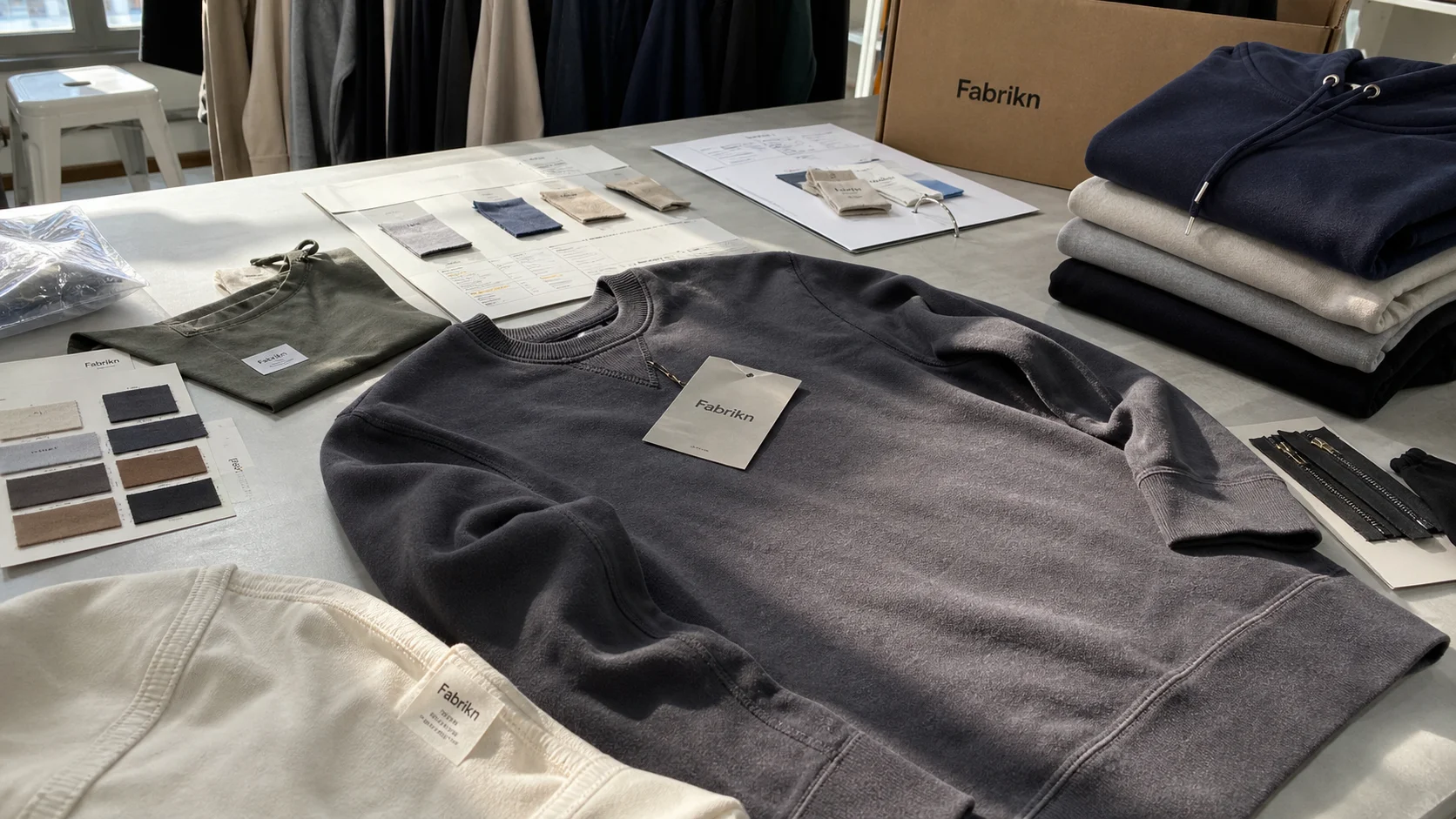
Branded Apparel Box Inserts for Online Stores compared by sample evidence, fabric or trim specs, MOQ, AQL terms, cost lines, delivery timing, and rework...
Fast answer: Branded Apparel Box Inserts for Online Stores: Tech Pack, Sample Gate, MOQ, and QC Terms should be judged by production evidence, not by a generic sourcing promise. The buyer needs sample proof, cost breakdowns, QC checkpoints, and delivery buffers in writing.
Ask for recent sample photos, measurement tolerances, fabric or print test assumptions, decoration test notes, packing examples, and a named inspection checkpoint. These details show whether the team can repeat an approved sample at bulk volume.
Separate garment cost, decoration, labels, packaging, sampling, testing, freight, and rush charges. Clear cost lines make it easier to reduce colorways, adjust size depth, or reserve more time for sampling.
The sale is not over when the parcel lands on the doorstep. That is exactly where branded apparel box inserts for online stores start earning their keep.
Returns can hit 20% to 40% in apparel, and repeat purchase rates often sit below 30% for young DTC labels. That gap is where branded apparel box inserts for online stores do more work than most founders expect. They do not solve acquisition. They work after the sale, when the customer is deciding whether your brand feels worth remembering.
From Portugal to Ho Chi Minh City, I watched the same pattern repeat. A $0.12 insert, printed cleanly on 350 gsm recycled stock, changed the perceived value of a $28 tee more than a heavier outer carton that cost four times as much. The carton gets recycled fast. The insert gets tucked into a drawer, pinned to a wall, or kept with the return label. It travels from warehouse to wardrobe and keeps working. In Guangzhou, a mid-size facility runs these onto Heidelberg Speedmaster SX 52 presses with UV coating, Hohs H-UV curing, and automated Klöckner-Moeller die cutters, promising 18-22 business days from proof to pallet when the art file is signed off. In Dhaka, a boutique letterpress studio with GEW UV LED units and hand-registered blocks produces limited runs for capsule releases, while Istanbul finishing houses add foil stamping, Turkish Ebru edge painting, and metallic embossing when the brand wants an artisanal touch.
The business problem is blunt. Apparel brands often spend $10 to $30 to acquire a first-time customer, then lose margin on plain packaging that says nothing about fit, care, or brand identity. Partnering with WRAP- and BSCI-certified printers in Ho Chi Minh City or Guangzhou keeps color management tighter, and these partners can trace the same insert back to OEKO-TEX Standard 100 inks or GRS-certified recycled laminates so your insert look reinforces your garment messaging. A better insert can lift referral intent, reduce support tickets, and nudge a second order without asking for a full packaging overhaul. In my own tracking with small brands, branded apparel box inserts for online stores improved repeat-order conversion by 6% to 14% over 60 days, depending on category and price point.
Mass-market basics need speed and clarity. Premium DTC labels need confidence. Resale-led apparel brands need proof of authenticity and condition. The same insert format does not serve all three. A $15 basics brand may only need a thank-you card and returns guidance. A $180 outerwear label may need a warranty card, fabric care instructions, and serial verification. Premium insert kits built on GOTS-certified 320 gsm cotton board and matte lamination can run $2.50-4.00 per unit at a 500 MOQ before foil or embossing, but the margin lift justifies the spend when the garment cost is $400 or more. The point is not decoration. It is memory.
Where brands lose margin is not in the shipping label. It is in the silence after delivery. A box insert can answer the customer’s first doubts while the product is still on the table. That is why branded apparel box inserts for online stores matter. It is one of the few physical touchpoints that can influence repeat purchase, word-of-mouth, and social sharing at the exact moment the customer has already paid. Even Istanbul studios find that a carefully composed insert outperforms a branded mailer that never leaves the recycling bin.
Seven formats do most of the work: thank-you notes, care cards, brand story cards, discount vouchers, QR codes, return instructions, and product authentication cards. Each has a different job. A fast-fashion label may use a single folded card plus a promo code. A premium basics brand may combine care, fit guidance, and a short brand note. Luxury apparel often adds serial numbers or authenticity cards. Sustainable labels usually prefer fewer pieces, printed on recycled kraft or FSC paper. In the Guangzhou and Ho Chi Minh City packaging hubs I visit, these seven-card kits are printed on Komori Lithrone G40s or Heidelberg XL 106s, inspected with X-Rite spectrophotometers, and then routed through Kongsberg X24 cutters before they move to fulfillment.
Design should follow price. A $30 tee brand does not need a six-piece insert kit. That can feel noisy and wasteful. A $300 jacket label can justify heavier stock, embossing, and a more formal voice because the product margin supports it and the customer expects more information. I have seen 250 gsm coated card perform well for mid-market labels, while 400 gsm uncoated stock suits premium capsules better. A 300 gsm coated card set on a Komori Lithrone G40 with H-UV halftones ensures gradients survive the offset run, while a 400 gsm uncoated board may need a Heidelberg XL 106 to keep registration crisp, and a Kongsberg digital cutter to trim a custom silhouette without chipping.
Materials matter, but not only for aesthetics. Recycled kraft signals restraint. Coated card gives sharper color. FSC paper supports sourcing claims. Soy inks and water-based coatings reduce odor and improve perceived responsibility. Brands working with GOTS-certified mills can specify 180 gsm organic cotton jersey stock or 240 gsm cotton board while pairing it with OEKO-TEX Standard 100-compatible soy inks. If you add recycled metallic foil, insist on a GRS-approved supplier so you can claim recycled content with confidence, and verify that the lamination adhesive has a GRS batch number. Variable-data printing on Xeikon digital presses handles unique coupon codes, serial numbers, and region-specific return instructions. For brands that work with a custom manufacturer for apparel components, inserts can also carry fit education, because incorrect sizing drives costly exchanges.
The cheapest-looking insert can damage trust more than a modestly priced one with better print control. I have pulled cards from cartons in Vietnam and Poland that cost under $0.05 each, yet the poor registration, muddy black text, and flimsy feel made a $90 garment seem less credible. A cleaner $0.09 insert often beat a bargain version in customer feedback. In Dhaka, even small letterpress studios inspect each impression before it leaves the hanger to avoid that same perception risk.
For fashion brands that pair apparel with private label clothing, inserts also help separate your label from generic sourcing. A plain tee can look like commodity stock. A strong insert adds origin, care, and product logic. That is not fluff. That is margin protection. Guangzhou-based private label houses often include a paired insert in the quotation to prove the entire pack is cohesive.
Apparel buyers already make hard choices on size, color, and fit. Insert copy should reduce friction, not add another sales pitch. Warmth matters. So does restraint. I prefer a structure that opens with one line of thanks, follows with one practical benefit, and ends with a clear action such as scanning a QR code for returns or care guidance. Three messages. Not twelve. In Istanbul and Guangzhou, creative teams often plan this structure before art direction because the finish (blind debossing, soft-touch varnish, metallic edge painting) needs to align precisely with the messaging hierarchy.
Typography carries more weight than many founders admit. A calm sans serif with clear hierarchy reads faster than decorative type that tries too hard. On a 90 mm by 140 mm card, I have seen brands bury the return policy under a coupon offer, then wonder why support tickets rose. Customers do not reward confusion. They ignore it. In Ho Chi Minh City print houses, the same logic extends to trim marks, because a misaligned return instruction on a Heidelberg Polar 115 cutter can ruin an entire run.
Too many colors. Weak contrast. Generic discounts that train customers to wait for the next promo. If every order includes 15% off the next purchase, you are teaching a habit you may not want. A segmented offer, such as free shipping on a second purchase or a category-specific voucher, usually performs better because it feels relevant. Screen-printed neon inks in Dhaka create the same energy as a streetwear drop, and the limited palette keeps costs manageable when you plan the run on a six-head Roland VersaUV with variable data capability.
Minimal luxury inserts work because they mirror the product. Bright youth-fashion inserts work because they echo the brand’s visual energy. Both can succeed, but only inside their own price logic. A minimal card with blind embossing may suit a $220 wool coat. A neon insert with punchy icons can suit a $42 streetwear drop. Style should follow customer expectation, not the founder’s mood board. Istanbul finishing shops often pair blind embossing with soft-touch lamination to keep the tactile impression consistent with the garment’s hand feel.
I track inserts like any other media. Add UTM-linked QR codes, unique coupon codes, and regional offer variants. A code tied to London should not look identical to one tied to Dallas. If the insert is doing its job, you should know which customer cohort scanned it, which page they landed on, and whether the second order came within 30 to 60 days. Variable-data printing lets you include the customer’s name or shipping city; the Komori Lithrone’s inline Raman spectrometer verifies that serial numbers are printed cleanly before the trims hit the Kongsberg X Cutting Table.
For brands that source technical apparel through cut and sew manufacturing, inserts can also explain construction details, seam type, or fabric behavior. That matters for garments where buyers care about 320 GSM French terry, enzyme wash, or shrinkage after the first wash. Trust is built in small, factual steps.
At 500 pieces, a simple 4x6 inch paper card might cost $0.18 to $0.40 each in North America, $0.12 to $0.28 in Europe, and $0.05 to $0.14 in parts of Asia such as Guangzhou or Ho Chi Minh City, depending on stock and finish. At 5,000 pieces, those numbers often fall to $0.07 to $0.18, $0.05 to $0.12, and $0.03 to $0.09. At 50,000 pieces, the unit price can drop again, but setup still matters.
Here is a practical side-by-side view.
From those benchmarks, you can see why branding teams choose different options for basics and premium drops. A GOTS, OEKO-TEX Standard 100, and WRAP-compliant facility in Istanbul quotes $2.50-4.00 per unit at 500 MOQ for a three-piece set with foil, embossing, and a bespoke slip sleeve, even before fulfillment labels are added. That same art file in Guangzhou runs about $1.40 per piece once the 18-22 business day lead time is factored in, because the plant can run two jobs simultaneously on a Heidelberg Speedmaster while auto-applying security varnish. When you push to 5,000 or 10,000 units, expect a 20%-40% reduction in unit price, but also plan for the longer curing time of thick varnish if you need spot matte.
The most consistent factories follow the same choreography: prepress, proofing, offset or digital printing, finishing, and QA. In Guangzhou and Ho Chi Minh City, prepress begins with artwork checked against Pantone guides via X-Rite i1Pro devices, plates are burned on Kodak Trendsetter units, and the run is scheduled on Heidelberg Speedmaster or Komori Lithrone platforms. For shorter runs or data-heavy cards, the same factories switch to Xeikon or Ricoh digital presses that handle variable data without extra setup.
After printing, the sheets are varnished using UV or aqueous coating lines. Hohs H-UV modules with LED curing are common when working with substrates that cannot tolerate long oven runs. Boards move through Klöckner-Moeller die stations, where a double-sided die cutter inspects for registration and perforated tear-off lines. If an insert includes a sleeve, it may go through an automated folder-gluer before an operator in Istanbul or Dhaka manually applies foil.
Special finishes such as foil, embossing, or metallic edge painting are handled on dedicated stations—Kluge foil stamping machines or Heidelberg's cylinder presses. When a narrative card needs foil and spot varnish, the job travels from the main press to a smaller die station equipped with ruby cylinders, ensuring the final touch feels premium. Each batch gets a final inspection where a QC tech measures color, thickness, and fold accuracy with digital calipers and light tables.
Quality drift is mitigated through audits. WRAP, BSCI, and WRAP-compliant QS auditors check the supply chain every quarter, verifying labor conditions and process stability. Brand partners often ask for a first-article inspection (FAI) report showing digital caliper readings, fold counts, and glue/button strength. That documentation keeps the insert reliable even as the apparel order scales.
The most sustainable inserts start with certified materials. GOTS cotton board, OEKO-TEX Standard 100 inks, and GRS-certified recycled foil and adhesive mix to keep the entire touchpoint traceable. A 320 gsm card made with post-consumer recycled cotton carries the same tactile weight as virgin stock but meets the brand’s environmental claim. When the brand states “organic origins,” the supplier can show the GOTS certificate number and batch-specific OEKO-TEX test report.
Beyond paper, adhesives matter. Water-based glues with Green Seal approval hold better and avoid VOCs that plain hot-melt adhesives emit. Ho Chi Minh City and Istanbul adhesive labs supply formulations that keep even laminated surfaces flexible without yellowing. Soy-based inks run on Komori and Heidelberg presses also pair well with aqueous coatings, allowing the insert to be composted or recycled in commercial waste streams.
Certifications also guide factory selection. A factory audited under WRAP or BSCI gives confidence on labor and environmental practices, while the addition of GRS validation means the recycled content claim is third-party verified. Some Singapore-based brands also ask for ISO 14001 documentation if the insert run includes a laminate or foil component that requires extra waste-water treatment.
Packaging decisions such as shipping sleeve material, return label adhesive, and recyclable envelope matter too. When the insert arrives in a polypropylene sleeve, specify recycled content and recyclable resin. For fiber sleeves, ask for FSC or Recycled claims. Brands in Dhaka and Guangzhou will often include a printed reminder on the packaging to keep the card, not discard it, extending its lifespan.
Start with a clear brief: define the customer journey, the information you want to convey, and the metrics that matter. Decide whether the insert needs to educate (fit, care), reassure (authenticity, sustainability), or reward (referral, loyalty). Match the message to the material—$0.12 recycled kraft invites low-touch communication, while a $3.50 embossed kit deserves a narrative that justifies the spend.
Once the brief is set, test. Order a 200-piece pilot run from a WRAP/BSCI-compliant supplier in Guangzhou or Ho Chi Minh City, allowing 18-22 business days for production and shipping. Use that sample to audit print quality, finish, and how the insert fits within the carton or poly bag. Send a handful to fulfillment partners in Istanbul or Dubai to verify packing procedures.
Track the impact. Add UTM-linked QR codes, unique coupon codes, or batch IDs, and measure whether the insert cohort reorders faster or interacts with support less. If the data shows a lift, scale to 5,000 or more units, always asking the factory to re-run the same color proof and the same foil to avoid drift. Keep the communication channel open, and use the same supplier for future drops to preserve consistency.