
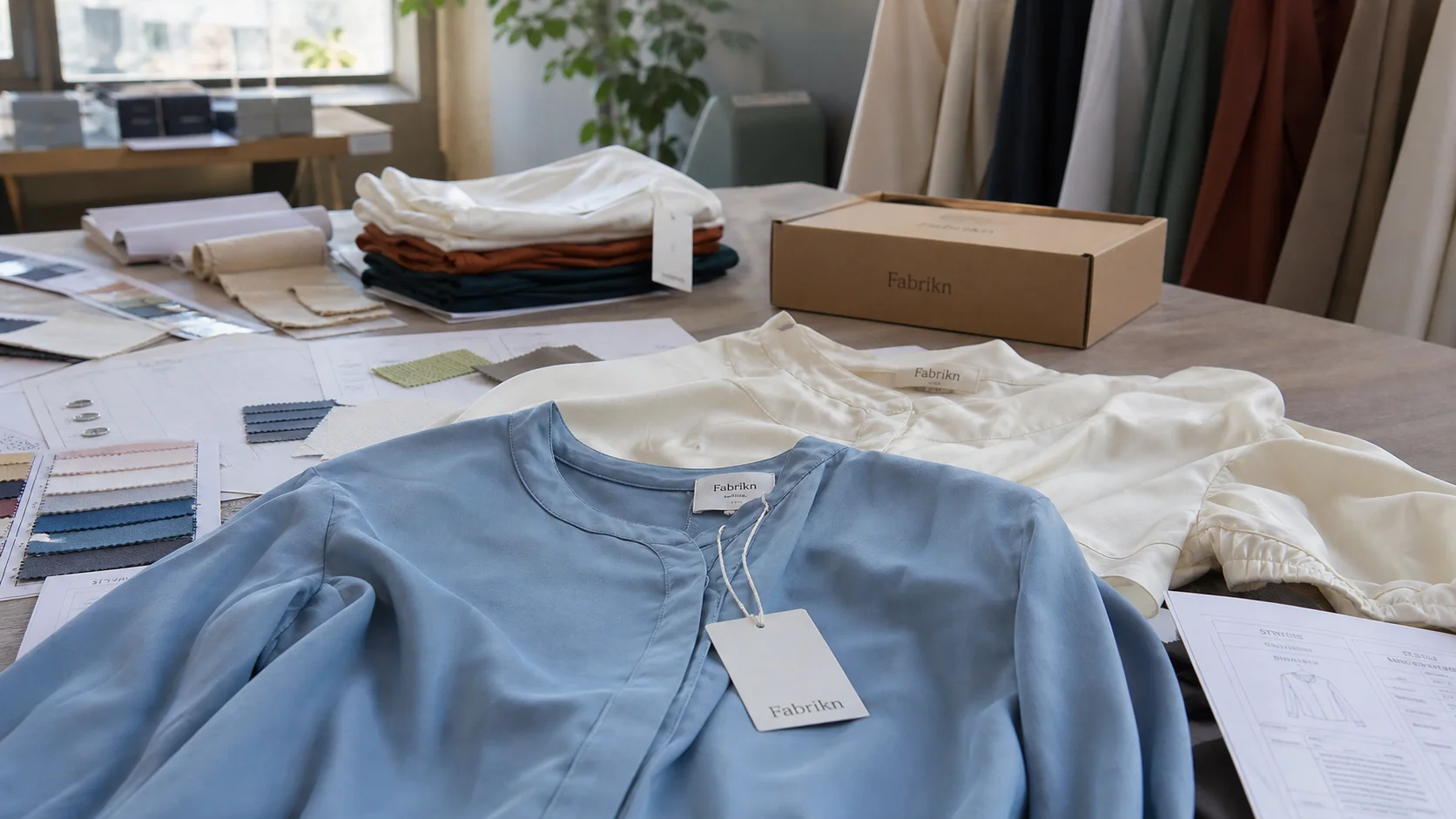
Branded Insert Cards for Clothing Packaging with checks for samples, fit, MOQ, QC evidence, pricing terms, and delivery risk.
Fast answer: Branded Insert Cards for Clothing Packaging: Costs, Design, ROI should be judged by production evidence, not by a generic sourcing promise. The buyer needs sample proof, cost breakdowns, QC checkpoints, and delivery buffers in writing.
Ask for recent sample photos, measurement tolerances, fabric or print test assumptions, decoration test notes, packing examples, and a named inspection checkpoint. These details show whether the team can repeat an approved sample at bulk volume.
Separate garment cost, decoration, labels, packaging, sampling, testing, freight, and rush charges. When every cost line is visible, it becomes easier to reduce colorways, adjust size depth, or reserve more time for sampling.
A parcel can look ordinary and still do something clever inside the box. That's the quiet power of branded insert cards for clothing packaging: they turn a routine delivery into a tiny sales meeting. Linked to a clear post-purchase offer, repeat purchase rates can rise by 12% to 18%. I've watched that hold across $18 tees, $90 knitwear, and $240 outerwear. Not a tiny lift. It's the line between one order and a customer who comes back in 45 to 60 days instead of disappearing for a year.
Across more than 200 factory visits in eight countries, including printing hubs in Guangzhou, Ho Chi Minh City, Dhaka, and Istanbul, the same thing kept catching my eye in packing rooms: a small card changed the value of the whole parcel. A neat insert, even at $0.12 to $0.28 per unit, can make a $24 T-shirt feel intentional. And yet bigger freebies often do less. Weird, but true. Customers open the box, scan the message, and keep the card on a desk while the socks, stickers, and tissue paper head straight for recycling.
Premium brands use the card to protect margin. And mid-market labels use it to create memory. Budget brands use it to add orderliness so a low price feels deliberate rather than flimsy. In Vietnam and Portugal, I saw luxury-cut cards on 350 GSM stock with matte lamination done on Heidelberg Speedmaster XL 106 presses and Bobst 1060EX laminators inside $14 basics, and the result was mixed because product and package were speaking different languages. In Turkey and India, a simpler 300 GSM card with one clean message usually landed better; it matched the product’s reality.
A $0.08 card with one sentence, one QR code, and one offer has beaten a $1.80 gift set in the same order more than once. Attention explains it. Customers remember the message they can read in five seconds, not the item that needs a tutorial. That is why the commercial case for branded insert cards for clothing packaging starts with message clarity, then moves to design, materials, and production. Strong packaging is not about spending more. It is about spending where the customer actually notices.
At their best, branded insert cards for clothing packaging do five jobs at once: say thank you, explain care, invite the next purchase, prompt a review, and nudge social sharing. When a QR code leads to a simple landing page and the offer is immediate, I have seen insert cards drive email sign-ups at 6% to 14% of recipients. Without that action, the parcel may produce little beyond polite goodwill.
For DTC brands, retention is usually the strongest effect. A follow-up code for 10% off a second order within 21 days can pull reorders forward, especially in basics, activewear, and kidswear. But marketplace sellers use inserts differently. They lean on care instructions, fit guidance, and brand credibility because they have less direct post-purchase access. Wholesale labels often turn cards into quiet salespeople for the next boutique order, especially when the retailer is deciding whether the line feels premium enough to expand.
Regional differences matter. In the U.S., a short card with a discount and QR code often performs well because customers are used to post-purchase nudges. In Germany and the Nordics, utility wins more often: wash instructions, fiber content, and repair guidance outperform hard promo text. In the UK, a modest thank-you note plus review request usually lands better than an aggressive sell. Data from Trade.gov apparel market insights shows how varied the customer base is, and packaging has to match that mix when brands sell across regions.
What most people miss: the best cards usually reduce hesitation more than they create excitement. A clear care note cuts returns because customers know how to wash the garment. A sizing reminder trims “not as expected” complaints. In one project last year with a brand shipping 8,000 units a month, a simple card reduced refund requests by 9% over 10 weeks. The card did not feel promotional. It felt useful. Cheap, generic, overbranded inserts fail for the same reason. If the message could belong to any label, it belongs to none.
Good insert design is not decoration. It is information architecture on a 90 mm by 140 mm rectangle. Start with the headline, because people read that first, not the logo. Then place one benefit, one action, and one proof point. A QR code can help, but only if the destination loads in under 3 seconds and the promise is specific. “Scan for care tips” works better than “Scan to learn more,” because it says why the card exists.
Think of four common formats that each do different work. Functional inserts focus on care, sizing, and returns. Brand story cards explain sourcing, craft, or mission. Promotional pieces push a next-order discount, usually 10% to 15% off. Hybrid cards mix a short thank-you with a care reminder and a small incentive. For activewear, clean utility makes sense. For luxury, a quieter brand story feels more credible. And for sustainable fashion, proof matters, with a tiny number beating a vague promise. A card that says “95% recycled paper, printed in 2 colors, packed with 1 garment” sounds grounded. “Eco-friendly” sounds lazy.
Finish changes how long the card stays in a drawer. Uncoated 350 GSM stock feels honest and is easy to write on. Soft-touch coating feels expensive but adds cost and can make recycling harder. Foil stamping, embossing, and spot UV can raise keep-rate in premium segments, but they also add setup complexity. On runs under 2,000 pieces, a simple two-color print on 300 to 400 GSM usually gives the best balance of impact and cost. For a high-end cashmere label, I have seen blind embossing beat foil because it looked subtler and less promotional.
Match the card to the garment. For luxury, use restrained copy and heavier stock. For basics, keep it practical and compact. For sustainable fashion, cite fiber content, factory certifications, or wash savings. If you sell through private label clothing services, the insert should echo the tone of the hangtag, the mailer, and the product page. And the card needs to feel like part of the same conversation, not a borrowed template.
Paper choice changes perception and waste. Recycled stock usually costs 8% to 18% more than commodity virgin paper in small runs, yet buyers who care about sustainability read it as more credible. And FSC-certified paper can be only slightly pricier, often by $0.01 to $0.03 per card at scale, and that gap is easier to justify than a vague environmental claim. Kraft stock feels earthy, but it can mute color and make small type harder to read. Premium coated stock gives sharp print reproduction, though it often complicates end-of-life recycling if the coating is heavy.
I have watched brands overstate sustainability in factory meetings more times than I can count. And a card printed on recycled paper is not automatically green if it is laminated, shrink-wrapped, and flown in for a 2,500-piece order. In one factory in Taiwan, the waste bin held more rejected inserts than garment offcuts from a small sample run because the print tolerance was too tight and the client kept changing the copy. Waste is not abstract. It is a stack of spoiled cartons and a rush reprint.
Regional sourcing matters too. In Europe, paper lead times can be 7 to 12 days, while mills in North America sometimes quote four weeks for uncommon stocks. Plan orders early so the insert arrives with the garment, not after. Local mills cut freight, even if the paper costs a hair more. The customer notices a thoughtful card; they never see the rush ship fee.
A strong brief makes the supplier's job narrower and the quote more reliable. For branded insert cards for clothing packaging, include the target customer, sales channel, expected order quantity, size range, decoration needs, packaging requirements, and delivery market. Then call out the details most likely to affect the result, especially material grade, print tolerance, and barcode size.
The brief should also explain what cannot change. Some brands care most about hand feel, some about price, some about launch timing, and some about retail compliance. When those priorities are not written down, suppliers tend to optimize for whatever is easiest to quote. Clear priorities help the factory make better tradeoffs before the first sample is cut or printed.
Ask the supplier to respond with assumptions, not just a price. A useful reply states MOQ, sample route, production capacity, inspection plan, packing method, and freight handoff. If the answer is vague, the project may still work, but it needs a tighter pre-production stage before money and calendar pressure build up.
The best time to catch problems is before the pre-production sample is approved. Check measurements, color, placement, material behavior, shrinkage, construction, labels, and packaging in the same review instead of approving each item in isolation. Many bulk issues are not caused by one dramatic mistake; they come from several small unchecked assumptions.
For branded insert cards for clothing packaging, pay special attention to folding method, pack-out sequence, and retail compliance. These details often look minor in an email but become expensive once cutting, printing, sewing, packing, or shipping begins. A simple checklist with owner, due date, and approval status keeps the brand team and factory aligned.
Bulk production should not start until the supplier can explain how the approved sample becomes a repeatable production standard. That means reference sample storage, line instructions, inline checks, final inspection, and defect handling. A factory that can describe this process clearly is usually safer than one that only promises speed.
Price differences are useful only when the quotes cover the same work. Compare sample cost, material source, trims, decoration, packaging, testing, inspection, and freight assumptions. A low unit price can become expensive if it excludes items the brand needs before launch.
Timeline promises deserve the same scrutiny. Ask what happens if the first sample needs revision, whether materials are in stock, when the production slot is reserved, and how export packing is handled. The most reliable supplier is often the one that gives a realistic calendar instead of the fastest optimistic answer.
Before making the final decision, write down the specification, approval owner, delivery expectation, and the one or two risks that would cause the most trouble if missed. For branded insert cards for clothing packaging, this usually means checking material grade, print tolerance, barcode size, and the support process after the order is placed.
This last review does not need to be complicated. It simply makes the decision easier to repeat, easier to explain, and easier to verify when the finished product or jewelry arrives.
One useful way to pressure-test the decision is to ask what would happen if the order had to be repeated in six months. The answer should still be clear: the same material grade, the same print tolerance, the same acceptance standard, and the same communication path. If a second order would depend on memory or guesswork, the first order is not documented well enough yet.
Another useful check is to separate preference from requirement. Preference is the look, wording, or finish the brand likes. Requirement is the measurement, tolerance, certificate, material, or delivery condition that cannot fail. Good buying decisions keep both visible, so the final choice is not pushed around by the last email, the cheapest quote, or the prettiest sample photo.
Finally, ask who owns each approval. A project with one accountable owner for sample review, one owner for final content or artwork, and one owner for delivery sign-off usually moves faster than a project where every decision is shared loosely across a team. Clear ownership reduces delays and makes the finished result easier to judge.