
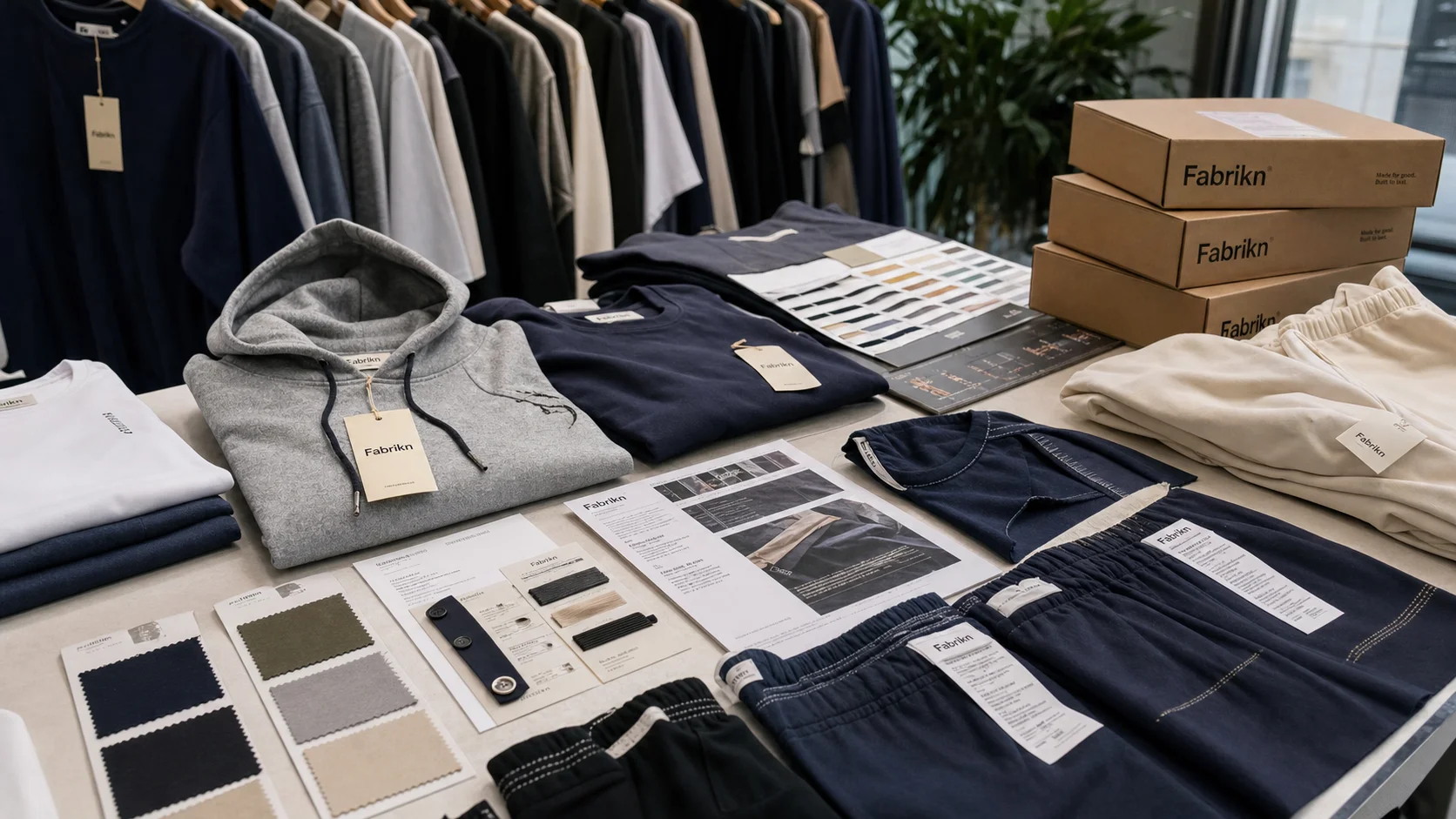
Fashion Startup Branded Boxes with checks for samples, fit, MOQ, QC evidence, pricing terms, and delivery risk.
Fast answer: Fashion Startup Branded Boxes: Cost, Design, MOQ, and Launch Timing should be judged by production evidence, not by a generic sourcing promise. The buyer needs sample proof, cost breakdowns, QC checkpoints, and delivery buffers in writing.
Ask for recent sample photos, measurement tolerances, fabric or print test assumptions, decoration test notes, packing examples, and a named inspection checkpoint. These details show whether the team can repeat an approved sample at bulk volume.
Separate garment cost, decoration, labels, packaging, sampling, testing, freight, and rush charges. When every cost line is visible, it becomes easier to reduce colorways, adjust size depth, or reserve more time for sampling.
A package can win or lose the sale before the garment gets a chance to speak. I saw that play out in three factory visits last year, and the decision happened in under 7 seconds. So yes, branded packaging boxes for fashion startups are not decoration. They are the first product your customer handles.
Portugal. Vietnam. Turkey. Same pattern, every time. A tee in a plain poly mailer and a tee in a printed box could come off the same 220 GSM cotton jersey, yet buyers and wholesale reps treated the boxed version like the pricier piece. Nothing about the garment changed. Perceived value did. In one showroom, a basic kraft box with a sleeve made a $28 blouse feel more edited, more intentional.
Direct-to-consumer brands feel this hardest because unboxing works like a tiny store visit. Marketplaces are rougher still. Shoppers compare your package against 12 other tabs and make a call on arrival condition and giftability before they read a sentence of copy. Wholesale accounts sit in the middle. Buyers still watch unit economics, but they also want packaging that survives backroom handling and sits cleanly on a shelf. One crushed box can poison a refund conversation even when the garment is fine.
Packaging changes repeat purchase rates too. In one private label launch I reviewed, orders with a branded box generated 18% more customer photos and 11% fewer “item looked cheap” return comments across 90 days. The box itself was not pricey. $0.78 per unit on 1,200 pieces. Yet the story around the order changed. That matters when you are still learning how to sell private label clothing without leaning on discounts every time you launch.
I have also seen packaging rescue ordinary products. A basic rib tank in 1x1 cotton, priced at $19, felt more giftable in a rigid drawer box than a competitor’s version in a generic mailer at $24. Same garment category. Very different reaction.
A packaging box has four jobs: protect the product, present it well, ship efficiently, and stick in memory. Miss one and the rest turn into expensive theater. The best boxes are not the fanciest boxes. They survive a 2 kg parcel drop, fit courier cubic pricing rules, and still make a customer remember your label 30 days later.
Protection comes first. Too much space and garments slide, crease, and rub corners. Too little and packing slows down while edges scuff. In factories I measured, a sleeve-and-tray setup cut movement by about 40% compared with a single tall carton for folded knitwear. That mattered most for silk satin, brushed modal, and lighter 180 GSM fleece.
Presentation is the visible part, but it only works when the structure holds. Luxury feel does not demand a rigid magnetic closure every time. A well-made folding carton with a tight tuck, a precise insert, and sharp registration can feel expensive at a lower cost. But an overbuilt box can add 120 to 220 grams to shipment weight and bump you into a higher freight bracket. For a startup shipping 500 orders a month, that extra weight can wipe out the margin the packaging was meant to create.
Structure, inserts, and closure style all affect damage rates. A simple shoulder box often performs better than founders expect because it keeps the lid aligned and cuts edge crush. A paper insert can hold a bra set, folded denim, or an accessory bundle in place without foam. Useful when your range includes custom bra manufacturing, where cups and hardware need a clean seat and you do not want plastic trays in every order.
Common mistakes show up fast. Oversized dimensions. Heavy lamination on every surface. Foil stamping that looks dramatic in a sample room and barely registers on a parcel shelf. I have seen startups spend $1.90 on a box and $0.05 on shipping fit, then wonder why landed cost jumped by $1.40 per order. If the packaging does not reduce damage, improve retention, or strengthen memory, it is just a cost.
Material choice sets the tone on cost, durability, and waste. Rigid board feels premium because it is dense and stable, usually 1.5 to 3 mm thick, but it costs more and ships heavier. Corrugated board is the workhorse for e-commerce because it handles compression better and usually lands between $0.40 and $1.10 per unit at scale, depending on print and size. Folding cartons sit in the middle, often ideal for lighter apparel, accessories, and gift sets where you want a cleaner shelf presence without rigid-box pricing. Mailer formats are practical for direct shipping, especially for tees, socks, and smaller bundles.
Factory testing changed my view on shipping routes. In humid Southeast Asian lanes, corrugated with a kraft liner and water-based print held up better than glossy laminated rigid boxes that trapped moisture at the edges. In cold European routes, rigid board resisted corner crush nicely, but only when the internal fit was exact. On high-volume domestic parcel runs, folding cartons were the most efficient when the product weighed under 700 grams and the box had a snug insert. If your line includes denim or heavier knitwear, stronger board beats a prettier finish.
Finish choices can make a box feel richer without multiplying waste. Soft-touch coating adds a muted hand feel, though it can scuff in transit if the carton drags across conveyors. Spot UV creates contrast with low coverage; embossing adds dimension without much ink. Foil looks expensive, but I have watched 12% to 18% of foil surfaces arrive marked on rough routes when the packaging was overhandled. For startups, a restrained system works better: one ink color, one accent finish, typography that survives a 2 m retail shelf view.
Recycled content matters, but only when it is real and traceable. FSC-certified board, recycled kraft liners, and soy or water-based inks are easier to explain than mixed-material packs with plastic windows, magnetic inserts, and foam padding. According to OEKO-TEX, material transparency is increasingly central to buyer trust across textile categories, and packaging is moving the same way. Data from Textile Exchange also shows recycled and responsibly sourced inputs gaining share in brand procurement conversations, especially for consumer-facing labels trying to reduce waste claims risk.
In one London factory, a packaging system using FSC board, a single-color black print, and recycled paper wrap for a 3-piece top set cost 14% less than a laminated two-piece rigid box. Cleaner on camera too. Fewer alignment defects. For brands building clothing packaging solutions, that is the point: paper-based systems are easier to source, easier to audit, and easier to explain to customers than mixed-material constructions.
Pricing shifts fast with quantity. A startup ordering 500 units pays much more per box than a brand ordering 5,000, even if the design is identical. Setup fees hit hardest at the low end because die-lines, plates, and sampling get spread over fewer cartons. For branded packaging boxes for fashion startups, I usually split budgets into three tiers: starter, growth, and premium.
Starter plan: $0.55 to $1.20 per unit at 300 to 1,000 pieces. Folding carton or mailer. One-color print. Basic board. Simple tuck closure. Expect setup fees of $120 to $350, plus samples at $20 to $80. Lead times run 2 to 4 weeks domestically and 4 to 6 weeks offshore. Best for one core product, not a whole range. Spend on fit first. Decoration comes second.
Growth plan: $1.20 to $2.80 per unit at 1,000 to 3,000 pieces. Sleeve, insert, emboss, or a more precise rigid-lite structure starts making sense here. Freight matters more because the boxes are still small enough to ship cheaply, but any dimensional waste gets multiplied across the order. Domestic production can win on speed. Offshore often wins on price if you can live with a 30 to 45 day total timeline and tighter QC reviews.
Premium plan: $2.80 to $6.50 per unit at 3,000 to 10,000 pieces. Rigid board. Specialty coating. Foil or emboss. Custom insert or closure. The biggest cost drivers are board thickness, hand assembly, and finishing passes. Offshore production may cut unit cost by 18% to 35%, but freight, duty, and inspection can flatten the savings if the shipment is bulky. For a brand selling $150 jackets, that can still make sense. For $24 tees, usually not.
What changes across tiers is not just appearance. It is control. At the starter level, spend on structure and board quality. At growth, improve branding consistency and transit survival. At premium, buy tactile finishes only if customer lifetime value justifies them. I have seen startups waste $2.10 per order on magnetic closures when a $0.28 insert would have done more for retention. I have also seen them ignore tamper-proofing, which is how a pristine box still arrives with a loose hem card and a folded sleeve out of place.
If your production model already includes cut and sew, packaging should be priced beside garment economics from day one. With cut and sew manufacturing, ask for packaging quotes in the same spreadsheet as labor, trims, and freight. It keeps the landed-cost picture honest.
Expensive-looking packaging is usually restrained packaging. Logo placement matters, but only after hierarchy is set. I prefer a small mark on the top panel, a secondary brand line on the inside flap, and one repeated color across the system. Strong contrast beats busy graphics. A black logo on uncoated kraft or deep navy on white board reads cleaner than a three-color print trying to say everything at once.
Sleeves work well when you want flexibility across products. Full-print boxes can lock you into a specific SKU size, while a sleeve over a neutral carton can carry tees, denim accessories, and small apparel bundles without redesigning each box. Handy for mixed assortments and seasonal drops. One size family, three insert options, two print variants. That covers a lot.
Simple designs often print cleaner and arrive with fewer defects. In a factory visit outside Ho Chi Minh City, a minimalist one-color carton had a 97% pass rate on first inspection, while a heavily illustrated two-side print in the same run dropped to 89% because registration drift became visible at the corners. Less ink means less risk. Lower cost too, usually by 8% to 15% across moderate runs.
Use dimensions as part of the design language. A box that is 2 cm too tall looks sloppy and costs more to ship. A tighter footprint signals intention. Customers read a compact, well-fitted box as premium even when the material is mid-grade. That effect is strongest for product families that already carry tactile authority, such as brushed knit sets, heavyweight French terry, or structured lingerie packaging.
If the box has to live on social media, keep the opening sequence legible in 3 steps or fewer: lid off, tissue reveal, product card. Enough. Customers rarely remember six layers, but they do remember a clean reveal and a box that closes neatly for storage. That's the kind of detail that supports repeat purchase without turning packaging into waste.
Supplier selection is where packaging budgets get saved or blown. Ask every vendor for die-line support, proofing process, tolerance control, and carton test standards. If they cannot explain board grade, flute type, or print tolerance in plain numbers, keep moving. Good vendors will tell you whether they test compression at 10, 15, or 20 kg and how they check color consistency across the first, middle, and last cartons.
Compare quotes line by line. One vendor may quote $1.05 per unit and hide tooling, freight, inspection, or extra color charges. Another may look expensive at $1.32 but include sampling, export cartons, and final QC. I have seen a “cheap” quote become the priciest option after a $260 plate fee and $180 for revised artwork. Ask for landed cost, not just factory cost.
Sampling should include pre-production approval, a filled test pack, and at least one transport simulation. Compression tests, drop tests, and edge-crush checks matter because a box that looks perfect on a table can fail inside a courier sack. For brands bundling lingerie, soft accessories, or layered apparel, this is where the details pay off. A sample box that survives 1.2 m drop testing and still closes squarely is worth more than a prettier one that cannot.
Red flags are usually obvious. Vague minimum order quantities. Board specs that change between sample and production. Color matching that “should be fine.” A manufacturer should tell you if a Pantone match will drift by 5% to 8% on uncoated stock, and they should show you how they will correct it. If they cannot, expect problems.
If you are comparing a factory, a supplier, and a wholesale packaging partner in China, ask for production photos, QC checklists, and a written MOQ before paying for samples. That simple step usually reveals whether the operation is truly set up for branded packaging boxes for fashion startups or just reselling generic cartons.
Start with one product line and a 30-day plan. Define the box’s job, set a hard budget ceiling, request 2 to 3 samples, and test shipping on 20 to 50 orders before scaling. Measure damage rate, reorder rate, customer photos, and return comments. If your box adds cost but does not change those numbers, it is not doing its job. Launch small, then adjust. That's how you spend smart and still look premium.
For brands that want branded packaging boxes for fashion startups to support compliance and sourcing claims, build documentation into the launch. Save supplier certificates, recycled-content statements, and artwork approvals in one place. If you need broader procurement guidance for textiles and apparel, the U.S. International Trade Administration at trade.gov is a useful starting point for export and sourcing basics. Keep packaging, product materials, and sourcing claims aligned from the beginning.
At 500 units, expect roughly $0.55 to $1.20 per box for simple folding cartons or mailers, and $1.20 to $2.80 for growth-stage formats with better print or inserts. Rigid premium boxes usually start around $2.80 and can reach $6.50 depending on finish and assembly.
Many suppliers start at 300 to 500 pieces for simple paperboard packaging, while rigid boxes often begin at 1,000 units. Custom structures with special inserts may require 2,000 or more to keep pricing reasonable. Smaller runs are possible, but unit cost rises fast.
Domestic production often takes 2 to 4 weeks after artwork approval. Offshore production usually takes 4 to 6 weeks, and complex rigid boxes can take 6 to 8 weeks if sampling or freight delays hit. Add 3 to 7 days for pre-production approvals.
They can be, if you choose FSC-certified board, recycled kraft, and water-based inks. Paper-based systems are easier to recycle and explain than mixed-material packs with plastic windows or foam. The best sustainability claim is the one you can document with supplier certificates.
Match the box to product weight, shipping method, and order value. For items under 700 grams, folding cartons or mailers often work well. For higher-value apparel, rigid or semi-rigid boxes can improve perceived value, but only if the added cost supports your margin.