
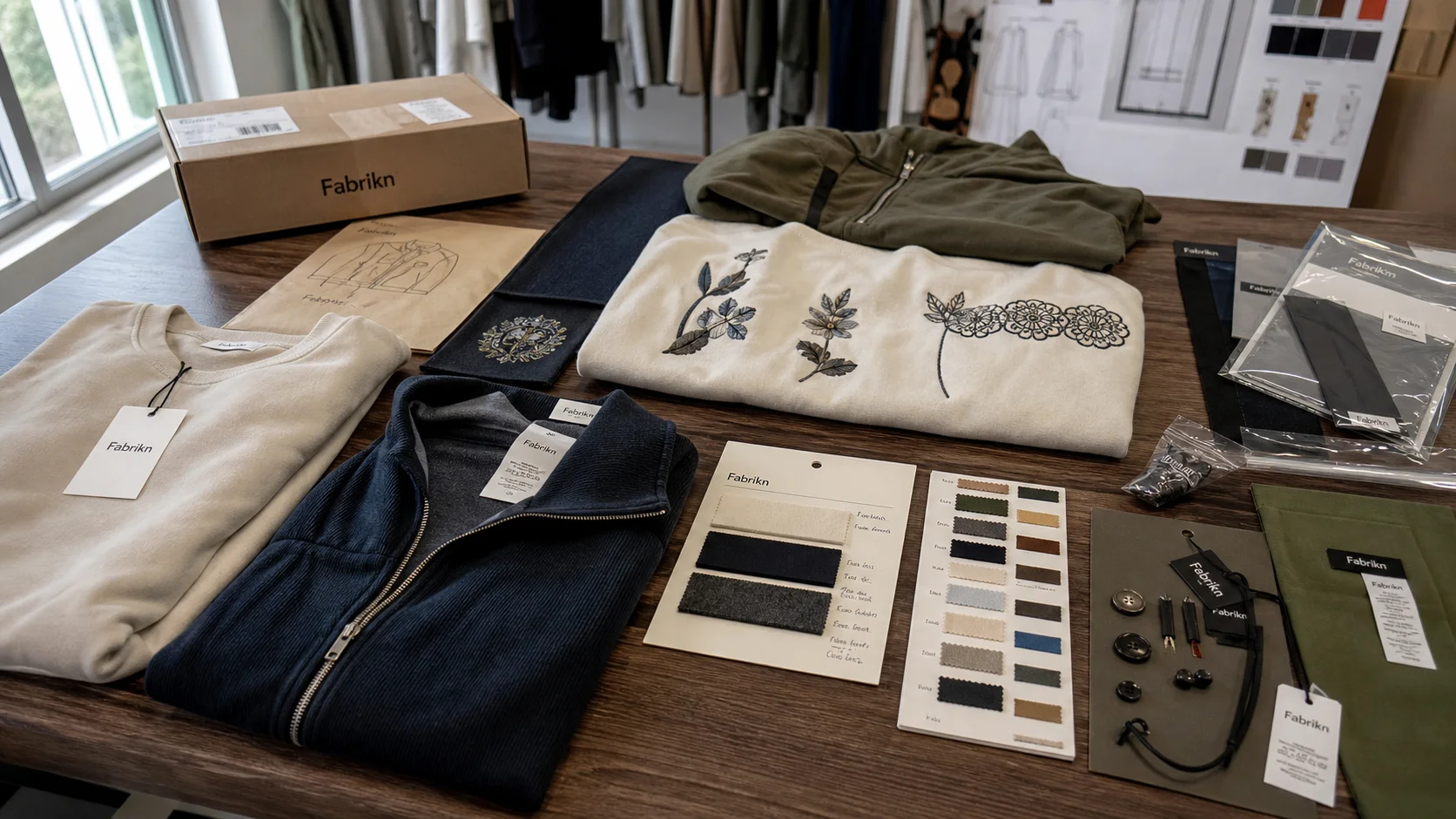
Premium Clothing Packaging Ideas for Brands compared by sample evidence, fabric or trim specs, MOQ, AQL terms, cost lines, delivery timing, and rework...
Fast answer: Premium Clothing Packaging Ideas for Brands: Material, Print, MOQ, and QC Terms should be judged by production evidence, not by a generic sourcing promise. The buyer needs sample proof, cost breakdowns, QC checkpoints, and delivery buffers in writing.
Ask for recent sample photos, measurement tolerances, fabric or print test assumptions, decoration test notes, packing examples, and a named inspection checkpoint. These details show whether the team can repeat an approved sample at bulk volume.
Separate garment cost, decoration, labels, packaging, sampling, testing, freight, and rush charges. Clear cost lines make it easier to reduce colorways, adjust size depth, or reserve more time for sampling.
A £2.40 box can lift a £160 shirt before anyone feels the fabric. When you compare premium clothing packaging ideas for brands, the real question is not “How does it look?” but “What does it do to the buying moment?” Retail testing has shown packaging can push willingness to pay by double digits, and return studies keep pointing to the same messy truth: 20% to 30% of apparel returns trace back to expectations set badly online. That is why premium clothing packaging ideas for brands matter. Not decoration. Signal, shield, memory.
On factory floors, the small details carry the most weight. A sharp flap crease. A magnetic closure that lands cleanly. Tissue that survives humidity without turning to mush. A printed insert that sits flat instead of curling like a cheap flyer. Fancy foil on a weak box? Waste. I have seen brands spend an extra $0.80 on metallic ink and still miss a sturdier mailer that would have cut transit damage by 4% to 6%. Wrong surface, wrong spend.
Luxury houses slow the moment down. Premium basics brands use packaging to make a £35 T-shirt feel considered. DTC labels squeeze referral value out of a box that photographs well, because one good unboxing can generate 3 to 5 organic shares. I’ve walked through factories in Portugal, Vietnam, and Bangladesh where the strongest packs were never the flashiest. Right board caliper. Clean print registration. Box size matched to garment volume. That’s the formula.
Operationally, packaging has three jobs at once: protect the product, reduce returns caused by wrinkling or crushing, and keep the brand in the customer’s head after the parcel is opened. Miss one, and the other two wobble. A premium tee packed in a bag that creases in transit doesn’t feel premium on arrival. An oversized carton may keep a jacket safe, but it also whispers slack controls. Customers read all of it.
Price and promise need to match. A £200 knit cannot live in the same box logic as a £28 bodysuit, and both differ again from outerwear. The cleanest systems are boring in the best way: one box size that fits three core silhouettes, two print colors instead of five, one insert that explains care, origin, and returns without rambling. Discipline keeps margins intact.
Material choice decides whether a pack feels collectible or disposable. Rigid boxes usually sit around 1,200 to 1,500 gsm board. Folding cartons make more sense for lower-volume launches because they ship flat and can cut freight by 18% to 30%. Mailers matter too. A premium mailer in FSC-certified board with a water-based coating can beat a glossy virgin-stock box in perception tests, even when the recycled option comes in 6% cheaper to produce.
Soft-touch lamination still wins on first touch for many fashion brands, especially with debossing or a restrained foil hit. But the finish has to earn its keep. Full-coverage foil ages fast. Textured papers often feel richer than shiny surfaces with half the visual noise. According to OEKO-TEX, certified supply chains are under growing pressure to document restricted substances, which matters when packaging sits near garments in storage for weeks. Customers may never quote the standard. Procurement teams will.
Recycled stocks can outperform virgin paperboard when the texture is right and the print is crisp. I’ve seen it in samples from Italy and Guangdong. A 350 gsm recycled wrapper with a natural tooth often feels more premium than a smooth 400 gsm virgin sheet because it reads as intentional, not generic. Consistency is the hinge. If the recycled board shifts in shade by 8% or more across a run, the premium effect falls apart.
Some brands throw money at decorative layers that add no reuse value. Double-wall box, branded belly band, internal tissue, separate sticker — looks rich in a pitch deck, then lands in the bin 30 seconds later. Better to keep one strong structure, one insert, one reusable element. I’d choose a boxed set for knitwear, a reinforced mailer for tees, and a dust cover for outerwear once the garment price moves above £180.
For premium bra lines and intimate apparel, the pack has different rules. Smaller items need compartmentalized inserts and cleaner size coding, not heavier board. That is why I often point brands toward custom bra manufacturing teams that understand delicate handling and compact packing logic. Babywear shifts the brief again: low-ink finishes, safe adhesives, easy-open closures, especially for gifting and hospital-adjacent purchases. Product category should drive the pack, not the other way around.
When sourcing from a supplier in China, ask for production photos, board specs, and coating details so you can compare quality across factories. A reliable factory will explain how the custom structure performs under heat, pressure, and shipping vibration. For larger wholesale or bulk programs, confirm the MOQ early so you do not overcommit before the design is approved.
Packaging budgets should track price point, not ego. For entry premium DTC basics, $0.45 to $1.20 per unit is a workable range, with MOQs from 500 to 2,000 pieces and setup fees around $150 to $600. Mid-market premium usually lands at $1.20 to $3.50, especially when printed inserts and custom mailers are involved. Luxury outerwear can justify $4.00 to $8.00, but only if the box handles presentation, protection, and storage.
Shirts and tees are the easiest to package well at low cost. Tissue. A folded garment. A rigid mailer or smart carton. That’s enough when it’s done cleanly. Knitwear needs more room and less compression; I’ve seen 320 GSM French terry arrive in better shape in a slightly larger carton than in a tighter bag that left fold lines all over it. Denim tolerates heavier board and fewer inserts. Outerwear needs the most structure because bulk and weight push corner crush risk up by 12% to 18% in transit.
Across regions, the cost picture changes fast. UK and EU suppliers usually offer tighter design control and shorter sampling loops — often 7 to 14 days for a prototype — but unit prices can run 10% to 25% higher than Asia once freight is folded in. China still dominates high-volume custom structures. South Asian hubs can be very competitive for simple packs and apparel-adjacent kits, especially when the garment is being made locally. According to U.S. Trade and market data, apparel and textile trade remains highly regionalized, and packaging sourcing tends to follow the same map.
Here’s the cost lens I use on audits:
Smaller brands do not need luxury-level spend to look premium. They need precision. A well-fitted carton, one tactile finish, disciplined branding — that beats three layers of shiny paper almost every time. I’ve watched private label lines outperform better-funded rivals simply because their packaging matched the product price and shipping method. That is where private label clothing services can align the garment, label, and pack from the start. Packaging should scale with the business, not drag it backward.
For larger production runs, a packaging supplier with a strong production line can stabilize color and assembly better than a small workshop. That matters when your wholesale program needs repeatable quality and a steady bulk supply for multiple drops.
Structure beats graphics. Every time. A well-proportioned box with clean seams and a satisfying closure feels pricier than a loud carton with five colors and no hierarchy. I’ve opened packs where the logo was perfect, yet the lid bowed by 2 mm and the premium effect evaporated. Customers may not measure that gap, but they feel it. They also remember the sound. A crisp close says control.
Color should work with fabric, not fight it. Black, cream, and muted stone still dominate premium apparel because they photograph cleanly and let the garment lead. Bright inks can work for youth labels, but they age fast when they cling to a trend instead of a brand code. Inserts matter too. A garment card with fabric content, origin, and care instructions does more than a generic thank-you note. I prefer provenance labels that say 100% cotton, 320 GSM, dyed in Turkey, packed in the UK. Specificity sticks.
Reusable elements matter when they earn storage value. Dust covers make sense for coats and occasionwear. Garment bags work for pieces above £150, especially if they’re breathable and branded lightly. Storage boxes help with knitwear sets and babywear keepsakes, but only if the construction survives 10 to 15 openings. Fail after two uses, and it’s landfill with a logo.
Photogenic details can drive social sharing, but restraint still wins. Satin ribbons, embossed marks, and a single foil edge photograph beautifully. Oversized hangtags, glitter coatings, sticker overload — not so much. Those choices look dated within 12 to 18 months and slow the packing line. The most shared packages I’ve seen were almost plain: one color, one message, one texture, one practical insert. Enough to make the brand legible in seconds, then trustworthy later.
Giftability is part of the business case. A package that opens neatly, protects the garment, and gives a clear return path turns more purchases into birthday gifts, holiday gifts, corporate gifts. I’ve seen conversion lift by 5% to 8% on gift-oriented pages when packaging photography showed the inside structure instead of just the exterior box. That’s why I push brands to design the unboxing sequence, not just the front panel.
For brands comparing premium clothing packaging ideas for brands across subcategories, the best design is often the one that disappears into the product story. It should feel custom, but it should not compete with the garment for attention.
Factory audits keep exposing the same failures. Print registration drifts by 1 to 2 mm on multi-pass jobs. Corners crush in transit when board strength is chosen by appearance instead of compression test. Adhesive failure shows up in humid warehouses, especially when low-cost glues are used to save $0.03 to $0.07 a unit. Color inconsistency is common too; a cream carton can shift visibly across two production batches if the paper mill changes pulp mix or coating weight.
Lead time is where brands get caught. Stock packaging can move in 5 to 10 days, which suits fast launches and small drops. Custom structures usually need 4 to 8 weeks, and specialty finishing can tack on another 1 to 2 weeks. Europe tends to move faster on sampling and proofing, South Asia offers strong labor economics for assembly and packing, and China still has the deepest bench for tooling and high-volume conversion. None of that helps if approvals turn messy.
Hidden costs show up after the quote. A revision to artwork can trigger a new plate or dieline charge. Damaged freight can wipe out 3% to 7% of a run if cartons aren’t palletized properly. Rush reprints often cost 20% to 40% more than planned production. I’ve seen brands order 2,000 extra units just to cover a weak QC process — expensive safety stock by another name.
Sampling should be treated like product development. Ask for a white sample, a printed sample, and a pre-production sample. Check the closure 20 times. Rub the surface with a dry cloth and a damp cloth. Stack the boxes 10 high and test for warping. If the packaging sits near garments with trims, snaps, or delicate mesh, run a transit simulation with the final packed weight. This matters even more for categories handled through clothing packaging solutions, where box and folded product have to behave like one system.
My rule is blunt. Sign off on structure first, artwork second, finish third. That order prevents expensive rework. A beautiful mockup that fails a 60 cm drop test is just a pretty problem.
At scale, a factory with strong QC should document checks for board thickness, adhesive strength, and print color variance. If the manufacturer cannot show those controls, the production run will eventually expose the weakness.
Sourcing starts with a brief that says exactly what the pack must do. State the garment type, folded dimensions, shipping weight, target unit cost, sustainability claims, and target launch date. Include 2D artwork, dieline expectations, and the number of SKU variants. If a supplier doesn’t ask for those details, I’d question their process. Vague briefs usually come back as revision bills, and revisions can add 10% to 25% to the final bill.
Mockups are worth the time. I ask for one hand-built sample and one machine-made sample before full production. Compare them on closure quality, print clarity, and freight efficiency. Domestic suppliers are often better for short lead times and complicated communication. Overseas suppliers tend to win on unit cost at 3,000 pieces and above, but only if cartons are consolidated and repeated air freight is avoided. Real savings show up when touchpoints drop, not when you chase the lowest quote.
Most budgets blow up in three places: custom tooling, specialty coatings, and low-volume freight. A custom magnetic closure can add $0.40 to $1.20 per unit. Soft-touch plus foil can add another $0.20 to $0.90. Air-freighting 500 boxes can cost more than making the boxes themselves. If the pack will be used for 12 months, the spend may make sense. If it supports a 6-week capsule, keep the structure simpler.
Negotiation isn’t just about price. Ask for tiered MOQs, better payment terms, and carton consolidation with garment shipments. If you’re ordering apparel and packaging together, align the production window so you aren’t paying twice for freight. Brands with tighter control over product specs, such as those using custom baby clothing manufacturing, often get better packaging rates because development and logistics can be bundled. Same logic, different category.
Where do brands waste money most? Finish-heavy features no customer reuses. A box that looks premium in the warehouse but can’t be stacked, stored, or returned efficiently adds cost without value. Put the spend into the parts people touch: closure, board strength, insert clarity, clean print finish. Those are the cues customers notice within 5 seconds, and the cues that survive the unboxing video.
When in doubt, compare quotes from a specialist packaging supplier and a garment-focused factory. The best option is usually the one that balances custom detail with reliable bulk production and a realistic MOQ for your launch plan.
Start with a 30-day plan. Days 1 to 5: define the garment, budget, and pack function. Days 6 to 12: request 2 to 3 supplier quotes and physical samples. Days 13 to 20: test structure, print, and transit performance. Days 21 to 25: approve artwork and sustainability claims. Days 26 to 30: train the fulfilment team, confirm QC checks, and schedule the launch. Packaging should reduce returns and support margin, not turn into a vanity project.
Before launch, review the final carton against the real packing line, not just the design deck. If the team can assemble it quickly, the quality is consistent, and the supplier can hold a stable production window, the program is ready to scale. Get those basics right, and premium clothing packaging ideas for brands become more than a nice-looking expense — they become part of how the product earns its price.
For premium basics, expect $0.45 to $1.20 per unit. Mid-market premium usually lands at $1.20 to $3.50, while luxury packaging can run $4.00 to $8.00 or more depending on inserts, coatings, and freight.
Stock packaging can ship in 5 to 10 days. Custom packaging usually needs 4 to 8 weeks, and specialty finishes can add 1 to 2 weeks. Sample approval often takes another 7 to 14 days.
A strong mailer or compact rigid box, one recyclable insert, and restrained branding usually work best. Keep the unit cost near $0.60 to $1.50 and avoid unnecessary extras that raise freight and packing time.
Yes. FSC-certified board, recycled paper, and water-based coatings can still feel premium if the structure is precise and the print is clean. I have seen recycled stock outperform virgin board in customer tests when texture and closure quality are right.
Start with a brief, then request one hand sample and one production sample. Compare quotes from domestic and overseas suppliers, and negotiate MOQs, payment terms, and freight consolidation before approving artwork.