
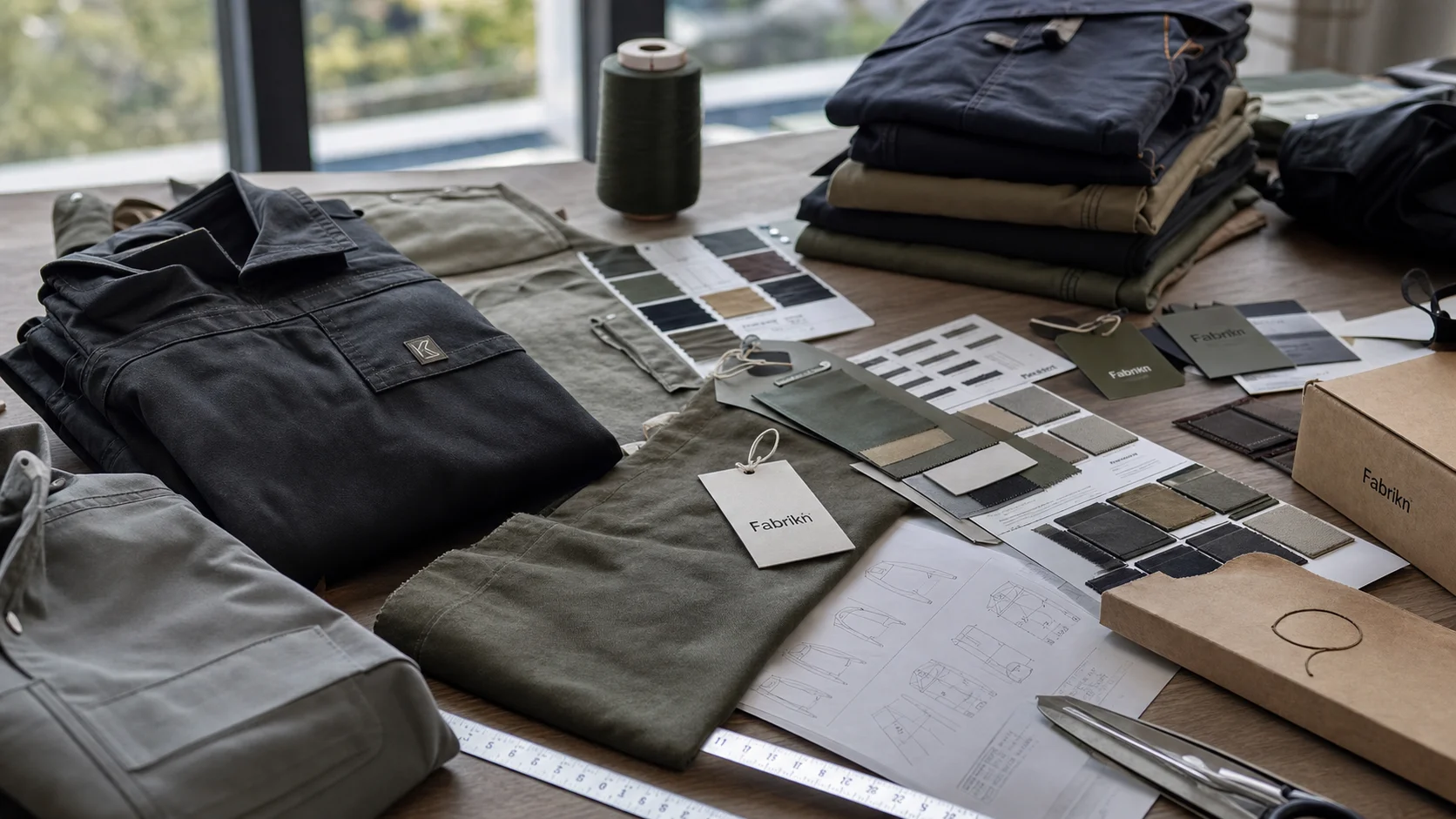
Branded Tape for Clothing Boxes with checks for samples, fit, MOQ, QC evidence, pricing terms, and delivery risk.
Fast answer: Branded Tape for Clothing Boxes: Costs, Materials, ROI should be judged by production evidence, not by a generic sourcing promise. The buyer needs sample proof, cost breakdowns, QC checkpoints, and delivery buffers in writing.
Ask for recent sample photos, measurement tolerances, fabric or print test assumptions, decoration test notes, packing examples, and a named inspection checkpoint. These details show whether the team can repeat an approved sample at bulk volume.
Separate garment cost, decoration, labels, packaging, sampling, testing, freight, and rush charges. When every cost line is visible, it becomes easier to reduce colorways, adjust size depth, or reserve more time for sampling.
The smallest part of the parcel is often the one people remember first. I’ve watched shoppers open boxes in a flagship backroom and on a wet doorstep, and their fingers went straight to the seal. Not the lid. Not the tissue. The tape. That tiny strip carries more weight than most teams admit, because branded tape for clothing boxes hits the eye before the carton does, and it does it for pennies, not dollars.
Across factory visits in Asia, Eastern Europe, and Latin America, the same pattern kept showing up. Brands spending $1.20 to $2.80 on a custom-printed carton still used generic sealing tape. Brands buying plain kraft boxes at $0.18 to $0.42 each used branded tape for clothing boxes at $0.06 to $0.18 per box and got a visible brand cue right away. That matters because unboxing content gets photographed, reposted, and reused far beyond the original shipment. One reel can reach 10,000 people before lunch.
Then there’s the failure mode nobody wants to talk about: a premium box ruined by tape lifting at the seam. In two warehouses I visited last year, the carton itself was fine, but the adhesive lost hold in 32% humidity swings and rough belt handling. The brand blamed the box supplier for damage. Wrong culprit.
That tension matters. Appearance pulls one way. Performance pulls another. Spend sits in the middle. Smaller apparel labels often use branded tape for clothing boxes as the cheapest way to signal identity without committing to 5,000 custom cartons or waiting 4-6 weeks for printed board. Larger programs treat it as a tactical layer, especially for seasonal drops, collaborations, and test launches. I’ve seen it work for luxury basics, athleisure, and even private label clothing brands that wanted a cleaner margin story without sacrificing the first touchpoint.
Choosing the right branded tape for clothing boxes also depends on whether you are working with a manufacturer, factory, or supplier that understands print consistency, production timing, and quality control. If you are buying wholesale or in bulk, ask for MOQ details early so you can match the packaging plan to your launch schedule. That matters even more for brands sourcing from China, where lead times and freight can change quickly.
The substrate decides half the story. For apparel shipping, the most common options are BOPP, kraft paper, PVC, and filament-reinforced tape. BOPP, or biaxially oriented polypropylene, is the workhorse. It prints cleanly, runs fast on auto-dispensers, and usually costs less than specialty paper options. In the quotes I reviewed, branded tape for clothing boxes made from BOPP sat around $0.07 to $0.15 per roll impression at mid volumes, depending on width, colors, and roll length. Kraft paper tape often cost 15% to 35% more, but it supports a more recyclable packaging narrative when used with the right carton and adhesive system.
PVC is tougher than many buyers expect. It handles abrasive edges and warehouse abrasion well, but it is harder to justify on sustainability grounds, and some buyers dislike the plastic gloss. Filament-reinforced tape is another category entirely: built for heavier multi-item shipments, return-heavy routes, or cartons that travel 3,000 km by road and then transfer hubs twice. Overkill for a 0.8 kg knitwear box. For a 4.5 kg multi-item outer shipper, it earns its keep.
Adhesive chemistry changes the result as much as substrate. Acrylic adhesives hold well in hot storage and age gracefully. Hot melt grips quickly, which helps on high-throughput packing lines, but can struggle in very cold rooms or dusty surfaces. Rubber-based adhesives cling aggressively and can perform better in humid warehouses, though they may cost more and leave messier residue. In facilities where cartons sit at 10-12°C before dispatch, I’ve seen acrylic underperform unless the board surface is clean and pressure is applied correctly.
Print quality is a separate issue. Matte paper tape often gives a softer, more premium look, but the ink must bond properly or the logo scuffs in transit. Glossy BOPP reproduces brand colors sharply, yet a rich navy can skew toward black if the press calibration is off by even 5% ink density. According to ISO testing frameworks for packaging performance, material behavior should be verified under the conditions it will actually face, not just on a sample table. That advice saves money. I’ve seen brands spend $0.01 more and prevent a $4 return.
Here’s what most people miss: for a box carrying a lightweight bra set or babywear, the tape choice can matter more than the carton grade. I’ve watched 32 ECT board fail because the seal line was wrong, while a simpler carton held perfectly with the right adhesive. That is one reason factories making custom bra manufacturing orders or custom baby clothing manufacturing shipments often ask for tape specs as early as they ask for print specs.
Pricing changes fast with volume. At low volume, branded tape for clothing boxes can feel expensive because setup charges dominate. I’ve seen small runs of 500 rolls priced at $1.20 to $2.80 per roll before freight, especially if the supplier uses short-run digital printing. At 5,000 to 10,000 rolls, the price often falls to $0.45 to $0.90 per roll, depending on width, number of colors, and whether the order needs custom carton-seal lengths. At 25,000 rolls and up, unit economics get far more forgiving.
Setup fees matter more than new brands expect. Plate fees, cylinder costs, or digital preparation charges can range from $80 to $500, with extra charges for each added color. A one-color logo may be the sweet spot for a new label. Two colors can still work. Four colors can look rich, but on small runs it can push the cost per box high enough that the tape stops being a savings tool and starts acting like a vanity spend.
Compared with other packaging choices, tape is often the cheapest visible signal. Custom boxes can run $0.60 to $1.80 per unit at modest quantities. Belly bands may cost $0.08 to $0.25. Stickers can be $0.02 to $0.09, but they often feel temporary and can fail on dusty board. Tape sits in the middle: visible, functional, and harder to ignore. If a brand ships 20,000 orders a month, a tape program that adds $0.10 per parcel costs $2,000 monthly. That is easier to defend than a full carton print shift costing $24,000 to $36,000 upfront.
Regional sourcing changes landed cost. Domestic production can shorten lead time to 7-12 days and reduce inventory risk, but the tape price may be 10% to 25% higher than offshore supply. Offshore suppliers can quote lower factory pricing, yet freight, duty, and warehousing can erase part of the gap. On one project, a roll quoted at $0.58 ex-works landed at $0.93 after freight and customs. The local option landed at $0.89 with a 9-day turnaround. The cheaper quote was not cheaper.
My rule is simple. If a brand ships under 3,000 orders a month, branded tape for clothing boxes usually beats custom cartons on cash flow. If the design depends on full-surface graphics or retail shelf presence, box printing may deliver more value per dollar. For hybrid brands moving between DTC and boutique wholesale, I often recommend cut and sew manufacturing partners align packaging spec early so the printed tape, tissue, and carton all match the product margin. Otherwise, the packaging eats the margin one layer at a time.
A sample roll on a clean desk proves almost nothing. Real shipping conditions are harsher. Recycled corrugate can carry dust, carton varnish, or fiber fuzz that weakens initial grab. Coated stock may look tidy but can be slippery at the seam. In humid warehouses, I’ve seen edge lift appear after 18 to 24 hours, not because the carton failed, but because the adhesive never fully anchored. Cold chains introduce another problem. A seal applied in a 6°C pack room can behave differently once the parcel crosses into a 28°C van at midday.
Factories reveal the weak spots quickly. At one plant in Vietnam, the tape looked perfect on the first 200 boxes, then started creeping at the flap edge once dust accumulated near the dispenser. In a Polish fulfillment center, boxes stacked 8 high showed compression at the top seam after 48 hours, and the tape had to carry a modest structural load, not just a cosmetic one. That is why peel strength, holding power, and edge-lift checks should be part of any approval process. Ask for lab data, then check it against real cartons, real belts, and real humidity.
According to ASTM methods used for pressure-sensitive tape evaluation, tests should cover adhesion to fiberboard, shear resistance, and performance after aging. I would add a warehouse test on the actual board grade, whether that is 32 ECT recycled corrugate or a heavier 44 ECT mailer. For brands shipping in dry climates like parts of Spain or Arizona, standard acrylic tape may be enough. In monsoon conditions across India or Bangladesh, water-resistant adhesives deserve closer scrutiny. For cold-chain-adjacent logistics, pressure application becomes non-negotiable.
I’ve inspected routes where the packaging held for 600 km but failed at the last handoff, usually because someone packed in a hurry and skipped the second pass over the seam. That is not a tape design problem alone. It is a process problem. Still, a well-chosen branded tape for clothing boxes can absorb more abuse than a pretty carton with a weak seal, and that difference shows up in return rates, not just on the packing table.
Good tape design behaves like tailoring. It fits. It does not shout. I prefer repeated marks at 120 mm to 180 mm intervals, with enough empty space between logos that the seam still reads as a seam. Too much ink turns the box into a billboard, and billboards rarely feel luxurious. Minimalist labels have known this for years. Fast-fashion brands often try to cram in too much, then wonder why the parcel looks cheap even when the product is strong.
Monochrome printing usually wins for premium perception. A single deep black, warm gray, or muted brand red can look expensive against kraft, white, or black cartons. Multi-color tape can work, but only when the brand already has a loud visual identity and the print is dense enough to stay crisp at arm’s length. On kraft, dark ink usually reads best. On white board, soft colors can feel cleaner. On black boxes, metallic inks can look elegant, though they often raise cost by 12% to 20%.
There is also a compliance angle. Warning icons, recycling marks, and carrier information do not have to fight the branding. They can sit on a narrow edge, or on the outer repeat, if the layout is planned properly. The best tape systems I’ve seen keep the message simple: brand mark, a short URL, maybe one operational cue. Nothing else. That restraint pays off visually and operationally.
For seasonal packaging, I like to test 2 colorways rather than 6. One for neutral shipments, one for gift periods. It is cheaper, easier to stock, and far less likely to trigger print inconsistency between batches. Apparel brands selling through private label clothing channels often learn this faster than lifestyle brands that try to apply runway logic to a box seal. Tape is not the runway. It is the border frame.
For teams working with a custom factory or a wholesale supplier, the design brief should also define color tolerance, tape width, and repeat length before production starts. That helps protect quality when the order moves from artwork to production. If the brand is sourcing from China, ask for a proof that matches the actual substrate, not just a flat PDF on screen.
Tape should not carry the entire package alone. It is one layer in a stack that may include tissue paper, a box sleeve, insert cards, return labels, and a QR code that links to care instructions or exchange policy. When those pieces are coordinated, the package feels intentional. When they are not, the customer notices the mismatch immediately. I’ve seen a gorgeous seal on a box with a flimsy insert card, and the effect was strangely cheap.
For DTC brands, a clean outer shipper paired with branded tape for clothing boxes and a single branded insert is often enough. For boutique retail, the box may need to survive multiple touches from staff and customers, so a stronger tape spec and a cleaner release liner matter more. For wholesale, the job is practical: keep cartons closed, identify the brand quickly, and make receiving easier in back-of-house. The packaging goal changes by channel. The tape should change with it.
Reverse logistics deserve attention too. Return-ready packaging benefits from tape that can be opened cleanly, then reclosed without destroying the carton. Some brands use dual-strip systems or paired return labels so the same box can travel twice. That can reduce material use if the return rate stays below 12% to 15%. If returns rise above that, over-optimized packaging can create more waste, not less, because every damaged carton gets replaced.
On sustainability, fewer components can mean less material overall. Yet if a brand removes the wrong layer, failures increase and waste climbs. I’ve seen a label line cut out internal inserts to save $0.03 per order, only to see damage claims rise by 2.4 percentage points. Packaging savings are real only when the system survives the route. That is why I ask brands to look at packaging as a network, not a single SKU.
If sustainability is part of the buying decision, reference independent standards before you finalize sourcing. The Textile Exchange publishes guidance on responsible materials, Textile Exchange is a useful benchmark for packaging-adjacent claims, and OEKO-TEX offers certification information that can support material transparency. Those references help a buyer separate marketing language from real documentation.
Start with a tight supplier brief. Define monthly volume, peak volume, carton dimensions, warehouse temperature range, humidity exposure, and brand color requirements. Then specify whether the tape will seal recycled corrugate, white SBS board, or coated mailers. Those details shape the quote more than most founders realize. A supplier quoting 1,000 rolls a month needs different information than one quoting 20,000.
Request samples and test them on actual cartons, not sample boards. I want brands to check adhesion after 10 minutes, 24 hours, and 72 hours. I also want a real packing run, ideally with 100 to 200 parcels through the full line. Ask for these data points from each supplier: price per roll, MOQ, lead time, print colors, adhesive type, shipping terms, and whether the ink or substrate has certification to back up the sustainability claim. If they mention recycled content, ask for documentation. If they mention compostable, ask for the standard behind it.
Run a rollout in five steps. First, sample review. Second, warehouse test. Third, a 500- to 1,000-unit pilot. Fourth, performance review with the fulfillment team and customer service. Fifth, full launch if the seal, print, and landed cost all hold. This sequence protects cash and keeps the brand from overcommitting to a roll that looks lovely but peels in week two.
Cost discipline matters. A supplier offering $0.62 per roll with a 4-week lead time may lose to a $0.79 domestic option if freight, duty, and stockouts are added in. I have seen a brand save $380 on purchase price and lose $2,100 in expedited shipping after a missed campaign window. Price alone is not a plan.
My final check is simple. Verify consistency across 3 production lots, not one. Confirm that the adhesive holds on your worst carton, not your best one. Then choose the option that balances cost, print quality, and proof of sustainability with real test data, not vague claims. That is how branded tape for clothing boxes earns its place in the packing room.
Most branded tape for clothing boxes falls between $0.45 and $0.90 per roll at mid volumes, with low-volume runs often reaching $1.20 to $2.80. Setup fees can add $80 to $500 depending on print method, number of colors, and roll length.
BOPP is usually the cheapest and most durable for standard apparel shipments, while kraft paper tape suits sustainability-focused brands. Filament-reinforced tape is better for heavier cartons or long-haul routes, especially when the box weighs more than 4 kg.
Typical lead times are 7 to 12 days for domestic production and 3 to 5 weeks for offshore orders, before freight. Complex print jobs or added colors can add 5 to 10 extra days.
Yes, for many smaller apparel brands. Tape can deliver a visible brand cue at a fraction of the cost of custom cartons, which often start around $0.60 to $1.80 per unit. It works best when the box itself is already clean and structurally sound.
Test on your actual carton stock in the warehouse, then run 100 to 200 parcels through normal packing, transport, and storage conditions. Check adhesion after 10 minutes, 24 hours, and 72 hours, and review results from at least 3 production lots.