
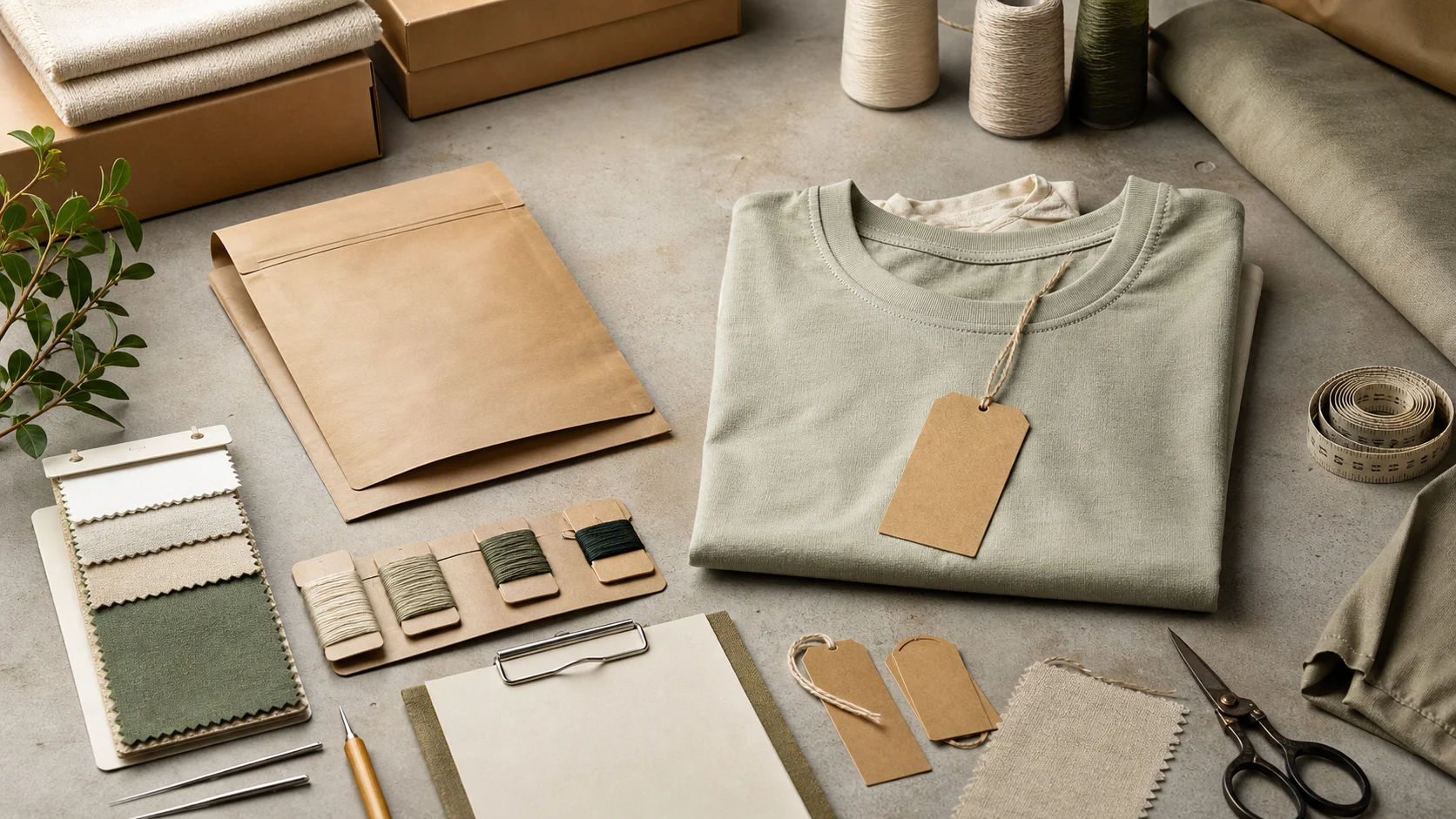
Working with a Clothing Manufacturer with checks for samples, fit, MOQ, QC evidence, pricing terms, and delivery risk.
Fast answer: Working with a Clothing Manufacturer: Tech Pack, Samples, Payments, and QC should be judged by production evidence, not by a generic sourcing promise. The buyer needs sample proof, cost breakdowns, QC checkpoints, and delivery buffers in writing.
Ask for recent sample photos, measurement tolerances, fabric or print test assumptions, decoration test notes, packing examples, and a named inspection checkpoint. These details show whether the team can repeat an approved sample at bulk volume.
Separate garment cost, decoration, labels, packaging, sampling, testing, freight, and rush charges. When every cost line is visible, it becomes easier to reduce colorways, adjust size depth, or reserve more time for sampling.
The prettiest quote I have ever seen nearly doubled the real cost once samples, freight, and fixes were added in. That is the trap most new brands hit when they first figure out how to start working with a clothing manufacturer. The number on the page is not the number that matters. It is only the opening bid.
After visiting more than 200 factories across 8 countries, I have seen the same style priced very differently in Bangladesh, Portugal, Turkey, and China because the variables are never identical. A basic French terry 320 GSM hoodie in Bangladesh may come in at $7.20 to $9.50 FOB for 1,000 pieces, while the same garment in Portugal can sit at $12.50 to $18.00 because of labor, energy, and fabric access. In Turkey, quicker replenishment and stronger local knit mills can cut lead time to 3-4 weeks, but sewing costs still sit above many Asian suppliers. China often lands in the middle, especially for cut-and-sew programs with MOQ 300-500 pieces and broad trim sourcing.
Factories do not price dreams. They price labor minutes, fabric availability, minimums, and risk. A woven shirt with two chest pockets, shell buttons, and chainstitch runoffs can be cheap in one country and expensive in another because one factory has a nearby shirting mill and another must import fabric with a 20% duty hit. The same logic applies to private label clothing services, where the garment may look simple but the pattern, labeling, and packaging stack up fast.
Here is what I have learned from the floor, not the showroom: strong first orders rarely come from the brand with the lowest budget. They come from the brand that arrives with a complete tech pack, a target margin, and a realistic delivery window of 45-90 days. I have seen factories ignore vague buyers for weeks, then move fast for the brand that knows its sales channel, retail price, and gross margin. Early decisions shape quality, timing, and cash flow. They also decide whether a factory sees you as a serious account or a sampling sinkhole.
The brands that win treat the first order like a data exercise. They know their target FOB, their freight budget, and the unit economics before asking for a quote. That is how to start working with a clothing manufacturer without burning through your launch capital on revisions.
The first decision is category, because category controls nearly everything else. Tees are not denim. Swimwear is not outerwear. A simple jersey tee can be sampled in 7-14 days, while a padded jacket may need 4-6 weeks just to confirm components. If you are launching children’s products, custom baby clothing manufacturing brings tighter compliance, softer trims, and more testing, which changes both cost and lead time.
I always tell founders to define one hero product first. Not seven. A tight capsule with 1 style, 2 colors, and 3 sizes will almost always move faster than a broad line with 12 SKUs, 4 fabrics, and a dozen label variations. The difference is not cosmetic. It is cash. One brand I worked with tried to launch tees, sweatpants, and overshirts together. Their MOQ requests were modest, but the factories priced small runs 15% to 40% higher because each style required separate cutting, setup, and QC. Their sample budget jumped from $450 to $1,300 before production even began.
Factories need specifics before they can price accurately: size range, material composition, trim list, color count, target unit cost, sales channel, and expected order volume. A DTC brand selling at $68 retail can absorb a different factory structure than a wholesale brand targeting $24 to $28 retail. If your target gross margin is 65%, your factory quote cannot float in a vacuum. You need a clear ceiling, not a wish.
Some factories will reject low MOQ requests outright. Others specialize in them and build the higher unit cost into their model. I have seen MOQ 100 pieces per color quoted at $18.00 per hoodie, while MOQ 500 pieces dropped it to $11.40. That is not greed. That is how setup cost gets distributed. If you are early-stage, a single product or a very small range protects your timeline and keeps sampling from swallowing your budget. It also makes it easier to cut and sew manufacturing because the factory can focus on one construction path instead of three.
Start with the product that best proves your market. Then make the factory fit the product, not the other way around. If you are still shaping the line, this is the point where how to start working with a clothing manufacturer becomes less about outreach and more about clarity.
Factories quote from documents, not from adjectives. A good tech pack saves weeks. A vague one creates guesswork, and guesswork gets expensive. I have watched well-known brands lose 2 to 4 weeks because the spec sheet said “relaxed fit” without a shoulder width, sleeve opening, or tolerance range.
The core documents are simple: tech pack, bill of materials, graded spec sheet, artwork files, color standards, and packaging instructions. If you want accurate costing, you must specify construction details too: stitch type, seam finishing, label placement, collar rib, zipper grade, and whether the hem is coverstitched or flatlocked. A factory can only quote a tee so many different ways. If the sleeve is set-in, dropped, or raglan, that changes labor and pattern time.
When I visited factories in Vietnam and Portugal, the same problem kept appearing. Buyers sent beautiful mood boards, but no measurement chart. Or they gave measurements with no grading logic. That meant the sample room had to guess what size M should become at L and XL, which added a second or third sample round. A clean tech pack can reduce sampling from 3-4 rounds to 1-2 in some cases, saving $80 to $300 per sample round depending on fabric and trim complexity.
Your sample references matter too. Send one garment for fit, one for finish, and one for quality target if you have them. If you are specifying performance fabrics, include test notes for shrinkage, pilling, and colorfastness. According to AATCC, standardized textile test methods are essential for comparing performance claims across mills and factories. I have seen brands skip this step and then panic when a $14.00 leggings sample fails stretch recovery after the first wash.
Compliance notes are not paperwork for later. They shape sourcing on day one. If your market needs OEKO-TEX or similar chemical restrictions, say so before the quote. For additional sustainability and chemical guidance, see OEKO-TEX certification standards and Textile Exchange sustainability resources. That avoids recycled time, rejected fabric, and a lot of emails nobody wants to write. The more exact your file set, the less room there is for expensive interpretation.
I compare factories on landed cost, not just ex-factory price. That means labor, freight, duty, cartons, labels, and the cost of fixing mistakes. Fabric sourcing alone can move the true cost by 10% to 25%. A mill with better availability may charge more per meter, but it can save two weeks and reduce air freight. Cheap by the piece is often costly by the carton.
Here is a practical comparison I use when advising brands:
Entry-level factories are not always bad, and premium factories are not always right for you. I have seen a premium Portuguese factory execute a flawless knit polo at $15.80 FOB, then a budget factory in the same region miss the collar symmetry by 8 mm. I have also seen a mid-market Chinese factory outperform a pricier competitor because its QC manager had 12 years of woven shirt experience. Price is one signal, not the verdict.
Compare by garment complexity. A fleece sweatshirt may be easy for one factory and difficult for another if their specialty is lingerie or woven tailoring. A denim program needs strong wash control, and the wash route matters. Enzyme wash and stone wash can differ by $0.40 to $1.20 per piece, but stone wash may create more shade variation and higher reject rates. The same logic applies to trims. A hidden zipper, bonded hem, or molded cup pushes a factory into a different skill bracket.
Government trade data helps anchor your expectations. Data from the U.S. International Trade Administration and trade reporting from WTO show that sourcing patterns still cluster by region because freight, duty, and lead-time risk matter as much as labor cost. That is why a local supplier may look expensive until a 6-week ocean schedule turns into a stockout.
The smartest buyers build a comparison sheet with 8 columns: MOQ, FOB price, sample time, bulk lead time, payment terms, fabric access, QC support, and communication speed. You can see the truth in 10 minutes when the numbers sit side by side.
The sample room tells you whether the project is real. The first sample is usually a proto sample, built to test construction and silhouette. Then comes the fit sample, where measurements and balance get checked on body. After that, a pre-production sample locks in final fabric, trims, and labeling before bulk begins. That sequence should feel controlled, not chaotic.
Accept some imperfection in the first round. The wrong hangtag size or a rough internal seam is not unusual. What should worry you is fabric mismatch, wrong measurements, weak seam quality, or a quote that suddenly jumps by 20% because the factory “forgot” a trim. Those are not small issues. They are signals that the factory either misunderstood the brief or never had the right sourcing setup.
Every revision cycle costs time. In my experience, each round adds 1 to 3 weeks depending on geography, workload, and how fast comments move. If your team takes 5 days to answer fit notes, the factory will not magically make up those days. Keep comments consolidated. Mark corrections clearly on the spec sheet. If you can, send a fit video with a tape measure in frame. It sounds basic. It saves days.
Before bulk approval, test wash performance, shrinkage, color fastness, and trim durability. I have seen a $9.80 tee pass fit but fail shrinkage by 7% after one wash, which is enough to change neckline balance and sleeve length. If the style uses print, check cracking after 5 to 10 wash cycles. If it uses embroidery, check puckering and needle pull. A factory that welcomes these tests is usually safer than one that rushes you to sign off.
When the product is sensitive, such as sleepwear or babywear, the sampling stage should include compliance checks early, not after bulk fabric is booked. That is where timelines are won or lost. In practice, how to start working with a clothing manufacturer well means treating sampling like a decision gate, not a formality.
Contracts are where optimism gets edited. I read them line by line. So should you. Deposit percentage, balance due, defect thresholds, remake policy, title transfer, pattern ownership, and late penalty language all matter. A common structure is 30/70: 30% deposit to start, 70% before shipment or against documents. Some factories ask for fabric deposits upfront, especially when yarn-dyed fabric or imported trims are involved.
Quality control should never be a vague promise. Ask where inline inspection happens, whether the factory supports final random inspection, and whether you can bring in a third-party audit. For knitwear, an acceptable defect rate may be 2.5% or lower. For more technical products, the tolerance can be tighter. A brand I worked with rejected a shipment because 11 pieces in 500 had broken bartacks. That was the right call. One weak clause can turn a usable order into a margin leak.
Watch for language around delays, force majeure, and material substitutions. If a factory can swap fabric without written approval, your product can drift without your consent. If the delay clause only protects the supplier, your launch date becomes a suggestion. Specify what happens if a shipment misses by 7 days, 14 days, or 21 days. Put numbers in the contract. Numbers leave less room for argument.
There is another place buyers get burned: ownership of patterns and samples. If you pay for development, you should know whether the pattern file is yours, whether the sample can be copied, and whether the factory may use your construction for another client. For brands building a larger line, these details matter almost as much as price. I have seen founders treat the contract like admin. Then they discover the deposit bought them production, but not control.
Read every page before wiring money. If the terms are unclear, ask for redlines. Good factories expect that. Weak ones resent it. If you are still comparing options, keep the focus on how to start working with a clothing manufacturer in a way that protects both quality and margin.
Your first 30 days should feel structured. Week 1, shortlist 5 to 8 factories and send the same tech pack to each. Week 2, compare quotes, MOQs, sample fees, and lead times. Week 3, review fit samples, lab dips, and cost sheets. Week 4, approve terms and send the first deposit only after the details are aligned.
Before you send money, ask how often the factory reports progress. Weekly photos are better than monthly silence. Ask who your day-to-day contact is, how quickly they respond, and who escalates if a problem sits unresolved for 48 hours. If the factory cannot answer those questions, the relationship will get harder once bulk production starts. That is where delays become expensive, fast.
Build a second-source relationship before the first order scales. The smartest brands keep a backup factory warmed up with a 1-piece sample or a small development project, even if they never use it immediately. That backup can save a season if your main supplier slips by 2 weeks or more. If you need to get a free quote, request a custom clothing manufacturing quote only after your brief is complete. A good factory can work quickly. A prepared buyer makes it possible.
For a simple tee or sweatshirt, first-round sampling can cost $50 to $150 per sample, while development for a small line often runs $300 to $1,500. Bulk pricing depends on MOQ, fabric, and region; a basic hoodie may land at $7.20 to $18.00 FOB depending on country and complexity.
Start with one hero SKU, one or two colors, and a complete tech pack. That keeps sampling tighter and usually lowers revision cycles from 3-4 rounds to 1-2. A focused launch is easier to quote and far easier to manage.
Sampling can take 7-14 days locally or 3-6 weeks offshore before production starts. Bulk production often adds another 3-8 weeks, depending on category and material availability. Total timeline for a first order is commonly 6-14 weeks.
Many factories start at MOQ 300 to 500 pieces per style or color, while smaller specialty factories may accept 100 to 200 pieces at a higher unit cost. Low MOQ orders can raise pricing by 15% to 40% because setup costs are spread across fewer units.
Yes. Local factories are often faster for samples, usually 7-14 days, and easier for communication. Overseas factories can be cheaper on labor, but freight, duty, and longer lead times can add 10% to 25% to the real landed cost.