
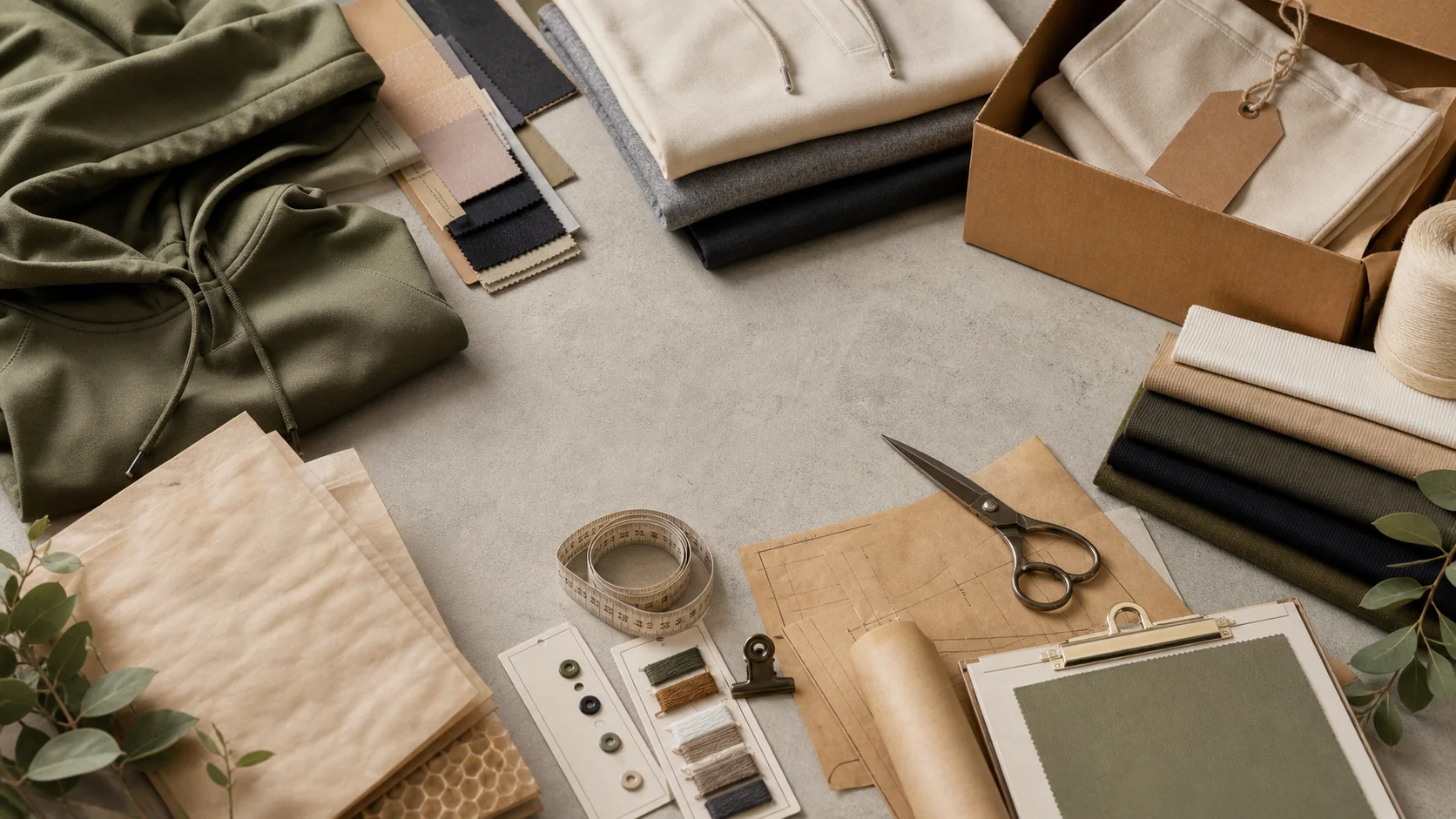
Branded Tape for Clothing Boxes with checks for samples, fit, MOQ, QC evidence, pricing terms, and delivery risk.
Fast answer: Branded Tape for Clothing Boxes: Costs, Specs, Impact should be judged by production evidence, not by a generic sourcing promise. The buyer needs sample proof, cost breakdowns, QC checkpoints, and delivery buffers in writing.
Ask for recent sample photos, measurement tolerances, fabric or print test assumptions, decoration test notes, packing examples, and a named inspection checkpoint. These details show whether the team can repeat an approved sample at bulk volume.
Separate garment cost, decoration, labels, packaging, sampling, testing, freight, and rush charges. When every cost line is visible, it becomes easier to reduce colorways, adjust size depth, or reserve more time for sampling.
The first thing a roll of branded tape for clothing boxes meets is not a mood board. It is a warehouse floor, a tape gun, and an operator who does not have time for anything that snags.
I’ve stood beside packing lines sealing 180 to 240 cartons an hour, and the same roll may be touched 20, 30, even 40 times before a customer sees it. That makes speed the starting point. A tape that runs cleanly on a manual dispenser can shave 2 to 4 seconds off each carton, which sounds tiny until you multiply it across 10,000 orders. Bad adhesive or sloppy print register turns into rework, crushed cartons, and extra labor minutes per parcel.
So no, I don’t begin with brochure language. Box volume, order value, carton touchpoints — that’s where the conversation starts. A brand shipping 1,500 units a month at an $85 average order value has a very different case from one shipping 50,000 units at $28. The tape has to earn its place in the workflow. If it slows the line, it’s expensive no matter how good it looks.
There’s also a blunt reason branded tape for clothing boxes often beats labels for fast-moving apparel shipments. A label tells you who sent the box. Tape seals the box and advertises it in one move. One step gone. One consumable gone. One chance to misplace something gone. For brands running mixed packaging fleets, that matters. A white mailer, a kraft carton, and a recycled shipping box can all carry the same identity without custom-printed corrugate.
Some premium brands spend more on the tape roll and still save money overall. I’ve seen teams drop separate stickers, fold-in inserts, and outer-wrap branding once the tape carried enough visual weight. One luxury basics brand I worked with cut $0.18 per shipment in secondary print costs after moving to printed carton seal tape, even though the tape itself cost 22 percent more than plain stock.
Here’s the real equation: if your box leaves the warehouse 5,000 times a month, and each parcel sees 6 to 10 touches before delivery, the tape becomes a measurable operational asset. If your line is slower, your cartons are fragile, or your average order value is low, the economics change fast. That’s why branded tape for clothing boxes should be chosen from the factory floor up.
Branded tape for clothing boxes is not decoration. It is seal integrity, tamper evidence, and a visual cue that makes a plain corrugated shipper feel deliberate. On DTC fashion orders, that cue lands at the doorstep. On wholesale shipments, it helps receivers spot cartons faster on a pallet. In outlet replenishment, it keeps mixed boxes from disappearing into a stack of beige.
I’ve compared taped cartons across channels. DTC orders usually travel 2 to 4 parcel hubs and benefit most from clear visual branding. Wholesale shipments are handled less gently, so durability matters more than polish. Outlet and inter-store transfers tend to be the roughest, with more stacking, more scuffs, and more repacking. A printed tape that resists tearing and stays legible after abrasion earns its keep in all three.
Brand perception matters too. A plain kraft box with printed tape can look intentional without the cost of a custom carton, which often starts around 3,000 to 5,000 units per size and can take 4 to 6 weeks longer to approve. That’s useful for emerging labels and for categories with frequent size changes. I’ve seen this work especially well for private label clothing programs, where packaging needs to look cohesive across multiple product lines.
Consumer psychology backs this up. Repeated logo exposure across the seal tape, shipping label, and insert improves recall during unboxing. According to the ASTM, packaging test methods focus heavily on package integrity because damage and tampering affect perceived quality as much as physical condition. In plain terms: a box that arrives intact and looks branded from 1 meter away is already doing marketing work before the garment is even seen.
Here’s what most people miss: simple one-color tape often looks more premium than busy graphics when carton sizes vary. I saw this repeatedly in factories supplying brands that used six box formats in one season. The cleaner tape pattern looked more consistent across small mailers, mid-size shirt boxes, and oversized outer shippers. Overdesigned tape exposed size differences; minimal tape hid them.
For brands shipping intimate apparel, bodywear, or babywear, that consistency can be worth more than a flashy print. In one category review, I noted that a crisp two-line logo on tape performed better than a full-color design on boxes moving through 3 different distribution centers. That’s especially true for sensitive categories such as custom bra manufacturing and custom baby clothing manufacturing, where packaging credibility matters as much as the garment inside.
The main substrates are PP, PVC, paper, and reinforced paper. PP is usually the cheapest, often around $0.18 to $0.42 per roll in larger runs, and it prints well for bold logos. PVC has better tensile strength and quieter unwind, but it is less attractive for brands trying to improve recyclability claims. Paper tape can support stronger environmental messaging, yet it needs the right adhesive and carton surface to avoid edge lift on dusty or rough board.
Reinforced paper tape sits in a different bracket. It can handle heavier cartons, sharper edges, and longer routes, but the per-roll price rises quickly. I have seen reinforced options quoted at 15 to 40 percent above standard paper tape, especially at low MOQs such as 500 rolls. For apparel brands shipping lightweight garments in 1.5 to 4.0 kg cartons, that is often unnecessary unless the route is especially harsh.
Print method changes the math. Flexographic printing makes sense for 5,000 rolls and up because plate costs get diluted, and the color consistency is strong. Digital print works better for 200 to 1,500 rolls, where setup is light and artwork changes are frequent. A flexo plate charge can run $120 to $450 per color, while digital may add $0.03 to $0.08 per meter, depending on width and coverage. That swing matters if you are testing two logo versions.
Adhesion is where fashion teams get blindsided. Recycled corrugated, especially 70 to 100 percent recycled board, has more dust, more fiber variance, and more roughness. On those cartons, a weaker adhesive can fail after 48 hours in storage or after repeated warehouse handling. I’ve watched boxes pop open at the corner because the tape bonded to the dust, not the board. The fix was not prettier artwork. It was a stronger adhesive.
Warehouse conditions change everything. Dry inland sites at 18 to 22°C behave differently from humid coastal facilities at 28 to 35°C and 70 percent relative humidity. In humid climates, the tape can soften, curl, or lose unwind control if the roll is poorly wound. In cold storage, the adhesive may need 24 hours at room temperature to reach full bond. That’s why a supplier spec sheet should always include carton board type, warehouse temperature, dust levels, and parcel route distance.
I also look at route length. A carton shipped 80 km to a regional customer needs a different spec from one traveling 1,800 km across three carriers. Apparel packaging does not live in a lab. It lives in trucks, depots, and loading bays. If you manufacture through cut and sew manufacturing, the same discipline that governs fabric choice should govern seal tape: choose for the actual journey, not the sample table.
For brands benchmarking sustainability claims, it also helps to cross-check material standards from independent authorities such as OEKO-TEX® and textile sustainability guidance from Textile Exchange. If your packaging program is part of a broader sourcing story, those references can support supplier due diligence and internal quality reviews.
Price per roll is the wrong first question. Total pack-out cost is the real one. I have seen branded tape quote sheets range from $0.28 to $1.10 per roll depending on width, substrate, print colors, and order size, but the cost per shipment depends on how many meters you use and how often the tape fails. A cheaper roll that forces 10 percent more waste is not cheaper.
Here’s a practical comparison. At 1,000 rolls, a digitally printed roll may cost $0.85 to $1.10, with low setup and fast sampling. At 10,000 rolls, flexo often drops the roll cost to $0.32 to $0.55. At 50,000 rolls, strong sourcing can bring it down near $0.18 to $0.30, though freight, customs, and carton size can add 12 to 20 percent before the tape reaches your DC. MOQ 500 is common for digital; MOQ 5,000 to 10,000 is more typical for flexo.
Now compare alternatives. Custom stickers can look tidy, but they usually add 1 to 2 labor motions per carton and are easier to misapply. Custom-printed cartons carry the strongest shelf impact, yet the minimums are often 3,000 units per size and the lead time is longer. Belly bands and outer sleeves create strong presentation, but they add paper use, packing labor, and more SKU complexity. For shipment-level economics, branded tape for clothing boxes often wins because it seals and brands at once.
Hidden costs matter more than suppliers admit. Plate charges can add $150 to $600 across a launch. Artwork revisions can cost one lost week and a second proof. Freight from factory to warehouse may add $0.04 to $0.18 per roll, depending on origin and carton packing density. I’ve also seen spoilage from weak unwind add 3 to 5 percent waste because workers cut and discard tangled rolls mid-shift.
Region by region, the trade-offs are blunt. Domestic production usually means 7 to 14 days shorter lead times and easier reorders, but the unit price may be 10 to 25 percent higher. Offshore production can lower unit cost, especially at 10,000 rolls and above, yet it raises minimums and introduces customs risk. In Europe and North America, I find brands pay more for speed. In South Asia and China, they pay less per roll and plan further ahead.
My decision rule is simple. If you ship fewer than 2,000 parcels a month and your average order value is under $40, branded tape for clothing boxes should be treated as a brand detail, not a core spend. If you ship 5,000 to 20,000 parcels a month and your average order value is above $60, it can replace at least one other branding layer and pay for itself. If you ship over 25,000 parcels, ask for costed samples from three regions before you commit. That is the only way to see the real landing cost. For trade and sourcing context, the U.S. Department of Commerce can also be useful when evaluating import timing and supplier risk.
I ask buyers to request a spec sheet with tape width, thickness, adhesive type, print colors, repeat length, and core size. Common widths are 48 mm and 72 mm. Typical thickness runs 45 to 65 microns for PP, higher for paper-reinforced grades. Repeat length should match the carton face, usually 150 to 300 mm, so the logo reads clearly without looking chopped.
Artwork is where many brands waste time. Logos that look strong in a PDF can disappear once repeated on a 48 mm tape line. Fine hairlines, tiny type, and gradients often break down in production. Colors also shift on kraft board. A bright blue on white cartons can read dull or greenish on brown stock. If your fleet mixes white and kraft boxes, ask for physical proofs on both.
Testing should happen before approval, not after a pallet arrives. I want drop tests from 0.8 to 1.0 meters, humidity checks at 65 to 75 percent RH, and a real warehouse-line trial on the actual cartons. A 200-box pilot is enough to spot unwind issues, tape curl, and seal failure. It is cheaper to reject a prototype than to rework 8,000 cartons in week three of a launch.
One detail I keep repeating is simple but ignored: a simpler print repeat often improves brand consistency and reduces production rejects. One or two strong brand marks, spaced cleanly, beat a crowded pattern that shifts by a few millimeters every run. I have watched factories reject overdesigned tape because the repeat exposed tiny registration errors across 12,000 meters. Clean art wins more often than clever art.
For fashion brands building packaging programs around recycled boxes, I also check how the tape looks on both high-bleed white board and rough kraft. That matters for labels, intimates, and babywear, where presentation must feel cohesive even when box sizes change. The brands that get this right usually think like manufacturers, not marketers. That is the same mindset I see in strong private label clothing programs.
From brief to delivery, the realistic timeline is 3 to 8 weeks. Artwork proofing usually takes 2 to 4 days. Plate or file prep adds 1 to 5 days depending on print method. Sampling can take another 3 to 7 days. Production may run 5 to 14 days. Freight is the wildcard: domestic shipping can be 2 to 5 days, while overseas freight can add 10 to 28 days.
Digital short runs are faster because there are no plates and fewer approval cycles. I’ve seen 500-roll trials move from artwork sign-off to dispatch in 7 to 10 days if the supplier already has the substrate in stock. Flexographic runs are slower to start but more economical once volume rises above 5,000 rolls. If you need three colorways for different seasons, digital can make sense even at a higher unit price.
Region matters. Local suppliers can respond to reorders quickly and patch a mistake in under 2 weeks. Offshore suppliers often need 4 to 6 extra weeks of buffer for shipping, customs, and port delays. For launch windows tied to seasonal drops, that buffer is not optional. I have seen brands miss a collection launch because they ordered box tape as an afterthought and had to switch to plain tape for 19 days.
Under-ordering is more expensive than excess. A mid-season switch from printed tape to plain stock weakens presentation, especially if the tape is the only branded element on the package. Keep a safety stock of 20 to 30 percent for fast movers. It costs less than emergency freight and a last-minute redesign. The warehouse will forgive too much tape. It will not forgive too little.
Start with a volume audit. Count monthly shipments, box sizes, and average order value. Then shortlist two or three supplier specs: one low-cost option, one performance option, and one sustainability-led option. Request samples, print proofs, and a quote that includes artwork, freight, and any plate or setup fees.
I use a simple scorecard. Rate print quality, adhesion, labor speed, waste rate, and customer feedback from unboxing photos on a 1 to 5 scale. Run a pilot on 200 to 500 cartons. If the tape saves 2 seconds per pack and keeps rejection under 1 percent, it is worth scaling. If it fails in humidity or the logo gets muddy, stop there.
Roll out by shipment type or geography. Start with one region, one carton size, or one high-visibility order line. That gives you a clean read on performance without risking the whole operation. Ask suppliers for samples in both white and kraft application, confirm file standards in vector format, and verify recycling claims against actual substrate and adhesive data. I always ask for documentation, not slogans.
The strongest branded tape decisions are rarely the flashiest. They are the ones that survive the warehouse floor, hold on humid routes, and still look sharp at the door. That is the standard I apply whether I’m reviewing basics, intimates, or custom baby clothing manufacturing programs built around high-volume gifting.
Most printed tape lands between $0.18 and $1.10 per roll, depending on substrate, width, print colors, and order size. Small digital runs cost more per roll, while 10,000-roll flexo orders usually reduce the unit price sharply. Freight, plates, and spoilage can add 12 to 20 percent.
PP is usually the lowest-cost option for standard apparel parcels. Paper tape works better if you want stronger recyclability messaging, while reinforced paper suits heavier cartons and longer transit routes. For recycled corrugated, ask for an adhesive tested on rough board and dusty surfaces.
Typical production takes 3 to 8 weeks from brief to delivery. Digital short runs can ship in 7 to 10 days if stock is available, while flexographic runs usually need more time for plates, approval, and curing. Overseas freight can add 10 to 28 days.
Yes, in many cases it can. Tape seals the box and adds visible branding without requiring 3,000 to 5,000 custom cartons per size. It is especially useful for brands with multiple box formats, seasonal changes, or monthly shipment volumes below 20,000 parcels.
Run a 200-box pilot on your real cartons. Check adhesion after 24 to 48 hours, do drop tests from 0.8 to 1.0 meters, and test in warehouse humidity between 65 and 75 percent RH. Review unwind speed, seal failure, and customer unboxing photos before scaling.